
What Happens When a Subcontractor Withdraws: 2026 Guide
A subcontractor withdrawal is defined as the unilateral exit of a specialty trade contractor from an active project before completing their contracted scope of work. This event triggers immediate contractual obligations, financial exposure, and operational disruption for the general contractor. The consequences range from formal cure notices and termination proceedings to replacement cost premiums of 15–30% above the original contract value. Understanding what happens when a subcontractor withdraws, and how to respond within the first 72 hours, is the difference between a recoverable delay and a project in legal freefall.
What happens when a subcontractor withdraws: contractual and legal steps
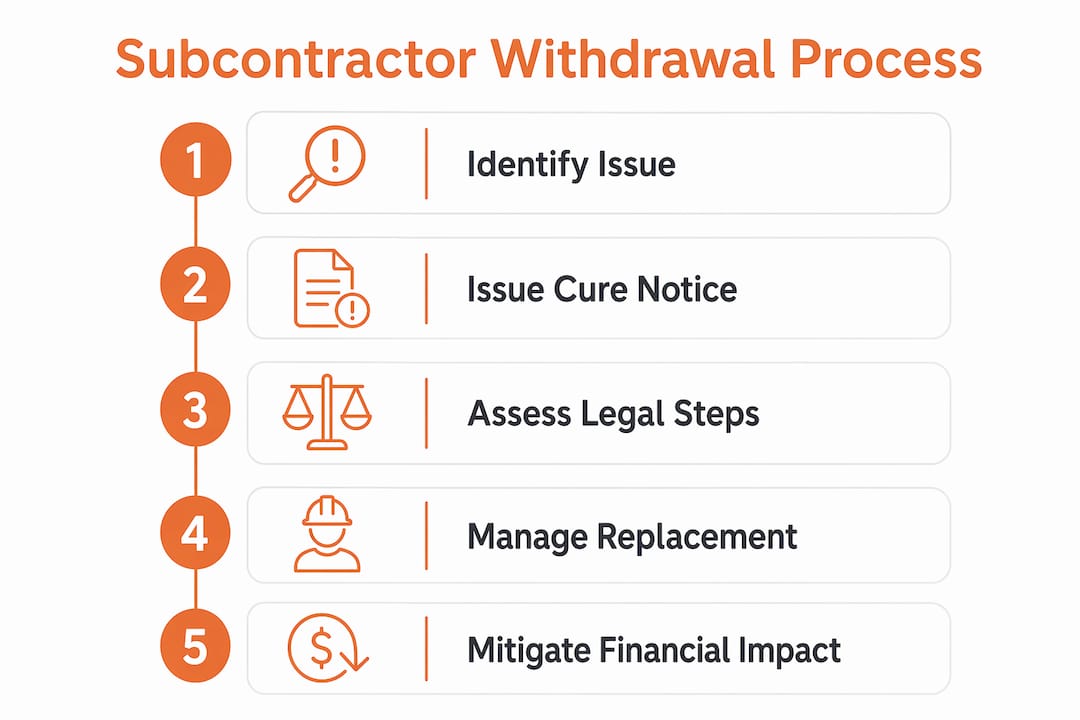
The first obligation after a subcontractor exits is formal documentation. You must issue a written cure notice within 48–72 hours, specifying the exact defaults, such as failure to maintain crew levels per the approved schedule or abandonment of site without notice. Industry best practices require this notice to give the subcontractor a 3–5 business day window to remedy the default before termination proceedings begin.
The legal framework distinguishes between two types of termination. Termination for cause applies when the subcontractor has committed a material breach, such as abandonment or chronic non-performance. Termination for convenience applies when the GC ends the relationship without fault, typically triggering payment obligations for work completed. Choosing the wrong basis exposes you to countersuits.
Vague cure notices are a common and costly mistake. Citing “poor performance” generically, without specifying the contractual obligation breached, often invalidates a termination for cause. That opens the door to wrongful termination claims and liability exposure for the GC.
Subcontractors also face serious consequences for unjustified exits. Under statutes such as Florida Statute § 489.129, unjustified abandonment can expose a subcontractor to civil litigation, loss of deposits, and disciplinary action. Defaults must also be disclosed on future bids, which directly damages bonding capacity and business reputation.
Pro Tip: Document every default with specifics: date, contractual clause violated, and observable evidence such as crew count versus scheduled crew count. This detail is what makes a cure notice legally defensible.
The legal doctrine of material breach also governs when a subcontractor can legally stop work. A subcontractor’s withdrawal is only justified if the GC or owner has committed a fundamental breach, such as chronic payment failure. Walking off without that legal basis creates direct liability for damages.
What is the financial impact when a subcontractor quits?
The financial consequences of a subcontractor exit are immediate and compound quickly. Replacement subcontractors charge a 15–30% premium over the original contract value. That premium reflects the risk of inheriting unfinished work, verifying the quality of prior installations, correcting defects, and coordinating under a compressed timeline.

The cost does not stop at the replacement contract. Liquidated damages can accumulate at $5,000–$10,000 per day depending on project scale, and every day spent re-procuring a replacement adds to that total. A two-week re-procurement process on a $20 million project can generate six-figure liquidated damage exposure before a new sub even mobilizes.
| Cost Category | Description | Risk Level |
|---|---|---|
| Replacement contract premium | 15–30% above original contract value | High |
| Liquidated damages | $5,000–$10,000 per day of delay | Very High |
| Defect correction costs | Verification and repair of prior work | Medium to High |
| Legal and documentation costs | Cure notices, termination filings, litigation | Medium |
| Re-procurement administration | Competitive bidding process time and cost | Medium |
Replacing a defaulted subcontractor without documented proof of default and competitive bids is a separate risk. Undocumented replacement hires weaken your cost recovery rights in litigation and insurance claims. You need an ironclad default record and a rapid, documented bidding process to protect every dollar you spend above the original contract.
Pro Tip: Run a minimum of three competitive bids for the replacement scope, even under time pressure. Document the bid process in writing. This protects your cost recovery under both Subcontractor Default Insurance and legal remedies.
Understanding subcontractor unreliability causes before a project starts is the most cost-effective way to avoid this financial exposure entirely.
How do you manage operations when a subcontractor leaves mid-project?
Operational continuity depends on early detection and a prepared response plan. By the time a subcontractor formally walks off, the warning signs have typically been visible for weeks. Recognizing those signs early gives you time to act before the project schedule breaks down.
Key early warning indicators include:
- Declining crew counts below the levels specified in the project schedule
- Missed milestone dates without documented justification or recovery plans
- Unresponsive project management from the subcontractor’s side on RFIs or submittals
- Unpaid sub-tier suppliers, which signal cash flow problems that often precede abandonment
- Quality defects increasing in frequency or severity on recent work
A documented performance scorecard tracking milestones, crew counts, and quality metrics is your strongest operational tool. Ongoing records are more defensible than verbal complaints when defaults arise, and they support both termination proceedings and insurance claims.
When a substitution becomes necessary, the subcontractor substitution process requires a structured site handoff. Replacement crews act cautiously when taking over mid-job. They conduct due diligence on the quality and scope of unfinished work before committing to a bid. You should prepare a complete handoff package that includes as-built drawings to date, inspection records, punch lists, and a clear scope delineation between completed and remaining work.
Communication with the owner and stakeholders during this transition is non-negotiable. Notify the owner in writing as soon as termination is anticipated. Provide a recovery schedule with the replacement sub’s mobilization date and a revised completion timeline. Owners who receive proactive communication are far less likely to pursue liquidated damages aggressively.
What insurance and bonding options protect against subcontractor withdrawal?
Two primary financial risk transfer tools exist for subcontractor default: Subcontractor Default Insurance (SDI) and traditional surety bonds. Each operates differently, and the right choice depends on your project profile and risk tolerance.
SDI is a first-party insurance policy held by the GC. It covers costs above the GC’s retention level, which typically ranges 10–20%, and processes claims faster than surety bonds, typically within 30 days. The GC controls the remediation process directly, without waiting for a surety to approve a completion contractor. This speed is critical when liquidated damages are accumulating daily.
Traditional surety bonds are third-party instruments. The surety investigates the claim, selects or approves the completion contractor, and controls the remediation process. This introduces delays and reduces GC control over the quality and pace of recovery. For projects where schedule is the primary concern, that loss of control is a significant disadvantage.
SDI is increasingly preferred by GCs because it eliminates the third-party layer and speeds claim processing. A detailed comparison of SDI versus performance bonds helps GCs select the right instrument for each project’s risk profile.
For projects in jurisdictions with complex construction insurance requirements, understanding construction all-risk coverage alongside SDI provides a more complete picture of your financial protection options. The combination of SDI and a well-structured subcontract is the most effective defense against the financial impact of subcontractor leaving a project mid-stream.
Key Takeaways
When a subcontractor withdraws, the GC’s response in the first 72 hours determines whether cost recovery and schedule recovery are achievable or lost.
| Point | Details |
|---|---|
| Issue a cure notice immediately | Specify exact contractual defaults within 48–72 hours to preserve termination rights. |
| Expect a 15–30% cost premium | Replacement subcontractors charge more to cover defect verification and compressed timelines. |
| Document everything for cost recovery | Undocumented replacement hires weaken insurance and litigation recovery rights. |
| Use performance scorecards proactively | Ongoing milestone and crew tracking enables early detection and stronger legal standing. |
| SDI outperforms surety bonds on speed | SDI processes claims within 30 days and keeps GC control over remediation. |
What I’ve learned from watching GCs handle subcontractor exits
The most common mistake I see general contractors make is treating a subcontractor withdrawal as a procurement problem when it is actually a documentation problem. The GC who wins in court, or in an SDI claim, is not the one who moved fastest to hire a replacement. It is the one who built an airtight paper trail from the first sign of distress.
I have watched projects recover cleanly from mid-project subcontractor exits because the superintendent kept a daily log with crew counts, and the project manager issued a cure notice that cited specific contract clauses and dates. I have also watched projects spiral into six-figure disputes because the GC skipped the cure notice to save time and hired a replacement on a handshake. The courts are not sympathetic to that approach.
The second thing I would tell any project manager is this: do not rush the replacement selection. The pressure to get someone on site is real, but hiring the first available sub without competitive bids destroys your cost recovery position. Three documented bids, even if you complete them in 48 hours, protect every dollar you spend above the original contract value.
Proactive subcontractor management, including qualifying subcontractors before project start and monitoring performance throughout, prevents most withdrawal scenarios before they reach the crisis stage. The GCs who rarely face this problem are the ones who built their subcontractor relationships on clear contracts, consistent communication, and early intervention when warning signs appear.
— Rowena
How Constructconnect-rconstructionsolutions supports your subcontractor risk management
Subcontractor withdrawal risks decrease significantly when you start with reliable, pre-vetted trade partners. Constructconnect-rconstructionsolutions specializes in AEC industry recruiting with over 30 years of experience connecting general contractors with subcontractors who have the financial stability, crew capacity, and track record to complete what they start.

The prorated 90-day payment model means you only pay for successful placements, and lower commission rates than the industry standard keep your procurement costs controlled. When a subcontractor exit forces you into emergency re-procurement, having a trusted sourcing partner with a deep pre-vetted network shortens your replacement timeline and protects your schedule. Reach out to Constructconnect-rconstructionsolutions to discuss how pre-qualified subcontractor sourcing fits your project risk management approach.
FAQ
What is the first step when a subcontractor withdraws?
Issue a written cure notice within 48–72 hours specifying the exact contractual defaults. This notice is the legal foundation for termination for cause and cost recovery.
How much more does a replacement subcontractor cost?
Replacement subcontractors typically charge 15–30% above the original contract value to cover defect verification, correction of prior work, and compressed schedule coordination.
Can a subcontractor legally walk off a job?
A subcontractor can legally stop work only if the GC or owner has committed a material breach, such as chronic payment failure. Withdrawal without that legal basis creates direct liability for damages.
What is Subcontractor Default Insurance (SDI)?
SDI is a first-party insurance policy held by the GC that covers default-related costs above the GC’s retention level and processes claims within approximately 30 days, faster than traditional surety bonds.
How do you protect cost recovery when replacing a subcontractor?
Document the default thoroughly and run a competitive bidding process with at least three bids before hiring a replacement. Undocumented or sole-source replacement hires weaken recovery rights in both litigation and insurance claims.