
What Is Subcontractor Default on a Project: A GC's Guide
Subcontractor default is defined as a subcontractor’s failure to fulfill specific contractual obligations on a construction project, including timely completion, quality standards, safety compliance, or payment to suppliers. As Attorney Aaron Hall explains, defaults trigger formal contractual remedies such as withholding payment, cure demands, and termination for cause. The industry term “default” carries precise legal weight: it is not simply poor performance but a contract-specific breach that must be formally identified, noticed, and given an opportunity to cure before remedies apply. For general contractors and project managers, understanding subcontractor default means knowing how to protect project schedules, budgets, and legal standing when a trade partner stops performing.
What is subcontractor default on a project, and how does it work contractually?
Subcontractor default occurs when a subcontractor breaches one or more defined obligations in the subcontract agreement, including schedule milestones, workmanship standards, insurance requirements, or compliance with OSHA regulations. Subcontractor defaults cause project delays, quality failures, and increased costs, all of which the general contractor typically absorbs first before pursuing recovery. The distinction between poor performance and legal default matters enormously: a subcontractor who is slow is not automatically in default until the contract’s procedural triggers are met.
Most subcontracts specify the events that constitute default. Common triggers include:
- Persistent schedule delays beyond contractually defined thresholds
- Defective or non-conforming work that fails to meet project specifications
- Abandonment of the work site without legal justification
- Failure to maintain required insurance coverage or bonding
- Non-payment to suppliers or sub-tier subcontractors
- Refusal to comply with safety directives or regulatory requirements
Once a default event occurs, the contract’s notice and cure process begins. Cure provisions protect subcontractors by providing a defined window, typically 7 to 15 days, to correct the breach before termination becomes valid. This protection also benefits general contractors: following the cure process correctly shields you from wrongful termination claims. Courts treat notice and cure strictly, requiring written communication that identifies the specific breached clauses and states the cure deadline precisely.
Pro Tip: Always reference the exact contract clause number in your written notice of default. Vague notices that cite “failure to perform” without specifying the breached provision have been invalidated by courts, voiding the general contractor’s termination rights entirely.

Premature or improperly issued termination carries serious consequences. Termination for default is fact-intensive and requires proof of nonperformance tied to specific contract terms. A general contractor who terminates without following the required steps can face a wrongful termination claim, converting what should have been a recovery situation into significant legal liability.
What are the early warning signs of subcontractor default?
Recognizing subcontractor performance issues before they escalate into formal default saves schedule time, legal fees, and project relationships. Pre-default operational signals include reduced crew size, chronic missed submittals, supplier complaints about unpaid invoices, and recurring quality deficiencies. Each of these indicators, taken alone, may seem manageable. Together, they form a pattern that experienced project managers recognize as a precursor to abandonment or financial collapse.
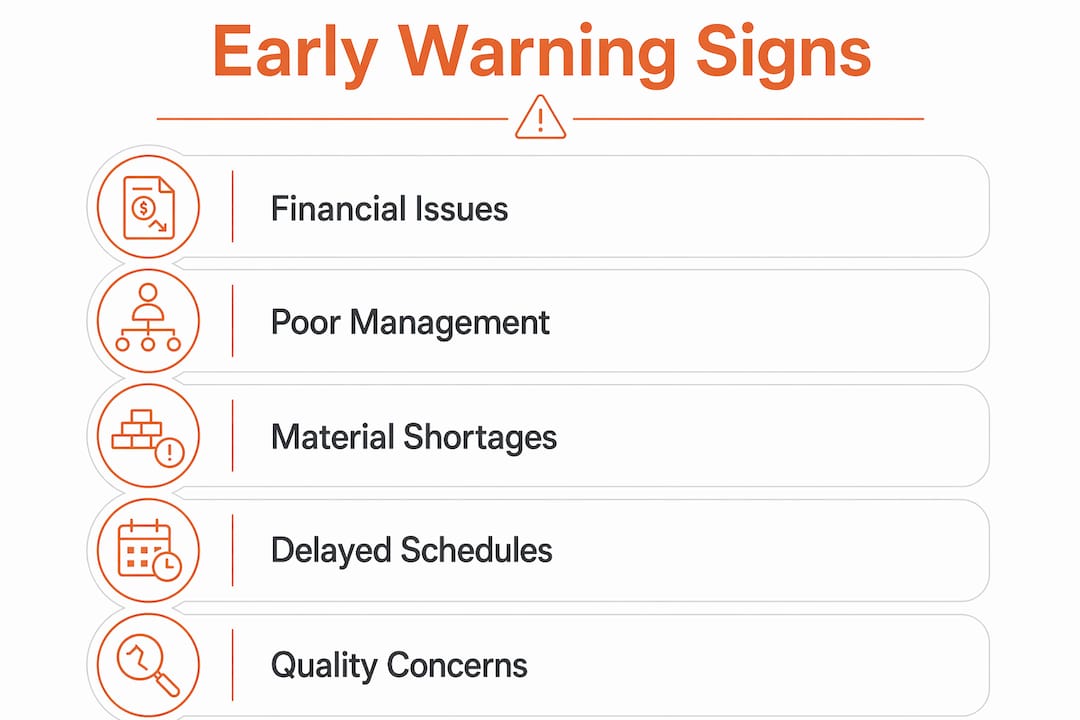
The most reliable early warning signs fall into three categories:
Operational indicators:
- Crew size drops below the levels specified in the subcontractor’s schedule of values or manpower plan
- Repeated failure to submit shop drawings, RFIs, or material submittals on schedule
- Increasing rework rates or inspector rejections on completed work
- Equipment or tools being removed from the site without explanation
Financial warning signs:
- Supplier or sub-tier contractor complaints about unpaid invoices, which can also expose the general contractor to lien claims
- Requests for early payment releases or schedule-of-values front-loading
- Subcontractor principals becoming difficult to reach regarding payment disputes
Communication breakdowns:
- Supervisory calls going unanswered or routed to junior staff without authority
- Missed coordination meetings or incomplete responses to RFIs
- Subcontractor superintendent turnover mid-project without notice
Subcontractors often default due to financial instability, poor management, or material shortages, all of which surface through these operational signals weeks before a formal breach occurs. Understanding why subcontractors miss deadlines gives you a structured framework for reading these patterns early.
Pro Tip: Start a contemporaneous log the moment you observe any of these warning signs. Date-stamped field notes, photographs, and email records are the foundation of a defensible default claim. Operational signals that are not converted into documented evidence carry little weight in dispute resolution or bond claims.
How do general contractors manage subcontractor defaults and mitigate project impacts?
Managing subcontractor defaults requires a sequence of deliberate, contract-compliant steps. Moving too fast risks wrongful termination liability. Moving too slowly allows schedule and cost damage to compound. The following process reflects standard industry practice for handling defaults from first signal to resolution.
-
Issue a written cure notice. Identify the specific contract clauses breached, state the required corrective actions, and set a cure deadline of 7 to 15 days as specified in the subcontract. Reference dates, locations, and observable deficiencies. Precise, timely notices are the foundation of every valid termination and recovery action.
-
Document all deficiencies and costs. Photograph defective work, record daily crew counts, and preserve all written communications. Remedies after default including back-charges and re-procurement costs require documented proof tied to the subcontractor’s breach.
-
Withhold payment where permitted. Most subcontracts allow withholding of amounts sufficient to cover the cost of correcting defective work or completing unfinished scope. Confirm the specific withholding language in your agreement before acting.
-
Evaluate the cure response. If the subcontractor responds to the cure notice and corrects the breach within the specified period, document the resolution and continue monitoring. If the cure is inadequate or ignored, proceed to termination.
-
Issue a termination for cause notice. Reference the original cure notice, confirm the cure period has expired without satisfactory correction, and state the effective date of termination. Subcontractor abandonment without legal justification is treated as breach of contract, but termination still requires proper timing and documentation.
-
Engage replacement subcontractors or activate surety bonds. Obtain competitive bids for the remaining scope. The cost difference between the original contract value and the replacement cost is recoverable from the defaulting subcontractor or their surety.
The table below compares two common response paths after a confirmed default:
| Response path | Best used when | Key risk |
|---|---|---|
| Cure and continue | Subcontractor has capacity to recover and schedule allows | Default recurs without stronger documentation |
| Terminate and replace | Subcontractor is financially insolvent or has abandoned work | Replacement procurement delays and cost overruns |
Qualifying subcontractors before project start reduces the frequency of reaching this decision point in the first place.
What role does subcontractor default insurance and surety bonds play?
Two primary financial instruments protect general contractors from the impact of subcontractor defaults: subcontractor default insurance (SDI) and performance bonds. Understanding how they differ determines which tool fits your project’s risk profile.
Subcontractor Default Insurance (SDI) is a policy that shifts subcontractor default risks from the general contractor to an insurance carrier. Providers including Liberty Mutual and AXA XL offer SDI products that cover replacement costs, delay damages, and additional expenses caused by a subcontractor’s failure to perform. Unlike a performance bond, SDI is purchased by the general contractor, not the subcontractor, giving the GC direct control over the claims process and coverage terms.
Performance bonds and surety bonds are purchased by the subcontractor and guarantee performance to the general contractor as the obligee. The surety steps in to complete the work or compensate the GC if the subcontractor defaults. However, failure to notify the surety of a subcontractor default can relieve the surety of liability entirely. Courts have voided bond claims where the obligee failed to provide reasonable notice of default.
| Feature | Subcontractor default insurance | Performance bond |
|---|---|---|
| Purchased by | General contractor | Subcontractor |
| Claims control | GC controls process directly | Surety controls response |
| Notice requirement | Per policy conditions | Strict contractual notice to surety |
| Coverage scope | Replacement cost, delays, expenses | Completion or financial compensation |
| Cost | GC absorbs premium | Built into subcontract price |
Notifying the surety requires a defined operational workflow: declare the default in writing, provide a narrative of damages, and formally demand remedy. Treating this as a casual notification rather than a structured legal trigger is one of the most common and costly mistakes general contractors make on bonded projects.
Pro Tip: Build your surety notification workflow into your project management system as a triggered checklist. When a cure notice is issued, the surety notification process should start simultaneously. Waiting until after termination to contact the surety often falls outside the bond’s conditions precedent, eliminating your recovery rights.
SDI offers faster claims resolution and broader coverage than most performance bonds, but it requires the GC to maintain a rigorous prequalification program for covered subcontractors. Carriers including AXA XL require documented prequalification records as a condition of coverage. This creates a direct financial incentive for the kind of upfront due diligence that reduces defaults in the first place.
Key takeaways
Subcontractor default requires strict contractual compliance at every stage, from written notice through cure period enforcement to surety notification, or general contractors risk losing their recovery rights entirely.
| Point | Details |
|---|---|
| Default is contract-specific | A breach must be formally identified in writing with specific clause references before remedies apply. |
| Cure periods are mandatory | Most subcontracts require 7 to 15 days for the subcontractor to correct the breach before termination is valid. |
| Early signals require documentation | Crew reductions, missed submittals, and unpaid suppliers must be converted into dated, written evidence. |
| Surety notice is time-sensitive | Failing to notify the surety promptly can void performance bond claims and eliminate financial recovery. |
| SDI vs. bonds serve different needs | SDI gives GCs direct claims control; performance bonds place control with the surety but shift cost to the subcontractor. |
What I’ve learned about defaults after three decades in AEC
The most expensive defaults I have seen were not caused by subcontractors who were obviously unqualified. They were caused by capable subcontractors who were financially overextended across too many simultaneous projects. The warning signs were there: superintendent turnover, slower submittals, a few supplier complaints. The general contractors involved either missed them or chose not to escalate because the relationship felt solid.
That is the uncomfortable truth about subcontractor defaults. The procedural knowledge matters enormously, but the real protection comes from disciplined monitoring and the willingness to issue a cure notice before you are certain you need to. Waiting for absolute confirmation of default almost always means the schedule damage is already done.
I have also seen general contractors lose valid termination rights because their cure notices were vague or their surety notifications came two weeks after termination. The contract does not reward good intentions. It rewards precise, timely, documented action. If your project management team does not have a written default response protocol that references your specific subcontract language, that gap is your largest risk exposure right now.
The other lesson worth stating plainly: prequalification is not a procurement formality. It is your first line of defense against default. Verifying financial stability, bonding capacity, current workload, and references before award eliminates a significant share of the defaults that reach the formal notice stage. The time invested in thorough prequalification consistently returns more value than any insurance product or legal remedy after the fact.
— Rowena
Reduce subcontractor default risk with better sourcing

The most effective way to reduce subcontractor default risk is to avoid placing unqualified subcontractors on your projects in the first place. Constructconnect-rconstructionsolutions provides AEC recruiting and sourcing built specifically for general contractors who need pre-vetted trade partners with verified financial stability, bonding capacity, and field performance records. With 30+ years of AEC industry experience and a prorated payment structure that ensures you only pay for successful placements, the team connects you with subcontractors who perform. When a default does occur, emergency subcontractor sourcing is available to minimize schedule impact and get your project back on track quickly.
FAQ
What is the legal definition of subcontractor default?
Subcontractor default is a subcontractor’s failure to fulfill specific contractual obligations, including schedule, quality, safety, or payment requirements. It requires formal written notice and a cure period before termination or other remedies become enforceable.
How long is a typical cure period after a notice of default?
Most subcontracts specify a cure period of 7 to 15 days following written notice of default. The exact duration is defined in the subcontract agreement, and courts require strict compliance with that timeline.
What happens if a general contractor terminates a subcontractor improperly?
Improper termination, including vague notices or premature action before the cure period expires, can result in a wrongful termination claim against the general contractor. This converts a recovery situation into significant legal and financial liability.
What is subcontractor default insurance, and who buys it?
Subcontractor default insurance (SDI) is a policy purchased by the general contractor that covers losses from subcontractor performance failures, including replacement costs and delay damages. Providers such as Liberty Mutual and AXA XL offer SDI as a direct alternative or supplement to performance bonds.
Can a surety deny a bond claim after subcontractor default?
A surety can deny a bond claim if the general contractor failed to provide timely, proper notice of default as required by the bond’s conditions precedent. Notifying the surety must follow a documented workflow that begins at the time of default declaration, not after termination.