
Subcontractor Scope of Work Defined for GCs
Most construction disputes don’t start with bad intentions. They start with a vague sentence in a subcontract. Getting the subcontractor scope of work defined correctly is not a formality you handle before the real work begins. It is the real work. Change orders account for 36.9% of global construction disputes, and the majority trace back to scope language that was too broad, too assumed, or simply missing. If you’re a general contractor or project executive, this guide will show you exactly what a solid scope document contains, where most GCs go wrong, and how to protect your margins from the first page of the subcontract.
Table of Contents
Key takeaways
PointDetailsScope is more than a task listA complete subcontractor scope defines tasks, materials, quantities, exclusions, and supply responsibilities.Granularity prevents disputesSpecifying exact materials and methods eliminates the ambiguity that drives costly change orders.Legal autonomy mattersContracts must preserve subcontractor independence to protect the GC from unintended employer liability.Scope is a living documentUpdate the scope throughout the project lifecycle to reflect design changes and field clarifications.Costs must tie back to scopeSeparating direct costs by subcontractor scope is the clearest path to protecting project margins.
Subcontractor scope of work defined
In standard industry terminology, the subcontractor scope of work is the section of a subcontract agreement that precisely describes what a specific trade contractor is obligated to perform, supply, and complete on a given project. It is distinct from the prime contract’s general conditions. Where the prime contract governs the overall project, the scope of work in a subcontract governs that trade’s specific obligations and nothing more.
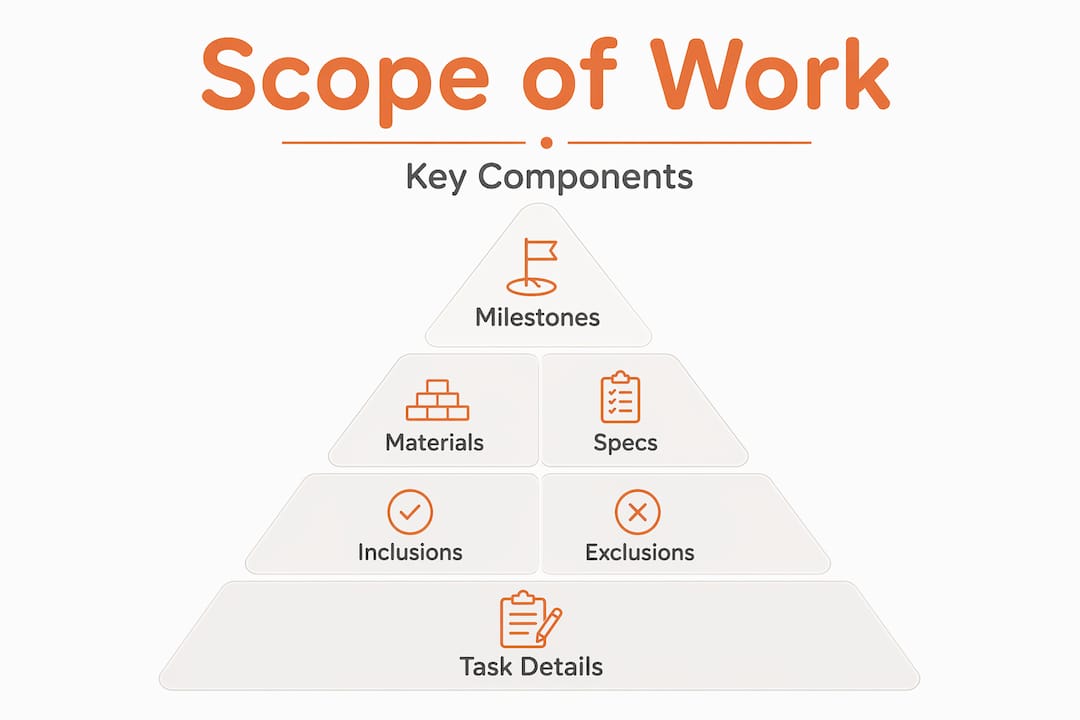
A well-written scope document includes several distinct layers:
Specific task descriptions: Not “electrical work,” but “install 200-amp service panel, run conduit to all first-floor outlets per plan sheet E-2.1.”
Materials and specifications: Brand, model, grade, and quantity where applicable, including who supplies what.
Supply responsibilities: Clearly labeled as contractor-furnished materials (CFM) or owner-furnished materials (OFM).
Explicit exclusions: What the subcontractor is not responsible for, stated plainly.
Deliverables tied to milestones: Which scope items must be complete before the next trade mobilizes.
Tier 1 subcontractors manage the most critical work on a project, while Tier 3 subs handle labor-intensive or specialized tasks. That tiered structure matters because the depth of your scope language should match the criticality of the work. A Tier 1 mechanical sub needs a more granular scope than a Tier 3 cleanup crew.
The scope also functions as the backbone of your contractor subcontractor agreements. Courts and arbitrators refer to it first when disputes arise. If the language is loose, the interpretation defaults to whoever argues most convincingly, not whoever was right.
Pro Tip: Write the scope before you negotiate price. When subcontractors bid against a detailed scope, you get apples-to-apples pricing and far fewer “I didn’t include that” conversations during construction.
Key components of a scope of work document
The difference between a scope that holds up under pressure and one that generates change orders every other week comes down to structure. Here is what a complete subcontractor work outline must contain, and why each element earns its place.
Task descriptions
Generic category names are the single biggest source of scope disputes. Specifying “install 4x12 subway tile to ceiling” instead of “tile work” eliminates the ambiguity that drives cost and schedule risk. Every task description should answer: what exactly, where exactly, and to what standard.

Materials and specifications table
ComponentWhat to specifyWho suppliesMaterialsBrand, model, grade, finish, quantityCFM or OFMEquipmentType, capacity, rental vs. ownedSub or GCFasteners and consumablesSpec reference or approved equalSubTemporary worksShoring, formwork, scaffoldingDefined per trade
Inclusions and exclusions
Inclusions tell the sub what they own. Exclusions are equally important and often skipped entirely. If your concrete sub is not responsible for saw-cutting existing slabs, write it down. Assumptions about exclusions are where grey areas between adjacent trades turn into finger-pointing during closeout.
Milestone alignment
Effective subcontractor project management depends on integrating the sub’s scope deliverables directly into the master schedule. Each scope section should reference the corresponding schedule activity ID so the sub knows exactly when their work must be complete and what predecessor tasks they depend on.
Pro Tip: Add a “Scope Clarification Log” as an exhibit to the subcontract. Any verbal clarifications made during bid review get documented there, signed by both parties, and incorporated by reference. This single habit eliminates a significant portion of “that’s not what we agreed to” disputes.
Common pitfalls and contractual nuances
Even experienced GCs make predictable mistakes when defining subcontractor responsibilities. Knowing where the traps are is half the defense.
Ambiguity and assumed knowledge
The most common mistake is writing scope language that makes sense to the person who wrote it but means something different to the person reading it. “Furnish and install all necessary plumbing” sounds complete. It is not. Does “necessary” include the gas line? The hose bibs? The pressure test? Every undefined term is a future change order waiting to happen.
Legal distinctions in the GC-sub relationship
A May 2026 Supreme Court ruling reinforced that prime contractors are not employers of subcontractors unless they actually control the subcontractor’s work environment. This matters for how you write your scope. If your scope language starts dictating how a sub performs their work rather than what they must deliver, you may be inadvertently assuming employer-level liability.
Similarly, courts have ruled that requiring subs to “consider” OSHA standards does not transfer enforcement obligations to the GC unless the GC controls daily site operations. Your scope should reference OSHA compliance as the sub’s obligation, not a shared responsibility.
Delay and schedule risk
Subcontractor-caused delays that cannot be excused result in no time extension or compensation for the contractor. That means your schedule risk is directly tied to how clearly you defined the sub’s scope and schedule obligations upfront. If the scope doesn’t specify when a task must begin, when it must be complete, and what constitutes acceptable progress, you have limited recourse when performance falls short.
“A scope of work is not a wish list. It is a contractual obligation. The more precisely it is written, the more clearly it can be enforced.” This principle holds in arbitration, litigation, and every pre-construction meeting in between.
Submittal compliance
Rubber-stamping subcontractor submittals without internal compliance checks increases rejection risk and schedule delays. Your scope should require that submittals reference the specific specification section they satisfy. When a sub submits a product data sheet, your team should be able to trace it directly to a scope line item before it goes to the architect or engineer of record.
Best practices for managing scope during execution
Writing a strong scope is step one. Keeping it enforced through the life of a project requires deliberate systems.
Integrate scope into the schedule at the activity level. Each scope deliverable should map to a schedule activity. When you update the schedule, the scope reference updates with it. This makes it immediately visible when a sub is drifting from their obligations.
Manage trade interfaces proactively. The grey areas between adjacent trades, such as where the mechanical sub’s scope ends and the electrical sub’s scope begins, must be resolved before mobilization, not during it. Hold a pre-construction coordination meeting specifically to walk through interface points and document the resolution in writing.
Tie cost tracking to scope line items, not lump budgets. Firms that separate direct costs from overhead and track them back to specific scope locations maintain significantly healthier project margins. If your cost codes don’t align with your scope structure, you can’t see margin erosion until it’s too late.
Treat the scope as a living document. The scope of work evolves through the project lifecycle and must be updated to reflect design changes and field clarifications. Every revision should be numbered, dated, and issued as a formal scope amendment, not a verbal instruction.
Establish a change order protocol in the scope itself. Define the process for submitting, reviewing, and approving change orders directly in the subcontract scope section. Specify the response window, the required documentation, and what happens if work proceeds without written authorization.
Conduct scope-in reviews at project kickoff. Before a sub mobilizes, walk through the scope line by line with their superintendent. Document any clarifications. This meeting alone prevents a disproportionate share of field disputes.
Pro Tip: Build a “scope gap matrix” during buyout. List every specification section and confirm which sub owns it. Any section without a clear owner is a gap that will cost you money later.
Scope of work examples and templates
Concrete examples make the difference between a scope that gets written correctly and one that gets copied from the last project and adjusted minimally.
A poorly defined scope looks like this: “Subcontractor shall perform all drywall work as required by the project documents.” That sentence generates questions. Which project documents? Does “all drywall work” include metal framing? Insulation? Finishing to Level 5? Patching after other trades?
A well-defined scope for the same trade looks like this:
Furnish and install all interior metal stud framing per plan sheets A-4.1 through A-4.6, including track, studs at 16" o.c., and all blocking for millwork and fixtures per architectural schedule.
Furnish and install 5/8" Type X gypsum board to all walls and ceilings in fire-rated assemblies per UL design U419.
Tape, bed, and finish all gypsum board to Level 4 finish per GA-214, except wet areas which receive Level 5.
Exclusions: Acoustic insulation in exterior walls (by others), firestopping at penetrations (by others), painting (by others).
Sub-furnished materials: All framing, board, fasteners, and joint compound. GC furnishes access to loading dock and staging area.
A solid subcontractor responsibilities checklist for any trade scope should confirm the following before execution:
Task descriptions reference specific plan sheets and specification sections.
All materials are named with grade, finish, or approved equal language.
Supply responsibilities are labeled CFM or OFM for every material category.
Exclusions are written explicitly, not implied.
Scope deliverables are tied to schedule milestones by activity ID.
Submittal requirements are listed with due dates.
Change order protocol is referenced or included.
My take on scope clarity as a margin issue
I’ve reviewed hundreds of subcontract packages across commercial, institutional, and industrial projects, and the pattern is consistent. The projects that bleed margin almost always have one thing in common: a scope that was written in a hurry during buyout and never touched again.
What I’ve found is that most GCs understand scope is important in theory. The breakdown happens in practice, specifically when schedule pressure during buyout pushes scope writing to a junior PM who copies last project’s language and adjusts the trade name. That document then governs millions of dollars of work for the next 18 months.
The other thing I’ve observed is that scope clarity is a culture issue as much as a contract issue. Teams that treat the scope as a living, enforceable document tend to have fewer disputes, tighter margins, and better subcontractor relationships. Teams that treat it as a checkbox produce change orders at a predictable rate.
My honest advice: spend twice as long on scope writing during buyout. The time you invest there returns tenfold in avoided disputes, cleaner cost tracking, and subcontractors who actually know what they signed up for. Protecting project margins starts with separating direct costs by scope, and that only works when the scope is specific enough to track against.
— Rowena
How better sourcing supports scope execution
When your scope documents are precise, the next question is whether your subcontractors are qualified to execute them. That’s where the right sourcing partner changes the outcome.

Constructconnect-rconstructionsolutions brings 30+ years of AEC industry experience to subcontractor and talent sourcing, connecting GCs and project executives with pre-vetted partners whose capabilities match the specific demands of your scope documents. When you define subcontractor tasks with the granularity this guide describes, you need subs who can read, price, and execute at that level. Vague sourcing produces vague performance. Explore the AEC recruiting services at R. Construction Solutions to find trade partners and project staff who are matched to your scope requirements from day one. You can also explore business opportunity sourcing to connect with projects where your scope management capabilities give you a competitive edge.
FAQ
What should a subcontractor scope of work include?
A complete scope of work includes specific task descriptions, material specifications with quantities, supply responsibilities (CFM vs. OFM), explicit exclusions, and deliverables tied to project milestones. Generic category names without these details generate disputes and change orders.
How does a vague scope affect project costs?
Change orders account for 36.9% of construction disputes globally, with vague scope definitions as a primary driver. Ambiguous language forces cost absorption by either the GC or the sub, eroding margins on both sides.
Can a GC be held liable for a subcontractor’s OSHA violations?
Generally, no. Courts have ruled that referencing OSHA compliance in a subcontract does not transfer enforcement liability to the GC unless the GC controls the subcontractor’s daily site operations. Clear scope language that preserves subcontractor operational autonomy is the best protection.
How often should a subcontractor scope be updated?
The scope should be treated as a living document and updated formally whenever design changes, RFIs, or field clarifications alter the sub’s obligations. Each revision should be numbered, dated, and issued as a signed scope amendment to maintain a clear contractual record.
What is the difference between inclusions and exclusions in a scope?
Inclusions define what the subcontractor is contractually responsible for. Exclusions explicitly state what falls outside their obligations. Both are required. Omitting exclusions is one of the most common causes of grey-area disputes between adjacent trades during project execution.