
How to Qualify Subcontractors Before Project Start
Hiring the wrong subcontractor is one of the most preventable sources of project failure in construction, yet it happens constantly. Schedule delays, cost overruns, safety incidents, and contract disputes often trace back to a subcontractor who looked capable on paper but lacked the financial stability, safety culture, or staffing to actually deliver. The good news is that when you qualify subcontractors before project start, you give your project a defensible foundation. This guide walks you through exactly how to do it, using the formal industry process known as subcontractor prequalification, so you can build a reliable bench of partners before the first shovel hits the ground.
Table of Contents
- Key Takeaways
- How to qualify subcontractors before project start
- The prequalification process, step by step
- Red flags and common mistakes to avoid
- Maintaining compliance throughout the project lifecycle
- My perspective on why this cannot be a checkbox exercise
- How R. Construction Solutions strengthens your sub selection process
- FAQ
Key Takeaways
| Point | Details |
|---|---|
| Prequalification is not bidding | Evaluate safety and financial capacity separately from price to protect project outcomes. |
| Verify from primary sources | Collect insurance certificates directly from carriers, not from subcontractors, to avoid lapsed coverage. |
| Tier your thresholds | Apply stricter criteria to higher-risk trades and larger contract values for proportionate risk control. |
| Flag personnel continuity | Identify and contractually bind key project personnel during prequalification to prevent mid-project disruptions. |
| Treat it as an ongoing process | Annual renewal and triggered requalification keep your qualified sub roster current and compliant. |
How to qualify subcontractors before project start
Before you collect a single document, you need clarity on what “qualified” actually means for your specific project. A five-million-dollar commercial tenant improvement and a fifty-million-dollar infrastructure project have entirely different risk profiles. The scope of your prequalification criteria for subcontractor qualification should scale with the contract value, trade complexity, and potential consequence of failure.
The formal pre-project subcontractor evaluation process covers five core document categories. Here is what to collect and why each one matters:
- Contractor’s license verification. Confirm the subcontractor holds an active, trade-specific license in the state where work will be performed. Some states maintain online license lookup tools. A general contractor’s license does not substitute for a specialty license when one is required.
- Insurance certificates. You need current certificates of insurance (COI) covering general liability, workers’ compensation, and any trade-specific coverage required by your contract. The coverage limits must meet project minimums, and your firm must be named as an additional insured. COI verification must confirm no expiry and correct workers’ comp classifications.
- Safety records. Request three years of OSHA 300 logs, the Experience Modification Rate (EMR), and a written safety program. EMR is the metric workers’ compensation insurers use to measure a company’s historical claims performance relative to the industry. An EMR at or below 1.0 is generally considered acceptable; a score above 1.25 often warrants disqualification or heightened scrutiny.
- Financial documents. Audited financials or a reviewed financial statement, current bonding capacity from a licensed surety, and a minimum of three trade references from GCs give you a picture of the sub’s financial health and real-world performance.
- Key personnel identification. Request the names, roles, and qualifications of the superintendent and project manager who will actually lead the work. Key personnel continuity is a leading performance indicator that most GCs undervalue at the prequalification stage.
Pro Tip: Request a copy of the subcontractor’s written safety program and look for evidence of a dedicated safety officer or designated safety lead. A company that cannot produce a documented safety program has not operationalized safety, regardless of what their EMR says.
The prequalification process, step by step
A repeatable, defensible subcontractor prequalification process protects your firm legally, operationally, and financially. Here is how to build one that works for projects of any size.
- Define qualification standards for your project. Set minimum thresholds for EMR, bonding capacity, license type, and reference count before you issue any prequalification forms. These standards should be documented internally and applied consistently.
- Tier your requirements by risk and contract value. High-risk trades require stricter thresholds than lower-risk ones. A concrete subcontractor on a complex structure should face more financial scrutiny than a painting contractor on a simple TI job. Tiering by contract value is equally important.
- Issue structured prequalification forms tailored by trade. A generic form does not capture the right information for every trade. An MEP subcontractor’s form should address journeyman-to-apprentice ratios and license types. A roofing sub’s form should include OSHA fall protection program documentation.
- Verify insurance directly from the carrier. Accepting COIs from subs directly introduces risk of outdated or incorrect certificates. Contact the carrier or require carrier-issued verification to confirm active coverage.
- Evaluate financial health independently. Review bonding capacity from the surety, not just a letter from the sub. Check that the bonding limit is adequate for your contract value and ask references specifically about the sub’s financial reliability during the project.
- Confirm staffing continuity and capability fit. Ask who specifically will serve as superintendent and project manager. Identify project leadership during prequalification and consider binding their participation in your subcontract agreement.
- Set a renewal cadence. Prequalification as an ongoing relationship rather than a one-time gate requires annual renewals and event-triggered requalification after incidents, litigation, or ownership changes.
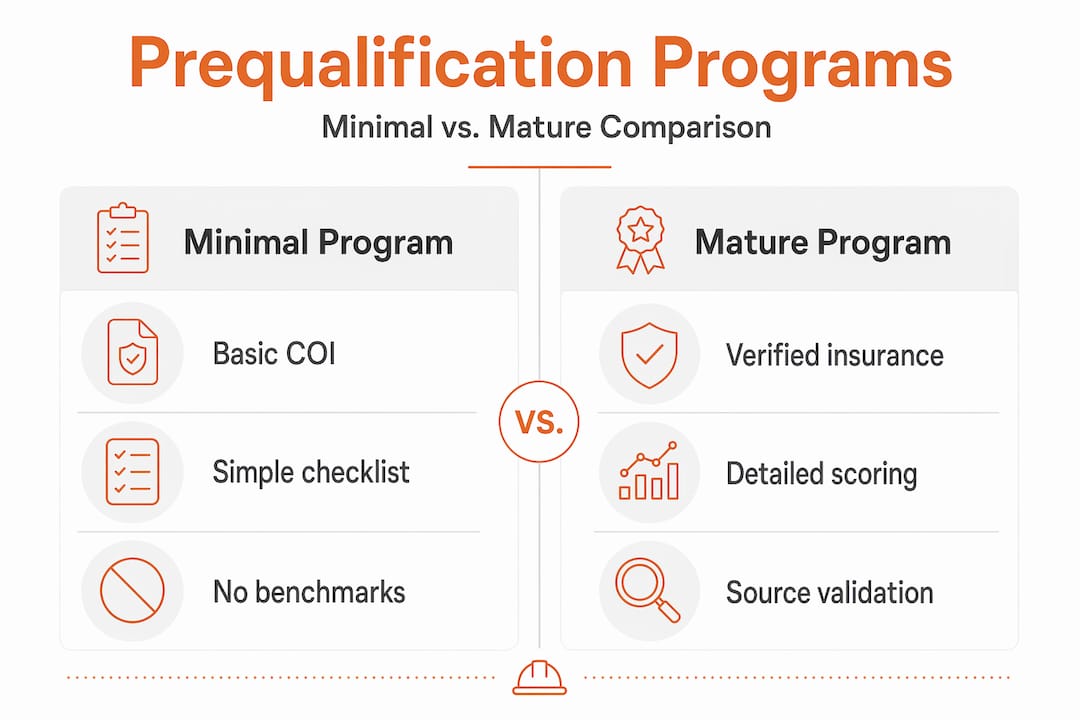
The table below compares a minimal versus a mature prequalification program so you can benchmark your current process.
| Criteria | Minimal program | Mature program |
|---|---|---|
| Insurance verification | Accepts sub-provided COI | Verified directly from carrier |
| Safety review | EMR check only | EMR, OSHA 300 logs, written safety program |
| Financial review | Verbal references only | Audited financials, surety letter, written references |
| Personnel review | Not reviewed | Named personnel identified and contractually bound |
| Renewal | No formal cadence | Annual renewal with incident-triggered requalification |
Pro Tip: Some public agencies require subs to submit prequalification applications at least 60 days before bidding. Even on private work, giving yourself a 30 to 60 day runway before bid date keeps the process from becoming rushed and unreliable.
Red flags and common mistakes to avoid
Even GCs with solid prequalification intentions make errors that undermine the process. Recognizing these patterns early saves you from the exact problems prequalification was designed to prevent.
- Accepting expired certificates. An expired COI provides zero coverage. Date-check every certificate on receipt and set a calendar reminder for renewals before they lapse. Operational failures regularly stem from lapsed or invalid coverage that was never caught.
- Mixing prequalification with bid evaluation. Prequalification focuses on capability and safety, while bid evaluation focuses on price. Running them simultaneously creates pressure to qualify a low bidder who does not meet your standards. Keep these two processes structurally separate.
- Verifying the company but not the people. A company may have an excellent EMR and bonding capacity, yet send an inexperienced crew to your job. Confirming company credentials without identifying the actual project team leaves a significant gap in your evaluation.
- Ignoring unusually low bids as a warning sign. A bid that is substantially below the next-lowest competitor often signals financial distress, scope misunderstanding, or an intent to make up revenue through change orders. Treat it as a trigger for additional financial scrutiny, not a win.
- Failing to handle prequalification refusals firmly. If a subcontractor declines to complete your prequalification process, treat that as meaningful data. Persistent refusal warrants removal from your bid list. A credible, capable sub will not object to a standard qualification process.
“Prequalification is not a bureaucratic hurdle. It is a professional standard. Any subcontractor who treats it as optional is signaling that their business practices may be equally selective about compliance.”
These mistakes compound over time. A GC who skips verification steps once builds a culture of shortcuts that eventually surfaces as a liability claim, a OSHA citation, or a failed project.
Maintaining compliance throughout the project lifecycle
Prequalification at the bid stage is not enough on its own. The subcontractor who was qualified six months before project start may have experienced ownership changes, insurance lapses, or safety incidents by the time work begins. Maintaining compliance is an active, ongoing responsibility.

| Compliance activity | Trigger | Recommended cadence |
|---|---|---|
| COI renewal tracking | Expiration date approaching | 60 days before expiry |
| Safety record review | OSHA citation or recordable incident | Within 30 days of incident |
| Financial status check | Bonding reduction, litigation filed | At contract execution and annually |
| Key personnel confirmation | Staffing change on sub’s team | Before each phase mobilization |
| Full requalification | Ownership change or extended inactivity | Every 12 months or upon trigger |
Aligning your prequalification documentation with your subcontract language is a step many GCs miss. Prequalification and subcontract risk-transfer must work together. Your subcontract agreement should require subs to maintain the same insurance and safety standards they demonstrated during prequalification and notify you immediately of any material change.
Written site enforcement plans and strong subcontract language also protect you from workforce compliance disruptions, including labor enforcement actions on site. Building this language into your standard subcontract template costs nothing and provides substantial protection.
Finally, maintain a bench of two to three qualified subs per trade so that a default or poor performance situation does not stall your project. Ongoing vetting of backup subs during slower periods is far less painful than scrambling for a replacement mid-project.
Pro Tip: Use a construction project management platform or a dedicated COI tracking tool to automate expiration alerts. Manual tracking in spreadsheets works until it does not. One missed renewal on a workers’ comp policy can expose your firm to significant liability.
My perspective on why this cannot be a checkbox exercise
I have watched prequalification programs get implemented with great intentions and then quietly erode into formality. A form goes out, gets returned incomplete, and gets filed anyway because the sub has a good relationship with someone in the office. That is where the risk actually lives.
In my view, the single most undervalued element of the best practices for subcontractor assessment is source verification. Getting a COI from the subcontractor is not verification. Calling the carrier and confirming active coverage, correct named additional insured status, and accurate workers’ comp class codes is verification. The difference matters enormously when a claim hits.
I also think the industry conflates familiarity with reliability. A sub you have worked with for five years still needs to meet your current standards. Their EMR can rise, their superintendent can leave, and their bonding capacity can shrink without you knowing unless you build renewal into your process.
What I have found actually works is treating prequalification as part of the relationship rather than a gate before the relationship. Subs who understand why you require it and see you apply it consistently to everyone are far more cooperative. Inconsistent enforcement, where you waive it for known subs but enforce it on new ones, creates resentment and sends the wrong signal about your firm’s standards.
The staffing continuity piece also gets far too little attention. I have seen projects go sideways not because the company was unqualified, but because the qualified superintendent was pulled off to another job three weeks into the schedule. Naming key personnel in the subcontract and requiring advance notice of any change gives you real leverage and early warning. That is the kind of AEC industry insight that separates experienced GCs from those still learning the hard way.
— Rowena
How R. Construction Solutions strengthens your sub selection process

When your project demands a qualified subcontractor bench and your internal capacity to screen and source them is stretched, Constructconnect-rconstructionsolutions offers a direct solution. With 30 years of AEC industry experience, the team connects general contractors with pre-vetted subcontractors and suppliers who have already passed rigorous vetting for safety records, licensing, financial health, and trade-specific capability. Unlike general staffing firms, Constructconnect-rconstructionsolutions specializes exclusively in the AEC sector, meaning every sourced candidate or sub partner is evaluated through a construction-specific lens. Whether you need to build a qualified sub roster for a single project or want to improve your subcontractor sourcing strategy across your entire operation, their prorated fee structure ensures you pay only for successful placements. Reach out to start building a compliant, reliable subcontractor network before your next project breaks ground.
FAQ
What does it mean to prequalify a subcontractor?
Prequalification is the formal process of evaluating a subcontractor’s safety record, financial health, licensing, and staffing capacity before inviting them to bid or awarding work. It is distinct from bid evaluation, which focuses on price.
What safety benchmarks should I use when screening subs?
An EMR at or below 1.0 is generally considered the acceptable threshold, and scores above 1.25 may disqualify a sub. You should also review three years of OSHA 300 logs and request a written safety program.
How often should subcontractor prequalification be renewed?
Annual renewal is the industry standard, but requalification should also be triggered by events such as an OSHA citation, recordable incident, ownership change, or significant reduction in bonding capacity.
Why should I verify insurance from the carrier rather than the subcontractor?
Certificates provided directly by subcontractors can be outdated or inaccurate. Verifying coverage with the insurance carrier directly confirms active status, correct named additional insured language, and accurate workers’ compensation classifications.
What should I do if a subcontractor refuses to prequalify?
Treat refusal as a meaningful risk signal. Explain that prequalification is a standard requirement applied to all subs, and if the refusal persists, remove that firm from your bid list. Qualified, capable subcontractors do not object to standard professional vetting.