
Emergency Subcontractor Sourcing for Construction Managers
When a subcontractor walks off the job, fails to mobilize, or your newly awarded project demands immediate trade coverage, emergency subcontractor sourcing in construction becomes the difference between a project that recovers and one that spirals into delays and liquidated damages. The industry term for this practice is emergency subcontractor placement, and it requires a structured, fast-moving process rather than frantic cold calls. This guide gives you concrete strategies, digital tools, vetting shortcuts, and a proactive bench-building system so the next crisis does not catch you without options.
Table of Contents
- Key takeaways
- Emergency subcontractor sourcing: what it requires upfront
- Step-by-step strategies for last-minute sourcing
- Rapid vetting and compliance verification
- Technology tools for faster subcontractor placement
- Building a resilient subcontractor bench
- My perspective on emergency sourcing readiness
- How professional sourcing support closes the gap
- FAQ
Key takeaways
| Point | Details |
|---|---|
| Prepare documentation upfront | Collect licenses, COIs, and EMR ratings before you need a sub, not during a crisis. |
| Use supply house networks | Lumber yards and trade counters provide real-time intel on which subs are financially stable and active. |
| Vet even under pressure | Skipping license checks and direct carrier COI verification creates legal and schedule exposure you cannot afford. |
| Leverage AI and video tools | Digital platforms and AI monitoring reduce sourcing lag and help you assess subcontractor quality before engagement. |
| Build a backup bench proactively | Maintaining two or three prequalified subs per trade prevents single points of failure on any project. |
Emergency subcontractor sourcing: what it requires upfront
Before you can move fast, you need to know exactly what you are sourcing. Emergency subcontractor placement, the formal term for what most field teams call last-minute subcontractor sourcing, depends on having two things ready before the phone calls start: a clear scope definition and a documentation checklist.
A vague scope wastes time. When you reach out to a mechanical contractor at 7 a.m. on a Monday asking if they can mobilize by Wednesday, they need to know the square footage, system type, inspection requirements, and access conditions immediately. Prepare a one-page scope summary you can send by text or email within minutes of identifying the need.
On the documentation side, here is what you need to collect from any subcontractor before issuing work:
- State contractor license number and expiration date
- Certificate of Insurance (COI) with your entity listed as additional insured
- Experience Modification Rate (EMR), ideally 1.0 or below
- W-9 for tax compliance
- OSHA 10 or OSHA 30 certification for on-site personnel
- Signed subcontract or letter of intent before mobilization
The table below summarizes the key prerequisites by category:
| Category | Document or Requirement | Why It Matters |
|---|---|---|
| Licensing | State contractor license | Confirms legal authority to perform the trade |
| Insurance | COI with additional insured endorsement | Protects your company from liability exposure |
| Safety | EMR rating and OSHA certifications | Indicates safety culture and reduces incident risk |
| Financial | W-9, credit references | Confirms tax compliance and financial stability |
| Contractual | Signed subcontract or LOI | Establishes scope, schedule, and payment terms |
Understanding trade-specific needs matters too. An electrical sub mobilizing for rough-in work has different crew size, equipment, and permit requirements than a drywall crew starting a finish phase. Matching the scope to the right trade specialty before outreach saves you from wasting time on subs who are qualified but wrong for the work at hand.
Step-by-step strategies for last-minute sourcing
Speed without structure produces bad hires. When you are under pressure, follow this sequence to move from identification to contract award without cutting corners that cost you later.
-
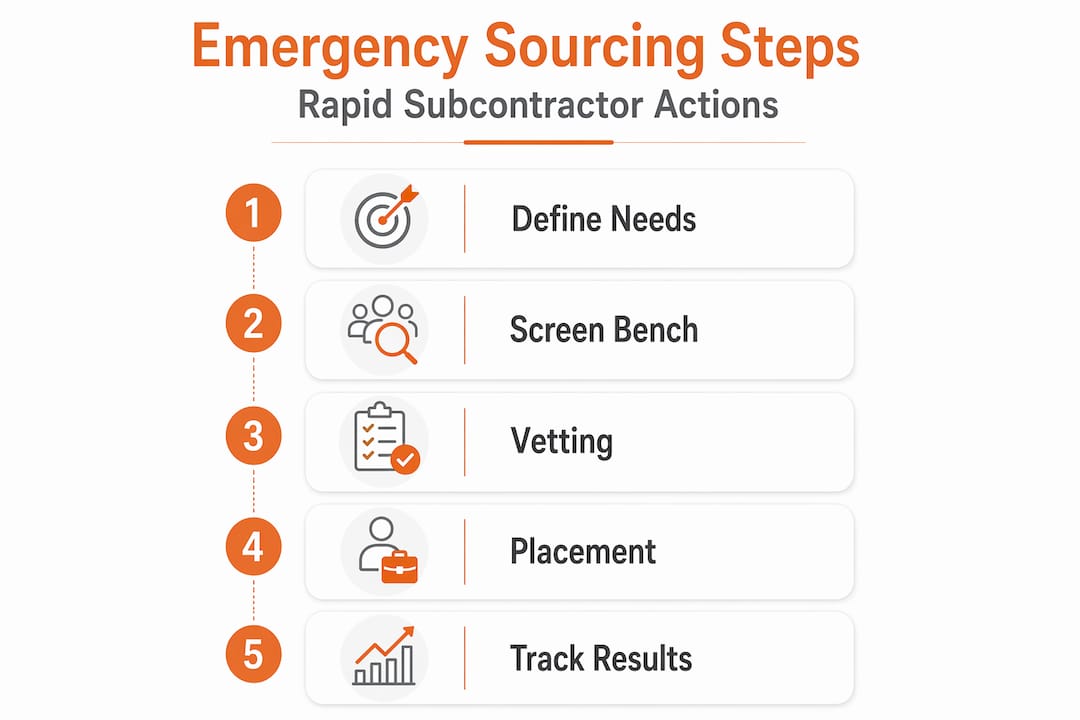
Call your peer network first. Other GCs and project managers in your market are your fastest and most reliable sourcing channel. A 60-second call to a colleague who recently finished a similar project can produce a direct referral to a sub who is already vetted, local, and available. This beats any online search for reliability.
-
Contact your supply house representatives. Supply houses provide real-time intel on which subcontractors are financially stable and currently active, giving you better reliability signals than any online profile. Your lumber yard rep, electrical counter, or plumbing supply house knows who is buying materials and who has gone quiet. That information is gold in an emergency.
-
Use digital sourcing platforms strategically. General contractor networks, trade-specific bid boards, and video-first discovery platforms each serve a different purpose. Video-first platforms let you assess a subcontractor’s craftsmanship and professionalism before you ever speak to them, which compresses the pre-qualification step significantly.
-
Issue a targeted outreach, not a mass blast. Sending a scope summary to 20 subs simultaneously signals desperation and attracts low-quality responses. Contact your top three to five candidates in order of preference. If the first two decline, move to the next tier.
-
Move from verbal agreement to written contract same day. Emergency labor placements can be confirmed within hours of the initial request, but verbal agreements without documentation create disputes. Use a short-form subcontract or letter of intent that covers scope, schedule, payment terms, and insurance requirements. Send it digitally and require a countersignature before mobilization.
-
Confirm permit status and inspection scheduling immediately. A sub who is ready to work but cannot pull permits in time is not actually ready. Verify permit lead times for the jurisdiction before committing to a mobilization date.
Pro Tip: Block two hours per month on your calendar specifically for subcontractor relationship maintenance. Call one or two subs per trade just to check in, ask what they are working on, and confirm their license status. When an emergency hits, you are calling contacts, not strangers.
Rapid vetting and compliance verification
The instinct under time pressure is to skip vetting and deal with problems later. That instinct is wrong. Fragmented procurement without proper prequalification creates hidden cost overruns, schedule disruptions, and legal exposure that far outweigh the time saved by skipping checks.
The critical vetting steps, even in an emergency, are:
- License verification: Check the state licensing board directly. Do not accept a copy of a license without cross-referencing the board’s online database for current status and any disciplinary actions.
- Direct carrier COI verification: Call the insurance carrier listed on the COI, not just the broker. Policies can be canceled after the certificate is issued. A 10-minute call confirms active coverage.
- EMR review: Request the sub’s current EMR from their insurance agent. An EMR above 1.2 signals a pattern of safety incidents that creates real liability on your site.
- Reference checks: Two quick calls to recent GCs who have used the sub are worth more than any credential. Ask specifically about schedule adherence, communication, and whether they would use the sub again.
- Scope-specific experience confirmation: Ask for two or three recent projects of similar scope and trade type. A sub with strong residential experience may not be the right fit for a commercial tenant improvement.
Pro Tip: Create a shared vetting tracker in Procore, Buildertrend, or even a shared Google Sheet that your entire project management team can access. When one PM vets a sub, that information is available to the whole team. You stop re-vetting the same companies and build institutional knowledge over time.
Common vetting mistakes that create downstream problems include accepting broker-issued COIs without carrier verification, skipping EMR review because the sub “seems professional,” relying on a sub’s self-reported license number without a database check, and issuing notice to proceed before a signed subcontract is in place.
Technology tools for faster subcontractor placement
The gap between a good sourcing process and a great one is usually technology. Construction managers who use AI-driven operations platforms, permit tracking tools, and video-first sourcing apps consistently outperform those relying on spreadsheets and phone books.
AI-driven platforms now monitor project data continuously, flagging overruns, expiring work authorizations, and labor capacity gaps before they become emergencies. AI project monitoring can recover $50,000 to $150,000 monthly by detecting these issues early and giving project managers time to act rather than react. That is a meaningful operational advantage when you are managing multiple projects simultaneously.
Permit tracking is another underused tool. Monitoring permit filings directly cuts the delay between a project being filed and your first contact from weeks to minutes. For GCs who also want to identify new project opportunities, this is a first-mover advantage that no lead aggregator can match.
The table below compares the top categories of sourcing tools and their specific emergency use cases:
| Tool Category | Primary Function | Emergency Use Case |
|---|---|---|
| AI operations platforms | Monitor project data, flag overruns | Early warning on subcontractor delays and capacity gaps |
| Permit tracking software | Track jurisdiction permit filings | Identify available subs working nearby projects |
| Video-first sourcing platforms | Visual pre-qualification of trades | Assess craftsmanship before first call |
| GC network bid boards | Broadcast scope to vetted subs | Fast outreach to pre-registered, licensed subcontractors |
| Procore / Buildertrend | Project and compliance management | Centralize vetting records and subcontract execution |
Video-first discovery platforms are growing in importance because they let you bypass unreliable text profiles and actually see a subcontractor’s work quality and job site behavior before you engage them. For emergency sourcing on short notice, that visual layer of verification reduces the risk of a bad hire significantly.
Building a resilient subcontractor bench
The best emergency sourcing strategy is one you rarely need to use. Proactive background sourcing with monthly license checks and regular relationship maintenance is the most effective defense against the chaos of last-minute placement.
Maintaining at least two prequalified backup subcontractors per trade eliminates single points of failure. If your primary electrical sub is fully booked or unresponsive, you have a second and third option who already know your documentation requirements and have been through your vetting process.
Here is how to build and maintain that bench without it becoming a second job:
- Schedule monthly outreach. Set a recurring calendar block to contact one or two subs per trade, confirm their license is current, and ask about their capacity over the next 60 to 90 days.
- Use post-project evaluations. After every project, score your subs on schedule adherence, communication, quality, and safety. That data tells you who belongs on your primary list and who should be moved to backup or removed entirely.
- Offer small relationship maintenance scopes. When you have minor work that fits a backup sub’s trade, award it to them intentionally. It keeps the relationship active, gives you a current performance read, and signals that you value the partnership.
- Centralize your subcontractor database. A shared, searchable roster with license expiration dates, EMR ratings, trade specialties, and contact information is a practical asset your whole team can use.
Pro Tip: Early procurement management on complex projects can reduce schedule risk by weeks. Apply the same logic to subcontractor sourcing: the earlier you identify and qualify your bench, the less exposure you carry when something goes wrong mid-project.
My perspective on emergency sourcing readiness
I have watched GCs treat subcontractor sourcing as something they do when they need a sub, and I have watched others treat it as an ongoing background process. The difference in outcomes is not subtle.
The GCs who struggle in emergencies are almost always the ones who have been too busy to build relationships when there was no immediate need. They have one electrical sub, one plumber, one framing crew. When any one of those relationships breaks down, they are starting from zero under maximum pressure.
What I have found actually works is treating your subcontractor bench like a staffing pipeline. You do not wait until a position is open to identify candidates. You maintain a shortlist of qualified, vetted people you could call tomorrow. The same logic applies here.
The uncomfortable truth about digital tools is that they are only as useful as the process behind them. I have seen project managers buy subscriptions to AI platforms and permit trackers and still end up scrambling because they never built the underlying database of pre-vetted subs those tools are supposed to surface. Technology accelerates a good process. It does not replace one.
My advice: pick one trade where you have a single point of failure right now and spend 90 minutes this week adding two qualified backup subs to your roster. That is the most productive thing you can do for your emergency readiness today.
— Rowena
How professional sourcing support closes the gap
When your internal network and digital tools are not enough to fill a critical trade gap on short notice, a specialized AEC recruiting and sourcing partner can compress the timeline significantly. Constructconnect-rconstructionsolutions brings 30-plus years of industry experience to exactly these situations, connecting construction managers with pre-vetted subcontractors who have already been screened for licensing, insurance, and trade-specific experience.
The prorated 90-day payment model means you only pay for successful placements, which removes the financial risk of engaging a sourcing partner during an already stressful project situation. Whether you need a single specialty trade on short notice or want to build a more structured subcontractor sourcing program for your pipeline, Constructconnect-rconstructionsolutions offers the industry-specific depth that general staffing agencies cannot match. Reach out before the next emergency, not during it.
FAQ
What is emergency subcontractor sourcing in construction?
Emergency subcontractor sourcing, formally called emergency subcontractor placement, is the process of rapidly identifying, vetting, and contracting a qualified trade contractor to fill a critical gap caused by a no-show, project award, or mid-project failure. It requires a structured process to avoid costly compliance and quality mistakes under time pressure.
How fast can emergency subcontractor placements be confirmed?
Emergency labor placements can often be confirmed within hours of the initial request, depending on trade complexity and crew size. Having pre-vetted subs on a ready roster reduces that timeline further.
What documents should I collect before issuing emergency subcontract work?
At minimum, collect a current state contractor license, a COI with your entity as additional insured, an EMR rating, a signed W-9, and OSHA certifications for on-site personnel. Issue a signed subcontract or letter of intent before any mobilization occurs.
What is the best way to find reliable short-notice subcontractors?
Peer referrals from other GCs and supply house contacts are the most reliable channels for short-notice subcontractors. Supply house representatives provide real-time intel on which subs are active and financially stable, which is a better indicator than any online profile.
How do I prevent emergency sourcing situations from recurring?
Maintain a bench of at least two prequalified backup subs per trade, conduct monthly relationship outreach, and use post-project evaluations to keep your roster current. Proactive bench management is the most effective long-term defense against emergency sourcing pressure.