
Why Subcontractors Miss Project Deadlines: A Field Guide
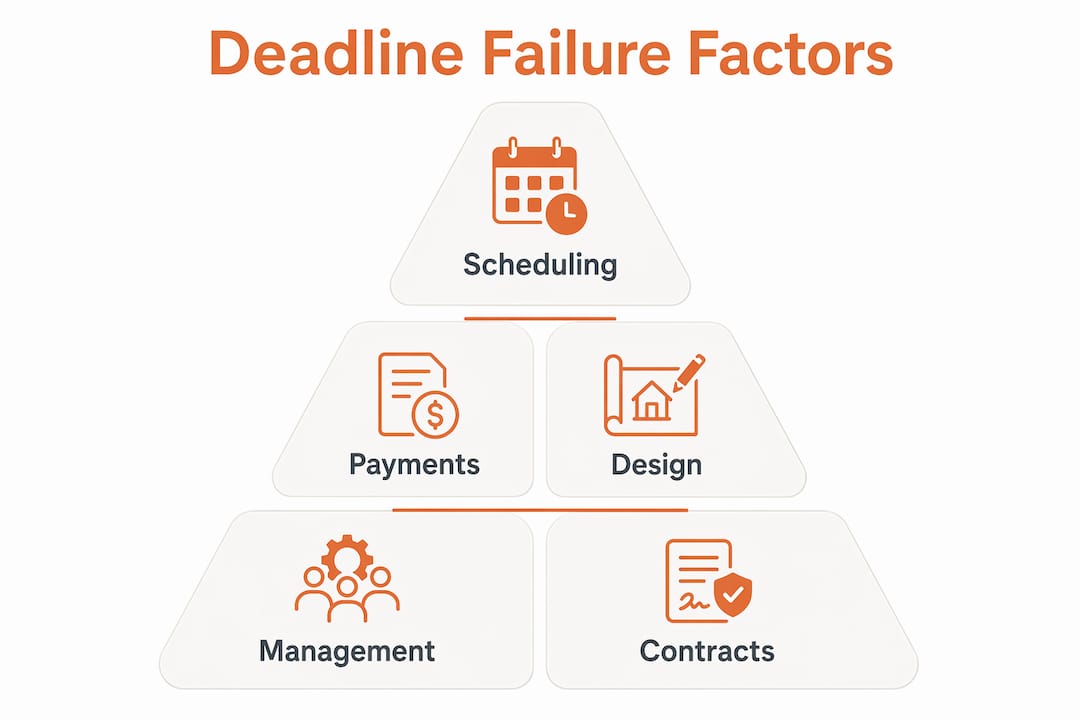
Missed deadlines are one of the most persistent and expensive problems in construction project management, and the reasons subcontractors miss project deadlines are rarely as simple as incompetence or bad faith. More often, the root causes are systemic. They live in scheduling gaps, payment misalignments, incomplete design documents, and communication breakdowns that no individual trade contractor can solve alone. Understanding these causes at a structural level is what separates contractors who repeat the same frustrations on every job from those who build reliable, high-performing subcontractor relationships.
Table of Contents
- Key Takeaways
- Why subcontractors miss project deadlines: scheduling and coordination
- Financial pressures and payment delays
- Design gaps and information flow breakdowns
- Management failures and accountability gaps
- Legal documentation and contract practices
- My take on what actually causes deadline failures
- How R. Construction Solutions helps you build a reliable subcontractor network
- FAQ
Key Takeaways
| Point | Details |
|---|---|
| Scheduling failures drive most delays | Unrealistic schedules and poor trade coordination are the primary sources of subcontractor slippage. |
| Payment gaps erode sub performance | Subcontractors waiting an average of 56 days to get paid shift labor and attention to better-paying jobs. |
| Design gaps cause hidden time losses | Slow RFI responses and incomplete documents create productivity losses, not just outright schedule delays. |
| Accountability systems reduce slippage | Clear performance expectations, documented scopes, and real-time tracking keep subcontractors aligned. |
| Documentation protects schedule control | Contemporaneous delay records and critical-path analysis are required to manage or dispute delays effectively. |
Why subcontractors miss project deadlines: scheduling and coordination
Construction scheduling failures are the most cited cause of subcontractor project delays, and they almost always originate before the first crew sets foot on site. According to Builder Outlook, coordination failures between trades, sequencing mistakes, and subcontractors not mobilizing as planned are primary failure points that consistently produce delays and project inefficiencies.
The core issue is that most construction schedules are built around ideal conditions. They assume full labor availability, timely material delivery, no weather disruptions, and seamless inspection approvals. When any one of those assumptions fails, and it always does, the schedule has no room to absorb the impact. Schedules updated monthly are effectively out of date before the ink dries, yet this is standard practice on many mid-size projects.
Trade stacking is a direct consequence of compressed or poorly sequenced schedules. When multiple trades are forced to work in the same area simultaneously because a predecessor trade is behind, efficiency drops for everyone. Compressed schedules force overlapping work into shared areas, reducing productivity and magnifying time losses across the board. A framing subcontractor who is three days behind can cost the MEP (mechanical, electrical, and plumbing) trades an entire week.
Permitting and start-readiness failures also contribute significantly. External and process barriers such as unclear responsibility for mobilization decisions and unresolved permit status prevent subcontractors from commencing work at contractually agreed start dates. This is not a subcontractor problem. It is a project readiness problem.
Common scheduling failures that lead to deadline slippage include:
- Failing to verify that predecessor work is actually complete before scheduling successor trades
- Setting mobilization dates without confirming permit status or site access conditions
- Building no schedule float for weather, inspections, or material lead times
- Skipping weekly schedule updates that reflect real field conditions
- Not requiring subcontractors to submit three-week lookahead schedules tied to the master CPM (critical path method) schedule
Pro Tip: Require each subcontractor to provide a written two-week lookahead every Friday. It takes ten minutes from them and gives you early warning of mobilization problems before they affect the master schedule.
Financial pressures and payment delays
Few things destroy subcontractor performance as reliably and quietly as payment problems. The data here is stark. Subcontractors wait 56 days on average to receive payment, while general contractors (GCs) believe they are paying in approximately 30 days. That perception gap is not just an accounting dispute. It has direct consequences for labor deployment and scheduling.

When a subcontractor’s payroll cycle is not covered by incoming payments, their superintendent moves crews to a project that is paying on time. You may not hear about it directly. You will see it in missed daily crew counts and slipping production rates. Delayed payments have caused work delays for 78% of subcontractors, adding one to six weeks of delay in nearly 77% of those cases.
Retention practices compound the issue. Holding back 10% of progress payments until project completion means a subcontractor finishing a six-month job is effectively working on partial pay for that entire duration. Paying only approximately 90% of progress payments forces subcontractors to absorb payroll and material costs they cannot recover until final completion. Regulatory bodies in multiple countries are now mandating prompt payment reforms specifically to address this chronic problem.
The fix is more administrative than financial. Many payment misalignments stem from visibility and tracking gaps rather than actual cash shortfalls on the GC side. When the subcontractor’s billing clock starts on invoice submission and the GC’s approval clock starts three days later, a structural mismatch is baked into every pay cycle.
Best practices to reduce payment-related delays:
- Define the payment clock start date explicitly in the subcontract: invoice receipt date, not approval date
- Use project management platforms such as Procore to automate invoice tracking and approval routing
- Share pay application status with subcontractors in real time so they can plan labor accordingly
- Review retention terms project by project and consider releasing retention in phases tied to milestone completions
- Conduct a payment audit on any subcontractor showing early signs of crew pullback
Design gaps and information flow breakdowns
There is an important distinction that many project managers overlook. A delay is a schedule slip. A productivity loss is something different: it occurs when a subcontractor expends more labor than planned to achieve the same output. Slow RFI responses and incomplete documents are leading causes of productivity loss claims, not always outright schedule delays. They cost you money and margin before they ever show up on a Gantt chart.
The practical impact is significant. When a sheet metal crew shows up and the ductwork routing shown in the issued drawings conflicts with structural steel that was field-modified, they either wait for an RFI response or rework completed installations. Neither outcome was in the original bid. Managing risk during the design stage proactively reduces exactly these kinds of field disruptions that stall subcontractor progress.
| Information issue | Direct impact on subcontractor | Indirect timeline effect |
|---|---|---|
| Incomplete drawings at bid | Scope ambiguity, change order disputes | Rework, schedule conflicts |
| Slow RFI response (5+ days) | Crew standby or out-of-sequence work | Production losses, trade stacking |
| Late design changes | Material restocking, re-coordination | Schedule compression downstream |
| Unclear finish specifications | Multiple resubmittals for approval | Delayed inspections, certificate of occupancy |
Pro Tip: Set a contractual RFI response window of 48 to 72 hours for field-critical items. Track open RFIs weekly in your project status meeting and assign a specific owner for each one. Unresolved RFIs are a leading indicator of future schedule slippage.
Understanding subcontractor scope of work at contract execution, with explicit references to issued drawing sets, eliminates a significant percentage of mid-project design conflict disputes.
Management failures and accountability gaps
Subcontractors do not perform uniformly across all their jobs. They perform better for contractors who are organized, responsive, and clear about expectations. This is one of the most important and underappreciated dynamics in construction project management. Systemic coordination and accountability failures at the project level are more often responsible for missed milestones than individual subcontractor incompetence.
When a subcontractor is working three concurrent projects, they will direct their best superintendent and largest crew to the job with the most organized general contractor. The job with weekly lookaheads, defined production expectations, and quick responses to submittals and RFIs gets prioritized. This is not dishonest. It is rational resource allocation.
Common management failures that contribute to subcontractor deadline issues:
- No defined production benchmarks for key scope items (linear feet of pipe per day, panels installed per week)
- Relying on text messages and phone calls for coordination rather than documented platforms
- Holding weekly subcontractor meetings with no written agenda or action items
- Failing to escalate when a subcontractor misses a two-week lookahead milestone
- Not auditing subcontractor crew sizes against what was committed at the time of award
Tools that actually improve subcontractor performance include daily field reports tied to production benchmarks, shared schedule access via platforms with mobile functionality, and formal subcontractor performance reviews at project milestones. If your superintendent cannot tell you by Wednesday whether a subcontractor will make their Friday milestone, your tracking system is not working.
Legal documentation and contract practices
The ability to act on a delay, whether to recover schedule or pursue a claim, depends almost entirely on documentation that was created at the time the delay occurred. Contemporaneous delay documentation and critical-path assessment are required to make a delay material and actionable. After-the-fact reconstruction of timelines is rarely persuasive in dispute proceedings and often leaves GCs without remedy.
Integrating legal awareness into daily project management looks like this:
- Log all potential delay events in writing on the day they occur, including weather, late deliveries, access issues, and design holds.
- Assess every delay against the current CPM schedule to determine whether it affects a critical-path activity or can be absorbed by available float.
- Issue formal written notice within the contractual notice period whenever a delay event may support a time extension or cost recovery claim.
- Track critical path impacts separately from delays that sit within schedule float, since not every slippage affects the project completion date.
- Require subcontractors to submit written notice of any delay they believe is compensable within the timeframe defined in their subcontract.
Early alignment on documentation and risk allocation at contract execution reduces disputes and shortens resolution timelines significantly. Dispute processes can run for years without this foundation.
My take on what actually causes deadline failures
I have spent years working in and around AEC project staffing, and the pattern I see over and over is this: subcontractor delays are symptoms, not root causes. When I hear a project manager say “our subs are just unreliable,” my first question is always about the schedule. Was it built with their input? Is it updated weekly? Were they given a defined scope at award or a summary paragraph?
The contractors who consistently deliver on time treat their subcontractors as partners with clear expectations, not vendors to be managed reactively. They document payment terms precisely, they respond to RFIs within 48 hours, and their superintendents know each sub’s crew size three days before a milestone. That discipline is not glamorous. It is just effective.
The hardest lesson I have seen contractors learn is that by the time a delay is visible on the schedule, you are already two to three weeks behind the actual problem. The warning signs are always there earlier: a superintendent who stops showing up to weekly meetings, a crew size that quietly drops from eight to four, an RFI that sits open for ten days. Improving subcontractor performance is less about finding better subcontractors and more about being a better project management partner to the ones you already have.
— Rowena
How R. Construction Solutions helps you build a reliable subcontractor network
Finding qualified, reliable subcontractors and project management talent is one of the most persistent challenges in the AEC industry, and it directly affects your ability to hit project deadlines.

Constructconnect-rconstructionsolutions brings over 30 years of AEC industry experience to the problem of unreliable partnerships and poor project execution. By connecting contractors with pre-vetted subcontractors and sourcing candidates with verified credentials, including OSHA 30 certification and Procore experience, R. Construction Solutions reduces the staffing risks that lead to schedule slippage. Their AEC recruiting services operate on a prorated 90-day model, so you pay only for successful placements. If deadline failures on your projects trace back to staffing and sourcing gaps, explore their talent and sourcing solutions to see how specialized AEC placement changes project outcomes.
FAQ
Why do subcontractors miss deadlines even on well-planned projects?
Even well-planned projects experience subcontractor delays when payment terms are misaligned, RFI responses are slow, or production benchmarks are not enforced. Systemic coordination failures at the project level are typically responsible, not individual subcontractor incompetence.
How much do payment delays affect subcontractor scheduling?
Significantly. Subcontractors report waiting an average of 56 days to get paid, and delayed payments have caused work delays for 78% of subcontractors, adding one to six weeks to project timelines in most cases.
What is the difference between a delay and a productivity loss?
A delay is a schedule slip that pushes a milestone date. A productivity loss means a subcontractor uses more labor than planned to achieve the same output, which affects project cost and margins before it appears on the schedule.
How should contractors document subcontractor delays?
Document every delay event on the day it occurs, assess its impact on the critical path using your current CPM schedule, and issue formal written notice within the contractual notice period. After-the-fact documentation rarely supports actionable delay claims.
What is the most effective way to manage subcontractor timelines?
Require weekly two-week lookahead schedules tied to the master CPM, define production benchmarks at award, track RFIs and submittals with assigned owners and response deadlines, and conduct formal performance reviews at project milestones. Explore the Constructconnect-rconstructionsolutions blog for additional project management guidance.

