
The Role of Subcontractor Substitution Process Explained
The subcontractor substitution process is a legally governed procedure that controls how and when a prime contractor may replace a named subcontractor during a construction project. Governed by statutes like California Public Contract Code §4107, this process protects project continuity, enforces contractual obligations, and prevents abuses like bid shopping. For construction professionals and project managers, understanding the role of subcontractor substitution process is not optional. It is a core competency that directly affects schedule, budget, and legal standing on every public and private project.
What legal and contractual constraints govern subcontractor substitution?
Subcontractor substitution is a legal event, not simply an operational decision. When a prime contractor wins a bid, a binding agreement known as Contract A forms between the contractor and every named subcontractor listed in that bid. Contract A binds prime contractors to those named subs, and substitution is only permitted under narrow, objectively justified circumstances such as bankruptcy, insolvency, or a subcontractor’s refusal to sign the formal subcontract.
The law is specific about what qualifies. Substitution requires formal agency approval and gives the original subcontractor the right to notice and a hearing before any replacement is authorized. That hearing requirement catches many general contractors off guard. It adds a procedural timeline that must be factored into project scheduling from the moment a substitution need arises.
Bid shopping is the most common misuse of substitution rights. Courts strongly penalize bid shopping and reject any substitution request driven purely by price preference after contract award. This protection exists to maintain fair competition and preserve the integrity of the bidding process. A contractor who attempts to swap a subcontractor simply to save money post-award faces legal penalties and potential contract termination.
The table below summarizes the key legal constraints and procedural steps you need to know.
| Legal point | Details |
|---|---|
| Contract A obligation | Prime contractor is bound to named subs from bid acceptance forward |
| Permitted substitution grounds | Insolvency, refusal to sign, failure to obtain bonding, or license issues |
| Required process | Written notice to original sub, formal agency request, hearing opportunity |
| Bid shopping prohibition | Substitution for price preference is illegal and penalized by courts |
| Non-compliance consequences | Delays, penalties, and potential contract termination |
Pro Tip: Document every communication with a listed subcontractor from bid day forward. If a substitution becomes necessary, that paper trail is your defense at any hearing.
How do subcontractor selection criteria relate to minimizing substitution risk?
The best way to manage the subcontractor replacement process is to avoid needing it. Rigorous pre-qualification before a project starts is the most effective risk control available to a general contractor. Constructconnect-rconstructionsolutions consistently finds that clients who invest in thorough pre-bid subcontractor qualification face significantly fewer substitution disputes during project execution.
54% of general contractors report increased change orders from subcontractors, and pre-bid qualification is the primary tool for reducing that exposure. Pre-qualification should cover five core criteria:
- Financial stability: Review bonding capacity, credit history, and current workload to confirm the sub can sustain performance through project completion.
- Safety record: Verify OSHA 30 certification, EMR (Experience Modification Rate) scores, and incident history. A poor safety record predicts future performance problems.
- Past project performance: Check references on projects of comparable size and complexity. Confirm on-time delivery and quality outcomes.
- Scope-specific experience: Match the subcontractor’s documented experience to the exact trade package scope. General experience is not a substitute for specific expertise.
- Communication and responsiveness: Evaluate how quickly and clearly a sub responds during the bid phase. Slow communication before award predicts delays after it.
Bid leveling is the next layer of protection. Bid leveling aligns subcontractor quotes on consistent assumptions, revealing true costs and risks beyond headline prices. Without it, you may select a low bidder whose scope exclusions create costly gaps later. The process involves preparation, analysis, normalization, clarification, and a final decision phase that promotes transparency across all bidders.
Best practice requires at least three qualified bidders per trade package to maintain pricing certainty and ensure a qualified backup if the primary sub cannot perform. That redundancy is your operational insurance policy. Finally, 91% of general contractors report improved productivity when using specialized subcontractor management software such as Procore, Autodesk Build, or Meltplan. These platforms centralize bid tracking, qualification records, and communication logs in one place.
Pro Tip: Tie every scope of work directly to the project drawings and specifications. Ambiguity in scope is the leading cause of mid-project disputes and substitution requests. Precision at the front end eliminates most problems before they start.

What are best practices during the substitution process?
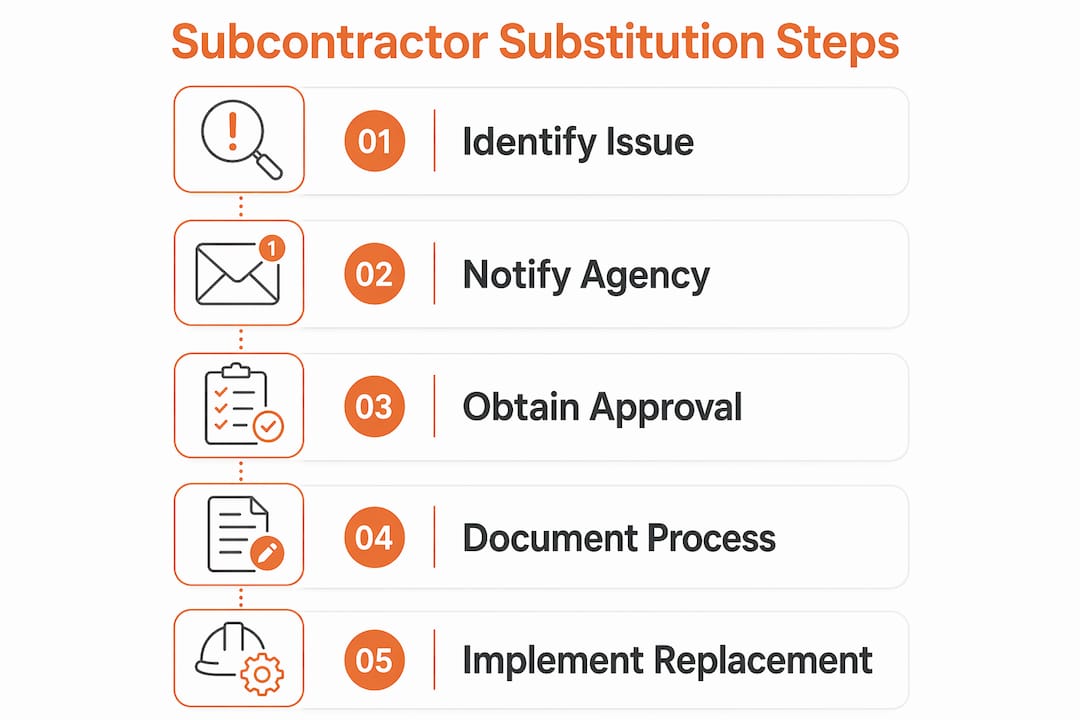
When a substitution becomes unavoidable, a structured approach protects everyone involved and keeps the project moving. The following steps reflect the procedural requirements under statutes like California Public Contract Code §4107 and align with sound project management practice.
-
Identify and document the grounds for substitution. Confirm that the reason meets a legally recognized threshold such as insolvency, failure to obtain required bonding, or license revocation. Record all supporting evidence in writing before taking any further action.
-
Notify the original subcontractor in writing. Provide formal written notice of the intent to substitute. This notice triggers the subcontractor’s right to object and request a hearing. Allow the legally required response period before proceeding.
-
Submit a formal substitution request to the awarding authority. Include all documentation: the grounds for substitution, the notice sent to the original sub, any response received, and the proposed replacement subcontractor’s qualifications.
-
Prepare for a substitution hearing if required. The original subcontractor’s right to a hearing is a mandatory procedural step on public projects. Prepare a clear factual record. Bring documentation of the grounds, your communications, and the replacement sub’s credentials.
-
Execute the replacement subcontract with well-defined provisions. Well-defined subcontract provisions including change order processes and contingent payment clauses are critical to managing the impact of the substitution. Gaps in the replacement subcontract create new disputes.
-
Update all project stakeholders and documentation. Notify the owner, architect, and bonding company. Update the project schedule, insurance certificates, and any relevant permit documentation to reflect the new subcontractor.
Use project management platforms like Procore or Autodesk Build to maintain a real-time audit trail throughout this process. Undocumented substitutions are the most common source of post-project litigation. You can also review the subcontractor coverage checklist for awarded projects to confirm you have met all legal thresholds before finalizing any replacement.
What operational and legal risks arise from improper substitution?
Failing to follow the substitution process correctly creates compounding risks that extend well beyond the immediate project. Improper substitution on public projects risks significant penalties, contract termination, and legal liability for the prime contractor. These are not theoretical outcomes. They appear regularly in construction litigation.
Project delays are the most immediate consequence. A disputed substitution can freeze work on a trade package for weeks while a hearing is scheduled and resolved. That delay cascades into other trades, pushing the overall completion date and triggering liquidated damages clauses. The financial exposure from a single mishandled substitution can exceed the cost savings that prompted the change.
“Contractors who treat substitution as a routine administrative task rather than a legal procedure consistently underestimate the exposure they are creating for themselves and their clients.” This perspective reflects what experienced construction attorneys observe repeatedly in substitution disputes.
Loss of trust is a longer-term risk that rarely appears on a risk register but consistently affects future business. Subcontractors who are improperly replaced share that experience within their trade networks. Owners who witness a substitution dispute lose confidence in the general contractor’s ability to manage the project. Rebuilding that trust takes far longer than the time saved by cutting corners on the substitution process. For guidance on preventing the scheduling conflicts that often precede substitution decisions, the proven steps for resolving scheduling conflicts offer practical field-tested advice.
Understanding common subcontractor contract disputes before they escalate to substitution is equally important. Many substitution requests originate from contract ambiguities that could have been resolved through direct negotiation. Proactive subcontractor management strategies, including regular performance reviews and early escalation of concerns, reduce the frequency of situations where substitution becomes the only option.
Key takeaways
The subcontractor substitution process is a legally defined procedure requiring documented grounds, formal notice, agency approval, and due process for the original subcontractor before any replacement is authorized.
| Point | Details |
|---|---|
| Legal basis is non-negotiable | Substitution requires statutory grounds and formal approval, not just operational preference. |
| Pre-qualification prevents substitution | Rigorous selection criteria covering financial stability, safety, and scope experience reduce replacement risk. |
| Bid leveling improves decisions | Normalizing subcontractor quotes reveals true costs and lowers the likelihood of performance failures. |
| Documentation protects all parties | Every step of the substitution process must be recorded to support hearings and avoid litigation. |
| Improper substitution carries serious risk | Penalties, contract termination, and project delays follow non-compliant substitution attempts. |
Why I think most contractors underestimate this process
After working across the AEC industry for years, I have seen the same pattern repeat. A subcontractor misses a milestone. The project manager wants to move fast. The substitution request goes in without proper notice, without documented grounds, and without a plan for the hearing that follows. Two weeks later, the project is stalled, the owner is asking questions, and the general contractor is managing a legal dispute instead of a construction schedule.
The substitution process exists to protect everyone, including the prime contractor. When you follow it correctly, you have a defensible record at every stage. When you skip steps, you hand the original subcontractor a legal argument they did not have before you acted.
Technology has improved this significantly. Platforms like Procore and Autodesk Build create automatic audit trails that satisfy most documentation requirements without extra effort. The problem is not the tools. The problem is that substitution is still treated as an operational inconvenience rather than a legal procedure with real consequences.
My advice is straightforward. Invest in pre-qualification. Use bid leveling. Maintain at least three qualified bidders per trade. And when a substitution becomes necessary, treat it with the same rigor you would apply to a contract negotiation. The process is not bureaucracy. It is protection.
— Rowena
How Constructconnect-rconstructionsolutions supports your subcontractor needs
Managing subcontractor substitutions is far easier when you have a qualified replacement ready before a crisis forces your hand.

Constructconnect-rconstructionsolutions specializes in recruiting and sourcing for the AEC industry, connecting general contractors and project managers with pre-vetted subcontractors who meet your specific trade, safety, and performance requirements. With 30-plus years of industry experience, the team at Constructconnect-rconstructionsolutions understands the urgency of subcontractor gaps and the legal stakes involved in replacement decisions. Whether you need a qualified sub for an emergency replacement or want to build a deeper bench of pre-qualified trade partners before your next bid, Constructconnect-rconstructionsolutions delivers faster sourcing at lower commission rates than traditional staffing firms.
FAQ
What is the subcontractor substitution process?
The subcontractor substitution process is the formal legal and contractual procedure a prime contractor must follow to replace a named subcontractor on a project. It requires documented grounds, written notice to the original sub, and formal approval from the awarding authority.
When can a prime contractor legally substitute a subcontractor?
Substitution is permitted only in specific circumstances such as insolvency, refusal to sign the subcontract, failure to obtain required bonding, or license issues. Price preference alone is not a legally accepted reason.
What happens if a contractor substitutes a subcontractor improperly?
Improper substitution on public projects risks penalties, contract termination, and legal liability. The original subcontractor also retains the right to object and request a hearing, which can delay the project significantly.
How does pre-qualification reduce the need for substitution?
Thorough pre-qualification covering financial stability, safety records, and scope-specific experience identifies unreliable subcontractors before they are listed in a bid. This reduces the likelihood of performance failures that trigger substitution requests mid-project.
What role does bid leveling play in subcontractor selection?
Bid leveling normalizes subcontractor quotes across consistent assumptions, revealing true costs and scope gaps that headline prices hide. It improves selection decisions and lowers the risk of choosing a subcontractor who cannot deliver.