
What Causes Subcontractor Unreliability in Construction
Subcontractor unreliability is defined as the consistent failure of a subcontractor to meet schedule, quality, or contractual commitments on a construction project. What causes subcontractor unreliability is rarely a single factor. Payment delays, scheduling failures, unclear contract terms, and cash flow strain combine to push even capable subcontractors into poor performance or outright default. According to data cited by Billd and Rabbet, 78% of subcontractors experience work delays directly tied to late payments. For construction managers and general contractors, understanding these root causes is the first step toward building a subcontractor network that actually delivers.
What causes subcontractor unreliability: the payment factor
Late payment is the single most documented driver of subcontractor reliability problems in construction. When a general contractor delays payment, a subcontractor’s cash flow tightens immediately, forcing them to prioritize jobs where payment is more predictable. The result is reduced crew sizes, slower mobilization, and in some cases, a complete work stoppage on your project.
The data from industry sources is specific:
- Nearly 50% of subcontractors faced delays that added 1 to 2 weeks to their schedules due to late payments.
- Approximately 30% experienced delays of 3 to 6 weeks from the same cause.
- Invoice approval delays of 2 to 4 weeks are common, and retainage practices that hold 5 to 10% of contract value until project closeout compound the cash flow pressure significantly.
Retainage is a particularly damaging practice when tied to whole-project milestones rather than scope-based completion. A subcontractor who finishes their work in month three of a twelve-month project may wait until month twelve to receive that withheld percentage. Scope-based retainage triggers reduce this risk and give subcontractors a financial reason to stay engaged and perform.
The connection between payment reliability and subcontractor prioritization is direct. Subcontractors run businesses with payroll, material costs, and equipment overhead. When your project pays slowly, it drops in their internal priority ranking. Prompt, predictable payment is not a courtesy. It is a performance management tool.
Pro Tip: Set up a structured payment schedule in your subcontract agreement with specific milestone dates, not just “net 30 from invoice receipt.” Automated invoice tracking through platforms like Procore or Sage 300 Construction reduces approval delays and keeps payment timelines visible to both parties.
How scheduling and coordination failures undermine subcontractor performance
Poor scheduling is the second major cause of subcontractor reliability problems, and it is often misattributed to the subcontractor rather than the general contractor’s coordination process. A subcontractor who is overbooked across multiple jobs due to unclear mobilization timelines is not inherently unreliable. The system that failed to communicate a firm start date created the problem.
The most common scheduling failures that generate subcontractor issues include:
- No written lookahead schedule. Verbal commitments about start dates are not binding and are easily forgotten. A three-week rolling lookahead shared with all trades removes ambiguity.
- Trade stacking. When multiple subcontractors are scheduled in the same space simultaneously, productivity drops and disputes over sequencing follow. This is a coordination failure, not a subcontractor failure.
- Unclear mobilization requirements. Subcontractors need to know not just when to show up, but what site conditions, materials, and access they will have. Incomplete information leads to wasted mobilization trips.
- No structured check-in process. Weekly coordination meetings with documented action items catch sequencing conflicts before they become schedule impacts.
Sequencing failures are particularly costly because they make reliable subcontractors appear unreliable. A skilled electrical subcontractor cannot rough in wiring if the framing subcontractor is three days behind. The electrical sub gets blamed for the delay, the relationship deteriorates, and the next bid cycle suffers. Structured lookahead planning and calendar-confirmed mobilization dates prevent this pattern. For a detailed breakdown of how missed deadlines develop, the field guide on subcontractor deadlines from Constructconnect-rconstructionsolutions covers the operational mechanics in depth.
Pro Tip: Send calendar invites with confirmed mobilization dates to every subcontractor at least two weeks in advance. Include the site access point, required materials on-site, and the name of the superintendent they report to. This single practice eliminates a significant share of “no-show” complaints.

How contract clarity gaps drive disputes and poor subcontractor performance
Unclear contracts are a primary cause of poor subcontractor performance because they create the conditions for payment disputes, scope disagreements, and change order conflicts. Payment disputes are the most prevalent contract disputes in large construction projects, and they are directly linked to ambiguous contract terms and incomplete design content at the time of award.
Vague scope descriptions generate change orders. Change orders generate payment friction. Payment friction generates the cash flow problems described above. The cycle is predictable and preventable.
Here is how contract clarity problems typically manifest:
- Undefined scope boundaries. When the contract does not specify exactly what is included and excluded, both parties fill in the gaps differently. Disputes follow.
- Missing design documents at bid time. Subcontractors pricing incomplete drawings build in contingency or miss items entirely, leading to disputes during execution.
- No dispute resolution process. Contracts without a defined escalation path turn minor disagreements into work stoppages.
- Ambiguous payment terms. “Payment upon GC receipt from owner” clauses, sometimes called pay-if-paid provisions, shift financial risk entirely to the subcontractor and damage trust.
| Contract element | Weak practice | Strong practice |
|---|---|---|
| Scope definition | General description of work | Line-item scope with inclusions and exclusions listed |
| Payment terms | Pay-if-paid with no timeline | Fixed payment schedule tied to milestones |
| Change order process | Verbal approval accepted | Written approval required before work proceeds |
| Dispute resolution | No defined process | Tiered escalation with defined response windows |
The bid leveling process is where contract clarity starts. When you compare subcontractor bids line by line and confirm that each bidder has priced the same scope, you eliminate the most common source of post-award disputes. Qualifying subcontractors before project start includes reviewing their understanding of the contract scope, not just their price.
What financial pressures push subcontractors toward default
43% of subcontractors risk failure due to insufficient working capital, a figure that reflects how thin the financial margins are in subcontracting. This is not a character flaw in the subcontracting community. It is a structural feature of an industry where subcontractors front labor and material costs weeks or months before receiving payment.
The financial pressures that cause subcontractor unreliability and default include:
- Working capital gaps. A subcontractor mobilizing on a $500,000 contract may need to carry $80,000 to $120,000 in labor and materials before the first invoice is approved.
- Retainage accumulation. On a multi-phase project, retainage withheld across several pay applications can represent a significant portion of a subcontractor’s total receivables.
- Material price volatility. When lumber, steel, or copper prices spike after a fixed-price contract is signed, subcontractors absorb the loss unless the contract includes escalation provisions.
- Payment prioritization by the GC. When a GC faces its own cash flow pressure, subcontractors are often the last to be paid, compounding the problem.
The McQueen Building Company shutdown in 2026 illustrates the downstream impact. One subcontractor had not been paid since November 2025, with amounts owed reaching up to $140,000. When a GC fails, subcontractors bear the financial consequences directly. Understanding a subcontractor’s financial health before award is not optional due diligence. It is a core risk management step. Resources on subcontractor cash flow explain how these pressures accumulate and what warning signs to monitor.
Operational practices that reduce subcontractor reliability problems
Addressing the causes of poor subcontractor performance requires process changes, not just better hiring instincts. GCs report 91% higher productivity when using structured software and qualification systems for subcontractor management. That figure reflects the cumulative effect of better pre-qualification, clearer communication, and consistent performance tracking.
The following practices directly reduce subcontractor reliability risks:
- Pre-qualify on capacity, not just price. Ask subcontractors about their current backlog, crew availability, and bonding capacity before award. A subcontractor who is already at 90% capacity will struggle to perform on your project regardless of their track record.
- Use structured bid leveling. Compare bids line by line to confirm scope alignment. This prevents post-award disputes and ensures the awarded subcontractor understands exactly what they priced.
- Implement invoice management systems. Platforms like Procore, Sage 300 Construction, or Textura automate invoice tracking and reduce approval delays. Faster approvals mean faster payments and better subcontractor prioritization of your work.
- Document performance consistently. Track schedule adherence, quality observations, and communication responsiveness for every subcontractor on every project. This data drives better decisions in future bid cycles.
- Monitor early warning signs. Missed submittals, unanswered calls, and shrinking crews are early indicators of financial or operational stress. Catching these signals early allows you to intervene before a delay becomes a default.
Building a reliable subcontractor network takes time, but the operational foundation is consistent: pay promptly, communicate clearly, document everything, and treat pre-qualification as a standing process rather than a one-time check.
Key takeaways
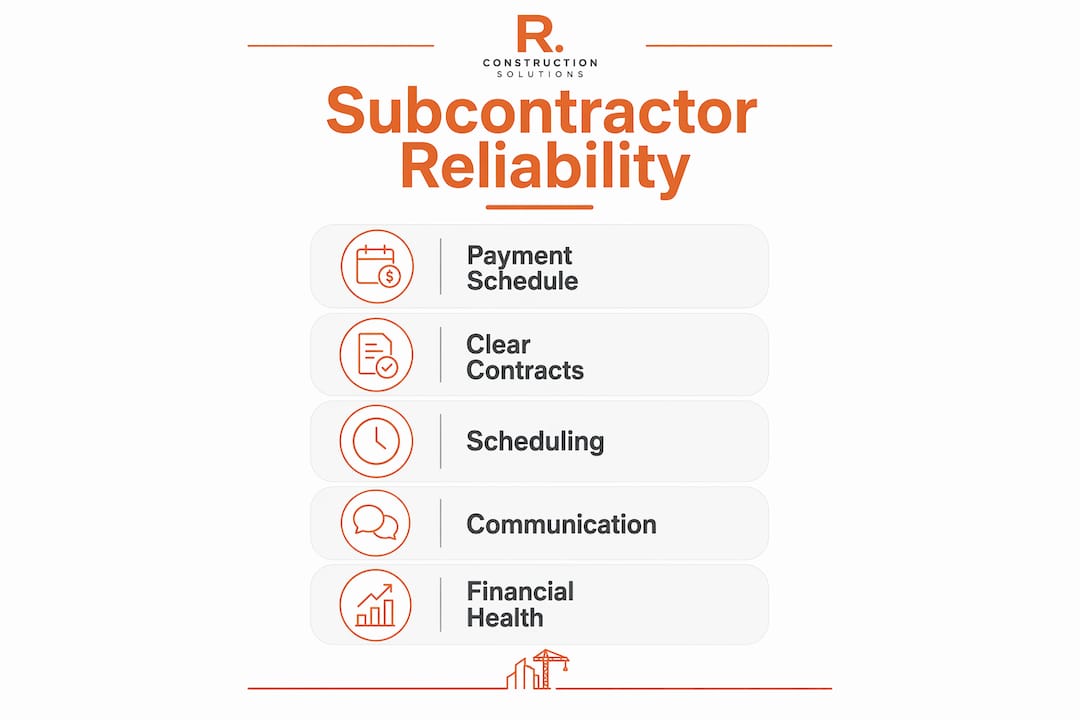
Subcontractor unreliability is caused by payment delays, scheduling failures, contract ambiguity, and working capital strain, and each factor is addressable through deliberate process changes.
| Point | Details |
|---|---|
| Payment drives prioritization | Late payments cause 78% of subcontractors to delay work; prompt payment keeps your project at the top of their schedule. |
| Scheduling gaps create false unreliability | Trade stacking and unclear mobilization dates make capable subs appear unreliable; written lookaheads fix this. |
| Contract clarity prevents disputes | Vague scopes and pay-if-paid terms generate change order conflicts; line-item scopes and fixed payment schedules reduce friction. |
| Financial health is a pre-qualification factor | 43% of subcontractors risk failure from working capital gaps; assess financial capacity before award, not after problems emerge. |
| Early warning signs are actionable | Missed submittals and shrinking crews signal stress; monitoring these indicators allows intervention before default occurs. |
What I’ve learned about reliability after 30 years in AEC recruiting
The most common mistake I see construction managers make is treating subcontractor unreliability as a hiring problem when it is actually a relationship management problem. You can hire the most qualified subcontractor in the region and still get poor performance if your payment process is slow, your schedules are vague, and your contracts leave too much open to interpretation.
What I have found consistently is that the subcontractors who perform best are the ones who trust that they will be paid on time and communicated with honestly. That trust is built through process, not personality. When I work with GCs to improve their subcontractor outcomes, the first thing I examine is not their bid list. It is their payment cycle and their contract templates.
The early warning signs matter more than most GCs realize. Documentation and communication gaps that escalate into missed mobilization are almost always preceded by smaller signals: a submittal that arrives late, a superintendent who stops returning calls, a crew that shows up two people short. Treating these as isolated incidents is a mistake. They are a pattern, and patterns are predictable. Build a subcontractor management system that monitors these signals and you will prevent more defaults than any pre-qualification checklist alone can achieve.
— Rowena
Build a more reliable subcontractor network with R. Construction Solutions

Subcontractor reliability problems are solvable when you have access to pre-vetted partners and the processes to manage them effectively. Constructconnect-rconstructionsolutions brings 30 years of AEC industry experience to the challenge of sourcing and qualifying subcontractors who meet schedule, quality, and financial standards before they ever set foot on your project. The AEC recruiting services connect construction managers and general contractors with subcontractors who have been evaluated for capacity, track record, and financial stability. For firms looking to expand their qualified partner network, the business opportunity sourcing program identifies and vets subcontractor relationships tailored to your project type and geography. Fewer surprises. Better outcomes. That is the standard.
FAQ
What is the most common cause of subcontractor unreliability?
Late payment is the most documented cause. 78% of subcontractors report work delays tied directly to payment delays, with many adding 1 to 6 weeks to their schedules as a result.
How do unclear contracts contribute to subcontractor issues?
Ambiguous scope definitions and pay-if-paid clauses generate payment disputes and change order conflicts that disrupt execution and damage the working relationship between GCs and subcontractors.
What are the early warning signs of subcontractor performance problems?
Shrinking crews, missed submittals, unanswered calls, and supplier complaints are the primary early indicators. These signals typically precede schedule impacts by two to four weeks, giving GCs time to intervene.
How does retainage affect subcontractor reliability?
Retainage held at 5 to 10% until project closeout creates significant cash flow strain for subcontractors who completed their scope months earlier. Negotiating scope-based release triggers reduces this pressure and improves performance motivation.
Can pre-qualification reduce subcontractor reliability problems?
Pre-qualification that evaluates current backlog, bonding capacity, and financial health directly reduces default risk. Filtering by experience and workload improves schedule adherence and reduces the likelihood of mid-project abandonment.