Stop Schedule Surprises: Construction Vendor Management in Seven Steps
Construction vendor management is the lifecycle discipline that keeps prequalified, compliant subcontractors and suppliers delivering work on time and within budget. It combines prequalification gates, continuous compliance checks, performance scorecards, and one centralized vendor database. Done right, the outcome is fewer schedule surprises, cleaner insurance coverage across every trade, and a subcontractor bench you can actually trust to bid the next job.
TL;DR:
- Prequalifying vendors ensures insurance, licensing, safety, and financial criteria are met before bidding, reducing project risks and avoiding costly rework.
- Implementing systematic scorecards on schedule, quality, safety, responsiveness, and cost helps monitor vendor performance and triggers corrective actions when thresholds are missed.
- Maintaining a centralized, regularly updated vendor database with compliance status, performance scores, and classification improves selection speed and reduces compliance gaps.
- Automated vendor management software with expiry alerts, integrated workflows, and field access eliminates tracking failures and enforces lifecycle gates for documentation.
- Building trusted vendor relationships involves early engagement, multi-project incentives, and continuous feedback based on scorecard data.
Table of Contents
- Why Vendor Management Matters More Than Most GCs Admit
- The Seven-Step Vendor Management Process
- The Prequalification Checklist Every GC Should Run
- Scorecards: What to Measure and How Often
- Building a Vendor Database That Actually Gets Used
- What to Look for in Vendor Management Software
- Turning Compliance Into a Lifecycle Gate
- Vendor Development and Preferred-Vendor Programs
- Your 30/60/90-Day Action Plan
- How R. Construction Solutions Puts This Into Practice
- A Straight Answer on Why This Discipline Pays Off
- A Faster Way to Build a Vendor Bench You Trust
- Sources
- FAQ
Why Vendor Management Matters More Than Most GCs Admit
A lapsed certificate of insurance doesn’t feel urgent until a subcontractor gets hurt on your site with no coverage in force. A missed prequalification step doesn’t feel costly until the drywall crew you hired can’t hit code and you’re eating the rework. Construction vendor management turns those quiet risks into visible, trackable line items before they become change orders.
The pattern is well documented: prequalifying subcontractors, tracking their performance, and centralizing vendor records reduces project risk in ways that ad hoc hiring never can. Treat vendor oversight as a system instead of a series of one off phone calls, and three things change:
- Fewer schedule slips caused by vendors who quietly can’t staff the job they bid
- Fewer insurance gaps that turn a minor incident into a liability nightmare
- Fewer scope disputes because expectations were documented at award, not renegotiated mid job
The firms that skip this discipline aren’t reckless. They’re usually just busy, running vendor selection off memory and a shared spreadsheet that someone forgot to update in March.
The Seven-Step Vendor Management Process
Every reliable construction supplier management program follows the same basic arc, whether it runs on paper or software. Here’s the sequence that works across trades and project sizes.
- Identify the need. Define scope, schedule window, and the specific trade licenses or certifications the work requires.
- Prequalify candidates. Screen for insurance, licensing, bonding capacity, and safety history before anyone gets a bid invite.
- Invite bids. Send scope packages only to vendors who already cleared prequalification, not the full contact list.
- Evaluate proposals. Compare price against capacity, past performance scores, and current workload, not price alone.
- Negotiate and contract. Lock scope, schedule milestones, payment terms, and compliance obligations into the executed agreement.
- Onboard and monitor. Confirm site-specific safety orientation, then track performance against the scorecard from day one.
- Closeout and lessons learned. Document what worked, score final performance, and update the vendor’s file before the next bid cycle.
Compliance gates belong at steps two and six, not as an afterthought at contract signing. A systematic vendor program that uses prequalification gates and centralized databases prevents compliance lapses and reduces schedule risk precisely because the checks happen before the vendor is on your critical path, not after.
Watch for escalation triggers along the way: two missed submittal deadlines in a row, a safety incident, an expired COI that isn’t renewed within five business days, or a performance score that drops below your minimum threshold. Any one of those should trigger a documented conversation. Two of them together should trigger a replacement search.
The Prequalification Checklist Every GC Should Run
Prequalification is where most vendor problems get caught, or missed; understanding how insurers select preferred contractors for claims can enhance your screening process. The checklist below reflects what experienced procurement leads actually verify before a subcontractor touches a bid list.
Insurance and licensing:
- Certificate of Insurance showing general liability, workers’ compensation, and auto coverage at your minimum limits
- Your company named as Additional Insured, with the endorsement attached, not just promised
- Active trade license in the jurisdiction where the project sits, verified against the state licensing board
- Bond capacity appropriate to project size, typically required above a defined contract value threshold
Safety and financial standing:
- Experience Modification Rate (EMR) at or below 1.0 for higher risk trades
- Clean OSHA citation history, or a documented corrective action plan if there’s a past violation
- Surety letter confirming available bonding capacity
- Dun & Bradstreet or equivalent financial check for larger scopes
- A lien search showing no active liens on recent projects
Treat a missing Additional Insured endorsement or an EMR above 1.25 as a hard stop, not a negotiation point. A five-factor risk score covering insurance, licensing, safety, financial stability, and past performance gives you a repeatable way to compare vendors instead of trusting gut feel.
Pro Tip: Run reference checks by asking the last GC a specific question: “Would you rehire this vendor for a critical-path scope tomorrow?” A hesitant answer tells you more than a glowing recommendation letter ever will.
For a deeper walk through documentation requirements, see our guide on subcontractor prequalification for GCs.
Scorecards: What to Measure and How Often
Vendor performance evaluation only works if you score the same dimensions every time, on a schedule vendors know about in advance. Five categories cover most of what actually predicts a good subcontractor relationship:
- Schedule adherence — percentage of milestones hit versus committed dates
- Quality — rework rate, punch list volume, and inspection pass rate
- Safety — incident count and near-miss reporting compliance
- Responsiveness — turnaround time on RFIs, submittals, and change requests
- Commercial performance — payment application accuracy and frequency of claims or disputes
Score at project milestones for short jobs and monthly for anything running longer than 90 days. A vendor who drops below your minimum threshold on two consecutive scorecards should trigger a formal corrective action conversation, not a quiet note in a file nobody reads again.
Scorecards earn their keep at the moment you use them for something. Continuous monitoring lets teams remove underperforming vendors while preserving preferred-vendor status for the subs who consistently deliver, which turns performance data into a real lever instead of a compliance exercise. A vendor sitting in the top tier for four straight quarters should get first look at your next bid list. One sitting in the bottom tier twice should get a conversation about whether they belong on it at all.
Building a Vendor Database That Actually Gets Used
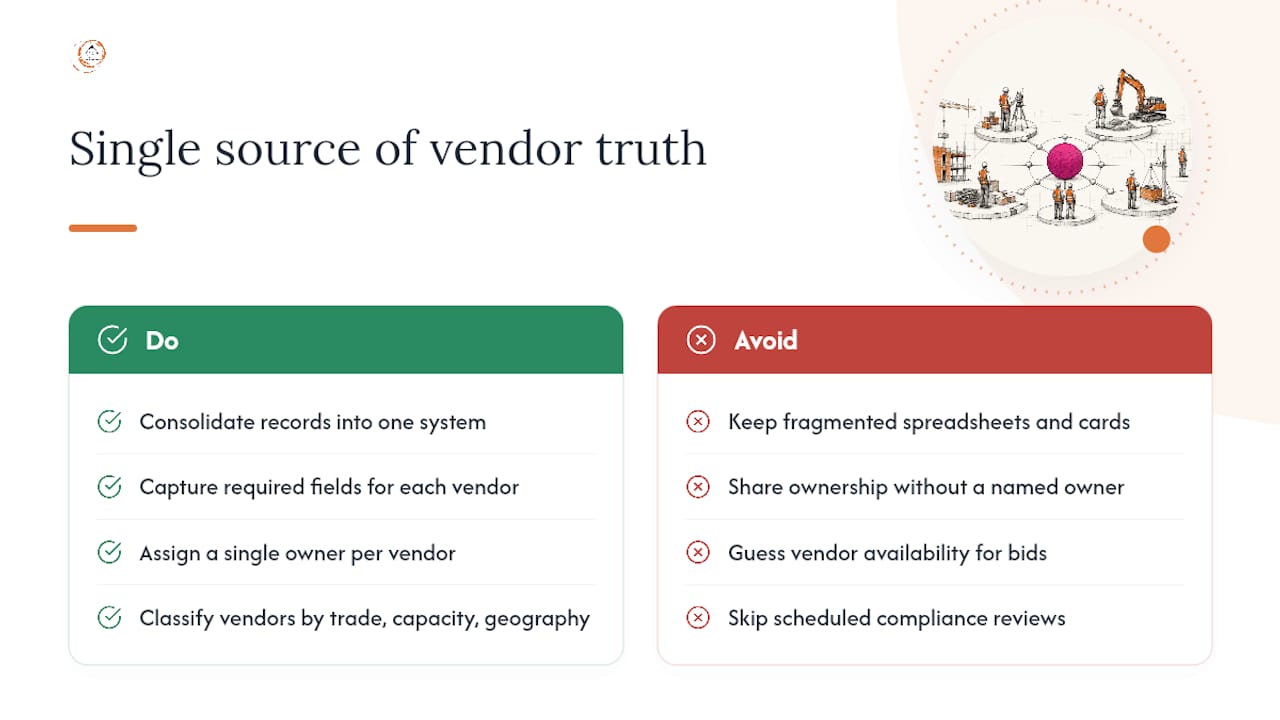
A vendor database only earns its keep if it’s the single place anyone checks before picking up the phone. Fragmented records, a spreadsheet here, a subcontractor’s business card there, are how compliance gaps happen in the first place. Consolidating vendor contact information, safety records, and project performance into one system of record eliminates the tribal knowledge problem where only one estimator remembers which framing crew actually shows up on time.
At minimum, every vendor record needs current insurance status, license expiration dates, bonding capacity, trade classification, geographic service area, and a running performance score. Assign one owner, usually a procurement lead or project administrator, responsible for keeping it current. Shared ownership without a named owner is how databases go stale within a quarter.
Classification matters as much as capture. Sorting vendors by trade, capacity, project type, and geography lets you build a targeted bid list in minutes instead of guessing who’s available. Layer risk-based tiering on top: Tier 1 vendors on critical-path scopes get quarterly reviews and tighter compliance monitoring, while Tier 3 vendors doing low-risk, low-dollar work might only need an annual insurance refresh.
What to Look for in Vendor Management Software
Manual tracking works fine until it doesn’t. Once a firm manages more than a handful of active vendors across multiple projects, spreadsheets stop scaling and someone inevitably misses a COI renewal. Automated COI extraction and expiry alerts close that gap without adding headcount.
When evaluating tools, prioritize these functional requirements over flashy dashboards:
- Automatic COI parsing that flags expiration dates without manual data entry
- A single system of record accessible to procurement, project management, and accounts payable
- Built-in scorecard templates that update automatically as project data comes in
- Compliance gating tied directly into your AP and PO workflows, so a lapsed vendor can’t get paid
- A vendor self-service portal where subs upload their own documentation
- Mobile access for field superintendents logging performance issues in real time
- Audit logs showing who approved what, and when
Roll new software out in phases: start with your top 20 vendors by spend, prove the workflow, then expand. Trying to migrate your entire vendor list on day one is how adoption stalls.
Pro Tip: Ask any software vendor how their platform handles an override. A GC will eventually need to push through a payment on a technicality, and if the system can’t log a documented exception, you’ve just traded one compliance gap for another.
Turning Compliance Into a Lifecycle Gate
Prequalification and scorecards mean little if a vendor with an expired COI can still get scheduled and paid. Lifecycle control fixes that by making compliance a gate, not a suggestion.
- Map compliance checkpoints to your procurement workflow so no purchase order issues to a vendor without current insurance and licensing on file.
- Tie the same gate into scheduling so a lapsed vendor can’t be assigned to a crew calendar until documentation clears.
- Connect compliance status to accounts payable so payment can’t process against an expired credential.
- Build a documented override path for legitimate exceptions, with a named approver and a timestamped audit trail.
- Train project administrators and superintendents on the exception process before go live, not after the first crisis.
This approach mirrors what construction vendor management done well prevents: downstream delays caused by a compliance lapse nobody caught until the vendor was already on site. Our guide on the PM’s role in subcontractor management breaks down who owns each checkpoint day to day.
Vendor Development and Preferred-Vendor Programs
Your best subcontractors are being courted by your competitors too. Bringing top performers into preconstruction and value engineering early gives them a stake in the project’s success before the first purchase order ever gets cut.
- Invite your highest-scoring vendors into design review and constructability discussions before bidding opens
- Offer multi-project commitments or faster payment terms to vendors who consistently hit your top scorecard tier
- Co-invest in safety or skills training for subs you plan to use repeatedly across your pipeline
- Use scorecard data to deliver specific, constructive feedback rather than a generic “great job this quarter”
Read more on structuring these relationships in our piece on the supplier-contractor relationship in construction.
Your 30/60/90-Day Action Plan
Start small and prove the system works before scaling it across your whole vendor list.
- Days 1 through 30: Clean up your existing vendor database, flag missing or expired insurance documents, and tier your top 20 vendors by criticality.
- Day 30: Assign a named database owner and run priority COI checks on every Tier 1 vendor.
- Days 30 through 60: Build your scorecard baseline using the last two completed projects per active vendor.
- Day 60: Activate compliance gating on new purchase orders for Tier 1 and Tier 2 vendors.
- Days 60 through 90: Reach out to top-tier vendors about preferred status and multi-project scheduling.
- Day 90: Review scorecard data across the full active vendor list and adjust tiering as needed.
Assign ownership clearly: procurement owns database integrity, project managers own scorecard input, and accounts payable owns gate enforcement. Track progress with one simple metric, the percentage of active vendors with current, verified compliance documents on file.
How R. Construction Solutions Puts This Into Practice
With extensive experience in AEC staffing, Constructconnect-rconstructionsolutions applies prequalification discipline before introducing a client to a subcontractor or supplier. It’s lifecycle control applied to sourcing itself.
A Straight Answer on Why This Discipline Pays Off
Lifecycle control isn’t paperwork for its own sake. It’s the difference between finding out a subcontractor’s insurance lapsed after an incident versus catching it before the next purchase order clears. Vendor development matters just as much: the crews who feel invested in your pipeline show up first when capacity gets tight. One more thing worth saying plainly: if your project photography still shows the same demographic in every image, fix it. Construction is a far more diverse trade than that, and your marketing should look like the jobsite actually does.
— Rowena
A Faster Way to Build a Vendor Bench You Trust
Building the prequalified vendor bench this article describes takes time most project managers don’t have between bid deadlines and site visits. Constructconnect-rconstructionsolutions offers a shortcut by connecting clients to a well-vetted network, with commission rates and a prorated fee structure. Current details on pricing and fees are available on their website.

That structure applies whether you need office staff, field personnel, or a pre-vetted subcontractor connection for a critical-path scope. If your current vendor list has more gaps than depth, start with a conversation about recruiting and sourcing support for your next project, or browse how we connect clients to business opportunities and supplier introductions across the AEC industry.
Sources
- What Is Vendor Management in the Construction Industry? | NetSuite
- Construction vendor management & scorecarding guide | Trueleveler
- How to build a vendor risk score for your construction business | DEV Community
- Construction vendor management: How to avoid project delays | NetVendor
FAQ
What Are the Four Stages of Vendor Management?
The four core stages are selecting and prequalifying vendors, onboarding and contracting, ongoing performance monitoring, and closeout with documented lessons learned.
What Does a Vendor Management Fee Typically Cover?
A vendor management fee usually covers the administrative cost of prequalifying, onboarding, and monitoring vendors, though structures vary widely by firm and contract type.
What Should I Look for in Vendor Management Software?
Prioritize automated COI tracking, a single system of record, built-in scorecards, and compliance gating tied directly into your payment and scheduling workflows.
How Often Should Construction Vendors Be Scored?
Score vendors at every project milestone for short jobs, and monthly for any engagement running longer than 90 days.
How Can R. Construction Solutions Help With Vendor Sourcing?
Constructconnect-rconstructionsolutions connects clients to pre-vetted subcontractors, suppliers, and equipment rental partners built on more than 30 years of AEC industry vetting, backed by a prorated payment structure.