
Supplier-Contractor Relationship in Construction: 2026 Guide
A supplier-contractor relationship is a formalized, collaborative partnership between construction contractors and their material or service suppliers, built on aligned expectations, shared goals, and mutual accountability to deliver projects on time and within budget. In the AEC industry, this relationship goes far beyond placing purchase orders. It defines how well your supply chain performs under pressure. Understanding what is supplier-contractor relationship means recognizing it as a core driver of project success, not just a procurement function. The industry term for managing these partnerships at scale is Supplier Relationship Management, or SRM, and it applies directly to every general contractor, project manager, and subcontractor working in construction today.
What is a supplier-contractor relationship in construction?
A supplier-contractor relationship in construction is the structured, ongoing connection between a contractor and the businesses that supply materials, equipment, or specialized services for a project. The most effective version of this relationship operates as a strategic partnership, not a one-time transaction. It includes formal agreements such as Service Level Agreements (SLAs), clear communication protocols, and defined performance metrics that both parties commit to upfront.
The stakes are high. 61% of global construction professionals say built environment projects have inherently adversarial supply chains. That figure signals a systemic problem, not just isolated friction. The same research found that 75% warn poor supplier-contractor relationships directly endanger business continuity. When a supplier fails to deliver rebar on schedule or a contractor withholds payment without notice, the entire project timeline shifts.
Top-performing firms treat their suppliers as invested partners. Successful Tier 1 builders formalize expectations through SLAs that define success criteria and enable faster issue resolution. This shift from vendor to partner is the defining characteristic of high-performing contractor-supplier collaboration in 2026.

What are the key characteristics and types of supplier-contractor relationships?
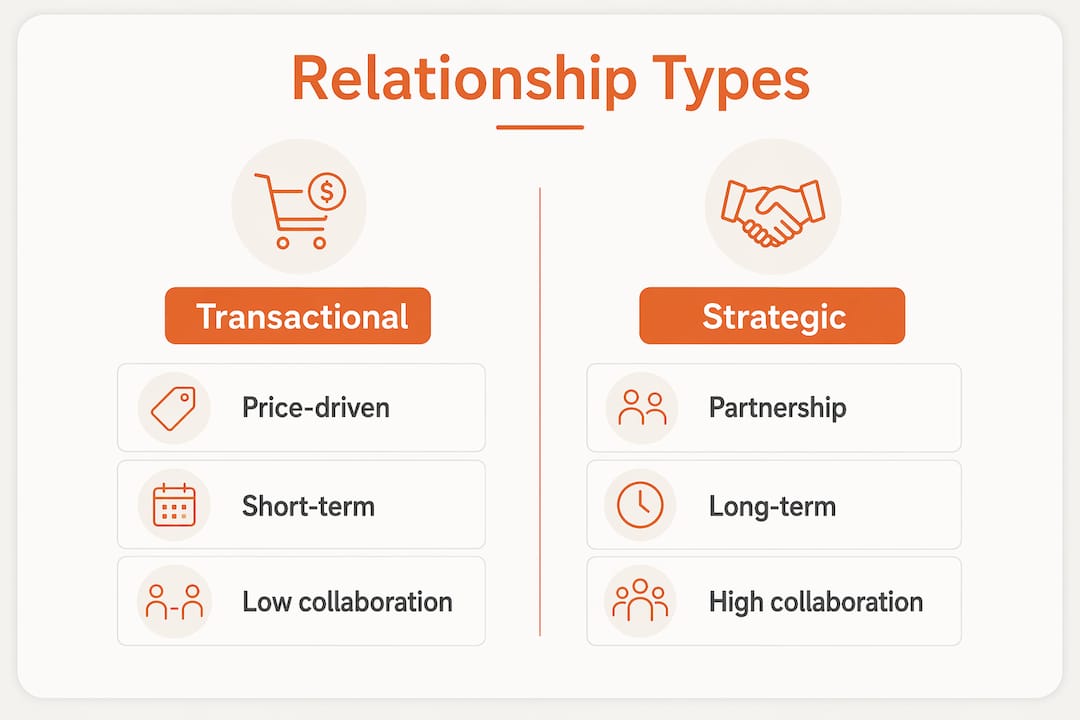
Supplier-contractor dynamics fall into two broad categories: transactional and strategic. Transactional relationships are project-specific, price-driven, and end when the contract closes. Strategic relationships are ongoing, trust-based, and built around shared performance goals. Both have a place in construction, but the type you choose should match the project’s complexity and duration.
Research published in the Journal of Global Operations and Strategic Sourcing found that collaboration and social interaction explain over 27% of variance in public project success. Formal contract structures alone do not drive outcomes. The relational qualities, how often teams communicate, whether they resolve conflicts constructively, and how much they trust each other, matter more than the paperwork.
The four common relationship models in construction are:
| Relationship type | Key feature | Best for | Risk |
|---|---|---|---|
| Transactional | Price-driven, short-term | Commodity materials | High supplier turnover |
| Preferred supplier | Repeat use, informal trust | Mid-size projects | Limited accountability |
| Strategic partnership | SLAs, shared KPIs, joint reviews | Complex or long-term projects | Requires significant investment |
| Integrated supply chain | Full collaboration from design phase | Large-scale or public projects | High coordination demand |
Pro Tip: During supplier selection, assess relational fit alongside technical capability. A supplier with slightly lower pricing but poor communication history will cost you more in delays and disputes than the savings justify.
How do supplier-contractor relationships impact construction project outcomes?
Strong contractor-supplier collaboration produces measurable results. Firms that adopt collaborative supplier relationships achieve 15–20% faster growth and reduce project disputes significantly. Procurement speed increases by 25% through optimized information sharing. These are not marginal gains. They represent the difference between winning repeat clients and losing bids to competitors who deliver more reliably.
Poor relationships produce the opposite effect. When trust breaks down, disputes escalate, change orders multiply, and project managers spend hours managing conflict instead of managing work. The importance of supplier relationships becomes most visible when they fail. A single unreliable supplier can delay a critical path activity, triggering liquidated damages and reputational damage that outlasts the project.
The benefits of strong relationships extend beyond cost and schedule:
- Faster resolution of delivery issues and specification changes
- Access to supplier market intelligence on material availability and lead times
- Custom fabrication solutions, such as prefab modules, developed through joint planning
- Reduced rework from clearer communication on specifications and tolerances
- Lower procurement overhead as repeat suppliers require less vetting per project
Joint quarterly performance reviews between contractors and suppliers boost innovation and improve project value by 5–10%. Reviews create a structured forum to identify bottlenecks, address recurring problems, and develop custom solutions before they become crises.
Pro Tip: Schedule quarterly reviews with your top five suppliers by spend volume. Bring your project manager and their account lead to the same table. The conversations that happen in those meetings prevent the disputes that happen on site.
What are best practices for establishing and maintaining effective supplier-contractor relationships?
Building durable contractor-supplier collaboration requires structure from day one. The process starts with qualification. Supplier qualification often suffers from subjective bias, where decisions rely on personal relationships rather than consistent criteria. Integrated governance that aligns safety, financial stability, and quality benchmarks with location-specific risks produces better outcomes and reduces the chance of a poorly matched partner reaching your job site.
Early supplier involvement
Early supplier involvement during project planning delivers market insights that optimize material availability and logistics. When a concrete supplier knows your pour schedule three months out, they can reserve capacity and flag lead time risks before they become schedule problems. Involving suppliers during preconstruction is one of the highest-return practices available to project managers.
Governance and formal agreements
SLAs define what success looks like for both parties. A well-written SLA covers delivery windows, quality standards, escalation procedures, and payment terms. It removes ambiguity and gives both sides a shared reference point when disputes arise. The role of subcontractors and suppliers in your governance structure should be documented, not assumed.
Digital infrastructure
Digital tools like shared portals and ERP integration reduce disputes by up to 40% and accelerate procurement by 25%. Dashboards that show real-time order status eliminate the most common source of contractor-supplier friction: one party not knowing what the other party knows. When both sides see the same data, misunderstandings drop sharply.
A practical engagement checklist for project managers:
- Qualify suppliers using standardized criteria covering safety record, financial health, and past performance
- Involve key suppliers during the preconstruction planning phase
- Establish SLAs before mobilization, not after the first dispute
- Set shared KPIs covering on-time delivery, defect rates, and response times
- Use a shared digital portal for purchase orders, delivery confirmations, and RFIs
- Conduct quarterly performance reviews with documented outcomes and follow-up actions
Pro Tip: Pilot a collaborative contract structure with one trusted supplier before rolling it out across your supply chain. Use that pilot to refine your SLA template and performance dashboard before scaling.
What challenges and industry trends affect supplier-contractor relationships?
The gap between what construction professionals want and what they practice is striking. 79% of professionals favor collaborative contracting models, but fewer than 1 in 8 actively implement them. In the UK, 20% of respondents were unaware these contract models even existed. That awareness gap explains why adversarial supply chains persist despite broad agreement that they cause harm.
The primary barrier is client-driven contract dominance. When project owners specify traditional lump-sum or design-bid-build contracts, contractors have limited room to introduce collaborative structures downstream. The contractor sits between the client’s contract requirements and the supplier’s need for fair terms. Changing that dynamic requires client leadership, not just contractor willingness.
“The shift from treating suppliers as interchangeable vendors to viewing them as strategic partners invested in shared success is the defining move that separates high-performing builders from the rest. It requires trust, formal structure, and a willingness to share information that most firms still guard too closely.”
Emerging trends point toward integrated project delivery (IPD) models and early contractor involvement (ECI) frameworks that bring suppliers into the process earlier. Material suppliers who build contractor networks gain access to pipeline visibility and preferred-vendor status that transactional suppliers never achieve. SLAs and digital platforms are the two tools most likely to accelerate this transition in the near term.
| Adoption challenge | Current state | Emerging solution |
|---|---|---|
| Adversarial supply chain culture | 61% see it as inherent | SLAs and joint governance frameworks |
| Low collaborative contract adoption | Fewer than 1 in 8 implement | Pilot programs and industry education |
| Client-specified traditional contracts | Dominant in most markets | IPD and ECI model advocacy |
| Digital tool adoption gaps | Inconsistent across firm sizes | Cloud-based portals and ERP integration |
The case for moving past transactional thinking
The construction industry has talked about collaboration for decades. What I have seen working in AEC recruiting and sourcing is that the firms actually doing it share one trait: they made a deliberate decision to treat supplier relationships as a business asset, not a procurement task.
The data supports that decision. A 27% variance in project success explained by relational factors alone is not a soft finding. It is a hard number that should change how you allocate management attention. Yet most project managers still spend more time negotiating price than building the relationship that determines whether the price even matters when delivery problems hit.
The firms I respect most have moved to structured quarterly reviews, shared KPIs, and digital portals that give suppliers real-time visibility. They prequalify subcontractors before projects start and revisit those qualifications annually. They treat an SLA as a living document, not a filing cabinet artifact. The transition is not painless. It requires internal discipline and a willingness to share data that feels uncomfortable at first. But the firms that make the shift stop losing projects to avoidable supply chain failures.
The uncomfortable truth is that most adversarial supply chains are not inevitable. They are the result of habits that nobody has taken the time to change. Client leadership matters here. When owners push for collaborative contract structures, the whole chain responds. Until that happens at scale, the burden falls on contractors and project managers to build better relationships one supplier at a time.
— Rowena
How Constructconnect-rconstructionsolutions supports stronger supplier-contractor partnerships
Constructconnect-rconstructionsolutions brings over 30 years of AEC industry experience to the challenge of building reliable, high-performing supplier and contractor networks. The firm specializes in AEC recruiting services that connect project managers and general contractors with pre-vetted suppliers and subcontractors who meet defined safety, quality, and performance standards.

For firms looking to move beyond transactional supply chains, Constructconnect-rconstructionsolutions also offers business opportunity sourcing that identifies collaborative partners aligned with your project pipeline and growth goals. The prorated payment structure means you pay only for successful placements, reducing the financial risk of expanding your supplier network. If unreliable partnerships have cost you time and money on past projects, this is a direct path to fixing that.
FAQ
What is a supplier-contractor relationship?
A supplier-contractor relationship is a formalized partnership between a construction contractor and a supplier of materials or services, governed by shared goals, SLAs, and performance metrics to deliver projects efficiently.
Why does contractor-supplier collaboration matter for project outcomes?
Collaborative relationships reduce disputes, accelerate procurement by up to 25%, and help firms achieve 15–20% faster growth compared to transactional supply chain models.
What are the main types of supplier relationships in construction?
The four main types are transactional, preferred supplier, strategic partnership, and integrated supply chain. Each suits different project scales and complexity levels.
How do you manage contractor relationships effectively?
Effective management requires standardized supplier qualification, early involvement in project planning, SLAs established before mobilization, shared digital portals, and quarterly performance reviews with documented follow-up.
What barriers prevent collaborative contracting in construction?
The primary barriers are client-specified traditional contracts, low awareness of collaborative models, and ingrained adversarial supply chain culture. Fewer than 1 in 8 professionals who favor collaboration actually implement it.
Key takeaways
Strong supplier-contractor relationships, governed by SLAs, shared KPIs, and digital infrastructure, are the most direct lever construction professionals have to reduce disputes, accelerate procurement, and protect business continuity.
| Point | Details |
|---|---|
| Adversarial supply chains are common but avoidable | 61% of professionals see adversarial dynamics as inherent, but SLAs and governance frameworks address the root causes. |
| Collaboration drives measurable growth | Firms with collaborative supplier relationships achieve 15–20% faster growth and 25% faster procurement. |
| Relational factors outweigh contract formality | Collaboration and social interaction explain over 27% of variance in public project success. |
| Digital tools cut disputes significantly | Shared portals and ERP integration reduce disputes by up to 40% by giving both parties the same real-time data. |
| Qualification must be standardized | Subjective supplier selection introduces avoidable risk. Consistent, criteria-based qualification improves quality and reduces project failures. |