
The PM's Role in Subcontractor Management: 2026 Guide
The role of PM in subcontractor management is defined as the direct oversight of all subcontractor activities, from contract execution through final payment, to keep a construction project on schedule, within budget, and compliant with quality standards. On a typical commercial project, a PM coordinates 15 to 40 subcontractors simultaneously. That scope demands far more than supervision. It requires contract negotiation, scope definition, performance monitoring, payment processing, and dispute resolution, all managed in parallel. The PM is the operational center of every subcontractor relationship on the job.
What are the key PM responsibilities for managing subcontractor relationships?
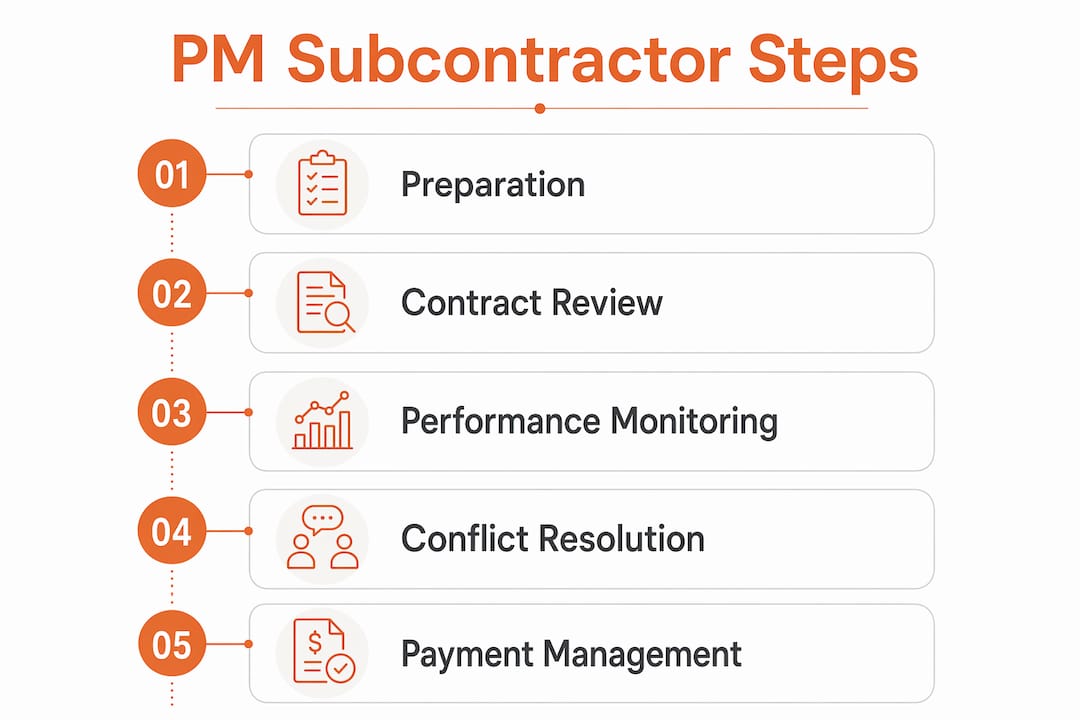
The PM’s responsibilities in managing subcontractor relationships span the full project lifecycle, from prequalification before a shovel hits the ground to final lien waiver collection at closeout. Each phase carries distinct obligations that, when handled well, prevent the disputes and delays that derail projects.
The industry term for this function is subcontractor administration, and it covers far more than most job descriptions suggest. Here are the core responsibilities every PM must own:
- Prequalification and onboarding. Prequalifying subcontractors filters out firms likely to cause defaults, quality failures, or schedule impacts. Time spent here pays back many times over during construction.
- Contract negotiation and scope writing. The PM must negotiate subcontract terms that define scope boundaries clearly, assign risk appropriately, and include enforceable schedule milestones.
- Communication and expectation management. Unclear expectations and inconsistent communication are primary causes of project failures. The PM sets the standard for how information flows on site.
- Coordination with field superintendents. The superintendent manages daily field operations. The PM translates contract requirements into field-level direction and resolves issues the superintendent escalates.
- Payment application processing. PMs review and certify pay applications against verified work in place, manage retention withholding, and collect conditional and unconditional lien waivers at each payment cycle.
- Dispute and performance issue resolution. When a subcontractor falls behind or delivers defective work, the PM issues formal notices, documents the impact, and drives resolution before delays compound.
- Technology and reporting. PMs submit weekly reports on budgets, pay applications, and change orders. Consistent reporting creates the paper trail that protects the GC in any dispute.
Pro Tip: Build your subcontractor onboarding checklist before the project starts. Include insurance certificates, OSHA 30 certification confirmation, Procore access setup, and signed subcontract execution. A complete onboarding packet on day one prevents administrative firefighting during mobilization.
The subcontractor relationship is fundamentally contractual. The PM’s job is to hold subs to defined scope, quality, and schedule while removing operational bottlenecks through site logistics and information flow. That dual obligation, enforcement and enablement, defines the role.

How does the PM monitor subcontractor performance and resolve conflicts?
Performance monitoring is where many PMs underperform. Tracking a subcontractor’s progress requires more than a weekly site walk. It requires documented, dated evidence that can support a formal cure notice or, if necessary, a contract termination.
Here is a structured approach to performance monitoring and conflict resolution:
- Establish baseline commitments at kickoff. At the subcontractor’s pre-construction meeting, confirm crew size commitments, equipment requirements, and milestone dates. Document these in writing.
- Track crew counts against commitments daily. Superintendents maintain daily field logs recording actual crew counts, equipment on site, and work completed. This data is the foundation for any delay claim.
- Align pay applications with scope progress. Every pay application should reflect verified work in place. Overpaying a subcontractor ahead of progress removes your leverage if performance issues emerge later.
- Issue formal cure notices with specific metrics. Documented, dated notices citing specific performance gaps carry legal weight. Verbal complaints do not. A formal cure notice process typically gives subcontractors 48 to 72 hours to rectify defaults before remedial action begins.
- Demonstrate schedule impact with data. When a subcontractor disputes a delay claim, the PM must show the critical path impact using schedule updates, daily logs, and crew count records. Anecdotal evidence loses in arbitration.
- Escalate through defined channels. If the cure notice does not produce results, escalate to the subcontractor’s principal, not just the foreman. Senior-level engagement often resolves issues that field-level conversations cannot.
“Failure to resolve subcontract disputes within 2 weeks may lead to 6 weeks of additional delays.” This ratio illustrates why early, documented intervention is not optional. It is the most cost-effective action a PM can take.
Collaboration with the superintendent is non-negotiable here. The superintendent sees the daily reality on the ground. The PM translates that reality into contractual action. When those two roles communicate daily, performance problems surface early enough to fix without cascading into schedule failures. For a deeper look at why subcontractors miss milestones, the field guide on missed deadlines covers the most common patterns and how to address them contractually.
What contract and payment strategies should pms apply for subcontractors?
Contract and payment management is where subcontractor management strategies either hold together or fall apart. Vague contracts and inconsistent payments are the two fastest ways to lose your best subcontractors to a competitor.
Scope exhibits: the first line of defense
Vague scope language is the primary cause of scope-related disputes in construction. Detailed scope exhibits that define inclusions and exclusions explicitly prevent disputes and reduce change orders. The PM must write or review every scope exhibit before the subcontract is executed. If two trades have adjacent work, the scope exhibit must define exactly where one trade’s responsibility ends and the other’s begins.
Bid timing and leveling
General contractors must provide 3 to 4 weeks minimum notice for bid invitations to receive quality responses. Rushing the bid process produces incomplete proposals that generate change orders later. Bid leveling, the process of comparing proposals line by line to identify gaps and exclusions, is a PM responsibility that directly affects contract quality.
Retention and lien waivers
| Practice | Standard Approach | Risk-Adjusted Approach |
|---|---|---|
| Retention rate | 10% withheld through substantial completion | Reduce to 5% after 50% completion for proven subs |
| Lien waiver type | Conditional on payment issuance | Unconditional required before final payment release |
| Retention release | At final completion and punch list sign-off | Phased release tied to scope milestones |
| Payment timing | Net 30 from certified pay application | Accelerated for preferred subcontractors |
The lien waiver process requires consistent execution at every payment cycle. A missing lien waiver at closeout creates title risk for the owner and legal exposure for the GC.
Payment reliability as a retention strategy
Payment reliability is the single most important factor for retaining top subcontractors in competitive labor markets. Delayed payments drive top-tier subcontractors to competitors, which directly impacts project quality and schedule. Automated pay application platforms can reduce processing time per subcontractor to 5–10 minutes. That efficiency gain is significant when you are managing 20 or more pay applications per month.
Pro Tip: Use Procore, Sage 300 CRE, or CMiC to automate pay application certification and lien waiver tracking. Manual spreadsheet processes introduce errors and slow down payment cycles, which costs you subcontractor goodwill and project momentum.
How can pms build long-term subcontractor partnerships?
The most effective subcontractor management strategy is not transactional. Top-performing GCs treat subcontractor management as a core business process by maintaining preferred subcontractor rosters and master agreements to secure labor priority and reduce overhead. This shift from project-by-project bidding to preferred partner models produces measurable gains in project predictability.
Here is what a preferred partner model looks like in practice:
- Preferred subcontractor roster. Maintain a vetted list of subcontractors by trade who have performed well on past projects. These firms get first access to bid opportunities and receive more favorable payment terms.
- Master subcontract agreements. Negotiate a master subcontract that covers standard terms, insurance requirements, and dispute resolution procedures. For each new project, you execute a short-form work order that references the master agreement. This eliminates repetitive contract negotiation and reduces legal review time.
- Labor access in constrained markets. In tight labor markets, preferred subcontractors prioritize your projects over competitors. That access is worth more than any savings from re-bidding to the lowest price every cycle.
- Centralized compliance tracking. Maintain a database of subcontractor insurance certificates, license renewals, OSHA 30 certifications, and safety records. Expired certificates are a liability exposure. Centralized tracking prevents gaps.
- Reduced onboarding overhead. A subcontractor who has worked with your firm before knows your Procore workflows, safety protocols, and reporting expectations. That familiarity reduces mobilization time and administrative friction on every subsequent project.
Building long-term contractor networks also improves risk mitigation. When a subcontractor defaults mid-project, a PM with a strong preferred roster can source a replacement faster than one who relies on cold outreach. That speed difference can mean the difference between a two-week recovery and a two-month delay.
Key takeaways
The PM’s effectiveness in subcontractor administration determines whether a project finishes on time, within budget, and with the workforce relationships intact for the next job.
| Point | Details |
|---|---|
| Define scope before contract execution | Detailed scope exhibits prevent disputes and reduce change orders throughout the project. |
| Prequalify every subcontractor | Screening for financial stability, safety records, and past performance reduces default risk significantly. |
| Issue formal cure notices promptly | Documented, dated notices citing specific gaps carry legal weight and resolve issues faster than verbal complaints. |
| Pay consistently and on time | Payment reliability retains top subcontractors in competitive markets and protects project continuity. |
| Build a preferred subcontractor roster | Master agreements and preferred partner models reduce re-bidding overhead and improve labor access on future projects. |
What i’ve learned about the pm’s real job in subcontractor management
After years of working closely with construction project managers across commercial, industrial, and civil projects, one pattern stands out clearly. The PMs who struggle most with subcontractor management are not the ones who lack technical knowledge. They are the ones who treat subcontractor administration as a paperwork function rather than a relationship and risk management function.
The shift I have observed in high-performing GC organizations is deliberate. They invest in scope writing before the contract is signed, not after the dispute starts. They issue cure notices the day a performance gap appears, not three weeks later when the schedule is already damaged. They pay on time, every time, because they understand that a subcontractor who trusts your payment process will staff your project before a competitor’s.
Technology matters here, but it is not the solution by itself. Procore and Sage 300 CRE reduce administrative burden significantly. But a PM who uses those tools without understanding the underlying contract obligations will still miss the signals that precede a subcontractor default.
The most common pitfall I see is over-reliance on the superintendent to manage subcontractor performance. The superintendent is your field intelligence source. The PM is the one who must translate that intelligence into contractual action. When those roles blur, performance issues go undocumented, cure notices go unissued, and disputes that could have been resolved in two weeks turn into six-week delays.
My advice is direct: own your subcontract documents, know your scopes better than your subcontractors do, and pay people what you owe them when you owe it. Everything else follows from those three commitments.
— Rowena
How Constructconnect-rconstructionsolutions supports your subcontractor staffing needs
Managing 15 to 40 subcontractors on a single project is only as effective as the quality of the workforce behind each contract. When a subcontractor defaults or a trade position goes unfilled, the PM needs a reliable sourcing solution, not a cold call to an unknown firm.

Constructconnect-rconstructionsolutions brings 30 or more years of AEC industry experience to the challenge of finding pre-vetted subcontractors and skilled construction professionals. Their AEC recruiting services connect project managers with qualified candidates across trades and project management roles, with a prorated payment structure that means you only pay for successful placements. For PMs who need to fill critical roles fast without overpaying a general staffing agency, that model is a direct operational advantage. Explore their talent sourcing solutions to see how they support construction teams from preconstruction through closeout.
FAQ
What is the primary role of a PM in subcontractor management?
The PM’s primary role is to coordinate all subcontractor activities, including contract execution, scope oversight, performance monitoring, and payment processing, to keep the project on schedule and within budget.
How many subcontractors does a typical PM manage on a commercial project?
A typical commercial construction project involves managing 15 to 40 subcontractors, requiring the PM to oversee contracts, payments, scope, and dispute resolution simultaneously.
How should a PM handle a subcontractor who is falling behind schedule?
Issue a formal written cure notice citing specific performance gaps, such as crew counts versus commitments, and give the subcontractor 48 to 72 hours to rectify the default before escalating to remedial action.
Why does payment timing matter in subcontractor management?
Payment reliability is the single most important factor for retaining top subcontractors. Delayed payments push skilled firms to competitors, which directly reduces project quality and schedule performance.
What is a master subcontract agreement and why should pms use one?
A master subcontract agreement is a standing contract that covers standard terms, insurance, and dispute resolution for a subcontractor across multiple projects. It reduces repetitive negotiation, speeds up contract execution, and builds the preferred partner relationships that improve labor access in tight markets.