
What Is Subcontractor Prequalification for GCs?
Subcontractor prequalification is defined as the upfront vetting process by which general contractors assess trade subcontractors across financial health, safety performance, bonding capacity, insurance coverage, management capability, and relevant project experience before inviting them to bid. The goal is to build an approved pool that minimizes subcontractor failures causing schedule delays, cost overruns, and quality defects. In the AEC industry, this process is formalized through prequalification questionnaires, scoring systems, and tiered approval frameworks. Understanding the subcontractor qualification process is not optional for serious construction managers. It is the foundation of reliable project delivery.
What is subcontractor prequalification and why does it matter?
Prequalification protects GCs from subcontractor failures that damage contract performance, reputation, and bottom line. A trade contractor who wins a bid but lacks the bonding capacity, cash flow, or safety culture to execute creates problems that ripple across the entire project schedule. The importance of subcontractor prequalification becomes clearest when you consider that a single underqualified electrical or mechanical sub can stall a multi-million-dollar project for weeks.

Prequalification is also the cheapest form of risk mitigation a general contractor can implement. Catching a financially distressed subcontractor before award costs almost nothing. Replacing one mid-project costs time, money, and often client trust. For construction managers overseeing multiple concurrent projects, a well-maintained approved pool means faster bid cycles and fewer surprises during execution.
The process also creates a defensible paper trail. When disputes arise over subcontractor performance, a documented prequalification program demonstrates that the GC exercised reasonable due diligence in selecting trade partners. That documentation has real legal and contractual value, particularly on public works projects where accountability standards are higher.
What information is collected during subcontractor prequalification?
A standard prequalification questionnaire covers seven core data categories. Each one reveals a different dimension of subcontractor reliability.
- Financial health: Current financial statements, credit references, and working capital ratios indicate whether a sub can sustain operations through a project’s payment cycle without defaulting.
- Experience Modification Rate (EMR): The EMR is a workers’ compensation insurance metric that reflects a company’s historical safety performance relative to industry peers. A score above 1.0 signals above-average incident rates and typically triggers higher insurance premiums for the GC.
- OSHA 300 logs: These logs document recordable workplace injuries and illnesses over the past three years. Reviewing them alongside the EMR gives a fuller picture of actual field safety.
- Bonding capacity: Confirmation from a licensed surety that the sub can obtain performance and payment bonds up to a specified dollar threshold is non-negotiable on most public projects and many private ones.
- Insurance certificates: General liability, workers’ compensation, and umbrella coverage must meet project-specific minimums. Reviewing the surety limits and coverage before award prevents gaps that expose the GC to liability.
- Past project history: References from owners and GCs on comparable projects verify that the sub has actually delivered work of similar scope and complexity.
- Litigation and lien history: Active liens, pending lawsuits, or prior contract terminations are red flags that questionnaire responses alone may not surface.
- Key personnel: Identifying the superintendent, project manager, and safety officer assigned to your work confirms that the sub’s experienced staff will actually be on your project, not just listed on the form.
One critical point on verification of submitted documents: never accept questionnaire answers at face value. Call the listed references. Confirm bonding with the surety directly. Cross-check OSHA logs against public OSHA inspection records where available. Verification is what separates a genuine prequalification program from a paperwork exercise.
Pro Tip: Safety program quality matters as much as lagging metrics like EMR. A sub with a clean three-year EMR but no written safety program, no toolbox talk records, and no designated safety officer is a hidden risk. Assess both the safety program quality and the historical data together.
How to prequalify subcontractors: a step-by-step process
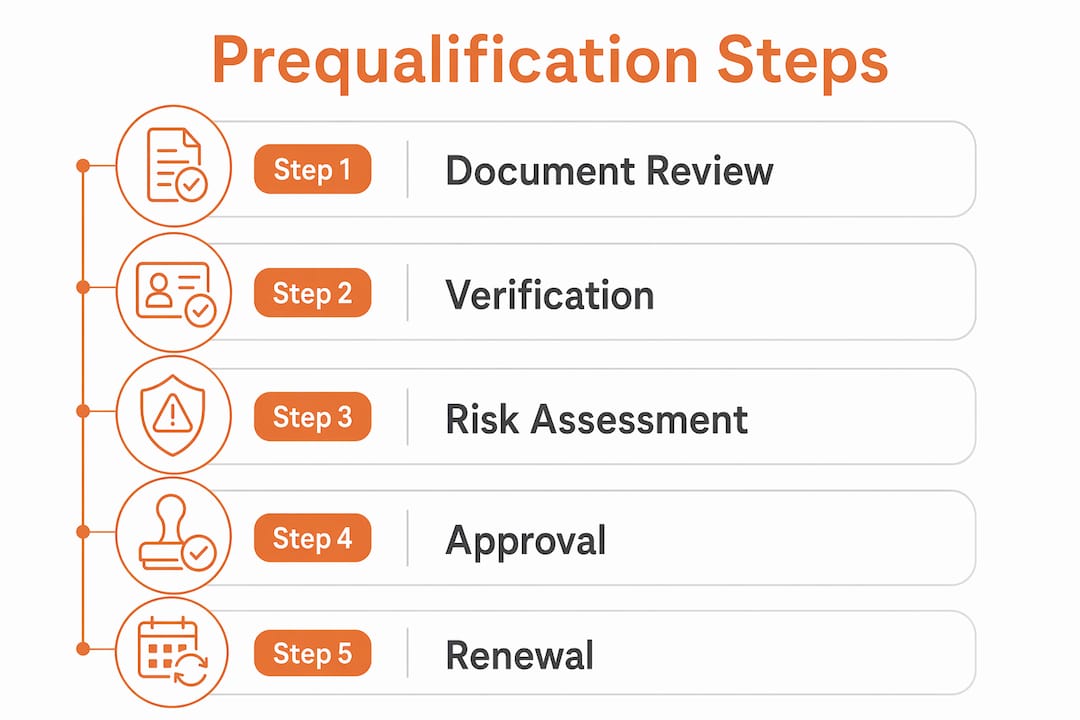
The subcontractor evaluation criteria you apply must follow a repeatable workflow to be defensible and efficient. Here is the five-step process that experienced GCs use.
-
Define criteria and approval tiers. Before distributing a single questionnaire, decide what thresholds matter for your project types. A GC focused on healthcare construction will weight safety and infection control protocols differently than one building industrial facilities. Set minimum scores for financial ratios, EMR caps, and bonding thresholds. Then establish approval tiers, such as Tier 1 for subs approved up to $500,000 in award value and Tier 2 for subs approved up to $2 million. Tiered approval systems reduce over-screening of smaller subs while managing financial exposure on larger awards.
-
Distribute the prequalification questionnaire. Send the form with a clear deadline and a point of contact for questions. Standardize the format so responses are comparable across subs. Many GCs use platforms like Procore, Textura, or dedicated prequalification software to centralize this step.
-
Review and verify responses. Score each submission against your defined criteria. Contact references, confirm bonding with the surety, and cross-check any safety data against external records. Flag incomplete submissions for follow-up rather than disqualifying them outright, since some subs simply need guidance on what is required.
-
Score submissions and assign approval tiers. Use a consistent scoring rubric so decisions are objective and documented. Assign each approved sub to the appropriate tier based on their financial capacity, bonding limit, and safety record. Record the rationale for any borderline decisions.
-
Maintain qualification files with annual renewal. The typical prequalification workflow includes annual renewal to prevent data aging. Set calendar reminders 60 days before each sub’s renewal date. Beyond annual cycles, trigger requalification immediately when a sub experiences a serious safety incident, a key personnel change, a lien filing, or a merger or acquisition.
Pro Tip: Document every decision in writing, including why a sub was approved, conditionally approved, or declined. If a subcontractor later files a bid protest or dispute, that documentation is your first line of defense.
Public vs. private project requirements: what changes?
The rules governing subcontractor prequalification differ significantly depending on whether you are working on a public or private project.
| Factor | Public projects | Private projects |
|---|---|---|
| Mandate | Often required by statute or agency rule as a condition of bid eligibility | No federal mandate; driven by owner contract requirements or GC policy |
| Bonding threshold | Typically tied to project dollar value with specific surety confirmation required | Set by owner or GC based on risk tolerance |
| Safety criteria | EMR caps and OSHA log review commonly specified | Varies; GC sets standards |
| Past project experience | Often requires documented completion of projects above a dollar threshold | GC defines relevant experience benchmarks |
| Documentation standard | Formal, auditable records required for public accountability | Internal records sufficient but recommended for legal defensibility |
| Bid eligibility | Prequalification is a prerequisite to bid on many public agency projects | Prequalification typically affects invitation to bid, not legal eligibility |
Many public agencies require formal prequalification tied directly to bidding eligibility, with strict thresholds on completed project values, bonding confirmation, and specific trade licenses. Failing to meet those thresholds means a sub cannot submit a bid, regardless of price or relationships.
On private work, no federal mandate requires formal prequalification, but owners increasingly include it as a contractual requirement in their GC agreements. Even when it is not contractually required, a documented program protects the GC in disputes and supports insurance underwriting. The benefits of subcontractor prequalification apply regardless of project type.
Technology and best practices to improve the qualification process
Manual prequalification, managed through email threads and spreadsheets, creates bottlenecks that slow bid cycles and introduce errors. Centralized data capture platforms that combine questionnaire distribution, document collection, and verification workflows address the most common operational failures.
Platforms like Procore’s prequalification module, Textura, and dedicated tools allow GCs to automate questionnaire distribution, track submission status in real time, store documents in a searchable database, and set automated renewal reminders. The operational benefits are direct: fewer missed renewals, faster review cycles, and a single source of truth for all sub qualification data.
Beyond software, these operational practices make the biggest difference:
- Prequalify ahead of bid cycles. Waiting until a bid invitation goes out to start prequalification creates last-minute pressure that leads to shortcuts. Build your approved pool proactively so qualified subs are ready when you need them.
- Set firm renewal deadlines with consequences. A sub whose qualification lapses should be removed from the approved pool automatically until renewal is complete. Soft enforcement leads to stale data.
- Integrate prequalification with your sourcing process. When your subcontractor sourcing process feeds directly into your prequalification database, you avoid duplicating effort and build a larger qualified pool over time.
- Use event-based triggers, not just calendar dates. A sub who files a lien on another GC’s project mid-year should be requalified immediately, not at their annual renewal date.
- Track trade-specific pools separately. A mechanical sub and a concrete sub require different evaluation criteria. Mixing them into a single undifferentiated list reduces the precision of your screening.
Common challenges and how to avoid prequalification pitfalls
Even well-designed prequalification programs break down in predictable ways. Knowing the failure modes in advance lets you build safeguards into your process from the start.
Qualification drift is the most common and most damaging problem. It occurs when a sub’s financial condition, safety record, or key personnel change significantly between renewal cycles, but the GC continues awarding work based on outdated qualification data. A sub that was financially sound 18 months ago may now be carrying excessive debt or have lost the superintendent who drove their safety culture. Annual renewal and event-triggered requalification are the only reliable defenses.
Relying solely on questionnaire answers without verification is the second major failure mode. Subs have an obvious incentive to present their best case on paper. Without direct confirmation from sureties, references, and public records, you are screening on self-reported data. That is not prequalification. It is paperwork.
A third challenge is administrative burden. Thorough prequalification takes time, and some subs, particularly smaller specialty contractors, push back on extensive documentation requirements. The solution is a tiered system that scales the screening depth to the award value and risk level. A sub bidding a $50,000 painting scope does not need the same financial scrutiny as one bidding a $3 million mechanical package.
- Avoid disqualifying subs for incomplete submissions without first offering guidance on what is missing.
- Do not apply the same criteria uniformly across all trade types. Bonding requirements for a structural steel sub differ from those for a landscaping sub.
- Never let prequalification become a one-time event. It is an ongoing program, not a form you collect once.
Pro Tip: Maintain active communication with your approved subs throughout the year, not just at renewal time. A quick check-in call when you hear about industry layoffs or a local economic downturn can surface qualification changes before they become project problems. Knowing why subcontractors miss deadlines often starts with catching early warning signs during the qualification cycle.
Key takeaways
Effective subcontractor prequalification requires defined criteria, verified data, tiered approvals, and annual renewal to protect project outcomes and GC liability.
| Point | Details |
|---|---|
| Define criteria before screening | Set financial, safety, bonding, and experience thresholds before distributing questionnaires. |
| Verify, do not just collect | Confirm bonding with sureties and call references directly to avoid a paperwork-only exercise. |
| Use tiered approval limits | Match screening depth to award value to reduce burden on smaller subs while managing financial exposure. |
| Renew annually and by event | Prevent qualification drift by scheduling renewals and triggering requalification on safety incidents or key personnel changes. |
| Centralize with technology | Platforms that combine questionnaire distribution, document storage, and renewal tracking eliminate manual bottlenecks. |
What I have learned after years of watching prequalification programs succeed and fail
After working closely with construction managers across the AEC industry for over three decades, I have seen one pattern repeat itself: the firms that treat prequalification as a living program outperform those that treat it as a compliance checkbox. The difference is not the sophistication of their forms. It is the discipline of their follow-through.
The most common mistake I see is investing heavily in the initial setup, designing a thorough questionnaire and scoring rubric, and then letting the program go stale. Renewals slip. Event triggers get ignored. Two years later, the approved pool is full of subs whose circumstances have changed materially, and no one knows it until a project is already in trouble.
The second thing I have observed is that the best prequalification programs are built around relationships, not just documents. When a project manager knows a sub’s superintendent personally and checks in regularly, they often catch qualification-relevant changes, a key hire leaving, a cash flow squeeze, a safety incident on another job, before those changes show up in formal records. Technology platforms are valuable for organizing data and enforcing renewal cycles. They do not replace the judgment that comes from knowing your trade partners.
The future of prequalification is moving toward real-time data integration, pulling EMR updates, lien filings, and license status automatically rather than waiting for annual submissions. GCs who build that capability now will have a meaningful advantage in bid cycle speed and risk management. For everyone else, the fundamentals still apply: define your criteria, verify everything, and never let a qualification file go stale.
— Rowena
How Constructconnect-rconstructionsolutions supports your vetting process
Building and maintaining a qualified subcontractor pool takes more than a good questionnaire. It requires access to trade contractors who have already been evaluated for the right credentials, safety record, and project experience.

Constructconnect-rconstructionsolutions brings 30-plus years of AEC industry experience to the subcontractor sourcing and recruiting process. Their AEC recruiting services connect general contractors with pre-vetted trade partners and project staff, reducing the time and risk involved in building a qualified pool from scratch. For GCs looking to expand their subcontractor network or fill critical project roles quickly, Constructconnect-rconstructionsolutions offers a prorated payment structure that means you only pay for successful placements. Explore their business opportunity sourcing solutions to see how they can support your next project.
FAQ
What is subcontractor prequalification in construction?
Subcontractor prequalification is the process of evaluating trade contractors across financial health, safety performance, bonding, insurance, and experience before inviting them to bid. It builds an approved pool that reduces the risk of subcontractor failures during project execution.
What does a subcontractor prequalification checklist include?
A standard subcontractor prequalification checklist covers financial statements, EMR scores, OSHA 300 logs, bonding capacity confirmation, insurance certificates, past project references, litigation history, and key personnel identification.
How often should subcontractor prequalification be renewed?
Prequalification files should be renewed annually at minimum. Event-triggered requalification is also required when a sub experiences a serious safety incident, a key personnel change, a lien filing, or a merger or acquisition.
Is subcontractor prequalification required by law?
Many public agencies require formal prequalification as a condition of bid eligibility. Private projects have no federal mandate, but owners often require it contractually, and GCs are advised to implement it as a risk management best practice regardless.
How does prequalification differ from a standard bid invitation?
A bid invitation goes to any interested contractor. Prequalification screens contractors against defined criteria before the invitation is issued, so only trade partners who meet financial, safety, and experience thresholds are eligible to bid on your work.