
Supplier Contractor Partnership Best Practices That Cut Delays
The strongest supplier-contractor partnerships share eight practices: segment suppliers by risk and spend, build clear governance, track a compact KPI scorecard, standardize onboarding, use contracts that share risk, run disciplined communication routines, pilot joint innovation, and build in resilience against single-source failures. Contractors who apply these consistently see fewer schedule slips, lower defect rates, and better margins because problems surface early instead of at the worst possible moment on a job site.
Here’s the core list, in the order we’ll cover them:
- Segment suppliers by criticality and spend
- Set governance, roles, and decision rights
- Run a KPI scorecard for continuous improvement
- Standardize onboarding and assessment
- Use contracts and incentives to align outcomes
- Institutionalize communication and trust-building
- Pilot joint innovation before scaling it
- Build resilience with contingency planning
Get these right and the payoff shows up fast: fewer emergency material runs, tighter cycle times, and subcontractors who show up ready instead of scrambling.
Key Takeaways
Supplier-contractor partnerships succeed when segmentation, governance, KPI tracking, and contract design all reinforce the same set of priority suppliers rather than operating in isolation.
| Point | Details |
|---|---|
| Segment before investing | Rank suppliers by criticality and spend so partnership resources go to the top 10 to 20 percent that matter most. |
| Track six core KPIs | Monitor Cycle Time, On-Time Delivery, Procurement ROI, Spend Under Management, Defect Rate, and Cost Variance monthly. |
| Centralize governance | Break project-level bidding habits by giving a steering committee authority over framework agreements. |
| Build resilience early | Keep safety stock and a tested backup supplier for any single-source, schedule-critical material. |
| Source with confidence | Constructconnect-rconstructionsolutions connects contractors to pre-vetted suppliers and subcontractors, reducing the risk baked into new partnerships. |
Table of Contents
- What Is a Supplier-Contractor Partnership Best Practice?
- How Should You Prioritize These Practices?
- How Do You Segment Suppliers for Partnership Investment?
- What Governance Structure Do Partnerships Need?
- Which KPIs Actually Predict Supplier Performance?
- What Should Supplier Onboarding Include?
- What Contract Terms Actually Align Supplier Behavior?
- How Do You Build Communication Routines That Build Trust?
- How Do You Run a Supplier Innovation Pilot?
- How Do You Avoid Single-Source Failures?
- What Does a Realistic Implementation Timeline Look Like?
- What Belongs on a Supplier Performance Dashboard?
- How Does This Look on an Actual Construction Project?
- What Red Flags Signal a Partnership Is Failing?
- How Should Disputes Between Suppliers and Contractors Be Resolved?
- How Do You Align Culture Between Supplier and Contractor Teams?
- What Technology Actually Supports Supplier Partnership Management?
- Why Partnerships Are Worth the Effort
- How R. Construction Solutions Supports Your Supplier Strategy
- Sources
- FAQ
What Is a Supplier-Contractor Partnership Best Practice?
A supplier-contractor partnership best practice is a repeatable process, contract structure, or communication routine that turns a transactional buy-sell relationship into a mutually accountable, performance-tracked collaboration. The distinction matters because most construction firms already have suppliers. Far fewer have partnerships.
The business case is straightforward once you look at the numbers:
- Performance consistency: long-term strategic partners show the highest and most consistent performance scores compared to suppliers in limited, transactional arrangements, particularly on close-out metrics.
- Innovation and continuity: deeper supplier relationships, when backed by governance and trust, produce innovation and supply continuity that transactional buying rarely delivers.
- Measurable ROI: metrics like Procurement ROI and Spend Under Management give procurement teams a defensible way to prove the partnership investment paid off, something we’ll define in detail in the KPI scorecard section below.
How Should You Prioritize These Practices?
Sequence matters more than most teams assume. Segment your suppliers first, because governance and contracts built around the wrong suppliers waste effort. Then set governance, stand up a KPI scorecard, formalize onboarding, and only then move to contract redesign, communication routines, and innovation pilots.
- Start with your top 10 to 20 percent of suppliers by spend and criticality.
- Pilot before you scale. Two or three suppliers, one scorecard, ninety days.
- Expect the investment to pay back through fewer delays and better margins. We cover the specific timeline and ROI expectations in the implementation roadmap and metrics sections below.
How Do You Segment Suppliers for Partnership Investment?
Not every supplier deserves partnership-level investment. Segmentation sorts suppliers by two axes: how critical their materials or services are to your schedule, and how much complexity or spend they represent. This is the same logic CIPS’s supplier relationship management framework recommends, and it prevents contractors from pouring governance resources into a low-risk commodity vendor while a single-source structural steel supplier gets treated like any other line item.
- Score suppliers on lead-time criticality, switching cost, and annual spend, then plot them on a simple matrix.
- Review segments quarterly. A supplier that moves from commodity to critical (say, after a price spike or capacity crunch) needs to be reclassified fast.
- Reserve framework agreements for suppliers in the high-criticality, high-spend quadrant. Everyone else stays transactional.
| Segment | Criticality | Spend/Complexity | Recommended approach |
|---|---|---|---|
| Strategic partner | High | High | Framework agreement, joint planning |
| Leverage supplier | Low | High | Competitive bidding, volume negotiation |
| Bottleneck supplier | High | Low | Secure with backup sourcing, monitor closely |
| Routine/commodity | Low | Low | Transactional, minimal oversight |
What Governance Structure Do Partnerships Need?
Partnerships fail without clear ownership. A steering committee, an SRM program owner, a contract owner, and an operations liaison need distinct, written decision rights, not a vague understanding that “someone” handles supplier issues. CIPS guidance frames this as core to any functioning SRM program, and construction research backs it up: strategic partnering breaks down when it stays bound to a single project instead of being managed across your full portfolio.
- Assign a named SRM owner who tracks scorecards and escalations across projects, not just one job.
- Give the steering committee authority to approve framework agreements and resolve disputes that site-level project managers can’t settle alone.
- Run monthly business reviews at the operational level and quarterly executive reviews for strategic suppliers.
| Role | Primary responsibility | Escalation trigger |
|---|---|---|
| SRM program owner | Owns scorecards, cross-project supplier strategy | Score below threshold two months running |
| Contract owner | Manages terms, renewals, incentive clauses | Contract breach or renegotiation window |
| Operations liaison | Daily coordination, delivery issues | Delivery miss or quality defect |
| Steering committee | Final approval on framework agreements | Cross-project dispute or strategic shift |
Cross-functional ownership matters here specifically because project-level bidding culture is the single biggest reason partnerships stay stuck at the transactional level.
Which KPIs Actually Predict Supplier Performance?
Six metrics do most of the work: Cycle Time, Supplier On-Time Delivery, Procurement ROI, Spend Under Management, Supplier Defect Rate, and Procurement Cost Variance. Construction procurement KPI research from 2026 identifies these as the metrics that most directly correlate with fewer delays and protected margins.
- Cycle Time: days from purchase order to delivery. Rising cycle time is often the first warning sign of a supplier under strain.
- Supplier On-Time Delivery: percentage of orders delivered on or before the committed date.
- Procurement ROI: value generated (cost savings, avoided delays) relative to procurement spend.
- Spend Under Management: percentage of total spend actively tracked and negotiated versus maverick, off-contract buying.
- Supplier Defect Rate: percentage of delivered materials or work rejected on inspection.
- Procurement Cost Variance: difference between budgeted and actual procurement cost.
Weight these based on what matters most to your project type. A prefab-heavy contractor might weight on-time delivery and cycle time at 60 percent combined, while a firm with tight margins weights cost variance and ROI higher. Pull data weekly at the operational level and roll it into a monthly steering report so trends get caught before they become schedule problems.
What Should Supplier Onboarding Include?
Standardized onboarding is what separates a supplier that performs from one that becomes your next fire drill. Reserve the full process for suppliers segmented as strategic or bottleneck; routine vendors don’t need it.
- Capability and financial health assessment
- Certification and insurance verification
- Sample orders or trial runs before full commitment
- File-exchange or EDI-lite setup for order and invoice data
- Documented SLAs covering lead time, quality tolerances, and communication response windows
- A contact map naming a primary and backup contact on both sides
- Weeks 1 to 2: capability assessment and documentation review, owned by procurement.
- Weeks 2 to 4: sample orders and SLA negotiation, owned jointly by procurement and the operations liaison.
- Weeks 4 to 6: system integration and go-live, owned by the operations liaison.
Folding this into your segmentation model keeps the process proportionate. A strategic steel supplier gets all six steps; a commodity fastener vendor might only need the first two.
What Contract Terms Actually Align Supplier Behavior?
Framework agreements, volume guarantees, and shared-savings clauses do more to align behavior than penalty-heavy contracts ever will. Research on multi-project procurement programs shows contractors often mix formal agreements with informal relational incentives, like guaranteed consideration for future projects, to sustain long-term supplier commitment even when individual contracts run short-term.
- Use framework agreements for strategic suppliers, with volume guarantees tied to your forecasted project pipeline.
- Add shared-savings clauses where a supplier’s process improvement lowers your cost. Split the savings instead of keeping it all.
- Reserve liquidated damages for genuinely critical items, not as a default clause. Overusing them signals distrust and invites suppliers to price in the risk.
- Bring committed volume forecasts into negotiations. Suppliers price more aggressively for contractors who can show real pipeline visibility.
Short-term agreements with relational incentives work well for suppliers you’re still evaluating. Multi-year contracts make sense once a supplier has proven consistency across at least two or three projects.
How Do You Build Communication Routines That Build Trust?
Trust doesn’t happen because two companies like each other. It happens because both sides commit to a communication cadence and stick to it, even when the news is bad. Survey research among construction leadership identifies trust, mutual commitment, and clear dispute-resolution paths as the top predictors of partnership success.
- Weekly: operations sync between your site team and the supplier’s account contact, covering delivery status and near-term needs.
- Monthly: formal performance review against the KPI scorecard, with both sides present.
- Quarterly: strategic workshop covering forecast changes, capacity planning, and upcoming project pipeline.
Share forecasts proactively rather than making suppliers guess your volume needs. Run joint root-cause reviews after any missed delivery or quality issue, and set escalation rules everyone agrees to in advance so a dispute doesn’t wait three weeks for someone to notice.
How Do You Run a Supplier Innovation Pilot?
Small, measurable pilots beat sweeping partnership overhauls. Pick one supplier, one process, and one metric, then give it a fixed window to prove itself.
- Define the objective (a cost reduction, a lead-time cut, a quality fix), the scope, and a baseline metric before day one.
- Set a duration, typically 60 to 90 days, with named owners on both sides.
- Establish a clear success criterion and a decision rule up front: scale it, adjust it, or kill it.
- Track lead-time reduction, defect reduction, or cost-per-unit as your primary metric, not vague satisfaction scores.
Fund the pilot jointly and share the upside if it works. A supplier that fronts an innovation cost with no guaranteed return has no reason to try again.
Pro Tip: Cap every pilot at one variable. Testing a new delivery schedule and a new packaging method at the same time makes it impossible to know which change actually moved the metric.
How Do You Avoid Single-Source Failures?
Resilience means mapping which materials would actually stop your project if a supplier failed, not assuming your usual vendor will always come through. Build a risk matrix scoring each critical item on lead-time sensitivity, single-source exposure, and the supplier’s financial health.
- Hold safety stock equal to lead time plus roughly two weeks for your most schedule-critical materials, a practice construction sourcing guides commonly recommend.
- Split volume across a primary and backup supplier, often around a 70/30 ratio for genuinely critical items.
- Test your backup supplier before peak season, not during a crisis.
- Map every material where a delay would stop work.
- Score each for single-source risk and lead-time sensitivity.
- Assign a backup and test it annually.
Single-sourcing is sometimes unavoidable, especially for specialty materials. When it is, add contractual performance triggers and consider dedicated inventory held on your behalf.
What Does a Realistic Implementation Timeline Look Like?
Standing up an SRM program takes roughly a year to mature, but you’ll see early wins well before that. CIPS guidance on supplier relationship management recommends starting with a pilot scorecard and two or three priority suppliers before scaling governance and tooling.
- Assess and prioritize: map your supplier base and segment by criticality and spend.
- Define governance: name your SRM owner, contract owner, and steering committee.
- Pilot the scorecard: launch the six-metric scorecard with two or three strategic suppliers.
- Onboard priority suppliers: run the full onboarding checklist for suppliers flagged as strategic.
- Run pilots and negotiate frameworks: launch one innovation pilot and convert your top performer to a framework agreement.
- Scale and improve continuously: extend the scorecard and governance model across your full strategic supplier base.
- 0 to 3 months: assessment and governance setup, owned by procurement leadership.
- 3 to 6 months: scorecard pilot and onboarding, owned by the SRM program owner.
- 6 to 12 months: scaling and framework agreements, owned jointly by procurement and operations.
Expect early ROI signals, tighter cycle times and fewer emergency orders, within the first two quarters. Margin protection and defect-rate improvement typically show up in year one as governance and contracts mature.
What Belongs on a Supplier Performance Dashboard?
A working SRM dashboard needs four layers: a top-level supplier health score, trend charts over time, supplier-level detail, and a risk heatmap flagging single-source exposure. Anything more granular buries the signal contractors actually need to act on.
- Top section: an aggregate score per supplier, weighted from your six core KPIs.
- Middle section: trend lines for Cycle Time and On-Time Delivery over the past six reporting periods.
- Detail section: individual supplier scorecards with defect rate and cost variance broken out.
- Bottom section: a heatmap flagging suppliers with single-source risk or declining financial health.
Tie every threshold miss to a specific action. A supplier scoring below target for two consecutive months should trigger a formal corrective plan, not a quiet conversation that goes nowhere.
How Does This Look on an Actual Construction Project?
Prefab coordination, just-in-time deliveries, and clear site acceptance criteria are where these practices either prove themselves or fall apart. A framework agreement means nothing if a delivery truck shows up at the wrong gate with no one authorized to accept it.
One pattern shows up repeatedly in construction procurement: a supplier moves from transactional to strategic partner over two to three projects, and on-time delivery and defect rates improve measurably once governance and a shared scorecard are in place, consistent with findings that long-term strategic partners post the highest and most consistent performance scores compared to suppliers left in ad hoc arrangements.
- Build prefab delivery schedules jointly with the supplier rather than handing them down after the fact.
- Set site acceptance criteria in writing before the first delivery, including who signs off and what triggers a rejection.
- Use just-in-time scheduling only once a supplier has proven reliable in the onboarding phase, not before.
Pro Tip: Assign one person, not a rotating site team, as the point of contact for your strategic suppliers. Consistency in who answers the phone builds trust faster than any contract clause.
R. Construction Solutions has spent over 30 years connecting AEC firms with pre-vetted subcontractors and suppliers, which is precisely the kind of vetting layer that makes the onboarding checklist above faster to execute with confidence.
What Red Flags Signal a Partnership Is Failing?
Certain patterns predict failure long before a project actually slips. Watch for these and act before they compound.
- Overreliance on a single supplier for a critical material with no tested backup. Fix: build the primary/backup split described in the resilience section.
- No scorecard, or a scorecard nobody reviews. Fix: assign scorecard ownership to a named person, not a shared inbox.
- Inconsistent governance where one project manager negotiates differently than another. Fix: centralize framework agreement authority with your steering committee.
- Micromanaging suppliers on operational detail while ignoring strategic performance trends. Fix: shift review meetings toward KPI trends, not daily minutiae.
- Unclear incentives where a supplier has no reason to improve. Fix: add a shared-savings or volume-based incentive clause.
Project-level bidding culture is the quiet killer here. When every project rebids the same category of supplier, strategic partnering never gets the chance to mature past a single job. The fix is centralizing at least framework-level decisions across your project portfolio, even if individual site teams keep day-to-day flexibility.
How Should Disputes Between Suppliers and Contractors Be Resolved?
Dispute resolution needs to be designed before the dispute happens, not improvised in the middle of one. Contracts should specify an escalation ladder: site-level resolution first, then the operations liaison, then the steering committee, with a defined number of days at each stage before it moves up.
Research into construction partnership success factors consistently points to clear dispute-resolution mechanisms as a top predictor of whether a partnership survives, right alongside trust and mutual commitment. That’s not a coincidence. Disputes are inevitable on any project with enough moving parts. What separates a partnership that survives a bad month from one that ends in litigation is whether both sides know exactly how a disagreement gets resolved before it turns into one.
Build three tiers into your contracts. First, direct negotiation between the operations liaison and the supplier’s account manager, with a short window, often five to ten business days, to resolve routine issues like a missed delivery or a quality dispute. Second, escalation to the steering committee for anything involving contract interpretation, liquidated damages, or repeated performance failures. Third, a named mediation or arbitration process for disputes that can’t be settled internally, specified in the contract itself rather than left to whichever attorney gets the call first.
Root-cause reviews matter here too. A dispute that gets “resolved” without anyone examining why it happened will likely repeat. Build a short joint review into your process any time a dispute escalates past the first tier, and document what changes on both sides to prevent a repeat.
How Do You Align Culture Between Supplier and Contractor Teams?
Culture clashes kill more partnerships than bad contracts do. A supplier used to being treated as a vendor won’t suddenly start behaving like a partner because a new agreement says so. Change management here means shifting behavior on both sides, not just updating a document.

Start by naming what’s actually changing. If your firm has historically rebid every category every project, tell your team and your suppliers explicitly that top-tier suppliers will now get multi-project consideration in exchange for performance transparency. Ambiguity about whether the old rules still apply undermines every other practice in this article.
Train your site-level project managers specifically. They’re the ones who interact with supplier field reps daily, and if they haven’t bought into the partnership model, they’ll default to old habits, treating every delivery issue as a one-off complaint rather than scorecard data. Bring supplier account managers into the same conversation. A supplier that doesn’t understand your KPI weighting will optimize for the wrong thing.
Cultural alignment also means matching expectations on transparency. A contractor asking a supplier to share forecast data and defect root causes needs to reciprocate with its own project pipeline visibility. One-directional transparency reads as surveillance, not partnership, and suppliers notice the difference quickly.
What Technology Actually Supports Supplier Partnership Management?
Most of what’s described above runs on infrastructure most contractors already understand: a shared scorecard, a simple file-exchange setup, and a dashboard someone actually checks. The technology layer doesn’t need to be complicated to be effective.
At minimum, you need a system that centralizes purchase order data, delivery confirmations, and quality inspection results in one place both sides can see. This can be an EDI-lite file exchange for smaller programs or a dedicated SRM platform for contractors managing dozens of strategic suppliers across multiple active projects. The specific tool matters less than whether the data flows in without someone manually re-entering it into a spreadsheet every Friday.
Dashboard tools that visualize the KPI scorecard described earlier, on-time delivery trends, defect rates, cost variance, save your SRM owner hours of manual reporting and make monthly business reviews far more productive. Look for something that flags threshold breaches automatically rather than requiring someone to notice a slipping trend buried in a spreadsheet.

Risk-monitoring tools that track supplier financial health are worth the investment for your strategic-tier suppliers specifically. A supplier’s credit rating shift or a public filing change is exactly the kind of early warning your risk matrix should be catching before it becomes a delivery failure.
Don’t over-invest in tooling before your governance and segmentation work is solid. A sophisticated SRM platform layered on top of undefined roles and no scorecard just digitizes the chaos.
Why Partnerships Are Worth the Effort
The pattern is consistent across the research and the construction cases behind it: contractors who invest in structured supplier partnerships see fewer delays, fewer disputes, and better margins than those who keep every relationship transactional. It isn’t a hard case to make once you’ve seen a schedule saved by a supplier who flagged a shortage three weeks early instead of the day the truck didn’t show.
Start with one pilot. Pick two suppliers, build the scorecard, and let the data make the case for scaling it.
How R. Construction Solutions Supports Your Supplier Strategy
Building the partnerships described above starts with having the right suppliers and people in the room in the first place, and that’s where a lot of contractors lose time they can’t get back. R. Construction Solutions connects AEC firms with pre-vetted subcontractors, suppliers, and equipment rental partners, so the onboarding and segmentation work above starts from a stronger baseline instead of an unknown vendor.
With over 30 years in AEC-specific recruiting and sourcing, lower commission rates than typical staffing models, and a prorated payment structure that ties cost to actual placement success, the risk of a bad supplier or hire lands on us, not you. Whether you need field personnel who already understand OSHA 30 requirements or a pre-vetted supplier network to strengthen your critical-item segment, Constructconnect-rconstructionsolutions’s recruiting services are built for exactly this problem. Reach out for an assessment of where your current supplier or staffing gaps sit, and start the conversation with a team that’s spent three decades solving them.
Sources
- A longitudinal archival study showing superior performance from long-term strategic partners
- From project partnering towards strategic supplier partnering
- Supplier relationship management — CIPS
- Building deep supplier relationships — HBR
FAQ
What are the five pillars of supply chain management?
Supply chain management typically rests on planning, sourcing, making, delivering, and returning, the operational functions that connect a raw material to a finished project. Supplier partnership practices like segmentation and governance sit primarily within the sourcing pillar.
What are the five key principles of working in partnership?
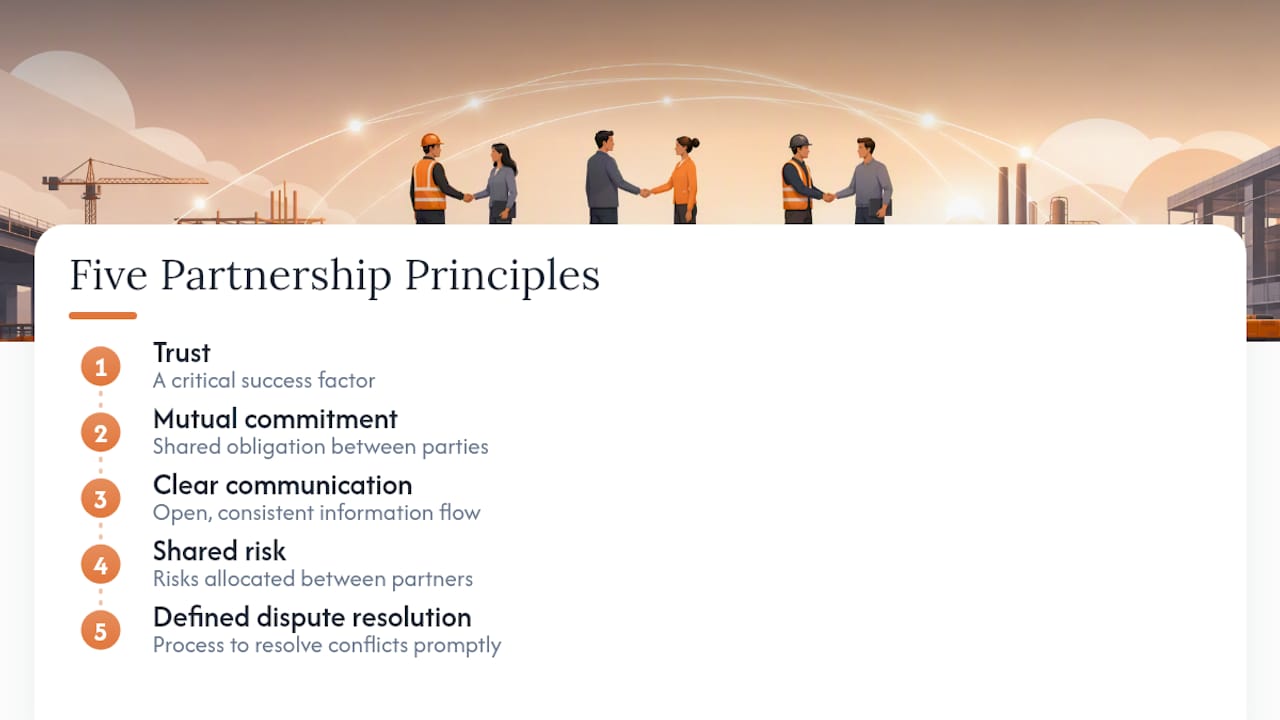
Trust, mutual commitment, clear communication, shared risk, and defined dispute resolution consistently show up as the critical success factors for construction supplier partnerships. Skipping any one of these tends to be where partnerships break down first.
What are the five types of supplier relationships?
Definitions vary across procurement frameworks, but a common version ranges from basic transactional buying, to ongoing approved-vendor status, to preferred supplier, to strategic alliance, and finally to full partnership with joint investment. The segmentation matrix earlier in this article reflects a simplified, construction-focused version of that spectrum.
How long does it take to build an effective supplier-contractor partnership?
Most contractors see early operational improvements, tighter cycle times and fewer emergency orders, within two to three months of launching a scorecard pilot, with full governance and framework agreements maturing over six to twelve months.
How does Constructconnect-rconstructionsolutions help with supplier partnerships?
Constructconnect-rconstructionsolutions connects AEC firms with pre-vetted subcontractors, suppliers, and equipment rental partners, reducing the upfront risk of onboarding an unproven vendor into your critical-item segment.

