
Replacing an Underperforming Subcontractor Mid-Project
What to do when a subcontractor is failing your project
Replacing an underperforming subcontractor mid-project is one of the most consequential decisions a general contractor can make. Get it right and you protect the schedule, the budget, and your relationship with the owner. Get it wrong and you face wrongful termination claims, surety disputes, and delays that compound faster than the original problem. The good news: a clear, documented process makes the difference between a controlled transition and a costly legal battle.
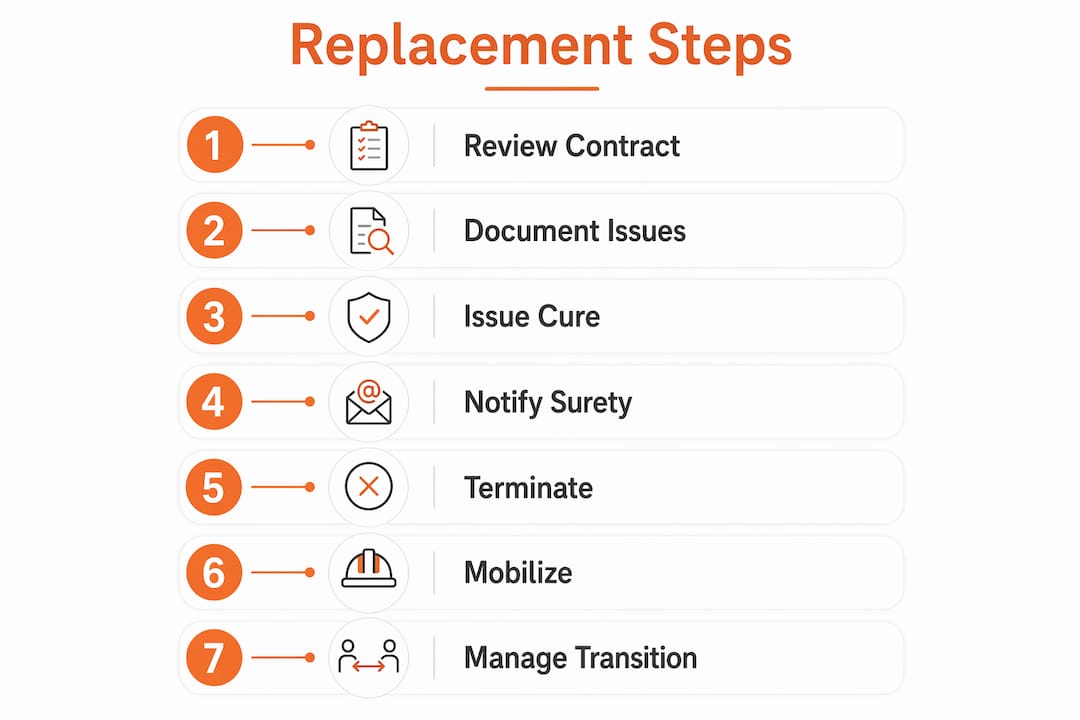
Subcontractor costs typically dominate hard costs in construction, so mismanagement at the trade level is one of the most direct paths to project failure. When a sub is falling short, here is the sequence that experienced GCs follow:
- Assess and document all performance failures in writing, with dated photos, daily reports, and inspection logs.
- Issue a formal cure notice per the subcontract, specifying deficiencies and a reasonable deadline for correction.
- Attempt supplementation before termination: add crew, redirect work, or issue joint checks to stabilize performance.
- Notify the surety immediately if the sub is bonded. Failure to do so can void your rights under the performance bond.
- Conduct a cost-to-complete audit to weigh replacement costs against forcing the current sub to finish under supervision.
- Formally terminate only after exhausting remediation options and following every contractual procedure to the letter.
- Mobilize a prequalified replacement quickly, keeping extra scope costs isolated from the terminated sub’s account.
- Communicate transparently with the owner, other trades, and your surety throughout the process.
Termination is serious business in construction. It can put a sub out of business, trigger litigation, and disrupt every trade that follows. That weight is exactly why the process above exists.
What contract clauses actually protect you when a sub underperforms
Your leverage in any subcontractor dispute lives or dies in the subcontract itself. Contracts drafted without the right provisions leave GCs exposed even when the sub’s failures are obvious and well-documented.
The two most powerful clauses are “time is of the essence” and flow-down provisions. “Time is of the essence” establishes that schedule deadlines are material contract terms, not suggestions. Flow-down clauses bind the subcontractor to every obligation in the prime contract, closing the gap between what you promised the owner and what the sub agreed to deliver. When a gap appears, the consequences, including termination and hiring a replacement at the sub’s expense, are already spelled out.
Beyond those two, a well-drafted subcontract should include:
- Detailed scope of work with bid leveling documentation to prevent “I didn’t know that was in my scope” disputes.
- Notice and cure period clauses that define exactly how many days a sub has to correct deficiencies after written notice.
- Termination for default rights that give the GC maximum discretion, including the right to hire a replacement at the sub’s expense.
- Supplementation rights allowing the GC to add crew or redirect work unilaterally and back-charge the sub.
- Insurance and indemnity requirements naming the GC as an additional insured and protecting against third-party claims.
- Performance and payment bond requirements for higher-risk scopes, providing a financial backstop if the sub defaults.
Many subcontractor conflicts that look like performance failures actually trace back to ambiguous scope documents. Clear, detailed contracts reduce those disputes before they start. If you are currently mid-project with a weak subcontract, document everything twice as carefully. Your contemporaneous records become your contract.
How to spot underperformance early and manage it before replacement becomes necessary
The best mid-project contractor switch is the one you never have to make. Catching problems at the two-week mark is far cheaper than catching them at the two-month mark. Structured performance monitoring is what separates GCs who manage issues from those who inherit crises.
Track subcontractor performance across three core dimensions: schedule adherence, cost performance, and quality and safety metrics. Daily reports, progress photos, routine inspections, and weekly look-ahead schedule reviews give you the data to identify drift before it becomes default. A sub who is consistently 10% behind on manpower commitments in week three will not magically recover in week eight without intervention.
When you see the warning signs, act on them immediately:
- Missed milestone dates or consistent failure to provide committed crew sizes.
- Repeated quality deficiencies requiring rework on already-completed scopes.
- Safety violations or failure to maintain OSHA compliance on site.
- Poor submittal and change-order responsiveness, including late pricing or incomplete backup.
- Communication breakdowns: unanswered RFIs, no-shows at coordination meetings, or directives ignored in writing.
Once you identify a problem, have a direct conversation first, then follow it with a written directive. That paper trail matters enormously if the situation escalates. Issue a formal cure notice if verbal correction fails, and document the sub’s response. A request by the sub for a meeting should be granted when time allows. Contemporaneous written notices and photo evidence are your best defense against a wrongful termination claim later.
One tactic worth considering before termination: supplementation. You can add crew to the sub’s scope, redirect discrete portions of work, or issue joint checks to their suppliers to stabilize cash flow. These steps keep the project moving while preserving your legal position. The PM’s role in subcontractor management includes knowing when to push harder and when to pull the trigger on a replacement.
Step-by-step process for replacing a subcontractor mid-project
When remediation has failed and termination is the only path forward, the process you follow determines whether you come out ahead or spend the next two years in arbitration. Every step must be deliberate, documented, and contractually grounded.
Review the contract before you act
Read the subcontract termination provisions in full before issuing any notices. Courts and arbitrators have overturned terminations because the GC skipped a procedural step, even when the sub’s failures were clear. If the notice period is five days and you can afford ten, give ten. Going beyond the minimum demonstrates good faith and strengthens your position.
Document, issue cure notice, and audit costs
Issue a formal written cure notice that identifies each specific deficiency, references the relevant contract clause, and sets a clear deadline. Simultaneously, conduct a cost-to-complete audit. Replacement mobilization plus the delay period often exceeds the cost of forcing the current sub to finish under strict supervision. That audit tells you which path is actually cheaper before you commit.

Notify the surety if the sub is bonded
If the defaulting sub carries a performance bond, notify the surety immediately. Advance payments or early release of retention to a bonded sub without surety consent can compromise your right to claim against the bond later. The surety has rights and obligations under the bond, and they need to be in the loop before you take any steps that could be characterized as overpayment.
Execute termination and mobilize a replacement
Once you have exhausted remediation options and the cure period has passed without adequate correction, issue the termination notice per the subcontract procedure. Then move fast. Leaving work incomplete compounds costs quickly. Pull from your prequalified subcontractor list and get a replacement on site as soon as possible. Specialized project recovery firms can rapidly assess scope gaps and plan re-mobilization when the situation is complex.
Manage the transition carefully
When onboarding the replacement sub, document the exact scope they are inheriting versus any extra scope added due to the termination. Any additional costs caused by the terminated sub’s failures should be tracked separately and charged back to that sub’s account, not absorbed into the replacement’s contract. Trade stacking, putting multiple crews into the same area to recover schedule, often creates safety hazards and lowers productivity for everyone on site. Sequence the recovery carefully.

Keep the owner, other trades, and your surety informed throughout. Transparent communication prevents rumors, reduces claims from adjacent trades, and demonstrates the good-faith management that protects you legally.
Expert insights and legal best practices for managing replacement risks
Experienced construction attorneys and project managers consistently reinforce one point: termination should be a last resort. Supplementation, work deletion, and negotiated resolution are almost always preferable to the disruption, liability, and litigation risk that follow a termination for default.
The legal considerations that most GCs underestimate include:
- Wrongful termination exposure: if you skip a procedural step or terminate without adequate documentation, the sub can flip the liability. Disputes and arbitration are highly probable after any termination for default.
- Warranty and long-term liability: when you terminate a sub and bring in a replacement, warranty responsibility for the completed work becomes a gray area. Address it explicitly in both the termination documentation and the replacement subcontract.
- Overlapping scope claims: the replacement sub will encounter conditions left by the terminated sub. Define the handoff scope precisely to prevent claims from the new sub for pre-existing deficiencies.
- Long-lead items and favorable purchase orders: the terminated sub may hold purchase orders or sub-subcontracts at favorable pricing. Losing those can add real cost to the replacement scope.
For bonded subs, the surety relationship adds another layer of complexity. The surety may want to support the sub’s performance rather than pay a completion claim. Understanding your rights under the bond, and getting surety consent before taking steps that could be characterized as overpayment, protects your claim.
Pro Tip: When issuing a cure notice, attach a detailed deficiency log with dated photos, specific contract clause references, and a written record of every prior verbal and written directive. That package becomes your claim file if the sub contests the termination.
The subcontractor substitution process involves more than swapping one trade for another. It requires managing overlapping warranties, re-sequencing affected trades, and updating the project schedule to reflect realistic recovery timelines. GCs who treat it as purely an administrative task tend to discover the legal and financial complications the hard way.
For urgent situations where you need a qualified replacement quickly, having access to a pre-vetted network is the difference between a two-week gap and a two-month one. Understanding insurance implications of supplementation before you act also prevents coverage gaps that can surface months later.
Constructconnect-rconstructionsolutions brings more than 30 years of AEC industry experience to exactly this kind of challenge, connecting GCs with pre-vetted subcontractors and suppliers when a mid-project replacement is unavoidable.

When a subcontractor replacement cannot wait, you need access to qualified trades immediately, not after a weeks-long search. Constructconnect-rconstructionsolutions specializes in AEC recruiting and sourcing for situations like this, with a pre-vetted network of subcontractors and a prorated placement model that means you only pay for successful results. Contact Constructconnect-rconstructionsolutions to find your replacement sub faster.
Key Takeaways
Replacing an underperforming subcontractor mid-project requires documented performance failures, strict adherence to contract procedures, surety notification for bonded subs, and rapid mobilization of a prequalified replacement to minimize delays and legal exposure.
| Point | Details |
|---|---|
| Document before you terminate | Contemporaneous written notices and dated photo evidence are your primary defense against wrongful termination claims. |
| Cure notice is mandatory | Issue a formal written cure notice per the subcontract before any termination, and give the sub the full notice period. |
| Notify the surety immediately | For bonded subs, failure to notify the surety promptly can void your rights under the performance bond. |
| Audit costs before deciding | A cost-to-complete audit often shows that forcing the current sub to finish under supervision is cheaper than replacement mobilization. |
| Isolate replacement costs | Track all extra costs caused by the terminated sub separately to support a credible back-charge claim. |
FAQ
How do you manage a subcontractor who is falling behind on schedule?
Issue a written directive immediately, document the specific delays with dated reports and photos, and require a written recovery plan from the sub. If performance does not improve, escalate to a formal cure notice per the subcontract.
Can you sue a contractor for poor quality work?
Yes. A GC can pursue claims against a subcontractor for defective work, delays, and resulting costs, but the strength of that claim depends heavily on how well the GC documented the deficiencies and followed the subcontract’s notice and cure procedures.
What are the clearest red flags that a subcontractor needs to be replaced?
Consistent missed milestones, repeated quality failures requiring rework, safety violations, failure to maintain committed crew sizes, and non-responsiveness to written directives are the most reliable indicators that remediation has failed and replacement should be considered.
How do you handle a bonded subcontractor default?
Notify the surety in writing immediately upon identifying a potential default. Do not release retention or make advance payments to the bonded sub without surety consent, as doing so can compromise your right to claim against the performance bond later.
What is the biggest mistake GCs make when replacing a subcontractor mid-project?
Skipping or shortcutting the contractual notice and cure procedures. Terminations are frequently overturned in arbitration because the GC failed to follow the prescribed steps, even when the sub’s failures were well-documented and undeniable.

