
How to Partner With General Contractors on Staffing and Sourcing
Partner with a specialized AEC recruiting and sourcing firm, and expect a vetted candidate shortlist or subcontractor match within the vendor’s stated first delivery window, typically 5 to 10 business days for office and management roles. R. Construction Solutions is a ready option, built specifically around this kind of engagement for general contractors and construction managers who need reliable people and reliable suppliers without adding headcount to their own HR function.
Before you sign anything, request three things from any prospective partner:
- A sample candidate shortlist or subcontractor match relevant to your current project type
- A written placement timeline broken out by role category (field versus office)
- Fee terms in writing, including whether they use a prorated or flat contingency structure
TL;DR:
- Specialized staffing firms typically deliver vetted candidate or subcontractor matches within 5 to 10 business days, significantly faster than internal HR processes.
- Pre-vetted subcontractors and suppliers reduce the risk of schedule delays caused by underqualified or unreliable partners on construction projects.
- Always obtain written details on fee terms, including contingency percentage, prorated payment schedule, and replacement guarantees before signing any agreement.
- Sharing project pipeline and role specifications early with your staffing partner improves placement speed and ensures candidates are prepared before urgent needs arise.
- R. Construction Solutions offers over 30 years of industry experience, a prorated fee structure, and a network of vetted subcontractors to align incentives and reduce project risks.
Table of Contents
- Why Partner With General Contractors’ Sourcing Teams Instead of Hiring Alone?
- What Questions Should You Ask Before Signing a Contractor Partnership Agreement?
- What Happens in the First 60 to 90 Days of a Partnership?
- Publisher Credentials: What R. Construction Solutions Brings to the Table
- What Makes a General Contractor a Good Long-Term Partner?
- What Red Flags Should You Watch for When Vetting a Contractor?
- How Do You Build a Lasting Contractor Partnership Over Time?
- A Note From Rowena on What Real Partnership Looks Like
- Ready to Start a Pilot Engagement?
- Key Takeaways
- Sources
- FAQ
Why Partner With General Contractors’ Sourcing Teams Instead of Hiring Alone?
The math on this is straightforward once you separate speed, risk, and cost into their own columns.
Speed comes first. Specialized construction staffing firms commonly present vetted shortlists within 5 to 10 business days for many office and management roles, with field roles varying more by local labor market depth. Compare that to the six to eight weeks a general contractor’s internal HR team often needs to source, screen, and reference-check a project engineer or superintendent candidate on its own, and the case for outside sourcing writes itself.
Risk reduction is the second lever, and it’s the one that gets underweighted in vendor conversations. A recruiting and sourcing partner that maintains a bench of pre-vetted subcontractors and suppliers reduces the odds of a schedule blowup caused by a subcontractor who underbid the job and can’t staff it, or a supplier who can’t hit a delivery date. That’s a project-quality issue as much as a hiring issue.
Operationally, a good partner absorbs work you’d rather not do in-house:
- Serving as employer-of-record for temporary field staff, handling payroll, workers’ comp, and tax filings
- Running background checks and confirming certifications like OSHA 30 before a worker sets foot on site
- Managing reference checks against actual trade experience, not just resume claims
- Coordinating both engineering/PM roles and skilled trades through a single point of coordination, which cuts down on duplicate outreach to the same labor pool
Pro Tip: Ask any vendor what percentage of their placements are prorated versus flat-fee contingency. A prorated structure, billed over the candidate’s first 90 days, means you stop paying if the hire doesn’t last, which shifts risk back onto the vendor instead of onto you.
What Questions Should You Ask Before Signing a Contractor Partnership Agreement?
Vendor calls tend to run long on rapport and short on substance. Use a short list of pointed questions to keep the conversation productive and comparable across every firm you’re evaluating.
- What’s your coverage? Ask specifically whether they place both office roles (project engineers, estimators, PMs) and field roles (superintendents, foremen, skilled trades), or just one category.
- How do you vet candidates? Push for specifics: what certifications get verified, whether OSHA documentation is confirmed before placement, and how many trade references get called per candidate.
- What are your performance numbers? Ask for average time-to-shortlist by role type and whether they offer a replacement guarantee if a placement doesn’t work out within a set window.
- What delivery models do you support? Temp, temp-to-hire, direct hire, and subcontractor sourcing are different products with different fee structures. Confirm they can flex across all of them, and ask how they handle union compliance if your projects are covered by a collective bargaining agreement.
- What are the exact commercial terms? Get contingency percentage, prorated schedule, and refund or replacement windows in writing before you sign anything.
A firm that hedges on any of these five, especially the vetting question, is telling you something about how thin their bench actually is. For deeper background on how contingency fee structures typically work in this industry, a hiring manager’s guide to contingency recruiting is worth reviewing before your first call.
What Happens in the First 60 to 90 Days of a Partnership?
Signing an agreement is the easy part. What separates a productive partnership from a frustrating one is what happens in the first quarter of working together.
- Intake and pipeline sharing. Hand the vendor your actual role specs, pay ranges, site locations, and safety requirements, along with a rough forecast of upcoming project wins. Sharing your project pipeline instead of waiting until a role is urgent lets the recruiter prioritize your requisitions and have candidates ready before you’re desperate.
- First shortlists arrive on a predictable cadence. Office and management roles typically move faster than specialized field crews, since certain trades are thinner in some regional markets.
- Onboarding gets coordinated, not improvised. Documentation, site safety orientation, and badge or site-access coordination should be mapped out before day one, not scrambled together the morning a new hire shows up.
- A single point of contact manages the relationship. You should not be bouncing between three different account reps depending on the week.
What to expect week to week:
- A weekly or biweekly check-in call, minimum, during active sourcing periods
- A named escalation contact for problems that can’t wait for the next scheduled call
- A documented process for handling replacements if a placement doesn’t work out
- A framework for scaling the relationship across multiple simultaneous projects, not just a single job order
Good subcontractor onboarding practices matter just as much as candidate onboarding. Structured onboarding for subcontractors reduces the odds of a trade partner showing up unprepared for your site’s specific safety and documentation requirements.
Publisher Credentials: What R. Construction Solutions Brings to the Table
Credentials matter in this business because you’re trusting a vendor with something expensive: your schedule.
R. Construction Solutions brings more than 30 years of AEC recruiting and sourcing experience to client engagements, spanning office staff placement, field personnel, and subcontractor and supplier connections. That tenure matters less as a marketing line and more as a practical signal: three decades in this specific industry means a working knowledge of which trades run thin in which regions and which certifications actually matter for which roles.
The firm’s fee model is built around a prorated structure with lower commission rates than many competitors, meaning fees track the placement’s actual first 90 days rather than landing as one lump sum the day someone starts. Combine that with active sourcing of pre-vetted subcontractors and suppliers, and the value proposition is aligned incentive: the firm gets paid for successful, lasting placements, not just warm bodies filling seats.
- 30+ years of AEC-specific recruiting and sourcing experience
- Prorated payment structure tied to successful, lasting placements
- Pre-vetted subcontractor and supplier network built to reduce delay and safety risk
- [Client case studies and outcome data: available on request]
- [Author and team credentials: available on request]
Fee structures that only reward a warm body on day one create the wrong incentive. A prorated model rewards placements that actually stick, which is the outcome contractors are paying for in the first place.
What Makes a General Contractor a Good Long-Term Partner?
Choosing which general contractor or construction management partner to work alongside deserves the same rigor you’d apply to picking a staffing vendor.
Start with financial stability. A contractor’s bonding capacity and payment history with subcontractors tell you more about long-term viability than their marketing materials ever will. Ask for references from subcontractors who’ve worked with them across multiple projects, not just one job.
Look at their project pipeline consistency. A general contractor with a steady, forecastable flow of work is easier to build a staffing or sourcing relationship around than one whose project volume swings wildly month to month. Consistency lets you and your recruiting partner plan sourcing cadence instead of reacting to emergencies.

Evaluate communication style during the sales process itself. If a general contractor is vague about scope, timeline, or safety expectations before you’ve even signed anything, that vagueness tends to persist once the project starts. Contractors who share detailed specs and realistic schedules upfront are typically the ones who run organized, well-staffed sites.
Finally, check their track record on safety and subcontractor treatment. A contractor with a poor OSHA record or a reputation for slow-paying subcontractors will cost you in ways that don’t show up until you’re already committed to the job.
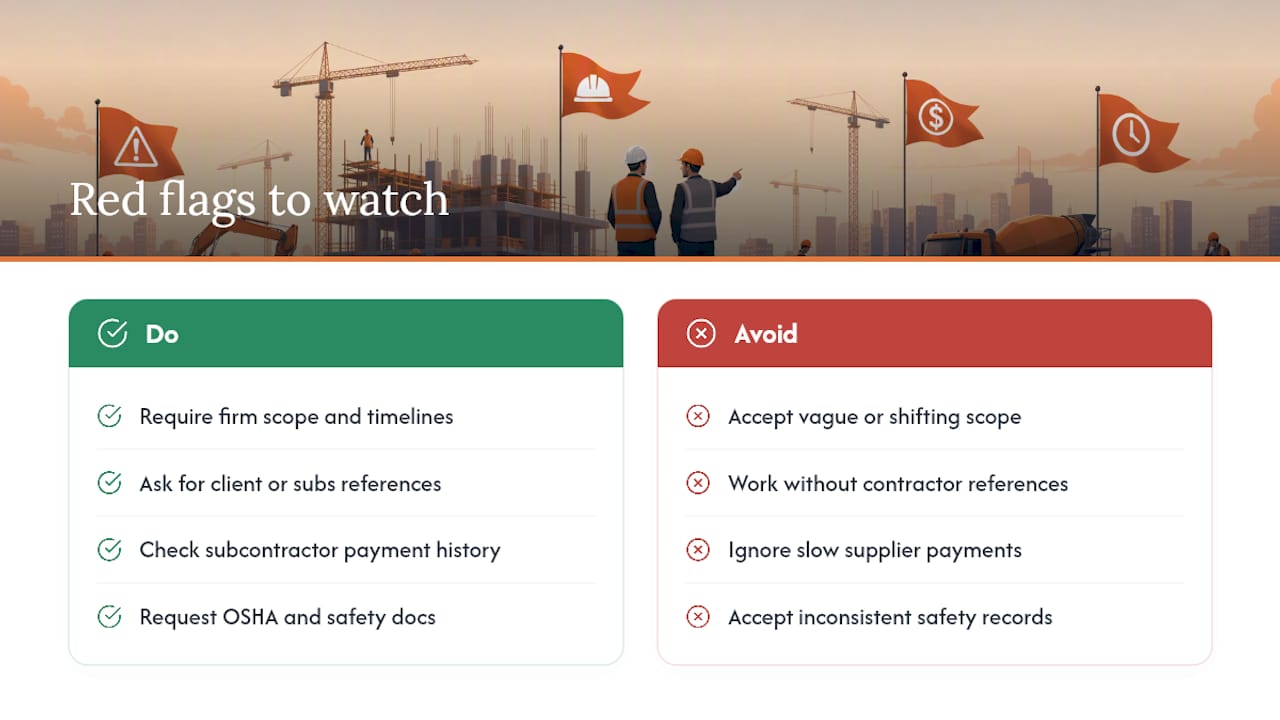
What Red Flags Should You Watch for When Vetting a Contractor?
Certain warning signs show up consistently before a partnership goes wrong, and most of them are visible before you sign anything.
Vague or shifting scope during negotiations is the first one. A contractor who can’t give you firm role specs, site requirements, or timelines during intake conversations usually can’t give you firm answers once work starts either.
Reluctance to provide references is another. Any established general contractor should be able to connect you with subcontractors or staffing partners they’ve worked with previously. Hesitation here often means the references wouldn’t be flattering.
Watch for payment history problems. Slow payment to subcontractors and suppliers is one of the most reliable predictors of project trouble, since it usually means the contractor’s own cash flow or bonding is stretched thin.
Inconsistent safety documentation is a serious flag. If a contractor can’t produce clean OSHA records or seems dismissive about site safety orientation requirements, that attitude tends to show up in how they treat every subcontractor and worker on site.
Finally, be cautious with contractors who resist a single point of contact structure. A general contractor who routes every communication through a rotating cast of project staff, with no clear escalation path, makes it much harder to solve problems quickly when something goes wrong mid-project.
How Do You Build a Lasting Contractor Partnership Over Time?
The partnerships that last past a single project share a few habits, and none of them are complicated.
Communicate proactively, not reactively. Share upcoming bids and project pipeline forecasts with your staffing or sourcing partner before you’re desperate for a hire. This single habit does more to improve placement speed and quality than any contract clause.
Give feedback on placements, both good and bad. A recruiting partner who never hears which hires worked out and which didn’t has no way to sharpen their vetting process for your specific needs over time.
Keep commercial terms fair on both sides. Contingency and prorated fee structures work because they align incentives. Nickel-and-diming a partner on fees while expecting premium candidate quality is a fast way to end up at the bottom of their priority list.
Treat the relationship as multi-project, not single-transaction. Contractors who go back to the same trusted sourcing partner across several projects build institutional knowledge that speeds up every subsequent engagement. The outsourced recruiting model works best when treated as an extension of your own team, not a one-off vendor transaction.
A Note From Rowena on What Real Partnership Looks Like
The partnerships I see work best aren’t the ones with the tightest contract language. They’re the ones where the contractor picks up the phone before a role is urgent, and the recruiting partner treats that early call as a priority instead of a nuisance.
Prorated and contingency fee structures matter here because they force alignment: the vendor only gets paid when the placement actually sticks, so their incentive matches yours. I’d also add that the imagery and materials representing this industry should reflect who’s actually doing the work today, a workforce that’s far more diverse in race and gender than older stock photography suggests, and our client-facing materials should show that honestly.
— Rowena
Ready to Start a Pilot Engagement?
If you’re evaluating options beyond building an internal recruiting function or relying on general staffing agencies that don’t specialize in AEC roles, a focused pilot is the lowest-friction way to test fit. R. Construction Solutions offers a prorated fee structure with lower commission rates than many competitors, meaning you pay based on placement success over the first 90 days rather than a flat fee upfront regardless of outcome.
To start, prepare a short intake packet: your open role specs or subcontractor needs, target pay ranges, site locations and safety requirements, and a rough forecast of upcoming project wins. From there, expect a sample candidate shortlist or supplier match within the vendor’s stated delivery window, followed by an onboarding plan covering documentation and site access. Visit the recruiting services page to review service details and request an intake call.
Key Takeaways
Partnering with a specialized AEC recruiting and sourcing firm reduces time-to-fill, project schedule risk, and upfront cost exposure through prorated fee structures tied to placement success.
| Point | Details |
|---|---|
| Speed to shortlist | Expect vetted candidates for office and management roles within 5 to 10 business days from a specialized vendor. |
| Vetting reduces risk | Pre-vetted subcontractors and suppliers cut the odds of schedule delays caused by underqualified trade partners. |
| Ask for terms in writing | Confirm contingency percentage, prorated schedule, and replacement guarantees before signing any agreement. |
| Share your pipeline early | Proactive communication about upcoming project wins lets a partner prioritize your requisitions ahead of urgent need. |
| R. Construction Solutions option | Offers 30+ years of AEC-specific experience, a prorated payment structure, and pre-vetted subcontractor and supplier connections. |
FAQ
What Does It Mean to Partner With General Contractors on Staffing?
It means engaging a specialized recruiting and sourcing firm that finds, vets, and places office staff, field personnel, subcontractors, and suppliers on behalf of a general contractor or construction manager.
How Long Does It Take to Get a Candidate Shortlist?
Specialized construction staffing partners commonly deliver vetted shortlists for office and management roles within 5 to 10 business days, though field roles can vary by local labor market depth.
What Fee Structures Are Common in Contractor Partnership Agreements?
Contingency fees paid on successful placement and prorated structures billed over the new hire’s first 90 days are the two most common models, with prorated terms reducing upfront cost risk for the contractor.
What Should I Ask a Recruiting Partner Before Signing?
Ask about role coverage, vetting and certification processes, time-to-shortlist metrics, replacement guarantees, and exact commercial terms including contingency percentage and refund windows.
Does R. Construction Solutions Handle Both Office and Field Roles?
Yes, R. Construction Solutions places office staff, field personnel, and connects clients with pre-vetted subcontractors and suppliers under a single prorated fee structure.