
The Role of Outsourced Recruiting Contractors in Construction
Outsourced recruiting contractors are external staffing specialists hired to source, screen, and place construction talent without the overhead of a permanent internal recruiter. In the Architecture, Engineering, and Construction (AEC) industry, this practice falls under the broader category of Recruitment Process Outsourcing (RPO), a model where a third party manages part or all of a company’s hiring function. Construction hiring managers face a persistent challenge: project demand spikes unpredictably, skilled trades and project engineers are scarce, and a 44-day average time-to-fill for permanent roles can derail schedules before a single nail is driven. The role of outsourced recruiting contractors is to close that gap with speed, specialization, and cost discipline.
What recruitment models do outsourced recruiting contractors use in construction?
Three primary models define how construction firms engage external recruiting support. Each suits a different project scale, budget, and level of internal HR capacity.
Full RPO transfers the entire recruitment function to an external provider. The provider operates under your brand, uses your applicant tracking system (ATS), and takes shared accountability for hiring outcomes. RPO contracts in construction typically span 2–5 years. This model fits large general contractors running multi-year infrastructure programs who need consistent, high-volume hiring across multiple trades and disciplines.
Modular RPO outsources specific steps in the hiring process. You might retain candidate selection internally while the contractor handles sourcing, screening, and OSHA 30 certification verification. This model gives your HR team control over final decisions while freeing them from time-intensive sourcing work. It works well for mid-size firms with an established HR function that needs targeted support during project ramp-ups.

On-demand recruiting is the most flexible option. Providers deploy embedded recruiters for a defined period, often with a minimum 3-month commitment. Construction firms use this model to scale capacity during bid-award cycles without committing to a long-term contract. It also serves as a low-risk entry point before moving to full RPO.
Here is how the three models compare across key decision factors:
| Factor | Full RPO | Modular RPO | On-demand recruiting |
|---|---|---|---|
| Contract length | 2–5 years | 6–18 months | 3+ months |
| Scope | End-to-end hiring | Selected process steps | Embedded recruiter capacity |
| Best fit | Large GCs, multi-year programs | Mid-size firms, targeted gaps | Project-cycle surges, pilot testing |
| Internal HR control | Shared | High | High |
| Cost structure | Fixed + performance fees | Per-module pricing | Hourly or monthly retainer |
The right model depends on your project pipeline, not on which option sounds most comprehensive. A superintendent-heavy infrastructure project calls for a different approach than a commercial fit-out requiring a surge of ProCore-experienced project managers.
How do outsourced recruiting contractors deliver cost and time efficiencies?
The financial case for outsourcing construction recruitment is direct. Savings per role can reach $100,000 annually when you factor out fixed benefits, payroll taxes, workers’ compensation, and overhead costs associated with full-time employees. That figure represents real budget that can be redirected to equipment, safety programs, or project contingency.
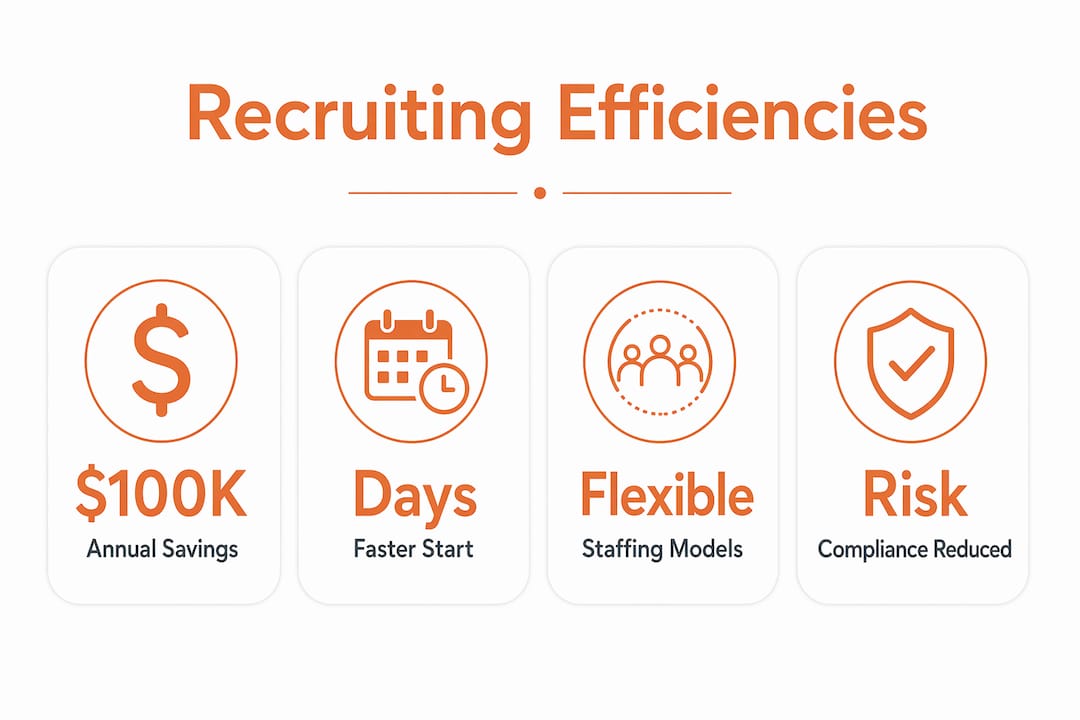
Time savings are equally significant. Contractors placed through outsourced recruiting can start within days compared to the 44-day average time-to-fill for permanent hires. On a fast-track commercial project, a three-week delay in filling a site superintendent role can cascade into schedule overruns that cost far more than the recruiter’s fee.
Outsourced recruiting also removes the fixed cost of maintaining a full internal recruiting team during slow periods. Construction demand is cyclical. Carrying three full-time recruiters through a low-bid quarter is expensive. An on-demand or modular RPO model lets you scale recruiting capacity up or down with your project load.
Pro Tip: Track your internal cost-per-hire before engaging an outsourced partner. That baseline number lets you measure actual savings and gives you a negotiating anchor when discussing fee structures.
The most resilient staffing strategies combine internal control with outsourced elasticity. Your internal HR team handles culture, compliance oversight, and onboarding. The outsourced contractor handles sourcing-intensive tasks that would otherwise consume your team’s capacity during peak demand.
How can construction leaders integrate outsourced recruiters with internal teams?
Integration is where most outsourced recruiting engagements succeed or fail. The goal is to treat your outsourced recruiter as an extension of your HR function, not as a vendor operating in a separate lane.
RPO providers work most effectively when they operate under the client’s brand and use the client’s ATS. This means your outsourced recruiter should have access to your job templates, your screening criteria for roles like OSHA 30-certified foremen or Procore-experienced project engineers, and your hiring manager contacts. Consistency in how candidates experience your brand matters, especially in a tight labor market where top talent evaluates employers carefully.
Follow these steps to set up a productive integration:
- Define role profiles before the engagement starts. Give your outsourced recruiter detailed job descriptions that include certifications required (OSHA 10, OSHA 30), software proficiencies (Procore, Bluebeam), and project-specific experience. Vague briefs produce mismatched candidates.
- Assign a single internal point of contact. A hiring manager or HR lead who responds to recruiter questions within 24 hours keeps the pipeline moving. Slow feedback is the most common reason outsourced recruiting engagements underperform.
- Share your ATS access and workflows. Outsourced recruiters who log candidates directly into your system create a searchable talent pool you retain after the engagement ends.
- Set weekly check-ins with clear metrics. Track candidates submitted, interviews scheduled, offers extended, and time-to-fill by role. Review these numbers weekly, not monthly.
- Communicate project priorities explicitly. If a project is moving to the concrete phase and you need five ironworkers in three weeks, say that directly. Outsourced recruiters perform better with deadline-driven context.
Pro Tip: Brief your outsourced recruiter on your company’s safety culture and any site-specific requirements before they begin sourcing. Candidates who arrive unprepared for your safety standards create onboarding friction that slows productivity.
Effective resource flexibility in construction hiring depends on clear communication channels between your project managers, HR team, and outsourced recruiting partner. When those three groups align on priorities, hiring timelines compress significantly.
What are common challenges when using outsourced recruiting contractors?
Compliance risk is the most serious pitfall. Construction firms that engage outsourced recruiting partners without vetting their compliance capabilities expose themselves to worker misclassification issues, prevailing wage violations, and procurement rule breaches. Providers must navigate procurement rules and Vendor Management System (VMS) workflows to keep engagements compliant. A recruiter unfamiliar with VMS platforms like Beeline or SAP Fieldglass can create billing and classification errors that trigger audits.
Onboarding gaps are the second most common failure point. Poor onboarding and weak communication reduce contractor productivity and engagement. When a placed candidate arrives on site without clear goals, a defined supervisor, or access to project documentation, their output drops immediately and their tenure shortens.
Knowledge retention is a subtler risk. When a long-term outsourced engagement ends, institutional knowledge about your candidate pipeline, preferred sourcing channels, and hiring manager preferences can walk out the door. Mitigate this by requiring your outsourced recruiter to document all sourcing activity in your ATS throughout the engagement.
“Contract hiring is best seen as a strategic complement to permanent staff, filling specialized expertise gaps without long-term risk. The firms that treat outsourced recruiters as temporary vendors rather than embedded partners consistently see lower placement quality and higher turnover among placed candidates.”
Selecting a partner who understands AEC recruiting specifically matters more than selecting the largest generalist staffing firm. A recruiter who does not know the difference between a superintendent and a project executive will waste your time screening the wrong candidates.
What steps should construction hiring managers follow to select outsourced recruiting contractors?
Choosing the wrong partner costs more than the recruiter’s fee. A structured evaluation process protects your hiring budget and your project schedule.
- Verify AEC industry experience first. Ask for a list of construction roles filled in the past 12 months. A partner who has placed OSHA 30-certified superintendents, licensed civil engineers, and Procore-trained project managers has the network you need.
- Assess compliance capabilities. Confirm the partner can operate within your VMS, handle prevailing wage documentation, and correctly classify workers as W-2 contractors or 1099 independents based on your engagement structure.
- Start with an on-demand pilot. Starting with on-demand recruiting before committing to full RPO lets you evaluate the partner’s sourcing quality, communication speed, and cultural fit without a multi-year contract.
- Audit your internal data before signing. Failing to audit internal recruitment data before engaging long-term RPO leads to poor outcomes. Know your current time-to-fill, cost-per-hire, and source-of-hire data before you hand over the function.
- Set performance targets in the contract. Define acceptable time-to-fill by role category, minimum candidate quality standards, and a replacement guarantee period. Constructconnect-rconstructionsolutions uses a prorated 90-day model that ensures clients only pay for successful placements.
The evaluation criteria that matter most in construction recruiting partner selection:
| Criterion | What to look for |
|---|---|
| AEC specialization | Roles filled in construction, engineering, and architecture in the past year |
| Compliance capability | VMS experience, worker classification knowledge, prevailing wage familiarity |
| Contract flexibility | On-demand, modular, and full RPO options available |
| Technology integration | ATS compatibility, reporting dashboards, candidate documentation practices |
| Fee structure | Performance-based fees, prorated guarantees, transparent billing |
Staffing agencies in construction that specialize in the AEC sector bring pre-vetted candidate networks that generalist firms cannot match. That network depth is the single biggest differentiator when you need a licensed structural engineer or a certified safety officer within two weeks.
Key Takeaways
Outsourced recruiting contractors deliver the most value in construction when firms treat them as embedded partners with clear briefs, ATS access, and defined performance targets.
| Point | Details |
|---|---|
| Model selection matters | Match the RPO model (full, modular, or on-demand) to your project cycle and HR capacity. |
| Cost savings are real | Outsourced contractors can reduce per-role costs by up to $100,000 annually versus full-time hires. |
| Speed closes schedule gaps | Contractors can start within days, versus a 44-day average fill time for permanent roles. |
| Integration drives quality | Embed outsourced recruiters in your ATS and brief them on certifications, culture, and project priorities. |
| Compliance vetting is non-negotiable | Confirm your partner understands VMS workflows and worker classification before signing any agreement. |
What I’ve learned from watching construction firms get outsourced recruiting wrong
Most construction leaders I’ve worked with approach outsourced recruiting the same way they approach equipment rental: find the lowest rate, sign the shortest term, and swap providers if it doesn’t work out. That mindset produces exactly the outcomes you’d expect. Placed candidates who don’t understand your safety culture. Recruiters who can’t tell a civil superintendent from a construction manager. Compliance gaps that surface six months after the engagement ends.
The firms that get this right treat their outsourced recruiting partner the same way they treat a trusted subcontractor. They invest time upfront in the brief. They share project context, not just job descriptions. They give the recruiter access to the people and systems needed to do the job well.
I’ve also seen firms skip the pilot phase entirely and commit to a multi-year RPO contract before they’ve audited their own hiring data. That is a predictable way to overpay for mediocre results. Start with on-demand recruiting for one project cycle. Measure the output. Then decide whether a longer engagement makes sense.
The construction industry has a labor shortage that is not going away. The firms that build a repeatable, well-integrated outsourced recruiting function now will have a structural advantage in project delivery for years. The ones that treat it as a one-off fix will keep having the same staffing conversations every bid season.
— Rowena
Recruiting solutions built for AEC hiring demands
Construction projects don’t wait for slow hiring processes. Constructconnect-rconstructionsolutions brings 30+ years of AEC industry experience to every search, connecting firms with pre-vetted candidates across project engineering, site supervision, and specialty trades.
Whether you need an embedded recruiter for a single project cycle or a structured RPO arrangement for a multi-year program, Constructconnect-rconstructionsolutions offers AEC recruiting services built around your project timeline and budget. The prorated 90-day placement model means you pay only for successful hires. Reach out to discuss how a tailored contract staffing solution can reduce your time-to-fill and keep your projects on schedule.
FAQ
What is the role of outsourced recruiting contractors in construction?
Outsourced recruiting contractors source, screen, and place specialized construction talent on behalf of a firm, operating as an extension of the internal HR team. They reduce time-to-fill, lower per-hire costs, and provide flexible capacity aligned with project cycles.
How long do RPO contracts typically last in construction?
RPO contracts in construction typically span 2–5 years, though on-demand models can begin with a minimum 3-month commitment for firms that prefer a shorter trial period.
What roles do outsourced construction recruiters typically fill?
Outsourced AEC recruiters fill roles ranging from OSHA 30-certified superintendents and licensed project engineers to Procore-experienced project managers and specialty trade supervisors. The best partners maintain active networks in these specific disciplines.
How do I reduce compliance risk when using outsourced recruiting contractors?
Vet your recruiting partner’s ability to handle VMS workflows, worker classification, and prevailing wage documentation before signing. Compliance risk rises when partners lack experience with construction procurement rules and vendor management systems.
Should I start with on-demand recruiting or full RPO?
Start with on-demand recruiting to evaluate sourcing quality and cultural fit before committing to a long-term RPO agreement. Many firms begin with an embedded recruiter model and transition to full RPO once processes and organizational knowledge are aligned.