
Role of Staffing Agencies in Construction Projects
Most construction managers think of staffing agencies as a source of warm bodies for short-term gaps. That framing costs you money, time, and project quality. The actual role of staffing agency in construction goes well beyond temporary labor supply. Done right, an agency partnership functions as an extension of your workforce strategy: sourcing pre-vetted candidates, managing employer-of-record compliance, and giving you the flexibility to scale labor precisely when project phases demand it. This guide will show you what that looks like in practice, and how to get the most from it.
Table of Contents
- Key takeaways
- The core role of staffing agencies in construction
- Strategic workforce planning: beyond the labor bench
- Agency versus internal hiring: a direct comparison
- How to build an effective agency partnership
- My take on what agencies really offer
- Build your project team with the right staffing partner
- FAQ
Key takeaways
| Point | Details |
|---|---|
| Agencies reduce hiring timelines | Vetted candidates for critical construction roles arrive in 7 to 14 business days, faster than internal HR can source them. |
| Compliance burden shifts to the agency | Workers’ compensation, I-9 verification, drug screening, and certification tracking are handled by the agency as employer of record. |
| Strategic value starts in preconstruction | Agency-supplied tradespeople can challenge designs and flag buildability issues before construction begins, saving costly redesigns. |
| Contract types match project risk | Temporary, contract-to-hire, and direct hire arrangements let you align staffing commitments with project phases and budget tolerance. |
| Single-agency partnerships outperform multi-agency | Exclusive agency relationships produce higher candidate fit for critical roles than splitting the search across multiple firms. |
The core role of staffing agencies in construction
The industry term for what construction staffing agencies deliver is “workforce solutions,” and it covers considerably more than most contractors realize. At its simplest, an agency maintains a ready pool of pre-vetted, skilled workers across trades and professional roles. At its most strategic, it acts as your labor market intelligence source, compliance manager, and workforce planning partner.
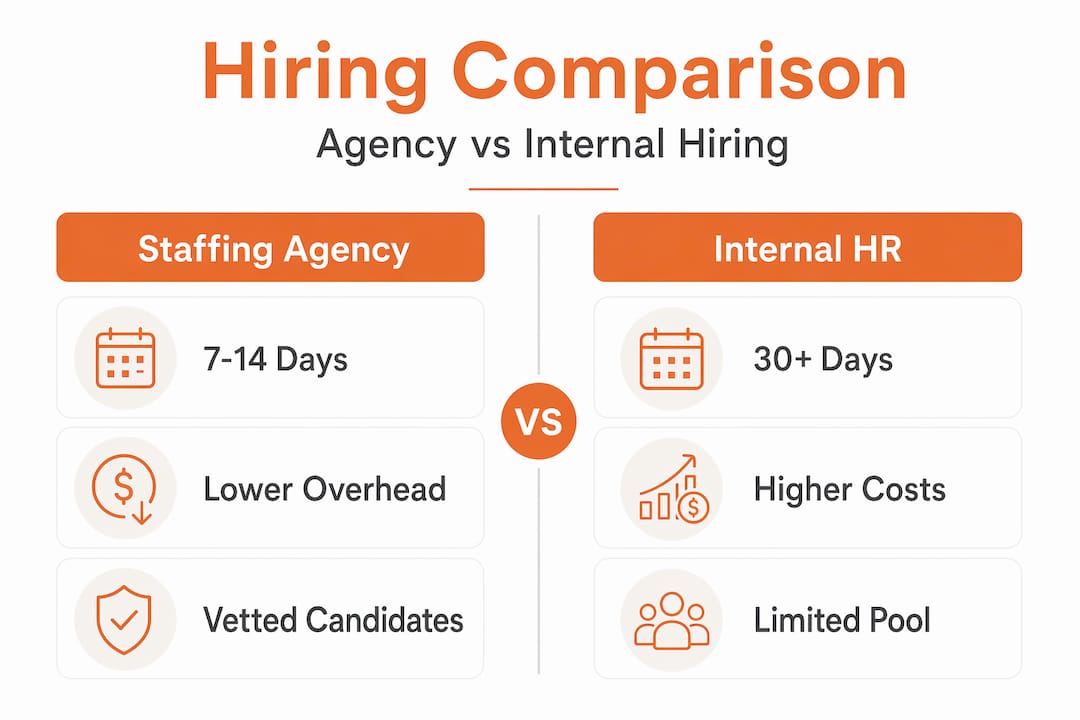
Speed is the first practical advantage. Staffing agencies deliver vetted candidates for critical construction roles within 7 to 14 business days. Your internal HR team, working from a standing start with job boards and resume screens, rarely matches that pace. On a commercial build where a superintendent vacancy stalls an entire subcontractor chain, two weeks of delay has a direct dollar value.
Beyond speed, the core functions agencies provide include:
- Pre-screened labor pools: Agencies maintain relationships with journeymen electricians, ironworkers, pipe fitters, project managers, and estimators, all with documented certifications and work history verified before you ever see a resume.
- Employer-of-record services: Agencies handle compliance burdens including workers’ compensation coverage, I-9 verification, drug screening, and OSHA 30 certification tracking, removing that exposure from your books entirely.
- Payroll and administrative offloading: The paperwork burden of onboarding temporary workers, managing weekly payroll, and processing terminations falls on the agency, not your project management office.
- Flexible contract structures: Most agencies offer three engagement types. Temporary placements fill short-term surge demand. Contract-to-hire arrangements let you evaluate fit before committing to a permanent offer, reducing bad hire risk. Direct hire is appropriate when you need to build permanent team capacity.
Pro Tip: When evaluating construction staffing services, ask the agency what percentage of their placed candidates hold active OSHA 30 certifications and ProCore experience. Agencies that track this data have built real quality controls. Those that cannot answer have not.
Construction employment rises with nonresidential hiring in 2026, and average pay for construction workers has climbed 20.2% above the private sector average. That wage pressure makes fast, accurate placement more important than ever. Agencies that understand the local labor market can locate the right superintendent or project engineer at current market rates, without the trial-and-error of an unguided internal search.
Strategic workforce planning: beyond the labor bench
The strongest construction teams use agencies as force multipliers for internal HR, not as substitutes. HR departments that partner with staffing agencies free their internal staff to focus on retention, culture, and long-range workforce planning, while the agency handles the high-volume, time-consuming sourcing work.
Here is how that plays out across the project lifecycle:
- Preconstruction involvement: Agencies that specialize in construction labor recruitment can place experienced tradespeople during the design and estimating phase. Tradespeople involved early in preconstruction help challenge designs and flag AI-generated estimates that miss real-world buildability constraints. That feedback loop prevents costly redesigns downstream.
- Peak demand surge coverage: When a project accelerates or a subcontractor falls short, you need workers within days, not weeks. Agencies with deep local benches handle that surge without you burning internal HR bandwidth on emergency sourcing.
- Workforce analytics and advisory input: Successful staffing agencies evolve from transactional recruiters to advisory partners, using AI-driven workforce analytics to forecast labor gaps before they become project risks. That is genuinely useful for multi-phase projects spanning 18 to 36 months.
- Retention support through benefits collaboration: 40% of craft workers are 45 or older, and the skilled trades workforce is aging faster than apprenticeship programs can replace it. Forward-thinking agencies work with contractors to structure flexible financial benefits that improve retention. An employee who stays through project completion is worth far more than one you recruited twice.
“Staffing agencies are not simply labor suppliers but strategic partners who strengthen workforce planning and flexibility in construction projects.” — Why HR Departments Partner with Staffing Agencies
The agencies worth working with are not just running searches. They are studying your project pipeline, understanding your superintendent’s management style, and bringing you candidates who will actually stay through punch list. That requires industry depth and the willingness to learn your business. To understand more about why AEC recruiting is being outsourced, the reasons have grown more compelling alongside the labor market pressures of 2026.
Agency versus internal hiring: a direct comparison
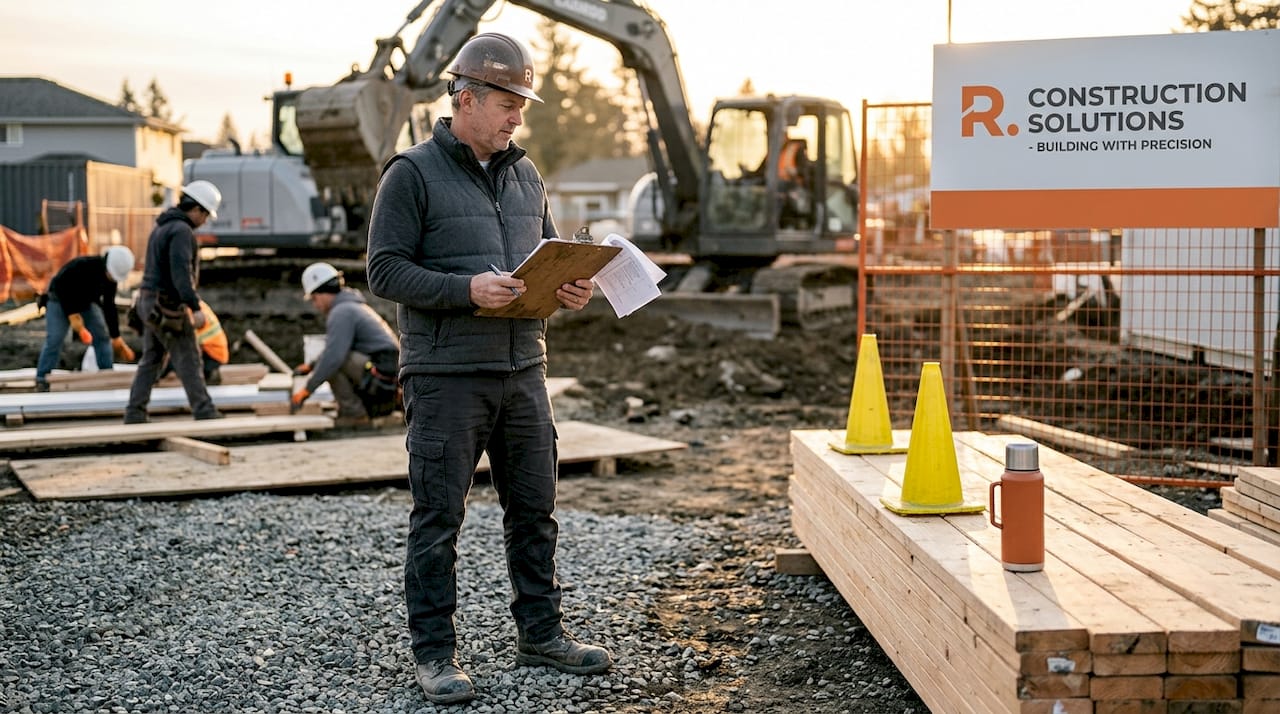
When you weigh construction staffing services against building an internal HR function, the comparison is not purely about cost. It is about capability, speed, and risk tolerance at specific project stages.
| Factor | Staffing agency | Internal HR hiring |
|---|---|---|
| Time to vetted candidate | 7 to 14 business days | 4 to 8 weeks on average |
| Access to passive candidates | Extensive through maintained networks | Limited without dedicated sourcing investment |
| Compliance and legal risk | Managed by agency as employer of record | Sits with your company |
| Cost structure | 15% to 30% reduction in total hiring costs | Higher fixed overhead per open role |
| Candidate specialization | Trade-specific, certified labor readily available | Generalist sourcing unless HR is AEC-focused |
| Risk mitigation on bad hires | Contract-to-hire buffers the commitment | Full salary risk on direct hire from day one |
Partnerships with staffing agencies reduce total hiring expenses by 15% to 30% by eliminating the overhead of job board subscriptions, background check platforms, and recruiter hours spent on sourcing. That number is often invisible to managers who only see the agency fee, not the total cost of their internal process.
Pro Tip: Multi-agency arrangements feel like they create competition that benefits you, but the data says otherwise. Single-agency partnerships yield higher candidate fit for critical roles. When you split a search across three agencies, each one knows they have a one-in-three shot at the fee. The result is speed over quality. Give an agency exclusivity on a critical role and hold them accountable for the outcome.
Internal hiring still makes sense in specific situations. If you are building a permanent, stable project management team and have a 90-day runway to fill roles, internal sourcing with a structured interview process works well. For trades-heavy, phase-dependent projects where labor needs shift every few months, agency partnerships consistently outperform. Regions like Santa Cruz where specialized construction talent is scarce make the case even clearer: local agency networks access candidates your internal team cannot find.
How to build an effective agency partnership
Getting the most from construction workforce management through an agency requires more than signing a contract and posting a job order. The way you structure and manage the relationship determines what you get out of it.
- Vet agency specialization first. A general staffing firm that places warehouse workers and construction foremen is not the same as an AEC-focused recruiter with 30 years of industry contact networks. Ask specifically about their placements for your trade categories, the certifications they verify, and whether they have placed candidates in projects similar to yours in scope and complexity.
- Define role requirements in precise terms. Vague job orders produce vague candidates. Give the agency the project type, software requirements (Procore, Bluebeam, Primavera P6), OSHA certification levels, and the specific reporting structure. An experienced agency will push back if your requirements are contradictory or unrealistic, which is a sign they know the market.
- Align contract types with project phases. Use temporary placements for predictable surge periods. Use contract-to-hire for roles where you need six weeks of observation before committing. Reserve direct hire for positions where you need that person long-term and have time to run the process properly. Mixing these up wastes both time and money.
- Communicate your project timeline in full. Agencies that understand your complete project schedule can start building their candidate bench before you actually need it. That proactive sourcing is what separates a three-day fill from a three-week scramble. Share your Gantt chart if the agency has earned that level of trust.
- Leverage agency flexibility for effective site collaboration when you scale up quickly. Rapid headcount increases stress onboarding processes. A well-integrated agency can handle new hire paperwork, orientation documentation, and certification validation so your project team focuses on getting workers productive, not administrative processing.
- Review placement performance at 30 and 60 days. Set explicit retention milestones with the agency. If a placed worker leaves before 60 days, what is the replacement guarantee? Agencies confident in their placements will offer a clear answer.
My take on what agencies really offer
I’ve worked alongside construction managers who treat staffing agencies as a last resort. They call when they are already two weeks behind and need bodies on site by Monday. The agency delivers, the manager concludes the agency is a transactional vendor, and the cycle repeats.
What I’ve seen from the other side is that the managers getting the most from agency relationships have invited the recruiter into their planning conversations. Not just job orders. Actual project kickoffs. When an agency recruiter understands that your mechanical subcontractor is chronically understaffed and your schedule has no float past week six, they start sourcing before you call them.
The real value of a construction staffing agency is information asymmetry. They know which OSHA 30-certified ironworkers in your metro are currently available, which ones are happy where they are, and which superintendents have a track record of finishing interiors on schedule. You do not have that knowledge. They do.
I’ve watched contractors underestimate that intelligence and overpay for it later through bad hires, missed milestones, and the invisible cost of a project that just feels perpetually understaffed. My recommendation is simple: treat your agency contact as a senior member of your pre-project planning team. The fees become easy to justify when you stop comparing them to a job board subscription and start comparing them to the cost of a delayed certificate of occupancy.
— Rowena
Build your project team with the right staffing partner
If you are managing multi-phase projects and your current hiring process cannot keep pace with your project schedule, the issue rarely gets better without a structural change.
Constructconnect-rconstructionsolutions specializes in recruiting for AEC firms with over 30 years of construction industry experience. That depth means pre-vetted candidates, not resume dumps. The team works on a prorated 90-day payment model, so you pay for successful placements, not failed searches. Commission rates are structured below the market standard, and every candidate goes through a vetting process calibrated to the specific technical and certification requirements of your role type. Whether you need a project engineer with Procore experience, an estimator familiar with commercial GC workflows, or a field superintendent with a verifiable track record, reach out to the team at R. Construction Solutions to discuss how to structure the engagement around your current project pipeline.
FAQ
What does a construction staffing agency actually do?
A construction staffing agency sources, screens, and places skilled workers across trades and professional roles, while handling employer-of-record compliance including workers’ compensation, I-9 verification, drug testing, and certification tracking. The agency manages payroll and legal exposure during the placement period.
How fast can a staffing agency fill a construction role?
Agencies typically deliver a vetted candidate pool for critical construction positions within 7 to 14 business days, significantly faster than internal HR teams starting from a cold search.
Is using a staffing agency more expensive than hiring internally?
Not when you account for total cost. Agency partnerships can reduce overall hiring expenses by 15% to 30% by eliminating the overhead of sourcing platforms, background check tools, and recruiter hours. The agency fee is visible; the internal cost is often not tracked.
What is a contract-to-hire arrangement in construction staffing?
A contract-to-hire placement allows a contractor to evaluate a worker’s performance and cultural fit over a trial period before extending a permanent offer. The agency remains the employer of record during this phase, which reduces the contractor’s financial and legal risk on the placement.
When should I use a staffing agency versus hiring directly?
Use a staffing agency when you need skilled workers within two weeks, when project phases create variable labor demand, or when you need access to passive candidates with specific certifications. Direct internal hiring works better for stable, long-term roles with a 60-plus day recruitment window and a fully resourced HR function.