
Getting Products Specified for Contractor Projects: A GC Playbook
Secure pre-vetted subcontractors, suppliers, and staffed personnel before bid day. That single discipline separates contractors who finish on schedule from those who spend the back half of a project managing defaults, re-procurement, and lien exposure. The playbook below gives you a six-field prequalification checklist, a Three Cs scoring rubric (Capacity, Capital, Character) endorsed by the Construction Financial Management Association (CFMA), a timeline and cost trade-off guide, and a ready-to-use prequalification form outline.
The bottom line: investing a few days in prequalification and early engagement saves far more than it costs. An experience modification rate (EMR) above 1.0, a thin bonding capacity, or a single unverified project reference are the signals that predict mid-project failure. Catch them before contract award, not after.
- Checklist: six core data points every sub or supplier must provide
- Three Cs rubric: a 0–3 scoring system with A/B/C tier thresholds
- Timeline guide: lead times by trade type and when to escalate
- Prequalification form: copyable fields and a scoring matrix
Table of Contents
- How do you get the right subs and suppliers specified for contractor projects?
- How do the Three Cs help you evaluate subs quickly?
- What do timing and cost trade-offs look like for prequalification?
- How do you qualify more subs without taking on more risk?
- Should you build an internal sourcing workflow or use an external partner?
- What should a prequalification form include?
- Key Takeaways
- Why pre-vetted sourcing changes project outcomes
- R. Construction Solutions: pre-vetted sourcing when your bench runs short
- Useful sources and further reading
- FAQ
How do you get the right subs and suppliers specified for contractor projects?
The answer starts with a structured prequalification process. Best practice calls for collecting six core data points from every sub or supplier before they earn a slot on your bid list:
- Company identity: legal business name, entity type, key personnel (owner, project manager, superintendent)
- Licensing and insurance: valid contractor’s license for the state of work, certificate of insurance (COI) with expiration dates for general liability and workers’ compensation
- Bonding capacity: surety agent name, aggregate and single-project bond limits
- Financial references: bank contact and two to three trade references with current contact information
- Safety history: EMR for the previous three years, OSHA 300 logs, and any recordable incident trends
- Verified project history: three to five completed projects of comparable scope, with owner or GC contacts you can actually call
Update the full package annually for every active partner. Recheck COIs and bond status quarterly for subs on live projects. For a first-time sub, run the full six-field check regardless of project size. For a repeat, proven sub on a small scope, a COI confirmation and one phone reference is a defensible shortcut.
Pro Tip: When a field is missing, prioritize by exposure. A missing bond is acceptable only when the contract includes payment retention, enhanced supervision, and a clearly scoped package that limits your financial exposure. Never waive the EMR or insurance fields.
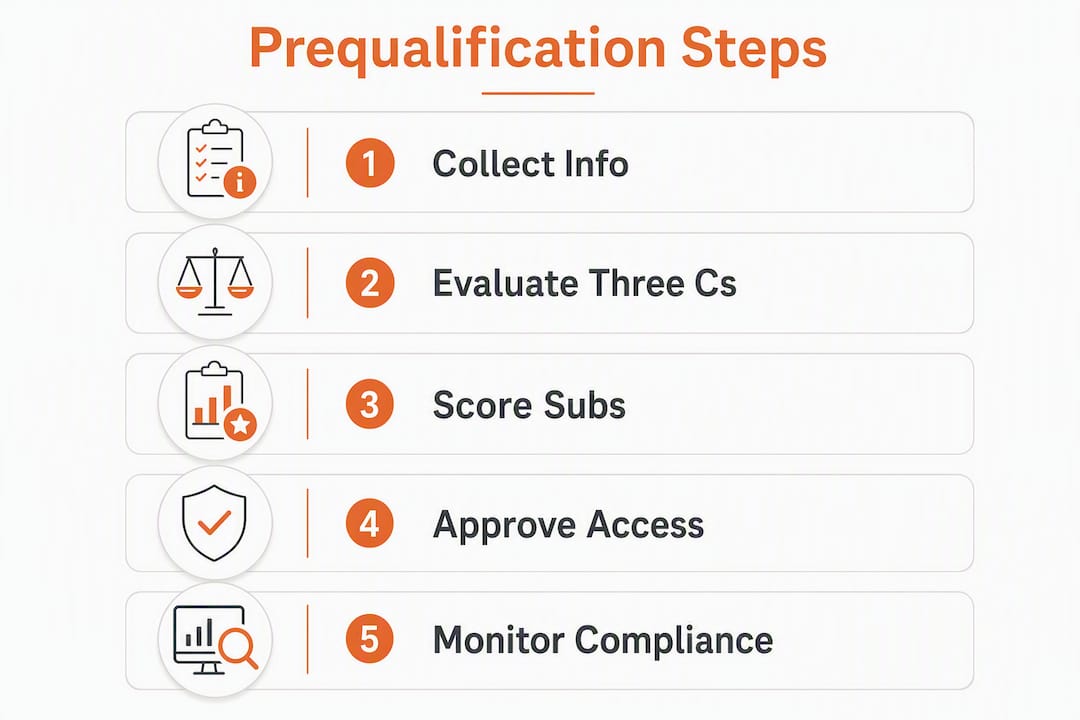
How do the Three Cs help you evaluate subs quickly?
CFMA frames prequalification as an underwriting exercise. The Three Cs give you a high-level lens that turns subjective impressions into a defensible, repeatable decision.
Capacity measures whether the sub can physically do the work: crew size, geographic range, current backlog relative to their workforce, and equipment availability. A sub carrying 140% of their normal backlog is a schedule risk regardless of their track record.

Capital covers financial health: liquidity, bonding capacity, and whether trade references confirm they pay suppliers on time. A sub who can’t pay their material suppliers will slow your project before they ever miss a milestone.
Character is the hardest to quantify but often the most predictive: reference quality, change-order handling, lien and claim history, and whether past GCs would rehire them. Sourcing through local supply houses and building inspectors consistently surfaces higher-quality leads than cold directories, precisely because those channels carry informal character signals.
A simple 0–3 scoring rubric
Score each C from 0 (disqualifying) to 3 (strong), then sum for a tier:
| Score | Tier | Bid access |
|---|---|---|
| 8 | A | Full bid access, standard oversight |
| 5 | B | Bid access with contract controls (retention, supervision) |
| 3–4 | C | Escalate for review; do not award without mitigation plan |
| 0–2 | Decline | Do not invite to bid |
A 48–72 hour quick-check (phone verification, COI spot-check, two trade reference calls) is enough to score most subs for urgent needs. Choosing the lowest bid without this step routinely costs more in re-procurement, lien resolution, and schedule recovery than the time saved skipping it.
What do timing and cost trade-offs look like for prequalification?
Start prequalification at least two to four months before bid day for most trades. Specialty equipment, prevailing-wage trades, and high-demand markets need more runway.
- Standard trades (framing, drywall, mechanical, electrical): 10–14 days minimum for a full prequal cycle
- Specialty or equipment-intensive trades (hydrovac, HDD, crane rental): 3–6 weeks, especially in growth markets
- High-growth states (Texas, Florida, Arizona, Georgia, North Carolina): structural subcontractor shortages mean capacity is committed earlier; waiting until bid day often means no qualified coverage
The cost comparison is straightforward. A modest sourcing or staffing fee paid upfront is a fraction of what re-mobilization, lien bond premiums, and schedule-delay penalties cost when a sub fails mid-project. Subcontractor defaults trigger a chain: re-procurement takes weeks, the replacement sub prices at a premium, and the original sub may file a lien before you can terminate cleanly.
Accept a shorter timeline only for repeat subs with a documented performance record on comparable work. When local coverage falls short of what you need, that is the trigger to escalate to an emergency sourcing partner.
How do you qualify more subs without taking on more risk?
The answer is graded risk controls, not a harder pass/fail gate. Capital project professionals consistently favor early engagement, segmentation, and tailoring qualification criteria to the project rather than applying a single universal standard.
A sub who scores B on the Three Cs rubric is not automatically disqualified. They are approved with conditions:
- Payment retention (typically 10%) held until milestone completion
- Enhanced supervision: daily check-ins with your superintendent or project manager
- Staged certifications: require OSHA 30 or trade-specific credentials before mobilization
- Performance milestones tied to payment releases
- Required submittals (shop drawings, material approvals) before work begins
For a limited-scope package on a light commercial project, a lower-capacity sub with a B score and a performance bond is a workable solution. For a public works job with prevailing-wage requirements, union halls and AGC chapter networks are the right sourcing channel because they pre-screen for apprenticeship ratios, safety logs, and certifications.
Pro Tip: Use a “yes, but” approach. Approve the sub, then write the mitigations into the subcontract. A decline costs you coverage; a conditional approval with contract controls costs you oversight time, which is manageable.
Should you build an internal sourcing workflow or use an external partner?
Both paths work. The decision turns on volume, market, and lead time.
Building an internal workflow
- Maintain a dynamic project-history database: track who finished on schedule, who handled change orders professionally, and who you would rehire. Static license data ages out; performance data compounds.
- Set a prequal cadence: full annual refresh for all active subs, quarterly COI and bond checks for live-project partners.
- Integrate expiration alerts: calendar reminders for COI renewals and bond expirations prevent the last-minute scramble that forces you to accept unvetted replacements.
- Run post-project performance updates: score each sub after closeout and update their tier before the next bid cycle.
For prevailing-wage or public projects, union halls and trade associations (AGC chapters, NECA, MCAA) are efficient sourcing channels. They pre-screen for certifications, apprenticeship ratios, and safety logs, which cuts your verification time significantly.
When to use an external sourcing partner
- Projects in high-growth markets where local capacity is committed (Texas, Florida, Arizona)
- Compressed lead times where internal prequal cycles can’t close fast enough
- Specialized trades or high-volume placements that exceed your internal bandwidth
- Supplier and subcontractor connections you need quickly for a bid you didn’t anticipate winning
Urgent sourcing process:
- Define scope, trade, and timeline
- Run a quick prequal (COI, one reference, EMR check)
- If coverage falls below target, escalate to an external partner immediately
- Finalize contract controls before mobilization
For specialty equipment needs, partners like Rocky Mountain Underground bring direct hydrovac and HDD sourcing experience that most internal databases don’t carry.
What should a prequalification form include?
A complete form covers these field groups:
| Field group | Fields to collect | Three Cs mapping |
|---|---|---|
| Company identity | Legal name, entity type, key personnel | Character |
| Licensing & insurance | License numbers, expiration dates, COI attachments | Capacity |
| Bonding capacity | Surety agent, aggregate limit, single-project limit | Capital |
| Financial references | Bank contact, 2–3 trade references with phone/email | Capital |
| Safety history | EMR (3 years), OSHA 300 logs, incident trends | Character |
| Project history | 3–5 projects, owner/GC contacts, scope descriptions | Capacity |
Score each field group on the 0–3 scale, sum to a tier (A/B/C), and set your bid-access rule accordingly. Require COI and bond documents as attachments, not self-reported fields.
For automation: set calendar reminders at 60 and 30 days before COI and bond expirations. If you manage more than 20 active subs, a bid-management platform with built-in document storage and expiration alerts pays for itself quickly. Below that threshold, a shared spreadsheet with conditional formatting handles the same job. When a sub’s tier drops below B at renewal, trigger your external-sourcing workflow before the gap affects a live bid.
Pro Tip: Import this table directly into Procore, Buildertrend, or your preferred bid platform as a custom form. Map each field to a required attachment so incomplete submissions can’t advance to the bid-invitation stage.
Key Takeaways
Pre-vetted sourcing before bid day is the single most reliable way to protect schedule, budget, and safety on contractor projects in North America.
| Point | Details |
|---|---|
| Run the six-field prequal | Collect company identity, licensing, bonding, financial refs, EMR, and project history before any first-time sub gets a bid invitation. |
| Apply the Three Cs rubric | Score Capacity, Capital, and Character 0–3 each; use the A/B/C tier to set bid access and oversight levels. |
| Start early by trade | Allow 10–14 days minimum for standard trades; 3–6 weeks for specialty or equipment-intensive scopes in tight markets. |
| Use “yes, but” approvals | Approve B-tier subs with contract controls (retention, supervision, milestones) rather than declining and losing coverage. |
| Escalate to Constructconnect-rconstructionsolutions | When local capacity falls short or lead time is compressed, R. Construction Solutions provides pre-vetted sub, supplier, and staff placements with a prorated 90-day payment structure. |
Why pre-vetted sourcing changes project outcomes
Most contractors treat prequalification as a compliance step. After 30+ years in AEC recruiting and sourcing, the evidence points somewhere different: prequalification is a competitive advantage, not overhead.
The contractors who consistently win in growth markets aren’t just bidding more aggressively. They’re bidding with a confirmed bench. When a project in Phoenix or Tampa breaks ground, the GC who already has a vetted electrical sub, a confirmed equipment rental source, and a qualified superintendent on file moves faster than the one running a cold search at bid day. That speed compounds. Owners notice. Repeat work follows.
The Three Cs framework works because it forces you to ask the questions that actually predict failure before it happens. A sub’s EMR tells you more about their management culture than their license number ever will. A trade reference who hesitates before answering “would you hire them again?” is a signal worth more than a polished bid package.
The firms that struggle aren’t cutting corners on purpose. They’re under time pressure, and prequalification feels like a delay. The data says otherwise: the time spent vetting is recovered many times over in avoided defaults, cleaner closeouts, and subcontracts that don’t generate lien disputes.
R. Construction Solutions: pre-vetted sourcing when your bench runs short
When your internal database doesn’t have coverage for a trade, a market, or a timeline, Constructconnect-rconstructionsolutions delivers pre-vetted subcontractors, suppliers, equipment rental introductions, and AEC staff placements without the overhead of a traditional agency retainer.
The difference is structural. Constructconnect-rconstructionsolutions charges lower commission rates than standard staffing agencies and uses a prorated 90-day payment model, so you pay only for successful placements, spread across the first three months. No placement, no fee. Services cover office and field personnel, specialty trade sourcing, supplier connections, and equipment rental introductions across high-growth North American markets including Texas, Florida, and Arizona.
When your next bid requires a trade you can’t cover internally, or when a project win comes faster than your prequal cycle can close, request a sourcing audit to see what’s available in your market before bid day.
Useful sources and further reading
- Subcontractor prequalification: what’s changed and best practices (CFMA) — CFMA’s guidance on the Three Cs framework and prequalification as underwriting
- Current State of Supplier Qualification in Capital Projects (ASCE/JCEM) — peer-reviewed study on early engagement, segmentation, and tailored qualification practices
- Subcontractor choices are costing contractors more than they think (Construction Business Owner) — cost analysis of mid-project defaults vs. upfront vetting
- R. Construction Solutions recruiting services — pre-vetted AEC staffing, subcontractor sourcing, and supplier placement
FAQ
What are the six fields every prequalification form must include?
Company identity, licensing and insurance (with COI expiration dates), bonding capacity, financial references, safety history including EMR for the previous three years, and verified project history with owner contacts.
How do the Three Cs work in a fast-turnaround bid situation?
Score Capacity, Capital, and Character 0–3 each using a 48–72 hour quick-check: one phone reference, a COI spot-check, and an EMR confirmation. A combined score of 5 or above qualifies the sub for bid access with appropriate contract controls.
When should a GC use an external sourcing partner instead of an internal process?
When local capacity falls below what a project requires, lead time is compressed, or the trade is specialized, an external partner like Constructconnect-rconstructionsolutions can place pre-vetted subs and suppliers faster than a cold internal search.
How often should a prequalification database be updated?
Run a full refresh annually for all active partners. Recheck COIs and bond status quarterly for any sub on a live project, and update performance scores after every project closeout.
What does EMR measure and why does it matter?
EMR, or experience modification rate, compares a company’s actual workers’ compensation claims to the industry average. An EMR above 1.0 signals above-average incident rates and often predicts management and safety culture issues that show up as schedule and liability risks on your project.