
Contingency Recruiting in Construction: A Hiring Manager's Guide
Contingency recruiting in construction is defined as a pay-for-performance staffing model where recruiters earn a fee only after a candidate is successfully hired. The U.S. construction industry faces a labor shortage exceeding 400,000 workers as of 2023, making flexible hiring models like this one more relevant than ever. Construction firms using flexible labor strategies report up to 22% improvement in project profitability. For hiring managers staffing roles from project engineers to superintendents, understanding what is contingency recruiting in construction is the first step toward building a workforce that moves as fast as your projects do.
What is contingency recruiting in construction?
Contingency recruiting, also called contingency search, is the recognized industry term for a hiring arrangement where the recruiter’s fee is contingent on a successful placement. No hire means no payment. This structure removes upfront financial risk for the construction firm and shifts accountability directly to the recruiter.
Recruiters are paid only when a candidate accepts an offer and begins employment. That payment typically equals 15%–30% of the new hire’s first-year salary, depending on the role’s seniority, the recruiter’s specialization, and market conditions. A superintendent placement at $120,000 per year, for example, would generate a fee between $18,000 and $36,000.

Most contingency arrangements also include a guarantee period, commonly 30–90 days. If the placed candidate leaves or is terminated within that window, the recruiter either refunds the fee or provides a replacement search at no additional cost. This guarantee gives construction firms a meaningful layer of protection on every placement.
The contingency model differs from retained recruiting in one critical way: it is non-exclusive. You can engage multiple recruiters simultaneously, and all of them compete to present qualified candidates. The recruiter who delivers the hire earns the fee.
Pro Tip: Define the role clearly before engaging any recruiter. A detailed job description that includes ProCore experience requirements, OSHA 30 certification expectations, and travel demands will produce far better candidate matches than a vague title and salary range.
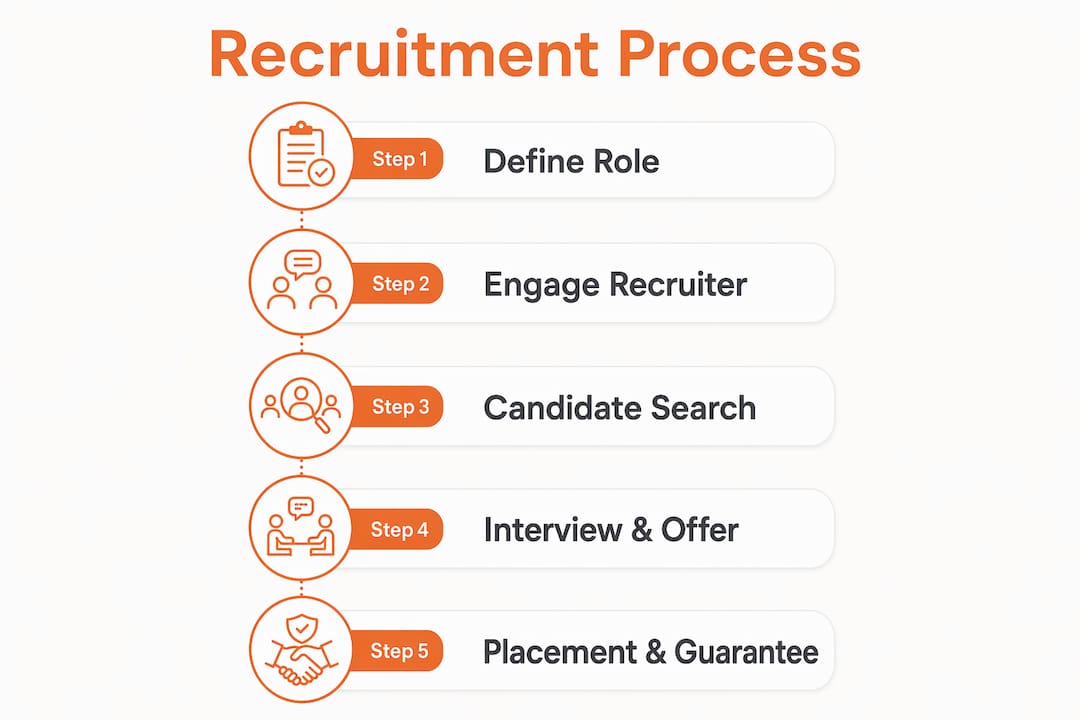
How does the contingency recruitment process work?
The contingency recruitment process follows a clear sequence, though the speed at which each step moves is one of its defining advantages for construction staffing.
- Role definition. The construction firm provides the recruiter with a detailed job brief. This includes the title, required certifications (such as OSHA 30), software proficiency like ProCore or Bluebeam, compensation range, project type, and timeline.
- Recruiter sourcing. The recruiter searches their candidate network, job boards, and referral channels. Because the engagement is non-exclusive, multiple recruiters compete to source candidates, which accelerates the pipeline.
- Candidate screening. The recruiter pre-screens candidates against the job brief, verifying credentials, experience, and availability before presenting them to the hiring manager.
- Presentation and interviews. The recruiter submits a shortlist. The construction firm conducts interviews and selects a finalist.
- Offer and placement. The firm extends an offer. Upon acceptance and the candidate’s start date, the recruiter invoices the agreed fee.
- Guarantee period. The placement enters a defined guarantee window. If the hire does not work out within that period, the recruiter provides a replacement or refund per the agreed terms.
This process suits roles with broader candidate availability and shorter hiring timelines, which describes a large share of mid-level construction positions including project coordinators, field supervisors, and estimators.
What are the benefits of contingency recruiting for construction firms?
The benefits of contingency recruiting are most visible in three areas: financial risk, hiring speed, and workforce flexibility.
- No upfront cost. You pay only when a hire is made. This makes contingency staffing for construction jobs a low-risk option, particularly for firms managing tight project budgets.
- Faster candidate pipelines. Non-exclusive recruiter engagement means multiple professionals are sourcing simultaneously. That competition produces candidates faster than a single-recruiter retained search.
- Workforce scalability. Construction workloads fluctuate by project phase. Contingency recruiting lets you scale hiring efforts up or down without committing to long-term recruiting contracts.
- Variable cost structure. Treating contingent labor as a variable cost rather than overhead gives construction firms financial resilience across project cycles. Firms that apply this model report measurable gains in stability and profitability.
- No exclusivity required. You retain full control over your hiring process and can run internal recruiting efforts in parallel with contingency searches.
Construction firms dealing with urgent project staffing needs benefit most from this model. When a project engineer leaves mid-project or a superintendent role opens unexpectedly, contingency recruiting provides immediate access to a competitive recruiter network without a retainer commitment. Insights from construction labor research confirm that workforce agility directly affects project outcomes, particularly on time-sensitive builds.
Statistic callout: Flexible labor strategies, including contingency staffing construction models, are linked to up to 22% better project profitability. That figure reflects the compounding effect of right-sized teams, reduced downtime, and faster role fills.
What are the challenges of contingency recruiting in construction?
Contingency recruiting is not the right model for every hire. Understanding its limitations helps you use it where it works and avoid it where it does not.
- Variable candidate quality. When multiple recruiters compete, some prioritize speed over fit. You may receive a high volume of resumes that require significant internal screening time.
- Overlapping outreach. Two or more recruiters may contact the same candidate with different messaging. This creates a confusing experience for the candidate and can damage your firm’s employer brand.
- Lighter role calibration. Contingency recruiters typically invest less time in deeply understanding your firm’s culture, project type, and team dynamics compared to a retained partner who is exclusively focused on your search.
- Not suited for executive or confidential roles. Retained search is the standard for VP-level, division director, or highly confidential positions where discretion and deep market mapping are required.
- Speed does not guarantee quality. Fast resume delivery is a feature of contingency search, but the first resumes in your inbox are not always the best candidates for the role.
The risks above are manageable with clear process controls. Limit the number of active contingency recruiters on a single role to two or three. Require each recruiter to submit a candidate summary alongside the resume. These steps reduce noise without eliminating the competitive sourcing advantage.
Pro Tip: Ask every contingency recruiter to confirm whether a candidate has been submitted to your firm by another recruiter before accepting the resume. This prevents duplicate submissions and protects you from fee disputes at the offer stage.
Contingency vs. retained recruiting: which model fits your hire?
The choice between contingency and retained recruiting depends on the role, the timeline, and the level of search depth required. The table below outlines the key differences.
| Factor | Contingency recruiting | Retained recruiting |
|---|---|---|
| Payment structure | Fee paid after successful hire | Upfront retainer, balance on placement |
| Recruiter exclusivity | Non-exclusive, multiple recruiters | Exclusive single-recruiter engagement |
| Best role types | Mid-level, volume, urgent fills | Executive, specialized, confidential |
| Search depth | Broad, competitive sourcing | Deep active and passive candidate mapping |
| Financial risk | Low, no payment without hire | Higher, retainer paid regardless of outcome |
| Candidate experience | Variable, risk of overlapping outreach | Consistent, managed by one recruiter |
Retained search suits roles that require careful stakeholder management, confidential replacement searches, or deep passive candidate outreach. Contingency recruiting suits roles where the candidate pool is broad and speed matters more than exhaustive market coverage. For most construction firms, the answer is not one model or the other. It is knowing which model to apply to which role. A project manager search during a busy season calls for contingency. A regional director search with confidentiality requirements calls for retained.
Understanding the role of staffing agencies in construction projects also helps hiring managers decide when to bring in external recruiting support versus managing searches internally.
Key Takeaways
Contingency recruiting in construction is the most cost-effective model for filling mid-level roles quickly, because firms pay only upon a successful hire and retain full control over the process.
| Point | Details |
|---|---|
| Pay-for-performance model | Fees of 15%–30% of first-year salary are due only after the candidate starts work. |
| Non-exclusive recruiter access | Multiple recruiters compete simultaneously, accelerating candidate pipelines for urgent roles. |
| Best for mid-level positions | Project coordinators, estimators, and field supervisors are ideal contingency search targets. |
| Financial resilience | Treating contingent labor as a variable cost links to up to 22% better project profitability. |
| Manage quality risks | Limit active recruiters per role and require candidate summaries to reduce noise and duplicate submissions. |
What I’ve learned from watching contingency recruiting work in the field
The debate between contingency and retained recruiting often gets framed as a quality argument. Retained search advocates argue that contingency produces lower-quality candidates because recruiters are chasing a fee, not a fit. That argument has merit in some contexts. It does not hold up across the board in construction.
Here is what I have actually observed: the construction labor market does not reward slow, methodical searches for most roles. A project engineer opening that sits unfilled for 60 days costs real money in delayed submittals, overworked team members, and schedule risk. Contingency recruiting, when managed well, fills that role in two to four weeks. The speed advantage is real and it compounds across a project portfolio.
The firms that get the most out of contingency staffing construction models are the ones that treat recruiters as partners, not vendors. They share detailed job briefs, provide fast interview feedback, and make decisions without unnecessary committee delays. Recruiters respond to that behavior by prioritizing those clients when strong candidates become available.
The model does have a ceiling. For a VP of Operations search or a confidential replacement of a division leader, contingency is the wrong tool. But for the volume of mid-level hiring that drives most construction firms’ day-to-day operations, it is the most practical and financially sound approach available. The key is knowing where that ceiling is and not pushing the model past it.
— Rowena
How Constructconnect-rconstructionsolutions supports your construction hiring
Constructconnect-rconstructionsolutions brings more than 30 years of AEC industry experience to every search, with lower commission rates and a prorated 90-day model that means you pay only for results.

Whether you need to fill a project engineer role quickly or build a pipeline of pre-vetted superintendents for an upcoming project phase, Constructconnect-rconstructionsolutions connects you with candidates who already meet your certification, software, and experience requirements. The team’s AEC recruiting services cover the full range of construction roles, from field supervision to project leadership, with a fee structure built around your success. For firms managing emergency subcontractor sourcing needs alongside direct hires, Constructconnect-rconstructionsolutions offers integrated solutions that address both sides of the workforce equation.
FAQ
What is contingency recruiting in construction?
Contingency recruiting in construction is a pay-for-performance hiring model where the recruiter earns a fee only after a candidate is successfully placed. Fees typically range from 15%–30% of the hired candidate’s first-year salary.
How does contingency recruiting differ from retained recruiting?
Contingency recruiting is non-exclusive and requires no upfront payment, while retained recruiting involves an exclusive contract and an upfront retainer fee. Retained search suits executive and confidential roles; contingency suits mid-level and volume hires.
What construction roles are best suited for contingency staffing?
Contingency staffing works best for roles with a broad candidate pool and urgent timelines, such as project coordinators, estimators, field supervisors, and project engineers. Executive and highly confidential positions are better served by retained search.
What are the main risks of contingency recruiting for construction firms?
The primary risks are variable candidate quality and overlapping recruiter outreach, which can create a confusing experience for candidates and increase internal screening time. Limiting active recruiters per role to two or three reduces both risks significantly.
How long does a contingency recruiting search typically take?
A well-managed contingency search for a mid-level construction role typically produces a shortlist within two to four weeks. Timeline varies based on role complexity, location, and how quickly the hiring firm provides interview feedback and decisions.
Recommended
- Recruiting Project Engineers for Construction Companies
- Emergency Subcontractor Sourcing for Construction Managers
- Why Santa Cruz Construction Companies Can’t Find Quality Estimators and Project Managers (And How 30 Years of Industry Experience Finds Them)
- What is AEC Recruiting and Why Construction Companies Are Outsourcing It