
Recruiting Project Engineers for Construction Companies
Recruiting project engineers for construction companies is the process of identifying, vetting, and placing qualified engineering professionals who manage schedules, budgets, subcontractors, and compliance on active construction projects. The right project engineer, formally called a construction project engineer or CPE, directly determines whether a project finishes on time and within budget. Compensation for these roles ranges from $60,000 for entry-level positions to $160,000 for senior engineers with a decade or more of experience. That salary spread reflects genuine market demand and the difficulty of finding qualified candidates through standard hiring channels.
What qualifications should you look for when hiring construction project engineers?
A qualified construction project engineer typically holds a Bachelor’s degree in civil, mechanical, or construction management engineering. Certifications like PMP are preferred for complex infrastructure and heavy civil projects. Candidates with 10 or more years of experience in specialized sectors such as heavy civil, water infrastructure, or mechanical construction command the highest salaries and deliver the fastest ramp-up time on new projects.
Beyond credentials, the skills that separate high-performing project engineers from average ones fall into three categories:
- Technical proficiency: Hands-on experience with Procore, Primavera P6, AutoCAD, and Microsoft Excel. Proficiency with these platforms signals that a candidate can manage RFIs, submittals, and scheduling without a learning curve.
- Field and compliance knowledge: Familiarity with Corps of Engineers project requirements, OSHA 30 certification, and contract compliance. Heavy civil project engineers handle complex subcontractor coordination, cost management, and regulatory adherence daily.
- Leadership and communication: Schedule management, budget tracking, and subcontractor coordination all require clear communication under pressure. Candidates who cannot lead a subcontractor meeting or escalate a scope issue will create delays regardless of their technical skills.
Pro Tip: Ask candidates to walk you through a specific project where they managed a schedule recovery. Their answer reveals sequencing knowledge, subcontractor management ability, and how they perform under pressure, all in one question.
Which tools and methods work best for construction engineer recruitment?

The most effective recruiting approach for project engineers relies on passive candidate outreach, not job postings alone. Most qualified engineers are currently employed and not actively searching. Reaching them requires market mapping and confidential headhunting, two methods that identify and approach candidates who would never respond to a job board listing.
A structured recruiting process for construction project engineers combines four methods:
- Market mapping: Identify engineers currently working at competing firms or on comparable project types. This gives you a target list of candidates with proven, relevant experience before you make a single call.
- Targeted job boards and professional networks: Platforms like the ASCE Career Center and LinkedIn reach active candidates. These channels work best for entry-level and mid-career roles where candidates are more likely to be open to new opportunities.
- Construction management software skills assessment: Use platforms like Procore and Primavera to build skills benchmarks. Candidates who cannot demonstrate proficiency in the tools your projects require will need costly training time.
- Specialized AEC recruiting firms: Firms that focus exclusively on architecture, engineering, and construction bring pre-built candidate networks and sector-specific screening criteria that general staffing agencies cannot replicate.
The table below compares the primary recruiting channels by reach, speed, and candidate quality:
| Recruiting Channel | Candidate Pool | Time to Fill | Best For |
|---|---|---|---|
| Job boards (ASCE, LinkedIn) | Active seekers | 2–6 weeks | Entry to mid-level roles |
| Market mapping and headhunting | Passive candidates | 4–10 weeks | Senior and specialized roles |
| General staffing agencies | Mixed pool | 2–5 weeks | Volume hiring, lower complexity |
| Specialized AEC recruiting firms | Pre-vetted, passive | 3–8 weeks | Critical project hires |
Specialized AEC recruiting firms consistently outperform general staffing agencies on senior hires because their candidate networks are built over years of industry-specific work. That depth is not replicable through a generic database search.
How do construction recruitment firms add value when hiring project engineers?
Specialized construction recruiters function as brand extensions for your company, not just resume forwarders. Recruiters who specialize in construction assess candidates on owner-operator mindset, subcontractor alignment, and the ability to own project outcomes, not just fill a seat. That distinction matters because a project engineer who manages defensively rather than proactively will cost you more in delays and rework than the recruiter’s fee ever would.
The specific advantages of working with a specialized construction recruiting firm include:
- Access to passive candidates: Market mapping and confidential headhunting surface engineers who are not visible through job postings, which is where the best talent consistently lives.
- Cultural fit screening: Strong recruiter-client partnerships enable vetting through both technical evaluation and personal reliability assessments, reducing the risk of a mis-hire that disrupts your project team.
- Market intelligence: Experienced recruiters know current salary benchmarks, competitor hiring activity, and candidate availability in your region. That information shapes your offer strategy before you make a single call.
- Risk reduction on critical projects: Recruiting specialized project engineers reduces delivery risk, improves schedule adherence, and strengthens cost control on complex builds.
“Treat hiring project engineers as risk management. Successful placements align with company culture and an owner-operator mindset.” — Hecht Search Group
The firms that deliver the best results for construction companies are those that understand the difference between a project engineer who executes tasks and one who owns outcomes. That distinction is what separates a project that finishes on time from one that bleeds cost overruns for six months.
What step-by-step process should construction companies follow to recruit project engineers?
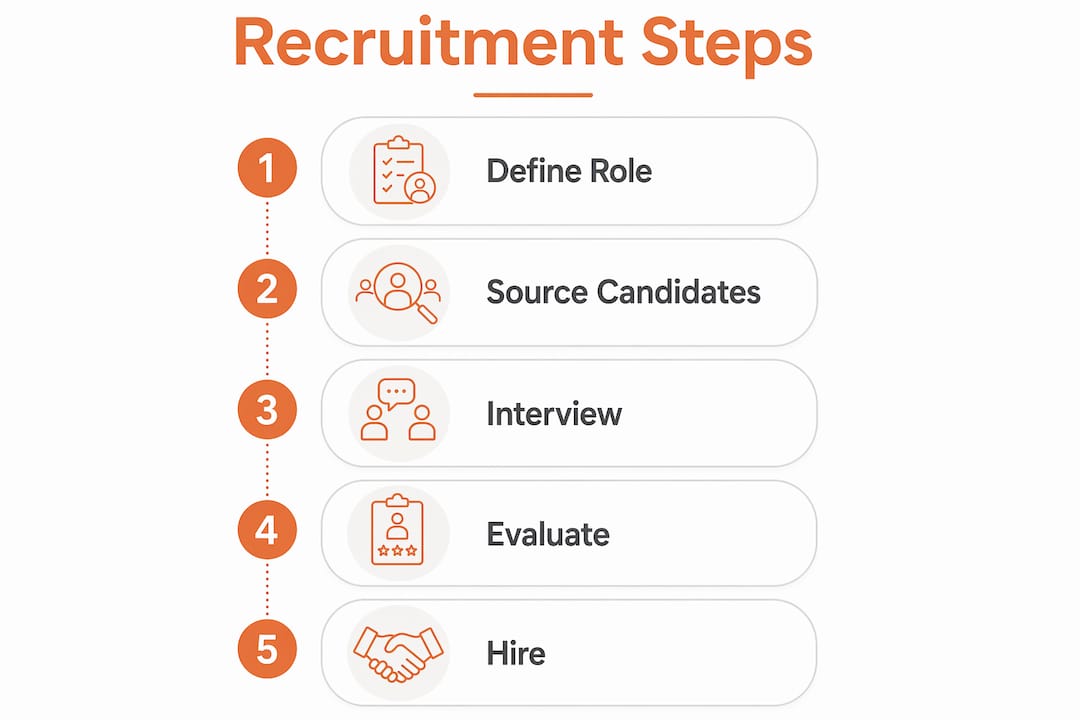
A repeatable recruiting process reduces time-to-fill and improves hire quality on every search. The following workflow applies whether you are filling one role or building out a full project team:
- Define the role precisely. Align the job description with your actual project plan. Specify the project type (heavy civil, commercial, infrastructure), required software proficiency (Procore, P6, AutoCAD), experience level, and OSHA certification requirements. Vague job descriptions attract unqualified applicants and waste screening time.
- Source through multiple channels simultaneously. Post on targeted job boards for active candidates while your recruiting partner runs parallel passive outreach. Waiting for one channel to produce results before activating another adds weeks to your timeline.
- Screen for delivery skills, not just credentials. Assess candidates on site delivery experience, HSE standards adherence, stakeholder management, and schedule performance. A PMP certification without field delivery experience is a credential, not a qualification.
- Conduct structured interviews focused on project outcomes. Ask candidates to describe specific projects where they managed subcontractor conflicts, recovered a schedule, or resolved a cost variance. Behavioral questions reveal how candidates perform under the conditions your projects actually create.
- Verify references with project-specific questions. Contact former project managers and owners, not just HR departments. Ask whether the candidate managed subcontractors effectively and whether they would hire them again on a complex project.
- Onboard with a 30-day integration plan. Assign a senior project manager as a point of contact for the first month. Introduce the new engineer to key subcontractors and owners early. Early relationship-building directly reduces the time before a new hire contributes at full capacity.
Pro Tip: Build your job description from your project schedule, not from a generic template. The specific phases, subcontractor types, and software tools on your active projects define the qualifications you actually need.
What common challenges arise when recruiting project engineers?
The construction industry faces a persistent shortage of experienced project engineers, and that shortage drives up both salaries and time-to-fill on every search. Entry-level engineers earn $60,000–$75,000, while senior engineers with 10 or more years of experience command $128,000–$160,000 annually. That range means your compensation package must be competitive before you begin outreach, or qualified candidates will decline before the interview stage.
The most common recruiting challenges and their solutions:
- Passive candidate status: High-quality engineers are rarely actively seeking a new role. Engaging them requires a direct, confidential approach that respects their current employment while presenting a compelling opportunity. General job postings will not reach this group.
- Cultural and skills mis-hires: A candidate who looks strong on paper but does not align with your project culture creates team friction and turnover. Structured behavioral interviews and thorough reference checks, focused on project delivery rather than general performance, catch these mismatches before an offer is made.
- Staffing gaps causing project delays: An unfilled project engineer role on an active project creates a direct schedule risk. Maintaining a relationship with a specialized AEC recruiting partner means you have a pipeline of pre-vetted candidates ready when a need arises, rather than starting a search from zero.
- Salary competition from larger contractors: Regional general contractors often compete against national firms for the same candidates. A clear career path, project variety, and a defined role on high-profile projects can offset a salary gap when compensation alone cannot close the difference.
The companies that consistently win on project engineer hiring treat recruiting as an ongoing function, not a reactive response to an open position.
Key takeaways
Recruiting project engineers for construction companies requires a proactive, multi-channel approach that combines precise role definition, passive candidate outreach, and specialized AEC recruiting expertise.
| Point | Details |
|---|---|
| Define roles from project plans | Build job descriptions from active schedules and required software, not generic templates. |
| Target passive candidates | Most qualified engineers are employed. Market mapping and headhunting reach them directly. |
| Use specialized AEC recruiters | Construction-focused firms screen for owner-operator mindset and delivery skills, not just credentials. |
| Compensation must be competitive | Senior project engineers command $128,000–$160,000. Underpaying eliminates top candidates before interviews begin. |
| Treat recruiting as risk management | An unfilled project engineer role creates direct schedule and cost risk on active projects. |
What I’ve learned about hiring project engineers that most guides won’t tell you
The single biggest mistake I see construction companies make is treating a project engineer search like a commodity hire. They post a job, wait two weeks, and then wonder why the applicants do not match the role. The reality is that the engineers who can actually run a complex project, manage a difficult subcontractor, and keep a schedule honest are almost never looking at job boards. They are heads-down on someone else’s project, and they will stay there unless someone reaches out directly with a compelling reason to consider a move.
What I have also observed is that cultural fit is not a soft concept in construction. A project engineer who thrives in a collaborative, owner-focused environment will struggle in a firm that runs projects through rigid top-down control, and vice versa. The companies that get this right spend as much time defining their project culture in the job brief as they do listing technical requirements. That specificity attracts candidates who will stay and perform, rather than candidates who accept an offer and leave within a year.
The other thing worth saying directly: the cost of a bad hire in a project engineer role is not just the recruiter’s fee. It is the schedule slippage, the subcontractor friction, the rework, and the owner relationship damage that follows. Partnering with a firm that understands construction from the inside, not just from a resume database, is the most direct way to reduce that risk. I have seen it make the difference between a project that closes out clean and one that drags into claims.
— Rowena
How Constructconnect-rconstructionsolutions supports your project engineer hiring
Constructconnect-rconstructionsolutions specializes in AEC industry recruiting with more than 30 years of experience placing project engineers, senior project managers, and construction professionals across heavy civil, infrastructure, and commercial sectors. The firm uses a prorated payment structure, meaning you pay only for successful placements, not for the search itself. That model aligns the firm’s incentives directly with your hiring outcomes.

If you are a general contractor or construction company looking to fill a project engineer role on an active project, Constructconnect-rconstructionsolutions brings pre-vetted candidates, market intelligence, and a direct outreach process that reaches passive candidates your internal team cannot access. Visit the recruiting services page to start a conversation about your current staffing needs.
FAQ
What does a project engineer do on a construction project?
A construction project engineer manages schedules, submittals, RFIs, subcontractor coordination, and cost tracking on active projects. They serve as the operational link between the project manager and field crews.
What qualifications are required for a construction project engineer?
A Bachelor’s degree in civil, mechanical, or construction management engineering is the standard baseline. Certifications like PMP and proficiency in Procore, Primavera P6, and AutoCAD are preferred for complex projects.
Why is passive candidate outreach important in construction recruiting?
Most experienced project engineers are currently employed and not actively searching. Passive candidate outreach through market mapping and direct headhunting is the primary way to reach this group.
What salary should construction companies budget for a project engineer?
Entry-level project engineers earn $60,000–$75,000 annually. Senior engineers with 10 or more years of experience command $128,000–$160,000, depending on project complexity and region.
When should a construction company use a specialized recruiting firm?
Use a specialized AEC recruiting firm when the role is critical to an active project, when previous searches have produced weak candidate pools, or when you need to fill a senior position quickly without disrupting current operations.