
Construction Background Checks: A Compliance-First Playbook
A tiered, role-based screening program is the right starting point for construction background checks: identity verification and a standalone FCRA disclosure for everyone, county-level criminal searches scaled to job access, MVR pulls for anyone driving equipment, drug testing where your contracts or state law require it, and license verification for licensed trades. Layer in the FCRA’s disclosure, authorization, and adverse action steps, and you have a program that protects your jobsites without exposing you to a discrimination claim from the EEOC or a class action over a missed notice.
Here’s the starter checklist to run today:
- Standalone FCRA disclosure form, separate from your onboarding packet, plus written authorization
- Identity and Social Security number trace to confirm the candidate is who they say they are
- Tiered, multi-jurisdiction criminal history search scaled to jobsite access
- Motor Vehicle Record (MVR) check for any role that drives a company vehicle or heavy equipment
- Drug testing where required by contract, DOT rules, or your drug-free workplace policy
- License and certification verification for electricians, plumbers, crane operators, and similar trades
Turnaround typically runs a few days for lower-tier roles and up to several business days for safety-sensitive positions, according to GCheck’s hiring compliance guidance.
Key Takeaways
A compliant construction background check program combines role-tiered screening, standalone FCRA disclosures, and individualized assessment of any criminal record before it factors into a hiring decision.
| Point | Details |
|---|---|
| Tier screening by access | Match check intensity, criminal scope, MVR, drug testing, license verification, to jobsite access and duties. |
| Follow the full FCRA sequence | Standalone disclosure, written authorization, pre-adverse notice, waiting period, then final adverse action notice. |
| Use Green factors, not blanket bans | Weigh offense nature, time elapsed, and job relevance before disqualifying a candidate. |
| Prioritize county-level searches | National indexes alone miss records that courthouse-level pulls catch. |
| Consider outsourcing for volume hiring | Constructconnect-rconstructionsolutions offers construction-specific vetting and prorated fees for teams that need pre-vetted candidates fast. |
This article is general information, not a substitute for advice from a qualified lawyer. Consult a qualified legal professional about your own circumstances before acting on anything here.
Table of Contents
- Which Construction Background Checks Should You Run?
- What Screening Package Fits Each Construction Role?
- What Does FCRA Require for Construction Employers?
- How Do You Choose a Construction Background Check Provider?
- How Fast Can You Complete a Background Check?
- Which Findings Actually Disqualify a Construction Candidate?
- How Do You Protect Candidate Data During Screening?
- What Other Checks Matter for Construction Hiring?
- How Do Background Checks Fit Your Drug-Free Workplace Program?
- Let R. Construction Solutions Handle Your Screening Risk
- Sources
- FAQ
Which Construction Background Checks Should You Run?
Not every hire needs the same screen. What changes the equation is jobsite access, equipment operation, and whether the role touches money or safety-critical systems. Build your check list around the job, not a one-size-fits-all template.
The core toolkit includes:
- Identity and SSN trace — confirms the candidate’s identity and surfaces address history that guides where to search for records
- County-level, multi-jurisdiction criminal search — the backbone of any real screen, because national databases pull from a patchwork of court feeds and miss records that county courthouses have on file
- Sex offender registry check — standard for roles with access to schools, hospitals, or residential job sites
- Motor Vehicle Record (MVR) — mandatory for anyone driving a company vehicle, forklift, or crane
- Employment and license/certification verification — confirms trade credentials like an electrician’s license or a crane operator’s certification are real and current
- Drug testing — required for DOT-regulated roles and common on public works projects with drug-free workplace mandates
- Limited credit checks — reserved for project managers, controllers, or anyone with purchasing authority
Run a national index alongside county searches, never instead of them. National indexes are aggregated feeds that lag behind or skip courthouses entirely, which is why county-level pulls remain the more reliable source, per EEOC guidance. Subcontractors and 1099 workers aren’t automatically exempt, either. If your company directs their daily work, controls their tools, or sets their schedule, the degree-of-control test can pull them into your FCRA obligations even without a W-2.
Pro Tip: Build FCRA authorization language directly into your subcontractor engagement agreements instead of chasing signatures once crews are already on site. Batching checks by access tier, as covered in subcontractor prequalification, saves real time during mobilization.
What Screening Package Fits Each Construction Role?
Screening intensity should scale with access and responsibility, not job title alone. Four tiers cover most construction workforces.
| Tier | Typical roles | Core components | Turnaround |
|---|---|---|---|
| Tier 1 | Perimeter, limited-access labor | Identity/SSN trace, county criminal search | 24–48 hours |
| Tier 2 | General field trades | Tier 1 plus MVR (if driving), drug test | 24–72 hours |
| Tier 3 | Safety-sensitive, high-access (crane, electrical) | Tier 2 plus sex offender registry, license/cert verification | 2–5 business days |
| Tier 4 | Supervisors, PMs, finance-adjacent roles | Tier 3 plus limited credit check, extended employment verification | 3–7 business days |
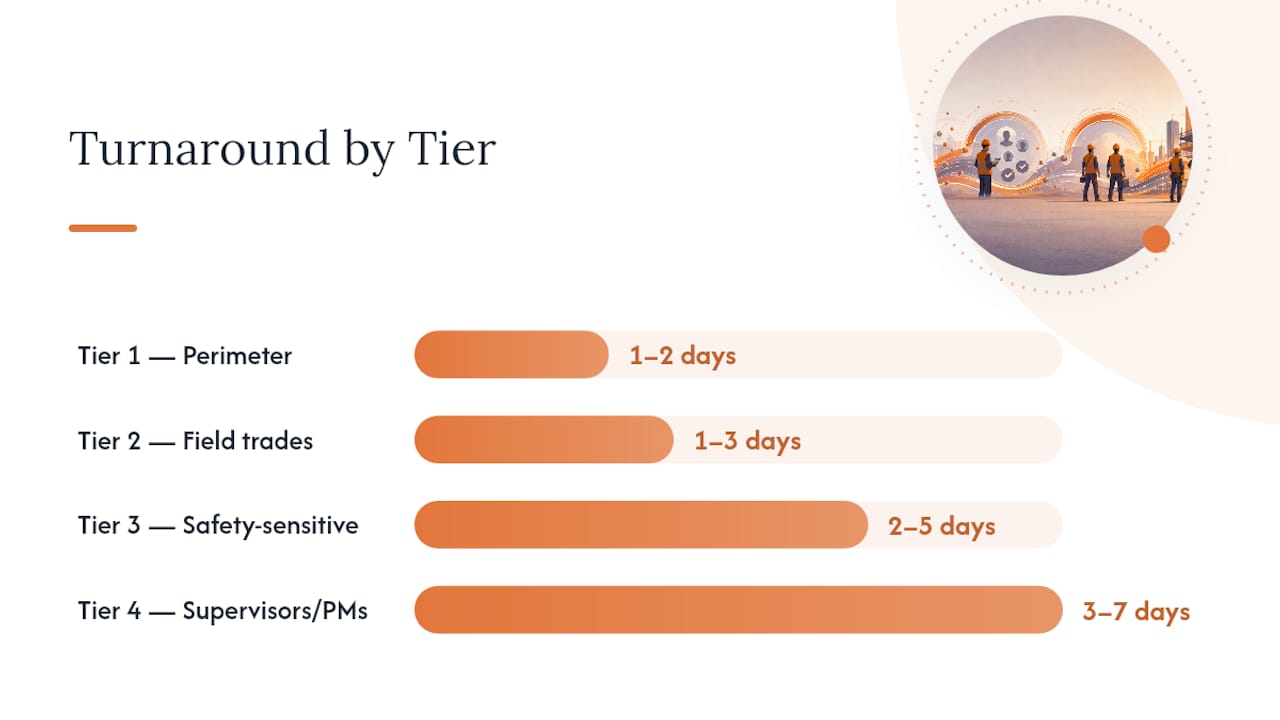
This tiered framework mirrors the approach GCheck recommends for construction employers managing mixed crews across multiple sites.
Costs climb with scope. County-level searches in multiple states, federal record checks, education credentialing, and multi-state MVR pulls all add line items. A single-county Tier 1 screen costs far less than a Tier 4 package spanning five states with license verification and credit review. Budget by tier volume rather than trying to price every hire identically, and revisit your package mix seasonally if you mobilize crews across state lines.
What Does FCRA Require for Construction Employers?
Site security badges and background checks are not the same thing, and passing one does not satisfy the other. Any report pulled through a consumer reporting agency for employment purposes triggers full Fair Credit Reporting Act obligations, regardless of how quickly you need the hire on site.
The FCRA sequence has firm steps, in order:
- Deliver a standalone disclosure document, separate from onboarding paperwork, stating you will obtain a consumer report
- Get written authorization before ordering anything
- Confirm your CRA certifies permissible purpose for the request
- If a report may lead to adverse action, send a pre-adverse action notice with a copy of the report and the Summary of Rights
- Wait a reasonable window, generally at least several business days per EEOC guidance before finalizing
- Send the final adverse action notice if you proceed with disqualification
- Retain records in case of dispute or audit
Discrimination law layers on top of that process. The EEOC’s enforcement guidance directs employers to apply the Green factors, meaning the nature and seriousness of the offense, how much time has passed, and the specific duties of the job, before disqualifying someone over a criminal record. Federal contractors face an added layer: OFCCP Directive 2013-02 bars blanket criminal exclusions and expects individualized assessment tied to business necessity, not a policy that auto-rejects anyone with a record.
Most FCRA litigation risk isn’t about the hiring decision itself. It’s procedural. Bundling the disclosure into a general onboarding packet, skipping the standalone document, or firing off adverse action too fast are common missteps that create class-action exposure even when the underlying decision was defensible, according to Venable LLP’s analysis of employer screening practices.
How Do You Choose a Construction Background Check Provider?
Prioritize a screening partner that combines direct courthouse access for county searches, a built-in adverse-action workflow, and role-tier templates already mapped to construction jobs. Generic index-only providers save a few dollars per report but shift the compliance burden, and the delay risk, onto you.
Weigh these dimensions when comparing vendors:
| Comparison dimension | What to check |
|---|---|
| Best for | High-volume seasonal hiring vs. federal-contractor-heavy rosters |
| Pricing model | Per-report fees vs. subscription/volume pricing |
| Turnaround SLA | Stated windows for county searches specifically, not just national index results |
| FCRA/compliance features | Integrated disclosures, automated pre-adverse and adverse action notices |
| Package components | Criminal, MVR, drug testing, and verifications bundled or itemized |
| ATS/HRIS integration | Direct feed into your applicant tracking or HR system |
| Federal contractor support | Access to databases and workflows suited to OFCCP-covered employers, such as SentryLink’s court-record network |
Providers like GoodHire market strong ATS integrations and self-serve dashboards, useful for high-volume field hiring where speed matters. SentryLink leans toward direct courthouse and state-repository access, which fits federal contractors that need defensible, audit-ready county results. Neither substitutes for your own internal FCRA process controls. Confirm any vendor’s stated SLA covers county-level pulls, not just the faster national index, and verify their platform actually generates pre-adverse and adverse action notices rather than leaving you to draft them manually.
How Fast Can You Complete a Background Check?
Start screening at offer acceptance, or earlier when you’re mobilizing a large crew for a project start date. Tying initiation to mobilization confirmation, rather than waiting for a formal start date, is what keeps seasonal hiring pushes from backing up your whole schedule.
- Assign the candidate a screening tier based on the role’s access and duties
- Deliver the standalone disclosure and collect written authorization
- Submit the order to your CRA
- Receive the report and run an individualized assessment if a record surfaces
- Follow the pre-adverse and adverse action sequence if you’re moving toward disqualification
Tier 1 and 2 checks generally clear in 24 to 72 hours; Tier 3 screens with county pulls in multiple jurisdictions can take 2 to 5 business days. Late initiation, courthouse backlogs, and multi-state hires cause most delays. Batching orders by tier and locking in pre-built subcontractor authorization language, as outlined in rapid vetting guidance for urgent projects removes most of that friction before it hits your schedule.
Which Findings Actually Disqualify a Construction Candidate?
A record should disqualify someone only when it connects directly to the job’s essential functions, weighed through the Green factors rather than a blanket rule.
Findings that commonly justify disqualification include:
- A recent violent felony for a safety-sensitive or supervisory role
- A DUI or multiple serious moving violations for anyone required to drive
- A falsified license or certification, such as a fabricated crane operator credential
- A pattern of recent, serious MVR infractions tied to equipment operation
What should never be the sole basis for a decision: an arrest without a conviction, a decade-old, non-violent conviction unrelated to the job, or an unverified online report that never came through your CRA.
How Do You Protect Candidate Data During Screening?
Background check data, Social Security numbers, driving histories, and criminal records among them, is some of the most sensitive information your company handles. Treat it that way from intake through disposal.
Limit access first. Only HR staff and the specific hiring manager involved in a decision need to see raw report contents; supervisors reviewing a hiring shortlist do not need SSNs or full criminal histories, only a pass or fail signal tied to your policy. Store reports in a system with role-based permissions and an audit trail, not in shared drives or email threads that anyone on the team can search.
Retention matters as much as access. Keep records only as long as your policy and applicable state law require, and destroy them securely afterward, shredding paper copies and permanently deleting digital files rather than archiving them indefinitely “just in case.” Indefinite retention turns a compliance asset into a liability if you’re ever audited or sued.

Vet your CRA’s own security posture before you sign anything. Ask how they encrypt data in transit and at rest, whether they log every access event, and what their breach notification process looks like. A provider with built-in audit logs and documented courthouse-access controls carries materially lower operational risk than one that treats data handling as an afterthought, a distinction Venable’s analysis of screening missteps makes clear. Finally, get authorization language in writing that specifically covers how long you’ll retain data and who can access it, and share that with candidates upfront rather than burying it in fine print.
What Other Checks Matter for Construction Hiring?
Criminal history and MVR checks cover the basics, but two additional verification layers matter specifically in construction: credential tracking and drug testing compliance.
OSHA-related certifications need direct verification, not a candidate’s word. OSHA 10 and OSHA 30 cards, confined-space training, fall-protection certifications, and crane operator credentials should all be checked against issuing bodies rather than accepted at face value. A forged or expired card on a safety-sensitive role is a liability that surfaces during an inspection or, worse, after an incident. Build credential expiration dates into your HR system so certifications get flagged for renewal before they lapse mid-project.

Drug testing compliance tracking deserves its own workflow. DOT-regulated roles, like commercial driving positions, require federal testing protocols with strict chain-of-custody rules. Many public works contracts and some state laws mandate drug-free workplace programs with random and post-accident testing built in, a distinction industry guidance on construction screening lays out clearly. Substance use risk in physically demanding trades is a documented workforce factor, according to SAMHSA’s research, which is one more reason a consistent testing policy, not an ad hoc one, protects your crews.
Track certification and testing compliance in the same system you use for background check results. Fragmented tracking across spreadsheets, email, and paper files is how expired credentials and missed test windows slip through.
How Do Background Checks Fit Your Drug-Free Workplace Program?
Background checks and drug-free workplace programs work best as one connected system, not two separate processes running on different timelines. Pre-employment drug testing should trigger at the same point as your other Tier 2 and Tier 3 screens, tied to offer acceptance, so a candidate isn’t cleared on background but still pending on a drug panel when they show up for orientation.
Random and post-accident testing protocols, where your contracts or state rules require them, need clear written policy that every employee signs at onboarding, not just field crews. OSHA’s injury and fatality data underscores why this matters in construction specifically: the physical risks of the job make impairment a safety issue first and a policy issue second.
Coordinate your drug-free workplace policy with your MVR and license verification workflows too. A driver who fails a random test needs immediate reassignment away from equipment, which only works cleanly if your HR system already flags that role’s driving requirements. Document every step, testing triggers, results, and any resulting personnel action, with the same retention discipline you apply to background check records. That paper trail protects you if a termination or reassignment is ever challenged.
A recruiter’s view on screening trade-offs
Rushing a background check to fill a crew fast is the most common way construction employers create legal exposure they didn’t sign up for. Rowena, who covers hiring workflows for Constructconnect-rconstructionsolutions, has seen last-minute mobilizations go sideways when a disclosure form gets skipped for speed. Early initiation isn’t caution for its own sake; it’s what keeps a compliant hire on schedule.
Let R. Construction Solutions Handle Your Screening Risk
When your team is stretched thin during a mobilization push, outsourcing recruitment and vetting to Constructconnect-rconstructionsolutions removes the scheduling risk that comes with managing FCRA steps in-house while also filling roles fast. Constructconnect-rconstructionsolutions specializes in construction-specific vetting, backed by 30-plus years of AEC industry experience, so candidates arrive pre-screened against the standards your jobsite actually needs.

The firm’s prorated contingency fee model means you pay only for successful placements, spread over the candidate’s first 90 days, not a flat retained-search fee regardless of outcome. That structure pairs naturally with project-based recruiting timelines, where crew needs shift as a job moves from mobilization to close-out. For office staff, field trades, or supervisory roles that need both recruiting and background diligence handled together, visit the recruiting services page to start a screening-enabled hiring engagement built around your next mobilization window.
Sources
- EEOC Enforcement Guidance on the Consideration of Arrest and Conviction Records in Employment Decisions
- Background Check Authorizations and Process: Small Missteps, Significant Risk | Venable LLP
- Summer Construction Hiring Background Check Compliance Tips
FAQ
What do construction companies look for in background checks?
Most construction employers check criminal history scaled to jobsite access, MVR records for driving roles, drug test results, and license or certification verification for licensed trades.
What disqualifies you from a job in a background check?
Disqualification typically ties to a recent violent felony for safety-sensitive roles, a DUI for driving positions, or a falsified license, evaluated individually rather than through an automatic exclusion policy.
What causes a red flag on a background check for a job?
Red flags include unexplained gaps in employment history, a criminal record close in time and directly related to the job’s duties, or a mismatch between a claimed license and what the issuing authority confirms.
What would fail a background check for a job?
A failed check usually involves a serious, recent, job-related offense, an expired or fabricated professional certification, or a positive drug test where testing is contractually or legally required.
Do subcontractors need the same background checks as employees?
If your company controls a subcontractor’s schedule, tools, or daily work, the degree-of-control test can bring them under the same FCRA and screening obligations as direct hires.