
Rapid Subcontractor Vetting for Urgent Projects: GC Guide
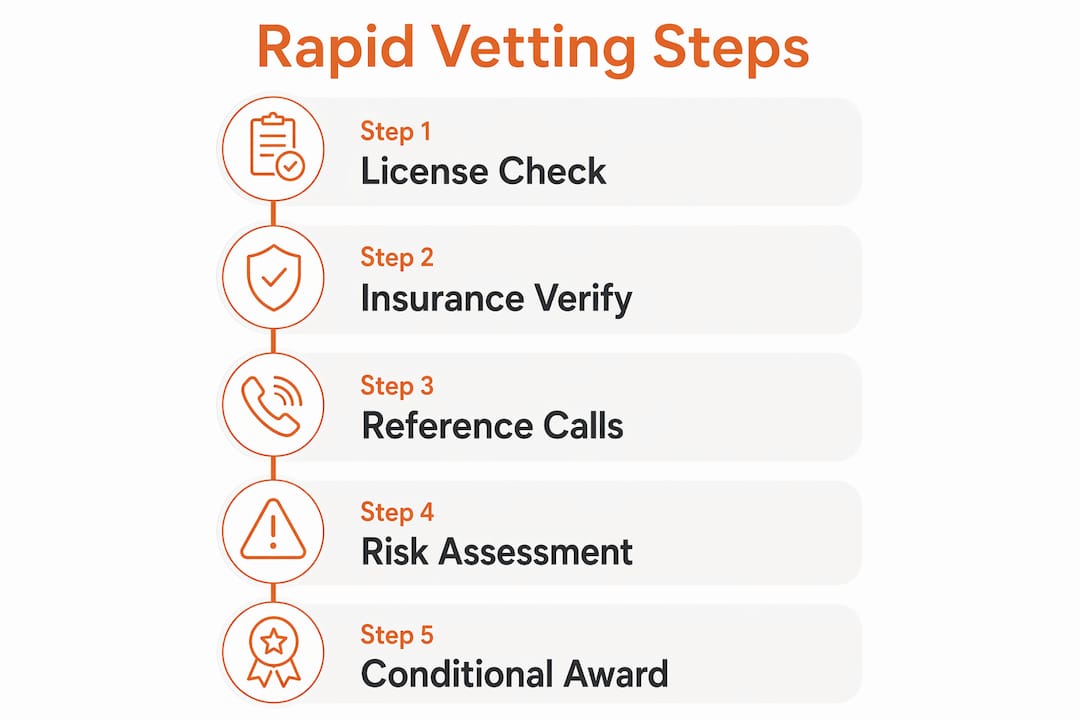
When a project is on the clock and you need a subcontractor now, use this three-step rapid vetting process: (1) run an immediate legal and insurance check in minutes, (2) confirm capacity and safety credentials within the first hour, and (3) issue a conditional award with monitored mobilization and escrowed holdbacks. That sequence is the shortest defensible path from unknown sub to boots on the ground.
Showstopper documents to confirm before anyone mobilizes:
- Active contractor license (verified via your state licensing board portal, not self-reported)
- Certificate of Insurance (COI) with direct insurer contact, correct additional insured wording, and policy dates that cover the full project duration
- Proof of workers’ compensation coverage, current and not lapsed
- Recent permit pull history in the jurisdiction (county or city portal, last 12–24 months)
- Experience Modification Rate (EMR) at or below 1.0, or a written explanation if above
- No open OSHA willful violations or active suspension flags
A streamlined urgent review can compress what normally takes 3–10 business days down to 1–2 days by focusing exclusively on these showstoppers and deferring full financial ratio analysis until after mobilization.
Pro Tip: Use a conditional award when you cannot complete every check before the mobilization date. A conditional award lets the sub begin limited, supervised scope while you complete the remaining verifications, with a contractual clause that allows immediate suspension if any showstopper fails. Never issue an unconditional award when insurance or license status is still unconfirmed.

Table of Contents
- Why does skipping rapid vetting cost more than doing it?
- What are the four pillars every subcontractor vetting must cover?
- How do you vet a subcontractor quickly when time is critical?
- How do you verify licenses, insurance, bonds, and safety records fast?
- What does a repeatable rapid vetting SOP look like for your team?
- What does the evidence say about the cost of fast vetting versus skipping it?
- What red flags should stop a hire or trigger a conditional award?
- Copy-and-paste vetting checklist and sample email for urgent requests
- Key Takeaways
- The part of emergency sourcing most GCs underestimate
- R. Construction Solutions cuts your emergency sourcing time significantly
- Useful sources for fast subcontractor verification
- FAQ
Why does skipping rapid vetting cost more than doing it?
Fast vetting prevents schedule slippage, legal exposure, and profit erosion. The math is straightforward: industry net margins for general contractors are commonly low, which means a single financially unstable subcontractor can erase an entire year of profit through delay claims, re-procurement costs, and liquidated damages.
Most GCs vet subs on price, relationships, and gut feel. That works until it doesn’t. When a sub runs out of cash mid-project, the GC absorbs the schedule hit, the lien exposure, and the cost of emergency re-procurement at premium rates. Mechanic’s liens filed by a sub’s unpaid material suppliers can cloud the owner’s title and trigger payment disputes that outlast the project by months.
Safety shortcuts compound the financial risk. A brief daily walk-through of subcontractor work areas costs several hours of staff time per week. A stop-work order triggered by an OSHA inspection, on the other hand, can delay a project by days or weeks, with ripple effects across every downstream trade.
The concrete consequences of skipping vetting:
- Liquidated damages assessed against the GC when a failing sub causes schedule overruns
- Extended credit exposure when the GC must front material costs for a cash-strapped sub
- Inspection failures tied to unlicensed work that require costly remediation
- Owner claims and contract termination when safety incidents occur on site
What are the four pillars every subcontractor vetting must cover?
These four pillars are the minimum for defensible vetting, even under time pressure: financial health, safety record, insurance and bonding, and experience with current capacity. In a true emergency, the depth of each check scales with available time, but none of the pillars disappears entirely.
Financial health
- Work-in-Progress (WIP) report: Confirms the sub is not dangerously overbilled relative to site progress. Request at least the most recent period.
- Pay patterns: Ask trade references specifically whether the sub paid their own suppliers and labor on time on recent jobs.
- D&B Paydex or bank reference: A Paydex score below 70 or a bank letter that hedges on creditworthiness is a yellow flag worth noting.
- Billing-ahead pattern: WIP reports that show consistent over-billing relative to installed work are the most reliable leading indicator of mid-project financial distress.
Safety record
- EMR (Experience Modification Rate) and Total Recordable Incident Rate (TRIR) for the last three years
- OSHA 300 logs for the most recent full year
- Documented site orientation history and toolbox talk records
- Minimum safety evidence in a rapid review: COI, workers’ comp clearance, EMR letter, and signed site safety acknowledgment
Insurance and bonding
- COI with carrier name, policy number, effective and expiration dates, and additional insured endorsement
- Verify directly with the insurer by phone or email — never rely solely on the certificate document
- Performance and payment bond capacity letter from a licensed surety if the scope exceeds your contract threshold
Experience and current capacity
- Permit pull history in the jurisdiction is more indicative of real capability than license database entries alone, because it shows the trades actually performed and recent activity
- Two trade references from projects of similar scope completed within the last 18 months
- Current equipment roster and confirmed crew headcount available for your start date
In a genuine emergency, defer the full D&B financial ratio review and detailed equipment audit until after conditional mobilization. The showstoppers — active license, valid COI with insurer verification, workers’ comp, and no OSHA willful violations — must be confirmed before anyone steps on site.
How do you vet a subcontractor quickly when time is critical?
Work through this timeboxed sequence. Each window has a clear owner and a minimum acceptable output.
0–10 minutes: License and insurance quick check
- Pull the sub’s license number and run it on your state contractor licensing board’s online portal.
- Confirm license classification covers the scope of work and that the license is active, not expired or suspended.
- Request the COI by email or text immediately. Confirm the insurer name and call the carrier’s verification line to confirm the policy is in force.
10–30 minutes: Permit history and capacity confirmation
- Search the county or city permitting portal for permits pulled under the sub’s license or company name in the last 12 months.
- Ask the sub directly: how many crews are currently deployed, and how many can be committed to your project by the start date?
- Request a signed statement of current workload and available manpower.
30–60 minutes: References and safety stats
- Call two trade references. Keep each call to five minutes using scripted questions (see Section 9 for the script).
- Request the EMR letter and most recent OSHA 300 log. Check the OSHA enforcement database for any willful citations.
- Confirm workers’ comp coverage with the carrier.
60–240 minutes: Conditional award paperwork and mobilization controls
- Issue the conditional award letter with explicit suspension clauses tied to any failed verification.
- Establish holdback or escrow terms in the subcontract for the first payment application.
- Assign a site superintendent or safety rep to conduct daily walk-throughs once the sub mobilizes.
Pro Tip: When calling references under time pressure, use three scripted questions: “Did they finish on schedule?”, “Did they pay their own subs and suppliers on time?”, and “Would you hire them again for a project of this size?” Three yes answers from two independent references is a defensible minimum for a conditional award.
How do you verify licenses, insurance, bonds, and safety records fast?
The fastest verification sources are your state licensing board’s online portal, direct insurer phone or email confirmation, the OSHA establishment search database, and county or city permitting portals. Each takes minutes when you know where to look.
Confirming a COI is valid:
- Match the insurer name on the certificate to the carrier you reach by phone. Ask for the policy number and confirm it matches.
- Verify the effective and expiration dates cover your full project duration.
- Confirm the additional insured endorsement names your company correctly.
- Ask whether the policy has any exclusions relevant to the scope (e.g., explosion, collapse, or underground work for excavation scopes).
State licensing boards and the OSHA enforcement database are publicly accessible and return results within minutes for most searches.
Pro Tip: Save a timestamped screenshot of every license lookup and log the insurer’s name, the representative’s name, and the call time when you verify a COI by phone. That record is your audit trail if a coverage dispute arises later.
| Document | Verification Source | Typical Turnaround | Minimum Acceptable Evidence |
|---|---|---|---|
| Contractor license | State licensing board portal | 2–5 minutes | Active status, correct classification |
| COI / general liability | Insurer phone or email | 10–30 minutes | Policy confirmed in force, correct dates and AI wording |
| Workers’ compensation | Carrier verification line | 10–30 minutes | Active policy, no lapse |
| Performance/payment bond | Surety agent confirmation | 30–60 minutes | Capacity letter from licensed surety |
| Permit pull history | County/city permitting portal | 5 minutes | Permits in trade and jurisdiction, last 12 months |
| EMR / safety record | Sub-provided letter + OSHA DB | 10–30 minutes | EMR ≤ 1.0, no willful OSHA citations |
What does a repeatable rapid vetting SOP look like for your team?
A named, timebound team with clear decision authority speeds urgent hires without sacrificing defensibility. Assign roles before the emergency arrives, not during it.
Role matrix:
- Estimator / procurement lead (0–30 min): Runs license lookup, requests COI, pulls permit history, initiates reference calls.
- Safety representative (0–60 min): Requests and reviews EMR letter, checks OSHA enforcement database, confirms workers’ comp, reviews site safety plan.
- Project manager (30–60 min): Reviews capacity statement, makes the conditional award decision, sets holdback terms.
- Legal / contracts (60–240 min): Drafts conditional award letter with suspension clauses, reviews bond capacity if required, files all verification records.
Decision authority: The PM holds the conditional award authority. The safety rep holds a hard veto on any sub with a willful OSHA violation or EMR above 1.25 without a documented corrective action plan.
Fallback options when a sub fails a showstopper check:
- Activate a secondary sourced sub from your pre-approved list (the strongest argument for maintaining a standing prequalified roster).
- Phase the scope: award the first mobilization segment to a qualified sub already on site and re-procure the balance.
- Issue a time-and-material arrangement with a trusted sub for the first 48–72 hours while full vetting completes.
AI-driven sourcing tools can accelerate shortlisting in the 0–30 minute window, but human verification of licenses, bonds, and insurance remains mandatory; no algorithm replaces a direct call to the insurer. For deeper integration of AI and ERP tools into your subcontractor management workflow, the technology is most effective when layered on top of a documented human SOP, not substituted for one.
What does the evidence say about the cost of fast vetting versus skipping it?
A vetted subcontractor reduces schedule risk and financial exposure in ways that show up directly on the project P&L. The 2–4% net margin reality means GCs have almost no buffer to absorb a mid-project sub failure. The cost of a two-day rapid vetting process is negligible against the cost of re-procurement, delay claims, and lien resolution.
Prequalification software with pre-built forms and scoring can reduce manual verification time, particularly for GCs managing multiple urgent hires simultaneously. The tools are most useful for document collection and tracking expiration dates; the judgment calls still belong to the PM and safety rep.
Key evidence points:
- A streamlined urgent review compresses standard 3–10 business day prequalification to 1–2 days by focusing on showstoppers.
- Daily brief walk-throughs cost several hours of staff time weekly and can prevent stop-work orders that delay projects by days or weeks.
- Permit pull history is a superior real-world indicator of trade competence versus static license database entries.
- AI-driven sourcing accelerates shortlisting but requires human document verification to be defensible.
Constructconnect-rconstructionsolutions, with 30+ years of AEC industry experience, provides pre-vetted subcontractor sourcing with documented verification trails, giving GCs a faster path to a defensible hire when internal bandwidth is thin. Rowena, whose practitioner perspective closes this article, has worked directly with GCs navigating emergency sourcing scenarios and brings that field-level insight to the guidance here.
What red flags should stop a hire or trigger a conditional award?
Any active license suspension, expired insurance, or evidence of insolvency is an immediate disqualifier. No conditional award, no phased scope, no exceptions.
Hard stop: If a subcontractor cannot produce a verifiable, in-force COI within two hours of your request on an urgent project, treat that as a disqualifier. A legitimate sub with active coverage can get you that document in minutes. Delay or evasion on insurance verification is one of the clearest signals that coverage may be lapsed or inadequate.
Disqualifiers (stop the hire immediately):
- Suspended or expired contractor license in the project jurisdiction
- COI that cannot be verified directly with the named insurer
- Active OSHA willful violation citations within the last three years
- Evidence of insolvency: recent mechanic’s liens filed against the sub, active judgment, or a bank reference that declines to confirm creditworthiness
Yellow flags (require conditional award or escalation to legal):
- No permit pull history in the jurisdiction for the relevant trade in the last 12 months
- EMR above 1.25 with no documented corrective action plan
- Heavy reliance on labor brokers with no direct-hire crew of their own
- No recent projects of similar scope or contract value
- Billing-ahead pattern flagged in WIP review
Ambiguous but serious signs:
- Thin manpower relative to the committed crew size (fewer than half the promised workers available at mobilization)
- References who hesitate on the “would you hire them again” question or qualify their answer
For root causes of subcontractor unreliability and how vetting addresses them systematically, that analysis supports the case for treating these yellow flags as seriously as hard disqualifiers on high-stakes projects.
Copy-and-paste vetting checklist and sample email for urgent requests
Required documents to request from the subcontractor:
- [ ] Active contractor license number and state (verified via portal)
- [ ] COI with carrier name, policy number, dates, and additional insured endorsement
- [ ] Workers’ compensation certificate with carrier contact
- [ ] W-9 (for payment processing)
- [ ] EMR letter from insurance carrier (last three policy years)
- [ ] Most recent OSHA 300 log
- [ ] Permit pull list or portal screenshot (last 12 months, project jurisdiction)
- [ ] Two trade references with direct contact numbers
- [ ] Signed site safety acknowledgment
- [ ] Bank reference letter or Paydex score (defer to post-mobilization if time prohibits)
Sample email to the subcontractor:
Subject: Urgent Document Request — [Project Name], Start Date [Date]
Hi [Name],
We are moving quickly on [Project Name] and need to confirm your qualifications before we can issue an award. Please send the following within two hours:
- COI naming [Your Company] as additional insured, with carrier contact information
- Active license number for [state/jurisdiction]
- EMR letter from your insurance carrier
- Two trade references from projects completed in the last 18 months
- Signed copy of our site safety acknowledgment (attached)
We will verify insurance directly with your carrier. Please confirm receipt of this email and your expected response time.
Thank you, [Your Name], [Title]
Scripted rapid-reference call (five minutes per call):
- “Did [Sub Name] complete their scope on schedule on your project?”
- “Did they pay their own suppliers and labor on time throughout the job?”
- “Would you hire them again for a project of similar size and complexity?”
File all responses with timestamps. Name files consistently: [SubName]_[DocumentType]_[Date] and store in the project’s compliance folder. Retain for a minimum of three years or per your contract’s record-keeping requirement, whichever is longer.
Pro Tip: For a ready-to-use subcontractor reliability checklist that aligns with this rapid vetting workflow, Constructconnect-rconstructionsolutions maintains downloadable templates built for field use.
Key Takeaways
Rapid subcontractor vetting for urgent projects requires timeboxed showstopper checks, a conditional award framework, and a named team with clear decision authority to protect schedule and margin without sacrificing defensibility.
| Point | Details |
|---|---|
| Compress to 1–2 days | Focus only on showstoppers; defer full financial ratio review until after conditional mobilization. |
| Verify insurance directly | Call the insurer to confirm the COI — never rely on the certificate document alone. |
| Permit history over license status | Permit pull history reveals actual trade activity and jurisdiction experience better than a license lookup alone. |
| Conditional award protects you | Issue a conditional award with suspension clauses when vetting is incomplete at mobilization time. |
| Constructconnect-rconstructionsolutions | Provides pre-vetted subcontractor sourcing with documented verification trails for GCs who need emergency sourcing support. |
The part of emergency sourcing most GCs underestimate
Speed pressure on urgent projects creates a specific cognitive trap: GCs treat the conditional award as the finish line when it is actually the starting gun for the most critical monitoring phase. The vetting you do in the first two hours is necessary, but what happens in the first two weeks of mobilization determines whether that hire holds or collapses.
The subs most likely to fail on urgent projects are not the ones who lied on their COI. They are the ones who were genuinely qualified at award time but overextended themselves across three simultaneous projects and started pulling crew from yours to cover a cash shortfall elsewhere. That pattern shows up in billing-ahead on WIP reports and in crew counts that drop below the committed number by week two. The construction planning tools that give you real-time project visibility are most valuable precisely here, in the monitoring phase after a rapid hire, not just in the sourcing phase before it.
The conventional wisdom says “vet fast, then trust.” The more defensible approach is “vet fast, then verify continuously.” Daily walk-throughs, weekly WIP reviews, and a standing escalation path to legal are not bureaucratic overhead on a tight schedule. They are the mechanism that makes a conditional award actually conditional.
R. Construction Solutions cuts your emergency sourcing time significantly
When your internal bandwidth runs out before your vetting checklist does, Constructconnect-rconstructionsolutions delivers pre-vetted subcontractors with documented verification trails already in place, so you are not starting from zero on an unknown sub at 7 AM on a mobilization morning.
With 30+ years of AEC industry experience and a prorated payment structure where you pay only for successful placements, Constructconnect-rconstructionsolutions gives GCs a faster path to a defensible hire without the full commission overhead of a traditional staffing agency. The pre-vetting work, the reference checks, the license and insurance confirmation, and the capacity verification are already done before a candidate reaches your desk.
For GCs managing urgent timelines, the emergency subcontractor sourcing process at Constructconnect-rconstructionsolutions is built for exactly this scenario. To request emergency sourcing support or explore the full recruiting services available for the AEC industry, reach out directly through the website.
Useful sources for fast subcontractor verification
These resources support the verification steps described throughout this guide. Bookmark them before you need them.
- OSHA Enforcement Database: Search by establishment name to find inspection history, citations, and willful violations. Results are available immediately and free.
- State contractor licensing portals: Each state maintains its own lookup. Search “[state name] contractor license lookup” to find the official board portal. Most return active/inactive status and license classification within two minutes.
- CheckLicensed: Aggregates license status, complaints, BBB history, and verified reviews across all 50 states into a single report, typically delivered within one hour during business hours.
- County and city permitting portals: Search “[county name] building permit search” to pull permit history by contractor name or license number. Turnaround is immediate for most jurisdictions with online portals.
- D&B Paydex / business credit: Dun & Bradstreet’s Paydex score reflects payment behavior to suppliers. A score of 80 or above indicates on-time payment; below 70 warrants a direct bank reference request.
- National Building Authority contractor vetting checklist: A structured checklist covering license, insurance, and safety verification steps, useful as a secondary reference for your team’s SOP.
- Subcontractor prequalification guidance (CFMA): The Construction Financial Management Association’s primer on prequalification covers financial review criteria and WIP analysis in depth.
Save a timestamped screenshot of every lookup and log insurer contact details at the time of verification. That documentation is your audit trail.
FAQ
What is the contractor vetting process for urgent projects?
Rapid contractor vetting focuses on three timeboxed steps: immediate license and insurance verification (0–10 minutes), capacity and safety confirmation (10–60 minutes), and a conditional award with monitored mobilization (60–240 minutes). A streamlined urgent review compresses standard 3–10 business day prequalification to 1–2 days by prioritizing showstoppers.
How do you verify a subcontractor’s license and insurance quickly?
Run the license number on your state contractor licensing board’s online portal (results in 2–5 minutes), then call the insurer listed on the COI directly to confirm the policy is active and the additional insured wording is correct.
What are the biggest red flags when hiring a subcontractor fast?
An active license suspension, a COI that cannot be verified with the named insurer, willful OSHA citations within the last three years, and no permit pull history in the relevant jurisdiction are immediate disqualifiers regardless of schedule pressure.
Can AI tools replace human verification when vetting subcontractors?
No. AI-driven sourcing tools accelerate shortlisting and document collection but cannot replace direct insurer confirmation, license board lookups, or a live reference call. Human verification of critical documents remains mandatory.
How does Constructconnect-rconstructionsolutions help with urgent subcontractor sourcing?
Constructconnect-rconstructionsolutions provides pre-vetted subcontractors with documented verification trails already completed, reducing the time a GC spends on license, insurance, and reference checks during emergency sourcing. Contact the team through the recruiting services page to request emergency sourcing support.