
Subcontractor Reliability Checklist for Construction Managers
A subcontractor reliability checklist is defined as a structured prequalification and ongoing monitoring framework that construction managers use to evaluate insurance, safety, financial health, and operational capacity before and during project execution. Used correctly, this checklist functions as a hard gate that stops unqualified subcontractors from reaching the jobsite. Construction managers who apply a formal subcontractor reliability checklist reduce schedule risk, protect against OSHA multi-employer citations, and build a defensible audit trail. Platforms like Procore and frameworks from Trueleveler and Bidi Contracting have formalized these criteria into repeatable processes that scale across project portfolios.
What should a subcontractor reliability checklist include?
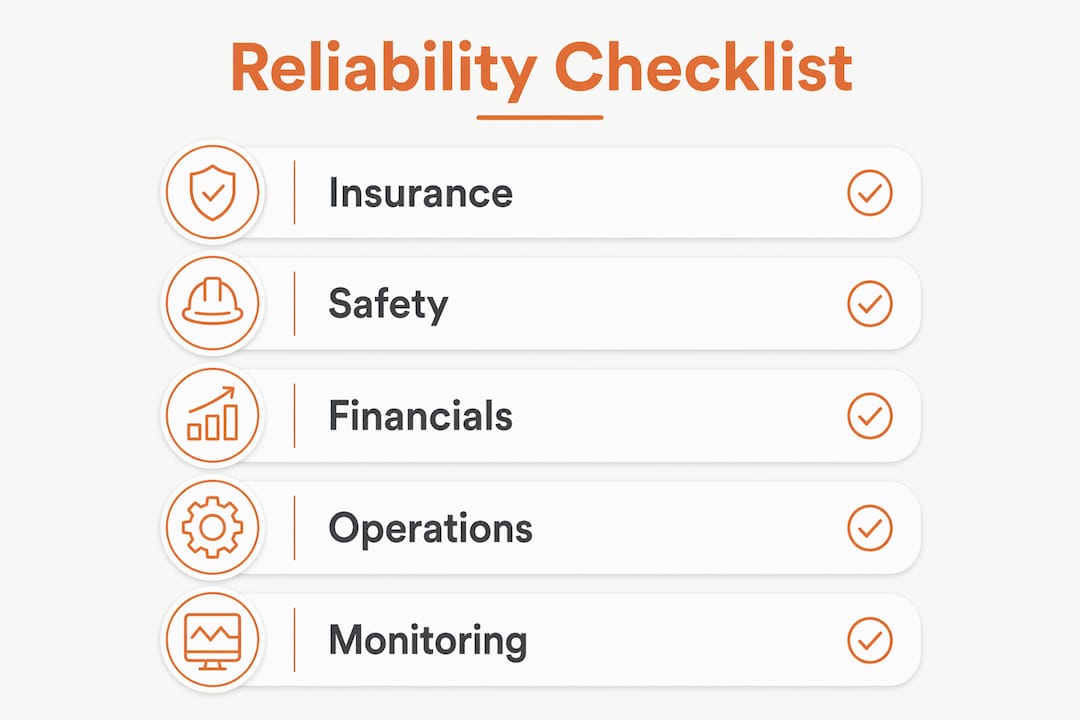
A complete reliability checklist covers five core categories: insurance and compliance, safety performance, financial health, operational capacity, and continuous monitoring. Each category functions as a gate, not a suggestion. A subcontractor who scores well on capability but carries lapsed workers’ compensation coverage is still a disqualifying risk. Trueleveler’s 2026 prequalification framework emphasizes six gates and continuous requalification to stop risk drift like coverage lapses or EMR creep. Construction managers who treat any single category as optional expose their projects to liability, delays, and cost overruns.

What are the essential insurance and compliance criteria?
Insurance verification is the first hard gate in any subcontractor vetting checklist. No contract should be executed and no work should begin until every required document is confirmed current and correctly structured.
The mandatory insurance types every construction manager must collect and verify include:
- General liability insurance: Minimum limits vary by contract value, but $1 million per occurrence is a standard floor for most commercial projects.
- Workers’ compensation: Required in every state for subcontractors with employees. Verify the policy covers all workers on your site, including temporary labor.
- Commercial auto: Covers vehicles used in connection with the project. Confirm it includes hired and non-owned auto coverage.
- Umbrella or excess liability: Provides coverage above primary policy limits. Higher-value contracts typically require $5 million or more in umbrella coverage.
- Professional liability: Required for design-build subcontractors or any trade providing engineered submittals.
The most common compliance failure is accepting a certificate of insurance (COI) without verifying the underlying endorsements. Certificates can be misleading; confirming additional insured status requires reviewing the actual endorsement form, not just the certificate summary. Contact the subcontractor’s insurer directly to verify that your company is named as an additional insured on the policy form itself.
Bonding requirements should be tiered by contract value. Bidi Contracting’s tiering framework recommends explicit thresholds, with higher-value contracts requiring performance and payment bonds plus audited financials. Document every verification step. Documented enforcement programs are a critical legal defense for controlling employers on OSHA multi-employer worksites.
Pro Tip: Set calendar alerts 60 days before every insurance policy expiration date. Automated reminders in platforms like Procore prevent coverage gaps from going unnoticed until a claim occurs.
| Document | Verification method | Common failure point |
|---|---|---|
| Certificate of insurance | Request endorsement forms from insurer | Additional insured listed on certificate only |
| Workers’ compensation | Confirm policy number with carrier | Policy excludes temporary or leased workers |
| Performance bond | Obtain bond form and surety contact | Bond amount insufficient for contract value |
| Business license | Check state licensing board directly | License expired or wrong trade classification |
How to evaluate subcontractor safety reliability beyond basic EMR scores
Experience Modification Rate (EMR) is a numerical score that compares a subcontractor’s actual workers’ compensation claims to the industry average. A score of 1.0 represents the industry average. Many owners require 1.0 or below for mid-tier contracts, and Bidi Contracting’s 2026 guidance identifies EMR thresholds between 1.0 and 1.25 as non-negotiables requiring three years of trend data. A single-year EMR snapshot can be misleading. A subcontractor with a 0.85 EMR this year but a rising trend from 0.72 three years ago is showing deterioration, not strength.
Assessing safety comprehensively requires layering outcome metrics with program evidence:
- Review three years of EMR data. Look for trends, not just the current number. Rising EMR signals a deteriorating safety culture.
- Pull OSHA 300 logs. These logs record every recordable injury and illness. Cross-reference them with the EMR to confirm consistency.
- Calculate the DART rate. DART (Days Away, Restricted, or Transferred) measures the severity of injuries, not just their frequency. A low OSHA 300 count with a high DART rate indicates serious incidents.
- Request the written safety program. A formal, current safety plan signals organizational commitment. An outdated or generic document is a red flag.
- Verify safety training records. Confirm that field workers hold current OSHA 10 or OSHA 30 certifications relevant to your project type.
- Assess safety leadership practices. Ask who conducts site safety audits, how often, and what happens when violations are found.
Trueleveler warns that a clean EMR alone is insufficient without underlying program evidence. A subcontractor can have a low EMR because they underreport incidents, not because their jobsite is safe. Safety must be assessed as a system, combining leading indicators like training and program quality with lagging indicators like EMR and DART rates.
Pro Tip: Build a single safety score by weighting EMR at 40%, DART rate at 30%, written program quality at 20%, and training verification at 10%. This prevents a strong EMR from masking a weak safety program.
Trigger events that force immediate requalification include any recordable fatality, a serious OSHA citation, or a lost-time injury rate spike within a 90-day window. Do not wait for the annual review cycle when a trigger event occurs.
What financial and operational factors belong in the checklist?
Financial health determines whether a subcontractor can complete your project without running out of cash. A subcontractor who wins a contract they cannot financially sustain will slow your schedule, file liens, and potentially abandon the work.
The financial documents every construction manager should collect include:
- CPA-prepared financial statements: At minimum, reviewed financials for the past two years. Audited financials for contracts above a defined value threshold.
- Bank reference letters: Confirm the subcontractor maintains adequate credit lines relative to the contract value.
- Bonding capacity letter: Issued by the surety, this confirms the maximum bond amount the subcontractor can obtain. Match this against your contract value.
- Trade and financial references: Contact at least three general contractors the subcontractor has worked with in the past 24 months.
Operational capacity is equally critical. A financially healthy subcontractor who is already committed to three other projects at full capacity cannot reliably staff yours. Confirm the specific superintendent or foreman assigned to your project by name. Verify that key personnel are not simultaneously assigned to competing projects. Check litigation history and lien filings through public court records. A pattern of lien claims against previous general contractors signals cash flow problems or billing disputes that will follow them to your project.
Scoring methods that include category minimum floors prevent a strong financial score from masking a disqualifying safety record. Set a minimum passing score for each category independently. A subcontractor must clear every floor, not just the overall average.
| Checklist category | Minimum document required | Escalation for high-value contracts |
|---|---|---|
| Financial health | Reviewed CPA financials | Audited financials plus bank letter |
| Bonding capacity | Surety capacity letter | Performance and payment bond executed |
| References | Three GC references | Five references plus site visits |
| Litigation history | Public records search | Attorney review of open claims |
Platforms like Procore’s prequalification solution centralize document collection, form review, and approval workflows. This removes the spreadsheet gaps that cause documents to expire unnoticed and approvals to stall in email chains.
How to maintain subcontractor reliability during the project lifecycle
Passing initial prequalification does not guarantee ongoing performance. Continuous requalification and event-driven triggers are critical for sustained reliability throughout the project lifecycle.
Annual requalification is the baseline standard. Every subcontractor on your approved list should submit updated insurance, financials, and safety data once per year. Stale prequalification data is a documented risk factor. A subcontractor who passed your checklist 18 months ago may have since experienced a major safety incident, lost key personnel, or taken on debt that threatens their bonding capacity.
Out-of-cycle requalification triggers include:
- A recordable fatality or serious OSHA citation on any project
- A lien claim filed against a general contractor on a current or recent project
- Key personnel changes, including the loss of the named superintendent or safety officer
- A merger, acquisition, or ownership change
- Any report of financial distress, including missed payroll or supplier disputes
The mobilization hold is best practice for managing compliance at project start. Subcontractors cannot begin work or attend kickoff meetings until all verified documentation is complete and logged. This sets a clear, documented compliance start date and removes ambiguity about when your obligations as a controlling employer began.
Pro Tip: Assign one team member as the compliance owner for each active subcontractor relationship. That person owns document renewal tracking, trigger event monitoring, and requalification initiation. Distributed responsibility means no one owns it.
Centralized platforms like Procore create a defensible audit trail by timestamping every document submission, approval, and expiration. This record is your primary defense in an OSHA audit or subcontractor dispute. Understanding why subcontractors miss deadlines often traces back to gaps in this ongoing monitoring process.
Key Takeaways
A subcontractor reliability checklist works only when every category functions as a hard gate, continuous monitoring replaces one-time screening, and digital platforms like Procore enforce document currency across the project lifecycle.
| Point | Details |
|---|---|
| Insurance is a hard gate | No contract or mobilization proceeds without verified endorsements, not just certificates. |
| EMR alone is insufficient | Combine EMR trends, DART rates, OSHA 300 logs, and written program quality for a complete safety picture. |
| Financial floors prevent masking | Set minimum passing scores per category so strong financials cannot offset a disqualifying safety record. |
| Requalification must be event-driven | Annual reviews miss risk drift; trigger events like lien claims or personnel changes require immediate requalification. |
| Digital platforms close the gaps | Tools like Procore centralize approvals, track expirations, and build the audit trail that protects you legally. |
What I’ve learned from watching checklists fail in the field
Construction managers often treat the prequalification checklist as a one-time administrative task rather than a living risk management system. That is where most reliability failures begin. I have seen projects stall because a subcontractor’s workers’ compensation policy lapsed two months after mobilization and nobody caught it until a worker was injured on site. The certificate was on file. The endorsement had never been verified.
The cultural challenge is real. Subcontractors push back on documentation requests, especially smaller firms who view the process as bureaucratic friction. The construction managers who handle this best frame compliance as a mutual protection conversation, not an interrogation. They explain that verified documentation protects the subcontractor from liability disputes as much as it protects the general contractor.
Requalification triggers are where I see the most silent risk accumulation. A subcontractor who sailed through initial prequalification two years ago may have since lost their safety director, taken on three overlapping contracts, and filed two liens against other GCs. None of that shows up in your file unless you built a trigger-based monitoring system. Technology closes that gap, but only if someone owns the process. Assign accountability, not just access.
— Rowena
How Constructconnect-rconstructionsolutions supports your subcontractor vetting process
Constructconnect-rconstructionsolutions brings over 30 years of AEC industry experience to the challenge of finding and vetting reliable subcontractors and field personnel. When your AEC recruiting needs extend beyond a checklist to sourcing pre-vetted candidates who meet your compliance standards from day one, the team at R. Construction Solutions delivers.

Their prorated payment structure means you only pay for successful placements, and their lower commission rates make expert sourcing accessible for projects of all sizes. Whether you need a qualified superintendent with Procore experience or a safety officer with OSHA 30 certification, Constructconnect-rconstructionsolutions connects you with candidates who arrive already screened against the criteria your checklist demands. Contact R. Construction Solutions to discuss how their sourcing process complements your subcontractor qualification process and reduces the time you spend chasing documentation.
FAQ
What is a subcontractor reliability checklist?
A subcontractor reliability checklist is a structured framework construction managers use to evaluate insurance, safety records, financial health, and operational capacity before awarding work. It functions as a prequalification gate that prevents unqualified subcontractors from reaching the jobsite.
How often should subcontractors be requalified?
Subcontractors should be requalified annually at minimum. Out-of-cycle requalification is required when trigger events occur, including serious safety incidents, lien claims, key personnel changes, or ownership transfers.
Why is EMR not enough to assess subcontractor safety?
EMR measures past claims outcomes but does not reveal whether a subcontractor has a functioning safety program. Construction managers should cross-reference EMR with DART rates, OSHA 300 logs, written safety programs, and training records for a complete assessment.
What is a mobilization hold?
A mobilization hold means a subcontractor cannot begin work or attend project kickoff until all required compliance documents are verified and logged. It establishes a clear, documented compliance start date and protects the general contractor in OSHA audits.
Which digital platforms support subcontractor prequalification?
Procore offers a dedicated prequalification solution that centralizes document collection, form review, and approval workflows. It removes spreadsheet gaps, tracks document expirations, and creates a timestamped audit trail for every subcontractor relationship.