
30+ Years: GC Focused Steps to Get Construction Vendors Approved Fast
Getting approved starts with one submission: a complete prequalification packet containing audited or reviewed financial statements, a surety bonding letter, current insurance certificates, EMR and OSHA 300 records, a capability statement, and three to five supplier references. Send it to the general contractor’s estimating team, register on the GC’s vendor portal, and any bidding platforms they use, then follow up within a week. Everything else in the vendor application process flows from getting that packet right the first time.
TL;DR:
- Most GCs prefer reviewed or audited financial statements for contracts over six figures, making compiled statements less acceptable for larger bids.
- Keeping insurance certificates current, financials within 12 months, and safety records organized is crucial to avoid rejection at the initial review stage.
- Building a complete, searchable prequalification packet in PDF format, with updated references and safety data, significantly speeds up approval.
- Registering on multiple vendor portals and maintaining active communication with estimating teams enhances visibility and follow-up chances.
- Engaging a sourcing firm can optimize the approval process by connecting firms directly with GCs actively seeking pre-vetted subcontractors.
Table of Contents
- What Documents Do You Need to Become an Approved Vendor in Construction?
- How Do General Contractors Evaluate Subcontractors and Suppliers?
- Preparing Financials, Bonding, and Safety Evidence That Pass Review
- How to Submit, Register, and Follow Up With General Contractors
- Practical Priorities From a Sourcing Specialist
- How Constructconnect-rconstructionsolutions Helps You Get on the Approved Vendor List
- Sources
- FAQ
What Documents Do You Need to Become an Approved Vendor in Construction?
General contractors reviewing a new subcontractor or supplier don’t read a resume. They read evidence, and the packet either proves you can finish the job without blowing up their schedule or it doesn’t. GCs routinely request financial statements, bonding letters, insurance certificates, safety records, and references before they’ll even consider a bid invitation.
Here’s what belongs in the packet, in the order a reviewer typically wants to see it:
- Cover sheet and company overview: one page, license numbers, years in business, primary trades or scope.
- Capability statement: a concise summary of your services, certifications, bonding capacity, and three to five representative projects with contract values.
- Financial statements: reviewed or audited preferred, current within 12 months.
- Surety bonding letter: states your aggregate and single-project bonding limits.
- Certificate of insurance: general liability, workers’ comp, auto, and umbrella limits clearly listed.
- EMR letter and OSHA 300 logs: last three years where available.
- Supplier and banking references: names, phone numbers, and account history, not just a logo list.
Build the packet as a single searchable PDF with bookmarked tabs matching that order, and name the file clearly, for example “CompanyName_Prequal_2026.pdf.” Keep a master version on hand, then trim it to match whatever prequalification questionnaire the specific GC provides. Most rejections at this stage aren’t about qualifications at all. They happen because financials are two years old, the insurance certificate has expired, or the file is a scanned image nobody can search. Fix those three issues and you clear the first hurdle almost automatically.
Pro Tip: Keep a “bid-ready” folder updated quarterly, not annually. When an estimator asks for your packet on a Friday afternoon with a Monday deadline, you want to attach a file, not spend the weekend rebuilding one.
How Do General Contractors Evaluate Subcontractors and Suppliers?
Every serious prequalification process scores three things: capacity, capital, and character. Miss one, and even a strong bid gets set aside.
Capacity covers whether you can actually take on the work. GCs look at your current backlog against your crew size and equipment, and they want to see a track record of scaling up without subcontracting out half the job to someone they haven’t vetted. A firm with three open projects and six employees raises a flag before the estimator even finishes reading page two.
Capital is financial stability, and GCs weigh it heavily because it determines whether you can carry project float and pay your own suppliers without a GC’s cash flow bailing you out. That’s why bonding capacity and banking relationships are scrutinized as closely as your bid price. Reviewers commonly check:
- Current ratio and working capital against contract size.
- Bonding limits relative to the project’s value.
- Banking reference letters confirming credit lines and account standing.
Character and safety rounds out the score: your EMR, OSHA history, any liens or litigation, and how past project owners describe your performance. Here’s the part most subs underestimate. GCs often trust a call to your material suppliers more than a call to another GC who liked working with you, because suppliers know exactly how fast you pay and under what pressure. A friendly GC reference is nice. A clean supplier payment history is proof.
Preparing Financials, Bonding, and Safety Evidence That Pass Review
Not every financial statement carries the same weight, and knowing the difference saves you a rejection letter. A compiled statement is essentially your bookkeeper’s summary with no verification attached. A reviewed statement means a CPA has applied analytical procedures and limited inquiry. An audited statement means the CPA has independently verified balances and transactions. For smaller residential or light commercial work, compiled statements sometimes pass. For anything approaching six or seven figures in contract value, most GCs prefer reviewed or audited statements, and compiled-only statements are a common reason larger contracts get rejected at prequal before bidding even opens.
If you don’t have audited financials yet, here’s a practical path forward:
- Ask your accountant what a step up from compiled to reviewed would cost. It’s usually far less than the revenue you’d lose from being locked out of mid-size bids.
- Request a bonding letter from your surety that states your aggregate limit, single-project limit, and current bond utilization. Vague letters get questioned.
- Line up two banking reference letters confirming your credit line and account history. These carry weight precisely because a bank has no incentive to inflate your standing.
- Calculate your TRIR and DART rates from your OSHA logs rather than handing over raw pages. Most GCs set EMR expectations between 0.85 and 1.0, and if you’re above that band, attach a one-page narrative explaining the incident, the corrective action taken, and your rate trend since.
A GC that sees a clear improvement story, not just a bad number sitting alone, treats a marginal EMR very differently than one with no explanation attached.
How to Submit, Register, and Follow Up With General Contractors
Getting the packet right doesn’t matter if it never reaches the right desk. Registration and outreach are what convert paperwork into bid invitations.
- Complete your profile on major project intelligence platforms and on each GC’s own vendor portal. Half-filled profiles rank lower in searches estimators run when they’re building a bid list.
- Keep licenses, insurance dates, and bonding limits current in every portal, not just your master file. Outdated profiles are the fastest way to get skipped when an estimator is filtering candidates.
- Reach out to the estimating team directly before bid day. Ask how they prefer to receive documents, PDF email, portal upload, or a shared drive, and follow their format exactly.
- Attend pre-bid meetings when you can. Face time with an estimator does more for your standing than another polished email.
- Follow up within a week of submitting, and again after the bid closes, regardless of outcome. Responsiveness signals reliability just as much as your numbers do, and it’s what moves you from a one-time bidder to a preferred subcontractor.
A detailed prequalification checklist can help you track which portals and GCs still need updated documents each quarter.
Practical Priorities From a Sourcing Specialist
After more than 30 years connecting AEC firms with vetted subcontractors and suppliers, a pattern holds steady: the subs who get approved fastest aren’t necessarily the biggest, they’re the ones who removed friction from the process. GCs don’t reward the most polished capability statement; they reward the one that answers every question before it’s asked.
Three moves speed approval more than anything else. First, get to reviewed or audited financials, or attach a clear mitigation letter if you’re not there yet. Second, keep supplier payment records and banking references clean and easy to verify, since that’s the call GCs actually make. Third, treat your capability statement as a living document, updated the moment a certification or project completes, not once a year.
For subs without an internal team to manage that constant upkeep, working with a firm that already maintains pre-vetted supplier and subcontractor relationships can shortcut months of cold outreach.
— Rowena
How Constructconnect-rconstructionsolutions Helps You Get on the Approved Vendor List
Some recruiting and sourcing firms exist because most subcontractors don’t have a full-time staff member whose only job is chasing prequalification paperwork and GC relationships. These firms connect suppliers and subcontractors directly to GCs and construction firms actively looking for pre-vetted partners, with fee structures designed to align payment with successful connections.

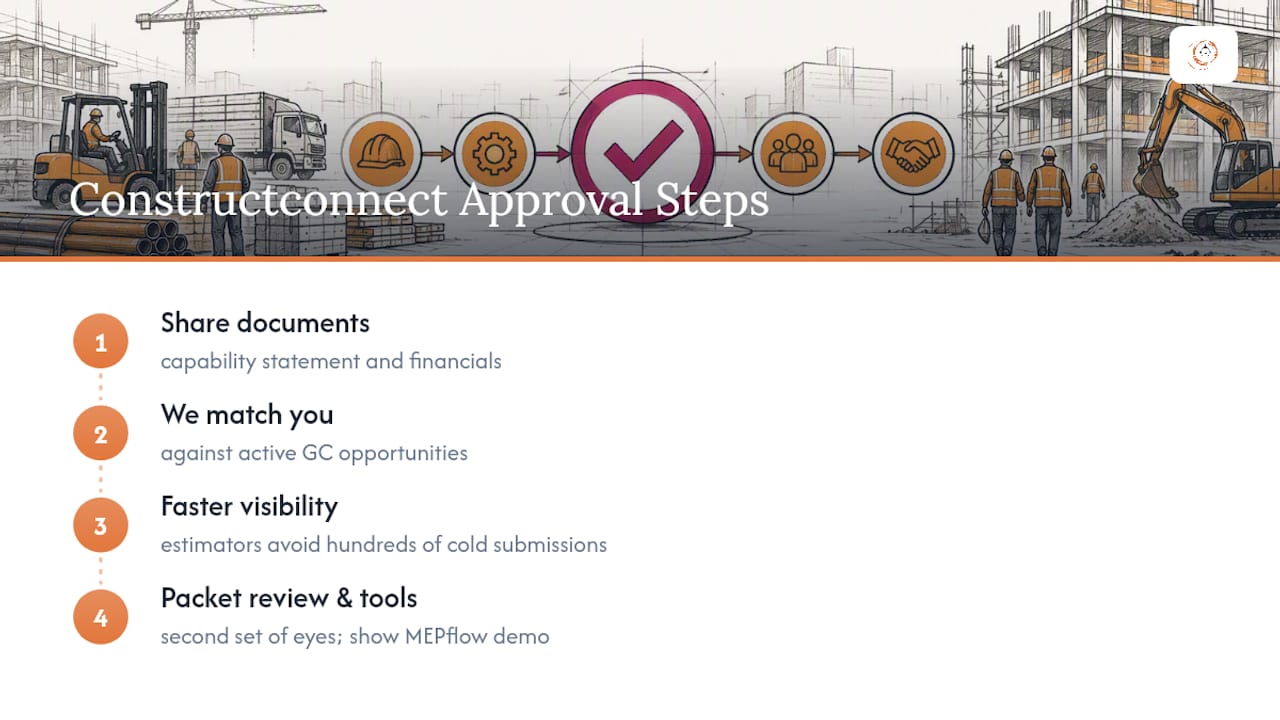
Engaging is straightforward: share your current capability statement and financial standing with our team, and we match you against active opportunities with GCs already searching for firms like yours. That gets you faster visibility with estimators who are otherwise sorting through hundreds of cold submissions, and it gives your packet a second set of eyes from people who’ve reviewed thousands of them. If modernizing your field operations is part of your prequal story, tools like MEPflow can help demonstrate the kind of real-time job visibility GCs increasingly expect from trade subcontractors.
Start with our Recruiting Services page and tell us where you’re stuck in the approval process. We’ll tell you honestly whether we can help.
Sources
For deeper document-by-document guidance, Blueprint Bonds’ packet walkthrough covers financial statement tiers and bonding letters in detail. Corpay’s payment-risk vetting guide explains how GCs weigh supplier calls. For a downloadable reference checklist, see our subcontractor reliability checklist, and suppliers of equipment should review our equipment vendor prequalification checklist.
- How to build a perfect prequal packet that passes
- Best practices in construction subcontractor prequalification
- Subcontractor prequalification: How general contractors vet subcontractors for payment risk
- How to connect with GCs who need subcontractors: A 2026 playbook
FAQ
What Is the First Step to Become an Approved Vendor in Construction?
Assemble a complete prequalification packet, financials, bonding letter, insurance, EMR/OSHA records, and a capability statement, then register on the GC’s vendor portal and contact the estimating team directly. Most GCs won’t consider a bid invitation without that packet on file first.
Do I Need Audited Financial Statements to Get Prequalified?
Not always, but larger GCs and bigger contracts typically prefer reviewed or audited statements over compiled ones. If you only have compiled statements, attach a note explaining your plan to move to a reviewed statement and lean on strong banking references in the meantime.
What EMR Score Do General Contractors Expect?
Most GCs set their EMR threshold somewhere between 0.85 and 1.0. If your score sits above that range, include a short narrative describing the incident, the corrective action taken, and how your rate has trended since.
How Long Does Vendor Approval Usually Take After Submission?
Timelines vary by GC and project size, but incomplete packets are the biggest cause of delay. Submitting a fully organized packet on the first pass, with current insurance and financials, is the single fastest way to move through review.
Can a Recruiting Firm Help Me Get Approved Faster?
A firm with existing GC relationships, like Constructconnect-rconstructionsolutions, can shortcut the cold-outreach phase by connecting your capability statement directly to GCs already sourcing subcontractors and suppliers. That doesn’t replace strong financials or safety records, but it does get your packet in front of the right estimator faster.