Equipment Vendor Prequalification: A Procurement Checklist
Require an evidence-backed prequalification package from every equipment vendor before you sign anything: a current certificate of insurance with correct additional insured language, a safety record with your EMR threshold documented, financial capacity proof, an equipment list with maintenance history, and three verifiable references. Verify the package, don’t just collect it. That verification step, not the paperwork itself, is where most procurement teams cut corners and pay for it later during mobilization.
Start today with these five moves:
- Pull the certificate of insurance first. Check the additional insured wording specifically. This is the single most common disqualifier, because vendors routinely submit a generic COI that doesn’t name your company or project correctly.
- Request the EMR (Experience Modification Rate) and three years of OSHA logs. Compare against your internal threshold, typically 1.0 or below for most general contractors.
- Ask for an equipment list with serial numbers and maintenance logs, not a marketing brochure. Vendors who can’t produce this in 48 hours usually can’t produce the equipment on time either.
- Collect two to three recent project references and actually call them. Ask about breakdowns, not just delivery dates.
- Set a verification deadline of 5 to 10 business days for standard equipment vendors, longer for specialty crane or hoisting suppliers with more documentation to check.
| Point | Details |
|---|---|
| Insurance certificate first | Verify additional insured language names your company correctly before reviewing anything else. |
| EMR and safety history | Compare the vendor’s Experience Modification Rate against your internal threshold, commonly 1.0 or below. |
| Equipment list with serials | Require actual maintenance logs and serial numbers, not promotional equipment lists. |
| Reference calls, not just names | Call two to three recent clients and ask specifically about breakdowns and response time. |
| Faster sourcing option | Constructconnect-rconstructionsolutions connects project teams with pre-vetted equipment suppliers, cutting the initial vetting workload. |
Key Takeaways
Effective equipment vendor prequalification depends on verifying insurance, safety history, financial capacity, and references before award, not just collecting the paperwork.
| Point | Details |
|---|---|
| Verify, don’t just collect | Call the insurance carrier and references directly rather than trusting self-reported documents. |
| Score against a weighted rubric | Use categories like safety (—), insurance (—), financial capacity (—), and technical capability (—) for consistent decisions. |
| Build timelines into procurement milestones | Budget 5 to 10 business days for full verification, longer for crane or specialty equipment audits. |
| Watch financial statement schedules | Missing depreciation schedules are a common, avoidable disqualifier on higher-value contracts. |
| Use a pre-vetted network to cut workload | Constructconnect-rconstructionsolutions connects project teams with pre-vetted equipment suppliers to reduce vetting time on new sourcing. |
Table of Contents
- What Is Equipment Vendor Prequalification and Why Does It Matter?
- Which Vendor Types Need Full Prequalification?
- What Documents Should You Require From Equipment Vendors?
- How Should You Score and Verify Prequalification Submissions?
- How Do You Manage the Vendor Submission and Approval Process?
- How Long Does Prequalification Take and Who Pays for It?
- What Are the Most Common Prequalification Mistakes?
- What Should a Prequalification Checklist and Questionnaire Include?
- What Does the Research Say About Effective Prequalification?
- Real-World Tradeoffs Procurement Teams Face
- How R. Construction Solutions Helps You Skip the Slowest Parts of Vendor Vetting
- Where to Find Official Prequalification Requirements and Guidance
- Sources
- FAQ
What Is Equipment Vendor Prequalification and Why Does It Matter?
Equipment vendor prequalification is the structured process of verifying an equipment supplier’s insurance, financial stability, safety record, and technical capability before they’re invited to bid or awarded work. It’s distinct from general contractor prequalification and subcontractor vetting, though the mechanics overlap. The goal isn’t paperwork for its own sake. It’s risk transfer and schedule protection, done before the crane shows up without a certified operator or the rented compressor breaks down in week two with no service agreement in place.
Project teams that skip this step and go straight to price comparison tend to discover the gaps at the worst possible moment: during mobilization, when a schedule slip costs real money every day. Materials and equipment often represent a majority of total capital project costs, which is exactly why supplier qualification carries outsized weight in controlling cost, schedule, and risk on any job where equipment reliability drives the critical path.
The core objectives of a solid prequalification process are straightforward:
- Reduce onsite risk by confirming a vendor’s safety program and insurance actually cover the exposure your project creates.
- Ensure equipment availability and spec compliance so the machine that shows up matches what was bid, not a substitute model with different lift capacity or fuel type.
- Protect contract schedule and budget by catching financial instability or capacity gaps before they become a mid-project surprise.
Here’s where prequalification earns its keep in practice. A superintendent orders a specialty compaction roller for a paving package, and the vendor’s equipment list on file shows two units of that model at a nearby yard. Without prequalification, that claim goes unverified until the truck doesn’t show. With it, someone already confirmed serial numbers and maintenance dates weeks earlier, and the backup unit is already identified.
Materials and equipment purchasing decisions shape a project’s cost trajectory long before the first piece of gear arrives onsite, which is why treating supplier qualification as a formality rather than a control point tends to backfire on schedule-sensitive work.
Which Vendor Types Need Full Prequalification?
Not every equipment purchase warrants the same scrutiny. A one-off rental of a pressure washer doesn’t need the same file as a tower crane supplier working a high-rise for 18 months. Here’s how to sort them.
- Equipment rental companies supplying critical-path machinery (cranes, excavators, aerial lifts used for extended durations) should go through full prequalification, including insurance verification, maintenance history, and operator certification review.
- Specialty equipment suppliers providing purpose-built or hard-to-replace equipment (tunnel boring machines, specialty pumps, custom formwork systems) need full review, given the difficulty of finding a substitute mid-project.
- Equipment repair and service vendors who maintain your critical machinery deserve scrutiny on response time guarantees and parts availability, not just insurance.
- Crane and hoisting vendors require the deepest review of any category, given the safety exposure. Operator certifications, rigging plans, and insurance limits all need independent verification, not a self-reported checkbox.
- Long-lead suppliers for equipment with extended manufacturing or delivery timelines need financial stability checks specifically, since a supplier’s cash flow problems can delay delivery months before anyone notices.
- Turnkey equipment contractors who both supply and install equipment (mechanical systems, specialty elevators) need the combined scrutiny of a supplier and a subcontractor, since they carry both product and installation liability.
The decision on how deep to go usually comes down to three questions: how much is at stake financially, how exposed is the site to safety risk from this equipment, and how often will you need this vendor’s service during the project. A one-time rental of a low-risk accessory, like a small generator for temporary power, rarely needs the full package. A crane vendor working your structure phase always does. If you’re also formalizing how subcontractors get approved for a project, the process for qualifying subcontractors before project start runs on a similar logic, just with different documentation weight.
What Documents Should You Require From Equipment Vendors?
The documentation list below covers what most procurement teams should request as a baseline, adjusted up or down by project risk.
- Certificate of insurance with general liability, auto, and workers’ compensation limits stated explicitly, plus correct additional insured wording naming your company and project.
- Equipment list with serial numbers matched to a maintenance log, not a generic catalog of what the vendor “can access.”
- Operator certifications for any equipment requiring licensed operation, particularly cranes and heavy lifting equipment.
- OEM service agreements proving the vendor has manufacturer-backed support, not just a handshake deal with a local mechanic.
- Financial statements or credit references, audited for higher-value contracts and reviewed statements acceptable for smaller ones.
- Safety program documentation including written safety plans, EMR, and three years of OSHA incident history.
- References from recent, comparable projects, ideally ones involving similar equipment types and project scale.
Vendor prequalification submissions typically move through third-party contractor management platforms, and documentation gaps, not actual safety performance problems, cause most approval failures. A vendor with a genuinely solid safety record still gets rejected because their COI expired last month or their EMR reporting doesn’t cover the right policy period.
On minimum thresholds: most general contractors set an EMR ceiling around 1.0, though high-risk trades sometimes flex to 1.2 with compensating controls. Insurance limits commonly run $1 million per occurrence and $2 million aggregate for general liability, higher for crane and hoisting work. Financial statement requirements typically scale with contract value: reviewed statements might suffice under $500,000, while audited statements become standard above that threshold.
Pro Tip: Ask specifically for the equipment depreciation schedule inside the financial statements, not just the summary sheet. Missing depreciation schedules are one of the most common reasons a technically qualified vendor gets flagged during document review, even when their overall financials look fine.
Watch for these red flags during review: an insurance certificate that expired within the last 30 days, an EMR above your threshold with no explanation of corrective action, maintenance logs that stop abruptly six months ago, or references that can’t be reached after two attempts. Any one of these should trigger a follow-up request before rejection, not automatic disqualification. Sometimes a vendor’s paperwork is sloppy even when their operation isn’t.

How Should You Score and Verify Prequalification Submissions?
A scoring rubric turns subjective “gut feel” decisions into something defensible and repeatable. Weight categories according to what actually drives risk on your project, not a generic template pulled from a different industry.
For high-value equipment categories, like tower cranes or specialty foundation equipment, weight safety and technical capability more heavily, since the downside of a failure is catastrophic rather than just costly. For low-value, low-risk categories, like small tool rentals, a lighter version of this matrix, focused mainly on insurance and basic references, is often enough.
Verification steps should include:
- Cross-check the insurance certificate directly with the carrier, not just the paper the vendor provided.
- Call at least two of the three references and ask pointed questions about breakdowns and response time, not just “would you use them again.”
- For crane, hoisting, or specialty equipment, schedule a physical equipment or site audit before final approval.
- Confirm financial statements match the format required for your contract threshold (audited versus reviewed).
- Log the verification date and reviewer name for every check, since this record matters if a dispute arises later.
Supplier qualification practices in capital projects commonly rely on early engagement and segmentation, meaning you tailor how deep you go based on project criticality rather than applying one uniform standard to every vendor regardless of risk.
How Do You Manage the Vendor Submission and Approval Process?
Prequalification only works as an operational system if someone owns each step and the handoffs are clear. Here’s a workable process flow:
- Invite vendors to submit a prequalification package, typically through a shared portal or standardized document request.
- Collect the package and confirm nothing is missing before starting substantive review.
- Complete a preliminary review for obvious disqualifiers, like expired insurance, before investing time in deeper verification.
- Verify the substantive claims: call the carrier, call references, check financial statement format.
- Score the submission against your rubric and document the result.
- Approve, conditionally approve, or reject, with a clear written reason attached to any conditional or rejected outcome.
- Monitor ongoing performance after approval, since a vendor’s status shouldn’t be static for the life of a multi-year contract.
Roles typically break down this way:
- Procurement owns the invitation, collection, and initial screening.
- Project managers weigh in on technical capability and schedule fit, since they understand what the equipment actually needs to do onsite.
- Site safety leads review the safety program and OSHA history in detail, not just a summary.
- Legal or insurance reviewers confirm coverage language and bonding capacity meet contract requirements.
Most mid-size and larger firms manage this through a vendor management platform rather than email threads and shared drives, since document retention and expiration tracking get unmanageable fast otherwise. Basic vetting checks against public fraud databases, like the resources published through Ic3, add a useful layer when a vendor’s documentation arrives electronically and something about the paperwork feels off. When a vendor disputes a score, build in a formal appeal path: a second reviewer, a defined response window, and a documented final decision, so the process stays defensible.
How Long Does Prequalification Take and Who Pays for It?
Timelines vary by equipment category and how much verification depth the project demands.
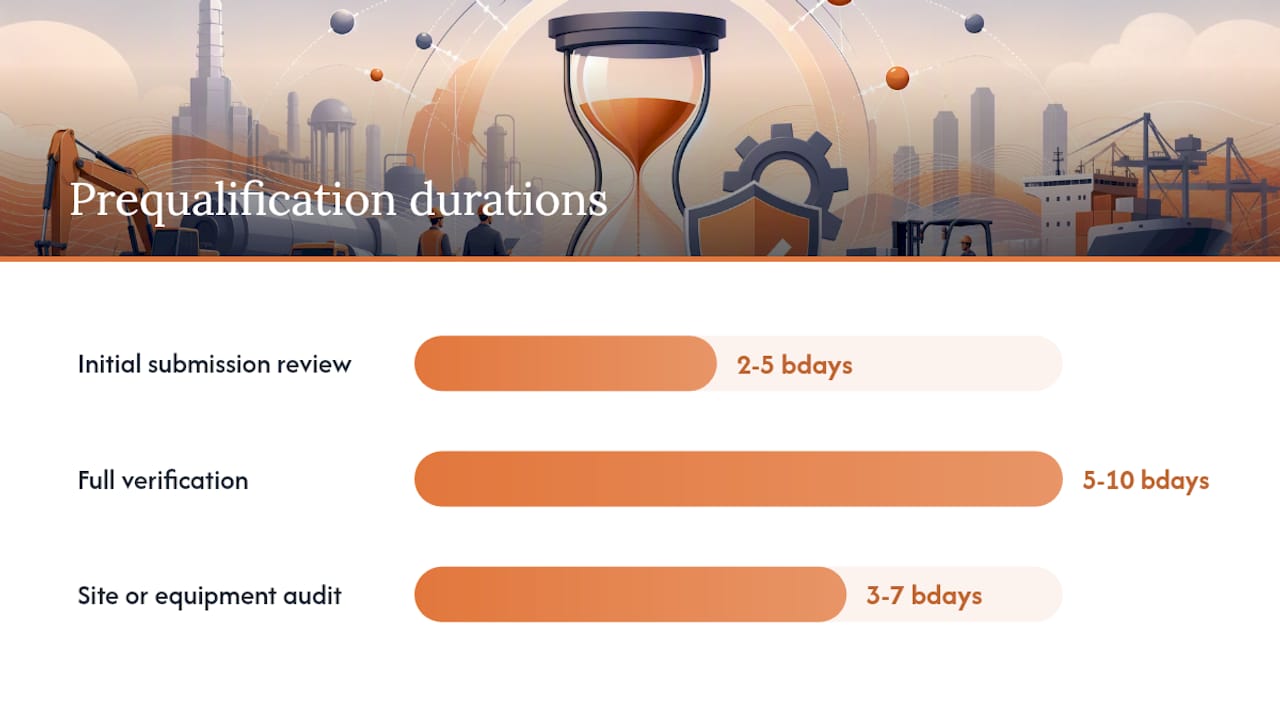
| Prequalification stage | Typical timeline |
|---|---|
| Initial submission review | 2 to 5 business days |
| Full verification (insurance, references, financials) | 5 to 10 business days |
| Site or equipment audit (crane, specialty equipment) | Add 3 to 7 business days |
| Requalification / renewal cycle | Annually, or per contract term |
Cost responsibility splits a few different ways depending on how your firm structures procurement. Some general contractors absorb the internal review labor as a cost of doing business, treating it as standard procurement overhead. Others require vendors to cover third-party platform fees for submitting and maintaining their prequalification documents, which shifts the administrative cost to the supplier side. A smaller number of clients pay for independent verification services directly, particularly on public projects where audit trails matter for compliance.
State agencies often formalize this cadence explicitly. Public works prequalification packets, like the one published by Rhode Island’s Division of Purchases, require detailed financial, safety, and litigation histories with periodic reapplication built into the contract terms, and they specify exact thresholds for audited statement requirements.
Build these timelines directly into your procurement milestones, not as an afterthought after the bid is awarded. If your crane vendor needs a 10-day verification window plus a site audit, and you don’t start that process until two weeks before mobilization, you’ve already created a schedule risk that prequalification was supposed to prevent.
What Are the Most Common Prequalification Mistakes?
A handful of failure patterns show up again and again across procurement teams, and most have straightforward fixes once you know to look for them.
Problem: Insurance certificates expire mid-contract without anyone noticing. Solution: Set automated expiry reminders 30 and 60 days out, tied to the vendor’s file in your management platform.
Problem: Safety programs are generic boilerplate that don’t reflect the vendor’s actual operations. Solution: Require a templated safety questionnaire specific to equipment type, not a one-size-fits-all PDF the vendor submits to every client.
Problem: A vendor has great equipment but no real OEM service backing, so a breakdown means weeks of downtime. Solution: Make OEM service agreement documentation a hard requirement for any equipment on the critical path, and build a minimum response-time service-level agreement into the contract.
Problem: Financial schedules are incomplete, particularly missing equipment depreciation schedules on statements submitted for higher-value contracts. Solution: Request the full financial package upfront, including depreciation schedules, rather than accepting a summary sheet and discovering the gap during a later audit.
Pro Tip: When a strong vendor fails on one specific criterion, like a slightly elevated EMR, consider conditional mobilization backed by a performance bond rather than a flat rejection. It protects your project while still giving a capable vendor a path to work with you.
A pre-qualified vendor network holds its value only if it’s actively maintained. Vendor networks that score performance after every order catch quality decay before it becomes a project problem, which is a meaningfully different discipline than a static list that gets built once and never revisited.
What Should a Prequalification Checklist and Questionnaire Include?
A working checklist should be ordered the way review actually happens, not organized alphabetically or by document type.
Documents to collect:
- Certificate of insurance with additional insured language confirmed
- Equipment list with serial numbers and maintenance logs
- Operator certifications for licensed equipment
- OEM service agreement or equivalent support documentation
- Financial statements matched to contract value threshold
- Safety program, EMR, and three years of OSHA logs
- Three references from comparable recent projects
Verification steps:
- Confirm insurance directly with the carrier
- Call at least two references
- Schedule a site or equipment audit for crane, hoisting, or specialty categories
- Cross-check financial statement format against contract threshold requirements
Acceptance criteria:
- Full approval: rubric score above 80%, no unresolved red flags
- Conditional approval: 60 to 80%, with a documented corrective action plan
- Rejection: below 60%, or any unresolved critical safety gap
A suggested vendor questionnaire should ask directly for: equipment specifications and available quantities, maintenance history by serial number, service area coverage and typical lead times, spare parts availability and average repair turnaround, and current insurance and bonding capacity. Adapt the depth by project type. A residential remodel doesn’t need the same crane-specific questions as a high-rise structural package, and a discipline-specific model, like the cabling contractor vetting checklist used in low-voltage IT work, shows how a niche trade tailors the same core questions to its own risk profile. If you’re building or refreshing a broader supplier roster, this pairs well with a contractor approved vendor list framework built around similar evaluation criteria.
What Does the Research Say About Effective Prequalification?
The strongest research on supplier qualification in capital projects doesn’t frame prequalification as a bureaucratic gate. It frames it as a collaborative capability-building step that pays off over the life of a project, not just at the award stage.
A survey of capital project professionals found that safety, experience, insurance, quality management, and financial stability are the factors applied most consistently across the industry, and that early engagement with vendors, before formal bidding even starts, tends to produce better outcomes than a purely transactional gate at the end of the process. That same research also documented common practices like site visits and deliberate segmentation, tailoring how deep the review goes based on how critical the vendor’s role actually is.
The industry consensus leans toward early engagement and a collaborative posture toward supplier qualification, treating it as a way to build vendor capability rather than simply to screen vendors out.
There’s a specific reason technical qualification and price need to stay separate steps rather than one blended score. Research on capital project procurement notes that separating technical evaluation from price prevents award decisions driven purely by the lowest bid, which routinely produces higher costs downstream when the cheapest vendor turns out to have poor parts availability or no real service capacity. A vendor that scores well technically but bids slightly higher is often the cheaper choice by the time you account for downtime risk.
- Early engagement with equipment vendors builds capability rather than just screening for compliance.
- Segmenting requirements by project criticality avoids over-documenting low-risk purchases and under-documenting high-risk ones.
- Keeping technical scoring separate from price evaluation protects against decisions that look cheap upfront and cost more over the life of the contract.
Rowena covers procurement and workforce strategy for the construction industry, with a focus on how prequalification and sourcing practices affect project delivery outcomes for general contractors and construction managers.
Real-World Tradeoffs Procurement Teams Face
Every procurement lead eventually runs into the same tension: the fastest available vendor isn’t always the best-documented one, and the best-documented vendor isn’t always available on your timeline. There’s no clean formula that resolves this every time, but there are patterns worth knowing.
Speed versus assurance shows up constantly on tight schedules. A project team facing a mobilization deadline in a week doesn’t have time for a full 10-day verification cycle on a crane vendor. The practical answer isn’t skipping verification, it’s compressing the parts that matter most (insurance, EMR, one urgent reference call) and deferring the lower-risk parts (deep financial statement review) to a conditional approval window, with a clear deadline for the vendor to close the gap.
Local vendor availability versus specialized OEM support is the other recurring tradeoff. A local rental company might have the excavator you need onsite tomorrow, but a regional specialist with direct OEM backing might be the safer bet for a piece of equipment that’s likely to need service mid-project. The rule of thumb that tends to hold up: for equipment on the critical path with a real chance of breakdown, OEM support wins over pure speed almost every time. For equipment that’s easily substituted if it fails, local availability usually wins.
On-site equipment inspections are worth the time specifically when the equipment’s condition is hard to verify on paper, older cranes, specialty pumps with heavy wear patterns, anything with a maintenance history that looks thin. If the paperwork is clean and the vendor has a strong reference track record, skip the inspection and save the time for the categories that actually need it.
Enforcing standards without damaging vendor relationships comes down to communication, not leniency. Vendors respect a clear, consistently applied rubric even when they don’t love the result. What actually damages relationships is inconsistency, approving one vendor’s expired COI because the project is behind schedule while rejecting another vendor’s minor documentation gap the same week. Consistency is what makes rejection feel fair rather than arbitrary.
How R. Construction Solutions Helps You Skip the Slowest Parts of Vendor Vetting
The prequalification process above works, but it takes real hours: chasing certificates, calling references, cross-checking financial statement formats. Constructconnect-rconstructionsolutions shortens that workload by connecting project teams directly with pre-vetted equipment suppliers and subcontractors already screened against the kind of standards outlined in this article, so your team spends less time on document chasing and more time on the verification steps that actually matter for your specific project.
With over 30 years in AEC-specific recruiting and sourcing, Constructconnect-rconstructionsolutions maintains relationships with equipment suppliers and subcontractors across multiple markets, plus a lower and prorated commission structure that means you pay for successful placements and connections, not a flat retainer regardless of outcome. That structure applies to both staffing placements and business partner introductions, including equipment vendor and subcontractor connections. Given that materials and equipment often drive the majority of a capital project’s total cost, starting your sourcing from an already-screened pool rather than a cold list cuts real time out of the front end of every project.
If your team is also staffing up the people who’ll manage these vendor relationships, from procurement leads to site superintendents, Constructconnect-rconstructionsolutions’s recruiting services cover both sides of the equation. Reach out to discuss your current supplier network gaps and request the vendor connections your next project actually needs.
Where to Find Official Prequalification Requirements and Guidance
- Journal of Construction Engineering and Management, Vol 152, No 8: Peer-reviewed research surveying 114 capital project professionals on which supplier-qualification factors matter most and how leading firms apply them.
- Rhode Island Division of Purchases Vendor Prequalification Form: A real public works prequalification packet showing exact documentation fields and financial thresholds required for state contracting.
- Industrial Compliance & Safety’s vendor prequalification guide: A practical breakdown of how third-party contractor management platforms structure the submission and review process.
- ASCE’s best practices summary on supplier selection: Research-backed commentary on why supplier qualification carries outsized weight in capital project cost and risk control.
- Ic3: Federal resource for identifying online fraud patterns, useful when vendor documents arrive electronically and something looks inconsistent.
Every hiring client and public agency sets its own specific prequalification rules, so confirm project-specific thresholds and required forms directly with the relevant portal before finalizing your internal checklist.
Sources
- Current State of Supplier Qualification in Capital Projects: Factors, Practices, and Industry Perspectives | Journal of Construction Engineering and Management | Vol 152, No 8
- What Is Vendor Prequalification and Why Do Clients Require It? - Industrial Compliance & Safety
- Vendor Prequalification Form
- Exploring best practices in selecting suppliers for capital projects | ASCE
FAQ
How Much Does Equipment Vendor Prequalification Cost?
Cost depends on who absorbs it: some firms treat internal review labor as standard procurement overhead, while others require vendors to cover third-party platform fees for submitting and maintaining documentation. There’s no universal flat fee, since it varies by platform and contract structure.
What Are the Requirements for Prequalifying Equipment Vendors?
Core requirements typically include a certificate of insurance with correct additional insured language, an EMR and OSHA history within your threshold, financial statements matched to contract value, an equipment list with maintenance records, and verifiable references from comparable projects.
What Are the Risks of Skipping or Rushing Prequalification?
Skipping verification risks mobilizing a vendor whose equipment doesn’t match the bid, whose insurance doesn’t actually cover your project, or whose financial instability delays delivery mid-contract, all of which tend to surface at the worst point in the schedule.
What Is the Purpose of Equipment Vendor Prequalification?
Prequalification exists to confirm a vendor’s insurance, safety record, financial stability, and technical capability before they’re awarded work, protecting project schedule, budget, and safety exposure rather than relying on price alone.
Can a Pre-Vetted Vendor Network Replace Full Prequalification?
A pre-vetted network, like the supplier and subcontractor connections available through Constructconnect-rconstructionsolutions, reduces the initial screening workload significantly, but ongoing verification and project-specific checks still matter since vendor performance can shift between projects.