
Contractor Approved Vendor List: A 2026 Field Guide
A contractor approved vendor list (AVL) is a curated, vetted database of subcontractors, suppliers, and manufacturers authorized to perform specific work on construction projects after passing a rigorous qualification process. In the industry, you will also hear this called a qualified contractor list or a contractor preferred supplier list. Both terms describe the same governance tool: a controlled roster that restricts procurement to vendors who have already proven their reliability, financial stability, and compliance credentials. For construction professionals and project managers, understanding what is a contractor approved vendor list is not optional. It is the foundation of sound procurement and risk management on any project of scale.
What is a contractor approved vendor list in construction?
An AVL functions as a governance tool that limits procurement to vetted entities, reducing the risk of sourcing from unqualified or unreliable subcontractors. This distinction matters on large commercial or infrastructure projects where a single underperforming subcontractor can cascade into schedule overruns and safety incidents. The AVL is not simply a contact list. It is an authorization record that signals each vendor has cleared defined thresholds for insurance coverage, licensing, safety performance, and financial health.
Tools like ProcureDesk and platforms referenced in 2026 procurement guidance from Sourceday treat the AVL as a living document rather than a static spreadsheet. That framing is correct. A list that is not actively managed becomes a liability rather than an asset. The AVL sits at the intersection of procurement governance and operational execution, which is exactly why project managers in the Architecture, Engineering, and Construction (AEC) sector treat it as a core project control document.

What are the essential components of an approved vendor list?
Eight core fields form the foundation of a construction AVL: legal company name, DBA (doing business as) name, primary contacts, payment terms, tax status (W-9 or W-8 form), vendor status, approved scope of work, and insurance certificate expiration dates. Standardizing these fields across every vendor record is a 2026 industry best practice. Without standardization, audits become guesswork and procurement teams make sourcing errors.
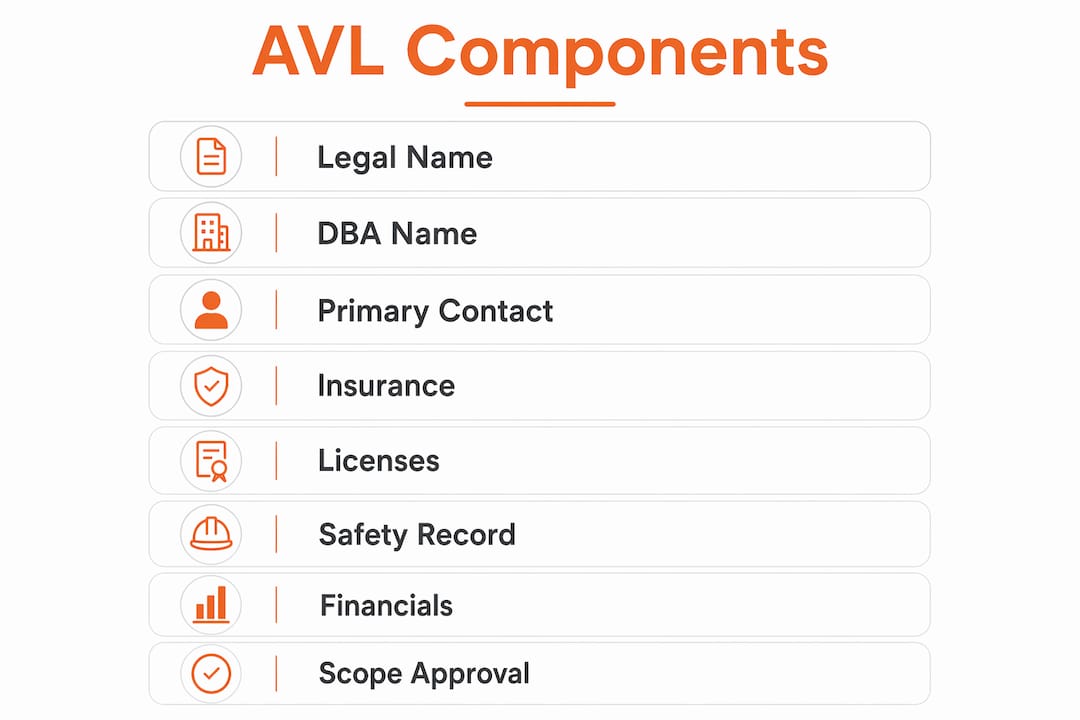
Minimum criteria vs. best practice standards
| Qualification Area | Minimum Criteria | Best Practice Standard |
|---|---|---|
| Insurance | General liability certificate on file | Certificate with project-specific endorsements and auto liability |
| Licensing | Active state contractor license | License verified against state database with expiration tracking |
| Safety Record | No active OSHA citations | EMR (Experience Modification Rate) below 1.0 with OSHA 300 log review |
| Financial Stability | Vendor self-reported | Third-party credit check or bonding capacity verification |
| Tax Documentation | W-9 on file | W-9 verified and updated annually |
Beyond the table above, qualification criteria should include a review of the vendor’s past project references, subcontractor default history, and any litigation record. Preferred vendors in an AVL often carry negotiated pricing and serve as default suppliers for commonly purchased services. That designation improves purchasing efficiency and gives your procurement team real negotiating leverage.
Pro Tip: Build your AVL template in a shared platform like Procore or a dedicated procurement system rather than a local spreadsheet. Shared platforms enforce field completion and give your whole team real-time visibility into vendor status.
How is a contractor approved vendor list created and maintained?
The contractor vendor approval process follows a defined sequence. Skipping steps, especially documentation review and the trial period, is where most project managers introduce risk. Here is the standard workflow used by construction firms with mature procurement programs:
- Initial screening. Collect the vendor’s legal name, license numbers, insurance certificates, and references. Run a basic compliance check against your minimum criteria table.
- Documentation review. Verify W-9 or W-8 tax forms, confirm OSHA 30 certification where required, and review the vendor’s EMR. Check that all licenses are active in the relevant state database.
- Reference and performance check. Contact at least two past general contractors or owners the vendor has worked with. Ask specifically about schedule adherence, quality of work, and responsiveness to RFIs (Requests for Information).
- Trial period assignment. Assign the vendor a small, low-risk task before granting full active status. Trial status precedes active status after a satisfactory performance review. This step is the most frequently skipped and the most valuable.
- Final approval and status assignment. After the trial period, the procurement lead or project manager reviews performance data and formally approves the vendor. Record the reviewer’s name, their ID, and a timestamp in your system.
- Ongoing maintenance. Schedule annual reviews of insurance expiration dates, license renewals, and updated tax documents. Flag vendors whose certificates lapse as inactive until documentation is renewed.
The vendor approval timeline typically runs 5–15 business days depending on vendor complexity and documentation requirements. A mechanical subcontractor with multiple license types and a large crew will take longer to vet than a single-trade supplier with a straightforward insurance profile.
Pro Tip: Keep trial status and active status as separate fields in your AVL. Conflating the two is a common mistake that leads to awarding full contracts to vendors who have not yet completed their performance evaluation.
How does scope-specific approval reduce risk in vendor lists?
An AVL links vendors to specific scopes rather than granting blanket authorization across all work types. A plumbing subcontractor approved for rough-in work on a commercial build is not automatically approved for medical gas piping or fire suppression systems. Scope-specific approval is the mechanism that prevents misapplication of vendor credentials and the project risk that follows.
Universal approval vs. scope-limited approval
| Approach | Pros | Cons |
|---|---|---|
| Universal approval | Faster procurement decisions | High risk if vendor lacks specific trade expertise |
| Scope-limited approval | Precise risk control per work type | Requires more detailed AVL administration |
| Commodity-based approval | Efficient for repeat material purchases | Less effective for complex subcontracted services |
Audit compliance requires that every approval decision include a timestamped record, the reviewer’s ID, and a documented rationale. Owners, bonding companies, and regulatory bodies increasingly request this documentation during project audits. If your AVL cannot produce a clear approval trail for a specific vendor and scope, you have a compliance gap.
The vendor master list is a separate document from the AVL. The master list contains every vendor your organization has ever transacted with. The AVL is the tightly controlled subset authorized for active procurement. Keeping these two lists separate prevents your procurement team from accidentally sourcing from a vendor who was removed from the AVL for performance or compliance reasons.
Pro Tip: When you assign a vendor to a specific scope in your AVL, document the subcontractor’s scope of work in writing at the same time. This creates a direct link between the approval record and the contractual scope, which satisfies both auditors and project managers.
What benefits and challenges come with using an approved vendor list?
The practical benefits of a well-managed contractor preferred supplier list are direct and measurable.
- Reduced sourcing risk. Procurement teams draw only from pre-qualified vendors, eliminating the guesswork of evaluating unknown subcontractors under deadline pressure.
- Enforced quality standards. Every vendor on the list has cleared your insurance, licensing, and safety thresholds. Quality floors are set before the first RFP goes out.
- Faster contract awards. When a scope opens up, your team already has approved vendors ready. You skip the full qualification cycle and move directly to bid solicitation.
- Negotiating leverage. AVL inclusion signals a vendor’s operational maturity and financial stability, which gives both parties a clearer basis for pricing discussions.
- Compliance documentation. A properly maintained AVL with audit trails satisfies owner requirements, bonding company requests, and regulatory reviews.
The challenges are equally real. Poor documentation and unclear vendor status communication lead directly to sourcing errors and project delays. Project managers who do not know which vendors are in trial status versus active status risk awarding scopes to vendors who have not completed their evaluation. Keeping the list accurate requires dedicated administrative effort, particularly on large programs with dozens of active subcontractors.
Balancing inclusiveness with control is another tension. An AVL that is too restrictive limits competition and can drive up bid prices. An AVL that is too permissive defeats the purpose of vendor governance. The right balance depends on your project volume, risk tolerance, and the depth of your existing supplier relationships. For emergency situations where you need to source outside your approved list quickly, having a defined exception process is critical. Understanding emergency subcontractor sourcing protocols keeps your project moving without abandoning your governance standards.
Key takeaways
A contractor approved vendor list is the single most effective procurement control a construction project manager can implement to reduce subcontractor risk and enforce quality standards before work begins.
| Point | Details |
|---|---|
| AVL definition | A vetted, scope-specific roster of authorized subcontractors and suppliers, not a general contact list. |
| Eight core fields | Legal name, DBA, contacts, payment terms, tax status, vendor status, approved scope, and insurance expiration are non-negotiable. |
| Trial period matters | Assign low-risk tasks before granting active status to verify real-world performance. |
| Scope-specific approval | Approve vendors for defined work types only; blanket approval creates uncontrolled risk. |
| Audit trail requirement | Every approval must include a timestamp, reviewer ID, and documented rationale to satisfy compliance reviews. |
What i have learned managing avls on complex construction programs
By Rowena
After working in AEC recruiting and sourcing for over a decade, the pattern I see most often is this: project managers build an AVL at the start of a program and then treat it as finished. They do not update insurance expiration dates. They do not move vendors from trial to active status with any formal review. They do not document why a vendor was approved for one scope but not another. Then an audit arrives, or a subcontractor underperforms, and the list offers no protection because it was never properly maintained.
The trial period is the step that separates a functional AVL from a compliance document that looks good on paper. Assigning a new subcontractor a small, low-risk task before granting full active status gives you real performance data. References tell you what a vendor did on someone else’s project. A trial period tells you what they will do on yours.
Scope-specific approval is equally underused. I have seen firms approve a concrete subcontractor for all concrete work across a multi-site program without distinguishing between standard flatwork and post-tensioned structural slabs. Those are not the same risk profile. Approving vendors at that level of granularity takes more administrative effort upfront, but it prevents the kind of scope mismatch that leads to rework and claims.
The technology piece is straightforward. Procore, ProcureDesk, and similar platforms make it possible to track vendor status, insurance expiration, and approval rationale in one place. The barrier is not the software. The barrier is the organizational discipline to use it consistently. Build the process first, then let the platform enforce it.
— Rowena
Build a stronger vendor roster with specialized AEC sourcing

Constructconnect-rconstructionsolutions works directly with construction firms and project managers to source and vet qualified subcontractors and suppliers for the AEC industry. With over 30 years of industry experience, the team connects you with pre-vetted candidates who meet your insurance, licensing, and safety standards before they ever appear on your approved list. The prorated 90-day payment model means you only pay for successful placements, not for candidates who do not perform. If you are building or rebuilding your vendor roster, explore the AEC recruiting services offered by Constructconnect-rconstructionsolutions, or review available business opportunity sourcing to identify qualified vendor partnerships aligned with your project pipeline.
FAQ
What is a contractor approved vendor list?
A contractor approved vendor list is a vetted database of subcontractors, suppliers, and manufacturers authorized to perform specific work on construction projects after passing defined qualification criteria. It functions as a procurement governance tool that restricts sourcing to pre-qualified vendors.
How long does the vendor approval process take?
The vendor approval process typically takes 5–15 business days depending on vendor complexity and the volume of documentation required for review.
What is the difference between a vendor master list and an AVL?
The vendor master list contains every vendor an organization has transacted with, while the AVL is a controlled subset authorized for active procurement on specific scopes. Keeping them separate prevents sourcing from vendors who have been removed for compliance or performance reasons.
How do you qualify subcontractors for an approved vendor list?
Qualification requires verifying insurance certificates, active licenses, OSHA safety records, financial stability, and past project references. Review the subcontractor pre-qualification process for a detailed step-by-step framework used by construction firms.
Why is scope-specific approval important in an AVL?
Scope-specific approval prevents vendors from being assigned to work types outside their verified expertise. A vendor approved for standard concrete flatwork is not automatically qualified for post-tensioned structural work, and treating those as equivalent creates direct project risk.