
Why Large Contractors Face Specialized Skill Gaps
Large contractors face specialized skill gaps because they must deploy a small pool of high-consequence, high-skill roles across many complex projects simultaneously, while the industry pipeline, absorptive capacity, and on-site supervision consistently lag behind that demand. The ABC projects show that construction must attract a large number of new workers in 2026 just to keep supply and demand in balance. Meanwhile, 57% of firms report that available candidates lack the skills, certificates, or licenses to perform the work. That combination of volume pressure and qualification failure is the core of the problem.
The roles most at risk are not general labor. They are:
- Commissioning engineers who validate complex building systems before handover
- Digital coordinators managing BIM workflows and model integrity across trades
- High-voltage electricians in demand for data centers and grid infrastructure
- Systems integrators who coordinate mechanical, electrical, and controls interfaces
When any one of these roles is unfilled or underqualified on a large program, the downstream consequences reach far beyond a single trade package.
Table of Contents
- Why do structural forces create contractor skill shortages across the industry?
- How does scale make the skill gap problem worse for large contractors?
- How do skill gaps show up in project outcomes and business metrics?
- How do you identify and measure specialized skill gaps in 30–60 days?
- What proven strategies close specialized skill gaps for large contractors?
- How do you operationalize workforce development across a large organization?
- How do you measure the ROI of workforce development investments?
- A practical staffing model that reduced specialist gaps: an operational case study
- Key Takeaways
- The gap that most contractors still underestimate
- R. Construction Solutions fills your critical specialist roles faster
- Authoritative sources and references
- FAQ
Why do structural forces create contractor skill shortages across the industry?
The shortage is not a hiring problem you can solve by posting more jobs. It is a pipeline problem built over decades.
Federal workforce funding has historically skewed toward four-year degree pathways, leaving trade-specific vocational programs chronically underfunded. The AGC’s 2025 Workforce Survey Analysis documents this directly, noting that rebalancing federal investment toward trade education is a prerequisite for changing throughput materially. Without that shift, the apprenticeship pipeline stays thin regardless of employer demand.
Demographics compound the problem. The construction workforce is aging, and retirement rates in skilled trades are outpacing replacement. The ABC’s 2026 projection of 349,000 new workers needed reflects not just growth demand but the gap left by experienced tradespeople leaving the field. Regional imbalances are sharp: electricians for data center construction in Northern Virginia and the Sun Belt are in especially short supply.
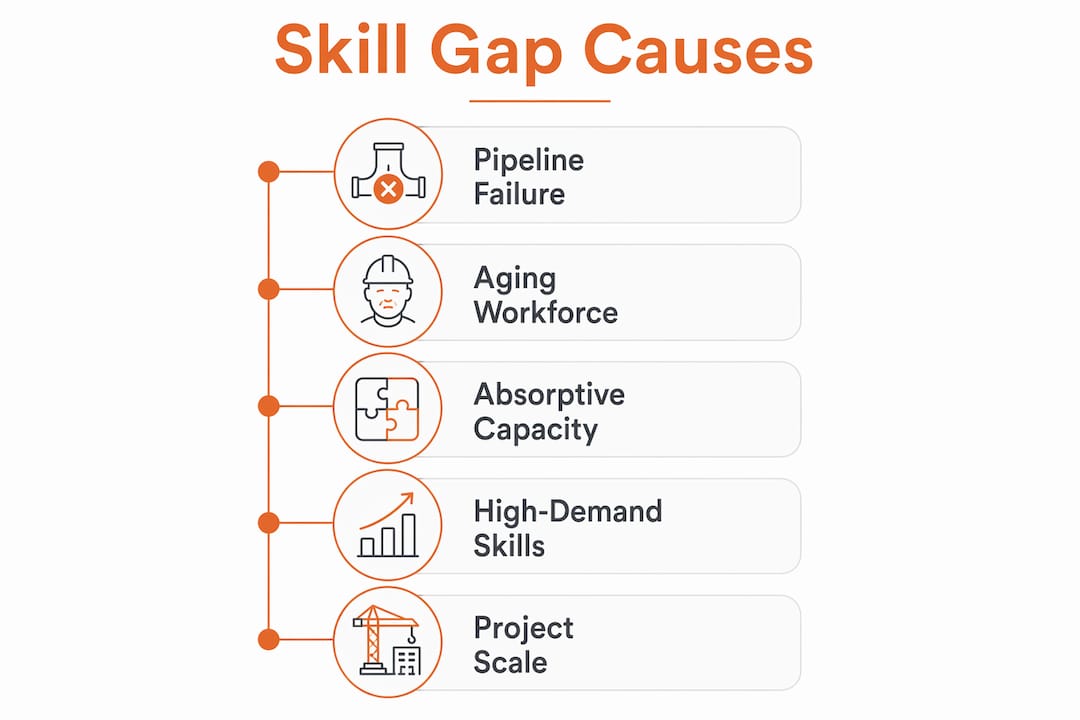
Large contractors also compete directly with the energy and technology sectors for digitally fluent and high-voltage specialists. That competition is structural, not cyclical, and it raises the cost of these roles regardless of broader economic conditions. Technology adoption in the form of BIM, digital twins, and automation does not reduce the need for skilled supervision. It reallocates risk into fewer, higher-consequence roles, concentrating delivery exposure on a smaller number of specialists.
Supply-side and demand-side pressures at a glance:
- Declining vocational enrollment and underfunded apprenticeship programs
- Accelerating retirements in high-skill trades with insufficient replacement cohorts
- Immigration enforcement tightening labor supply in some regional markets
- Surging project pipelines in manufacturing, data centers, and grid infrastructure
- Cross-sector competition from energy and tech firms for the same specialist pool
How does scale make the skill gap problem worse for large contractors?
Scale does not just magnify the shortage. It creates a distinct set of constraints that smaller contractors rarely face.

The core issue is what industry analysts call the absorption problem: the organizational capacity to turn recruits into site-ready specialists. Mark Farmer’s commentary on construction’s skills crisis frames this as a question of capability, competency, and capacity. A large contractor running six concurrent programs across three states cannot mentor a new commissioning engineer on all of them at once. The mentorship infrastructure simply does not scale at the same rate as the project portfolio.
Multi-project portfolios spread scarce specialists thin. A single experienced commissioning lead might be the only person in a contractor’s organization who can validate a complex MEP system. When that person is committed to one project, every other program waits or accepts a less-qualified substitute. Geographic expansion makes this worse: regional labor imbalances mean that moving a specialist from one market to another is often not practical or cost-effective.
High-integration project types concentrate demand on the narrowest skill sets. Data centers, grid infrastructure upgrades, and industrial megaprojects all require commissioning engineers, high-voltage electricians, and systems integrators in volume. When multiple large contractors are bidding and building these project types in the same region simultaneously, the competition for a handful of qualified specialists becomes acute.
Consider a program-level failure mode: a large contractor wins a $200M data center project and assigns a commissioning lead who has data center exposure but limited high-voltage systems experience. Punch-list issues surface during systems integration. The commissioning phase extends by six weeks. That delay cascades into the owner’s IT infrastructure deployment schedule, triggering liquidated damages and damaging the contractor’s relationship with a key client.
Pro Tip: During bid review, score each critical specialist role against your current bench. If commissioning, high-voltage, or digital coordination coverage is below 80% for the project’s peak demand period, price the gap into your risk register before you sign the contract.
How do skill gaps show up in project outcomes and business metrics?
Skill gaps do not stay abstract for long. They show up in the numbers that matter to your business.

Schedule delays are the most visible impact. A missing or underqualified specialist at a critical path activity creates delays that compound quickly, especially on tightly sequenced programs. Labor scarcity is already forcing contractors to rethink how they price and schedule projects, with shortages most severe in high-growth states and for specialized trades.
Rework is the second major cost driver. When a systems integrator lacks the experience to coordinate MEP interfaces correctly the first time, the cost of correction falls entirely on the contractor. Rework rates attributable to skill mismatch are among the clearest indicators that a workforce gap exists. Quality failures also create safety and compliance exposure: an underqualified electrician on a high-voltage system is not just a performance risk, it is a liability.
The business-level impacts extend beyond individual projects:
- Reduced bidding capacity: You cannot credibly pursue work that requires specialist roles you cannot staff
- Wage inflation: Competing for a thin pool of qualified specialists drives up direct labor costs on every project
- Subcontractor reliance: Gaps in your own workforce push more work to subcontractors, reducing margin and control
- Reputation risk: Repeated schedule slippage or quality failures on high-profile projects affects future award rates
Track these metrics on every active program: days of schedule slippage attributable to specialist vacancies, rework percentage by trade, cost variance on labor-intensive scopes, safety incident rates linked to specific skill categories, and crew utilization rates for specialist roles.
How do you identify and measure specialized skill gaps in 30–60 days?
A structured assessment does not require a large consulting engagement. You can run a credible gap audit internally in four to eight weeks.
Week 1: Build a skills inventory
- Create a role-by-project matrix listing every critical specialist role required across your active and awarded project portfolio
- Map current coverage: who is assigned, what credentials they hold, and whether they have been observed performing the role at the required complexity level
- Flag every role where coverage is absent, unverified, or held by a single person with no backup
Weeks 2–3: Run targeted assessments
- Conduct credential checks against recognized standards (NCCER certifications, OSHA 30, trade licenses, manufacturer-specific qualifications)
- Use supervisor capacity scoring: ask your superintendents directly how confident they are in the specialist coverage on their projects
- Review time-to-competency logs where they exist; if they do not exist, that absence is itself a finding
- Sample on-site observed performance for two or three high-risk roles
Weeks 4–8: Pilot training and hiring actions
- Prioritize the three roles with the highest criticality and lowest coverage
- Launch targeted specialist recruiting for any role where internal development cannot close the gap within the project timeline
- Initiate apprenticeship enrollment or credential upgrade programs for roles where internal candidates are close to qualified
Track these metrics going forward: vacancy-to-fill time for specialist roles, rework rate attributable to skill mismatch, percentage of projects with full critical-role coverage, and apprenticeship throughput per quarter.
What proven strategies close specialized skill gaps for large contractors?
Closing gaps requires a layered approach. No single intervention is sufficient on its own.
- Step 1: Skills mapping and role criticality scoring. Rank every specialist role by consequence of vacancy. Commissioning leads and high-voltage electricians on live projects rank highest. General foremen on standard scopes rank lower. This scoring drives where you invest first.
- Step 2: Blend internal training with apprenticeships. Apprenticeships and industry-driven training are the most durable medium-term remedies, but they require sustained employer commitment and funding. Pair classroom credentials with structured on-site mentorship. Certificates without mentoring rarely produce job-ready specialists.
- Step 3: Vet and supervise your subcontractor network. Subcontractor gaps are a direct extension of your own workforce gaps. Establish joint-supervision models for high-risk scopes and require credential verification before mobilization. Review common subcontractor gaps as part of your pre-award checklist.
- Step 4: Source targeted hires for high-consequence roles. For commissioning engineers, digital coordinators, and systems integrators, internal development timelines are often too long to meet project needs. Targeted external sourcing for these roles, using pre-vetted candidates with verified credentials, is the faster path.
- Step 5: Implement digital competency passports. Track each worker’s credentials, training completions, and observed performance in a centralized system. This makes coverage gaps visible in real time rather than at the point of crisis.
Recognized credentials to prioritize include NCCER certifications, OSHA 30, trade-specific licenses, and manufacturer qualifications for specialized systems. Tie credential attainment to pay band progression to create a retention incentive alongside the development benefit.
Pro Tip: Blended learning works best when the classroom component is completed before mobilization and the on-site mentorship is structured with specific competency milestones, not just hours logged. A 90-day mentorship with defined checkpoints produces more consistent results than an open-ended “buddy system.”
How do you operationalize workforce development across a large organization?
Workforce development at scale requires governance, not just good intentions.
The most effective model places a central workforce development function at the corporate level, with regional delivery leads who understand local labor markets and site-level mentors embedded in active projects. Without that three-tier structure, training initiatives stay fragmented and inconsistent across programs.
Funding is the most common failure point. Earmark training budgets as a line item in your overhead structure, not as a discretionary expense that disappears when margins tighten. Risk-sharing agreements with key subcontractors, where both parties co-invest in apprenticeship cohorts, spread the cost and align incentives. Integrating workforce planning into preconstruction, rather than treating it as an HR function, is one of the clearest differentiators between contractors who manage this well and those who do not.
A 12–18 month rollout typically follows this sequence:
- Months 1–3: Pilot cohort for two or three critical roles; attach mentors; establish baseline metrics
- Months 4–9: Scale to additional roles and regions based on pilot results; embed credential verification in procurement requirements
- Months 10–18: Integrate workforce development into standard preconstruction planning; tie subcontractor qualification to training participation
Typical annual cost per cohort (indicative budget lines):
These figures are indicative ranges based on industry benchmarks and will vary by trade, region, and program design. Validate against your own labor rates and overhead structure before budgeting.
How do you measure the ROI of workforce development investments?
A compact scorecard keeps your workforce investment accountable without creating administrative burden.
Track five metrics on a quarterly basis: critical role coverage percentage, time-to-competency for specialist roles, rework rate attributable to skill mismatch, safety incidents linked to specific skill categories, and net bid capacity (the number of projects you can credibly pursue given your current specialist bench).
A straightforward ROI calculation for a single program: take the reduction in rework cost achieved after a training cohort completes, add schedule savings from faster specialist mobilization, and subtract total training costs. On a $50M project where rework runs at 5% of labor cost before intervention and drops to 2% after, the savings on a $5M labor budget are $150,000. If the training cohort cost $35,000, the return is clear without requiring a complex model.
Suggested scorecard thresholds and measurement frequency:
| Metric | Target Threshold | Measurement Frequency |
|---|---|---|
| Critical role coverage % | ≥90% of active projects | Monthly |
| Time-to-competency (specialist roles) | Reduction of 20%+ vs. baseline | Quarterly |
| Rework rate (skill-attributable) | Below 3% of trade labor cost | Per project closeout |
| Safety incidents (skill-linked) | Zero tolerance; trend tracked | Monthly |
| Net bid capacity (specialist roles) | Positive gap vs. pipeline | Quarterly |
Run a quarterly audit: review each metric against target, identify which projects or trades are driving variance, and adjust your training or hiring cadence accordingly. The audit should take no more than two hours with a prepared dashboard.
A practical staffing model that reduced specialist gaps: an operational case study
A mid-size general contractor managing three concurrent data center projects in the Southeast faced a recurring problem: commissioning leads were either unavailable or underqualified at the point of systems integration, creating repeated schedule slippage and rework on MEP punch lists.
The intervention combined three elements. First, a specialized recruiting engagement identified and pre-vetted four commissioning engineers with verified data center experience and current OSHA 30 credentials. Second, each new hire was paired with a senior site superintendent under a structured 90-day mentorship protocol with defined competency milestones. Third, the contractor adopted a prorated payment structure for the recruiting engagement, paying only for successful placements that completed the mentorship period.
The results were measurable. Time-to-fill for commissioning roles dropped significantly compared to prior projects where the contractor had relied on general staffing channels. Rework on MEP scopes in the post-intervention projects was lower than on the baseline projects. The 90-day mentorship structure meant that by the time each new hire reached peak project demand, they were performing at the required level rather than still building site familiarity.
A reusable pilot checklist for your own organization:
- Define the two or three critical roles with the highest vacancy risk on your next awarded project
- Engage a specialized AEC recruiter with verified candidate pools for those specific roles
- Assign a named senior mentor to each new placement before mobilization
- Set competency milestones at 30, 60, and 90 days with a go/no-go review at each checkpoint
- Track rework rate and schedule performance on the pilot project as your primary outcome metrics
Key Takeaways
Large contractors face specialized skill gaps because pipeline failures, absorptive capacity limits, and cross-sector competition for narrow specialist roles combine to leave critical positions vacant or underqualified at the exact moment complex projects need them most.
| Point | Details |
|---|---|
| Pipeline failure is structural | The industry needs 349,000 new workers in 2026; underfunded trade education is the root cause. |
| Qualification gap is severe | 57% of firms report candidates lack the skills, credentials, or licenses needed for specialist roles. |
| Absorption limits scale | Mentorship infrastructure and supervision capacity do not grow as fast as project portfolios, creating a capability ceiling. |
| Measurement drives action | A 30–60 day skills inventory and targeted assessment identifies your highest-risk roles before a project crisis forces the issue. |
| Constructconnect-rconstructionsolutions offers a direct path | R. Construction Solutions combines specialist sourcing, pre-vetted candidates, and a prorated 90-day model to reduce time-to-fill and employer risk for critical AEC roles. |
The gap that most contractors still underestimate
The construction industry has spent years framing its workforce problem as a headcount shortage. That framing is incomplete, and it leads contractors to the wrong solutions.
The real constraint is absorptive capacity: the organizational ability to take a credentialed worker and turn them into a fully competent, site-ready specialist on a complex project. You can recruit your way to a full roster and still face the same commissioning delays, the same rework cycles, and the same supervision gaps if you have not built the mentorship infrastructure to support those hires.
What consistently works in large contractor organizations is not the training program with the most hours or the most impressive credential list. It is the combination of targeted sourcing for the right person, a structured 90-day mentorship with real milestones, and a governance model that treats workforce development as a preconstruction function rather than an HR afterthought. The contractors who close gaps sustainably are the ones who have made that investment in supervision and progression pathways, not just in recruiting volume.
Where leaders most commonly fail is in treating the two as separate problems. Recruitment without absorption produces churn. Mentorship without a qualified candidate to mentor produces nothing. The investment has to be simultaneous and coordinated.
R. Construction Solutions fills your critical specialist roles faster
When your project schedule depends on having a qualified commissioning engineer or high-voltage electrician on-site by a specific date, a general staffing agency is not the right tool. Constructconnect-rconstructionsolutions brings 30+ years of AEC-specific experience, pre-vetted candidate pools for high-consequence specialist roles, and a prorated 90-day payment model that means you pay only for placements that actually work out.

The practical difference: lower commission rates than traditional agencies, no payment for unsuccessful placements, and candidates who arrive with verified credentials and relevant project experience rather than a resume that needs interpretation. For large contractors managing multi-project portfolios across multiple states, that specificity reduces time-to-fill and the downstream cost of a mis-hire on a critical scope.
To run a pilot, the process is straightforward: define your two or three highest-risk specialist roles, share your project timeline and credential requirements, and Constructconnect-rconstructionsolutions will source and pre-vet a shortlist within an agreed timeframe. Explore AEC recruiting services or visit the R. Construction Solutions homepage to start a conversation about your current project pipeline.
Authoritative sources and references
- ABC: Construction industry must attract 349,000 workers in 2026 — Primary source for the 2026 labor demand projection and regional imbalances by trade.
- AGC 2025 Workforce Survey Analysis — Source for the 57% candidate qualification finding, apprenticeship recommendations, and federal funding analysis.
- Zurich: Workforce without workers — Why construction’s labor challenge is really a capability crisis — Frames the shortage as a capability crisis; supports absorption problem and technology-risk concentration arguments.
- Builder Outlook: Construction labor shortages are forcing contractors to rethink project execution in 2026 — Analysis of downstream effects on bids, schedules, and regional variance; supports preconstruction workforce planning recommendations.
- Modern Construction News: Construction skills crisis — Causes and solutions (Mark Farmer commentary) — Source for the “three C’s” framework (capability, competency, capacity) and the absorption problem framing.
- NCCER — Industry-recognized credentialing and curriculum standards for construction trades; referenced for credential verification recommendations.
FAQ
What are the most common challenges contractors face with skilled labor?
The two most consistent challenges are candidate qualification and absorptive capacity. 57% of firms report that available candidates lack the skills, certificates, or licenses required, and even qualified hires often lack the on-site mentorship needed to reach full competency quickly.
What are examples of skill gaps in construction?
The most consequential gaps in current project delivery involve commissioning engineers, high-voltage electricians, BIM/digital coordinators, and systems integrators. These roles are in short supply because they require both technical credentials and complex project experience that takes years to develop.
What are the signs that a contractor has a skill gap problem?
Recurring schedule slippage on specialist-dependent scopes, elevated rework rates on MEP or systems integration work, and an inability to staff critical roles without relying heavily on subcontractors are the clearest operational signals. A high vacancy-to-fill time for salaried specialist roles is an early warning indicator before project impacts appear.
What is the biggest safety risk linked to skill gaps in construction?
Underqualified workers in high-voltage electrical, systems integration, and commissioning roles carry the highest safety consequence. Errors in these scopes are harder to detect and more costly to correct, and they create direct exposure to serious injury, regulatory non-compliance, and project liability.
How can large contractors start closing skill gaps within 90 days?
Start with a skills inventory across your active project portfolio, identify the three roles with the highest criticality and lowest coverage, and launch targeted recruiting and apprenticeship enrollment simultaneously. Constructconnect-rconstructionsolutions’s prorated 90-day model is designed specifically for this kind of rapid, risk-managed pilot engagement.

