
Contractor Geographic Expansion Staffing: A 2026 Guide
Contractor geographic expansion staffing is defined as the process of recruiting, deploying, and managing qualified construction personnel to support a company’s entry into new regional markets. This practice sits at the intersection of workforce planning and business growth, and it is the method construction managers and general contractors use to maintain service quality while scaling operations beyond their home territory. Done correctly, it protects your brand standards, keeps projects profitable, and prevents the operational failures that sink otherwise capable firms. This guide breaks down the core components, practical steps, and readiness factors you need before your next market launch.
What is contractor geographic expansion staffing?
Contractor geographic expansion staffing is the structured approach to building a qualified workforce in a new geographic market before, or immediately after, a construction firm enters that territory. The industry term most closely aligned with this practice is “multi-location workforce deployment,” which covers everything from talent acquisition and licensing compliance to onboarding and communication system setup. Both terms describe the same operational reality: you cannot simply send two crew members to a new city and call it expansion.
The core staffing components for a new location include:
- Dedicated location manager or lead technician: Hiring a location manager who is fully trained in your company culture before the market opens is best practice. This person carries your operational standards into the new territory from day one.
- Minimum viable crew: Your crew must be certified for the services offered in the new market. Technicians with OSHA 30 certification and relevant trade licenses are non-negotiable for compliance and client confidence.
- Pre-opening joint work: New team members should run jobs alongside your existing crews before working independently. This transfers institutional knowledge and quality standards that no training manual fully captures.
- Communication protocol synchronization: Phone systems, customer interaction scripts, and dispatch procedures must mirror your home market standards before the first call comes in.
Pro Tip: Hire your location manager at least 60 days before launch. That lead time lets them shadow your best superintendent, learn your estimating process, and build relationships with local suppliers before they carry the operation alone.
The minimum viable crew concept is worth emphasizing. A crew that is technically skilled but unfamiliar with your reporting structure, safety protocols, or ProCore experience will create inconsistencies that damage your reputation in a market you have not yet established.

How can contractors use staffing solutions to scale hiring across new geographic areas?
Specialized staffing agencies in construction solve the single biggest obstacle in geographic expansion: finding qualified, pre-vetted candidates in a market where you have no existing network. A location-agnostic staffing model provides pre-built hiring infrastructure and standardized candidate evaluation, with the flexibility to adapt to local labor market conditions.
The practical benefits of using a staffing partner for multi-location hiring include:
- Local recruiter networks: Staffing partners maintain relationships with regional trade schools, union halls, and licensed subcontractors. You gain immediate access to a talent pool that would take years to build independently.
- Standardized screening: Centralized evaluation criteria, including background checks, license verification, and skills assessments, apply consistently across every location. This prevents the quality gaps that appear when regional hiring managers improvise their own processes.
- Regulatory compliance: Labor laws, prevailing wage requirements, and licensing rules vary by state and municipality. A staffing partner with local knowledge keeps your new operation compliant from the start.
- Automated recruitment technology: Multi-area hiring coordination through applicant tracking systems and automated screening tools reduces the administrative load on your existing team.
Multi-location hiring complexity is best managed through centralized frameworks combined with local execution. That balance matters because a rigid, one-size-fits-all approach fails in markets with unique labor dynamics, while a fully decentralized approach loses the consistency that defines your brand.
Effective geographic expansion also blends centralized hiring standards with local adaptations to balance scalability and regional market needs. For general contractors running multi-state projects, recruitment process outsourcing (RPO) is the most efficient model. RPO providers take ownership of the entire hiring cycle, from job posting to offer letter, freeing your leadership team to focus on project delivery rather than candidate sourcing.
Pro Tip: When evaluating staffing partners for AEC work, ask specifically about their experience placing superintendents and project managers with ProCore experience. Generic staffing firms rarely understand the difference between a qualified field foreman and a site superintendent ready to run a $5 million project.
What are common challenges and critical readiness factors before expanding staffing geographically?
The most common reason geographic expansion fails is premature execution. Expanding before maximizing internal capacity leads to overstretch, inconsistent service quality, and financial losses that can threaten the home operation. Your systems, not your ambition, determine when you are ready.
Financial readiness
Project-level profit and loss clarity is the first financial requirement. Granular zone-level financials reveal hidden costs in travel, labor burden, and local tax exposure that aggregate reports miss entirely. If you cannot identify which jobs in your current territory are profitable at the project level, you will not recognize unprofitable patterns in a new market until the damage is done.
Formal forecast models that simulate revenue, overhead, and break-even timelines improve expansion decision accuracy. Contractors who rely on gut instinct rather than financial models consistently underestimate the cash flow gap between market entry and first profitable month. Understanding your insurance obligations in a new region is equally important. A builders risk policy in a new state may carry different coverage requirements than your existing policy, and that gap can create serious liability exposure.
Operational readiness checklist
| Readiness Factor | Status Check |
|---|---|
| Internal systems documented and repeatable | All SOPs written, not just practiced |
| Home territory at or near capacity | Revenue and crew utilization maximized |
| Project-level P&L reporting active | Zone-level financials available monthly |
| Location manager identified and trained | Hired minimum 60 days before launch |
| Minimum viable crew certified | OSHA 30 and trade licenses confirmed |
| Communication systems synchronized | Phone, dispatch, and CRM mirroring home market |
Pro Tip: Run a mock launch week before you go live. Have your new crew handle simulated customer calls, dispatch scenarios, and a test job with your existing team observing. Problems that surface in a drill cost nothing. Problems that surface on day one cost clients.
Failing to synchronize communication systems before launch is one of the most cited causes of early expansion failure. A new market customer who calls and reaches an undertrained dispatcher, or worse, no answer at all, forms an impression that is nearly impossible to reverse.
What practical steps should construction managers take for staffing new geographic regions?
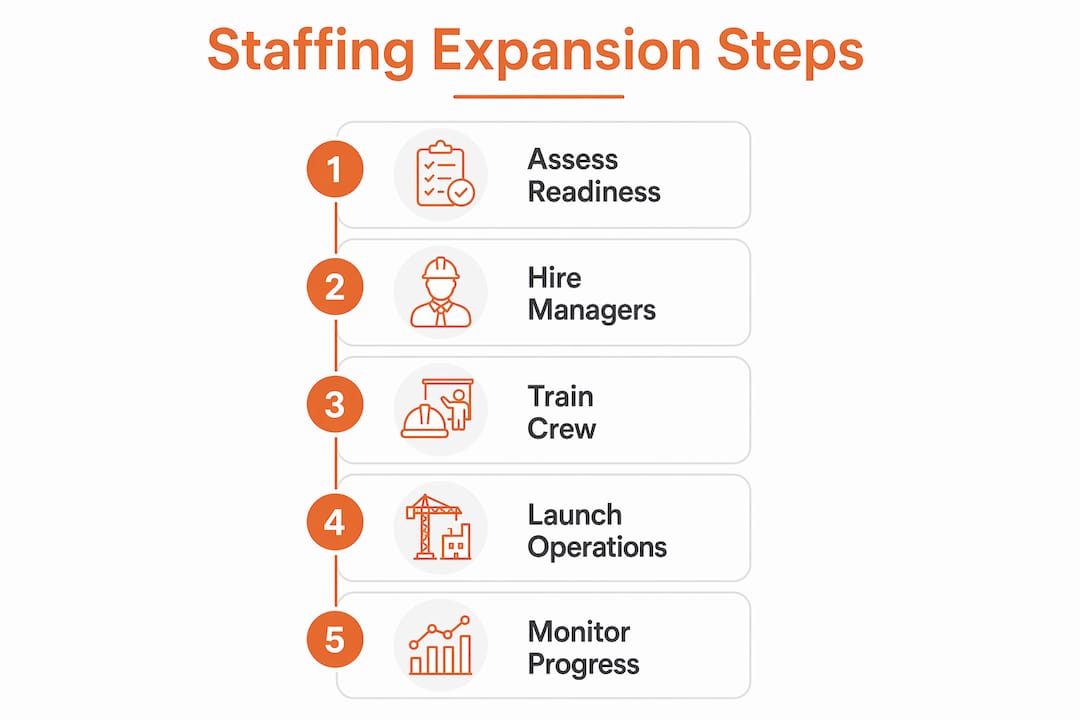
A structured timeline separates successful market entries from costly false starts. Full market expansion requires 60–90 days of planning that covers licensing, staffing, and communication setup. That window is not a suggestion. It reflects the actual time required to complete each step without cutting corners.
- Confirm financial and operational readiness (Day 1–14): Review project-level P&L reports, run scenario modeling for the new market, and verify your home territory is operating at capacity. Secure funding if needed. Contractors exploring small business expansion funding should finalize financing before committing to a launch date.
- Secure local licensing and insurance (Day 15–30): Research state and municipal contractor license requirements. Verify that your general liability, workers’ compensation, and builders risk coverage extends to the new territory or obtain supplemental policies.
- Recruit and hire the location manager (Day 15–30): Post the role, screen candidates with AEC-specific criteria, and bring the selected manager into your home operation for immersive onboarding. Candidates with multi-skilled worker profiles reduce your minimum viable crew size and lower initial overhead.
- Build the minimum viable crew (Day 30–60): Recruit locally through staffing partners or direct sourcing. Verify OSHA 30 certification, trade licenses, and relevant software experience for every hire. Run joint jobs with your existing crews before the launch date.
- Set up local operational infrastructure (Day 45–60): Establish a local office address, open a regional bank account, set up supplier accounts, and configure your phone system. Phone infrastructure can be ready in 48 hours but requires pre-launch testing to confirm call routing and recording work correctly.
- Conduct a phased quality review (Day 60–90): Run the new team through joint work with your senior crew. Use subcontractor onboarding best practices to formalize the integration process. Confirm all communication systems, reporting tools, and safety protocols are functioning before the official launch.
Pro Tip: Do not announce your new market publicly until your crew has completed at least two full jobs independently and passed your internal quality review. Early marketing that outpaces operational readiness creates demand you cannot yet serve reliably.
Key Takeaways
Contractor geographic expansion staffing succeeds when financial readiness, certified personnel, and synchronized communication systems are in place before the first job in a new market begins.
| Point | Details |
|---|---|
| Define readiness before hiring | Confirm project-level P&L clarity and home territory capacity before recruiting for a new market. |
| Hire the location manager first | Bring this person on at least 60 days before launch so they absorb company culture and processes. |
| Use staffing partners for scale | Specialized AEC staffing agencies provide pre-vetted candidates and local compliance knowledge you cannot build quickly. |
| Follow the 60–90 day timeline | Full market entry requires this lead time to complete licensing, staffing, training, and infrastructure setup. |
| Synchronize communication systems | Phone, dispatch, and CRM systems must mirror home market standards before the first customer call arrives. |
What I’ve learned about expanding too fast and too thin
Contractors who expand geographically without a staffing plan almost always make the same mistake. They send their best crew to the new market and leave their home territory understaffed. Within 90 days, quality drops in both locations, and the firm is managing two underperforming operations instead of one strong one.
The data-driven approach is not optional. Formal forecast models that project revenue, overhead, and break-even timelines give you a defensible answer to the question “are we ready?” Gut instinct has launched many expansions that financial models would have delayed by six months, and those delays would have saved the firm.
Certified staff is the other variable that contractors consistently underweight. An OSHA 30-certified superintendent who has run jobs with your existing team is worth three uncertified workers who need supervision. The minimum viable crew concept exists precisely because quality beats quantity in a new market where your reputation is still forming.
The administrative load of a second location surprises nearly every contractor I have spoken with. Payroll, licensing renewals, insurance certificates, and local tax filings multiply. Build that overhead into your financial model before you commit, not after you are already managing it.
Balancing standardization with local flexibility is the long-term challenge. Your core processes, safety standards, and reporting requirements must be identical across locations. But your hiring approach, supplier relationships, and community presence should reflect the local market. Firms that treat every new location as a copy-paste of headquarters miss the local nuance that wins repeat clients.
— Rowena
How Constructconnect-rconstructionsolutions supports your staffing expansion
Constructconnect-rconstructionsolutions brings over 30 years of AEC industry experience to the challenge of geographic staffing expansion. When you are entering a new market and need pre-vetted superintendents, project managers, or certified trade workers, the firm’s AEC recruiting services connect you with qualified candidates who are ready to work within your operational standards.

Constructconnect-rconstructionsolutions also supports contractors through business opportunity sourcing, helping you identify viable projects in target markets before you commit to a full expansion. The firm’s prorated 90-day payment model means you only pay for successful placements, which reduces the financial risk of staffing a new location. Contact Constructconnect-rconstructionsolutions to discuss your expansion timeline and staffing requirements.
FAQ
What is contractor geographic expansion staffing?
Contractor geographic expansion staffing is the process of recruiting and deploying qualified construction personnel to support a firm’s entry into a new regional market. It covers hiring, certification verification, onboarding, and communication system setup before the new location launches.
How long does it take to staff a new contractor location?
Full market expansion requires 60–90 days of planning, including licensing, staffing, and infrastructure setup. Rushing this timeline increases the risk of service failures and compliance gaps.
What certifications should new crew members have for geographic expansion?
New crew members should hold OSHA 30 certification and any trade licenses required by the state or municipality where the new location operates. Familiarity with project management software such as ProCore is also a practical requirement for most commercial roles.
When is a contractor ready to expand geographically?
A contractor is ready to expand when the home territory is operating at or near full capacity, internal systems are documented and repeatable, and project-level profit and loss reporting is active. Expanding prematurely before these conditions are met leads to overstretch and quality failures.
How do staffing agencies help with multi-location contractor hiring?
Staffing agencies provide local recruiter networks, standardized screening processes, and regulatory compliance support across multiple regions. They reduce the time and administrative burden of building a qualified crew in a market where the contractor has no existing talent pipeline.