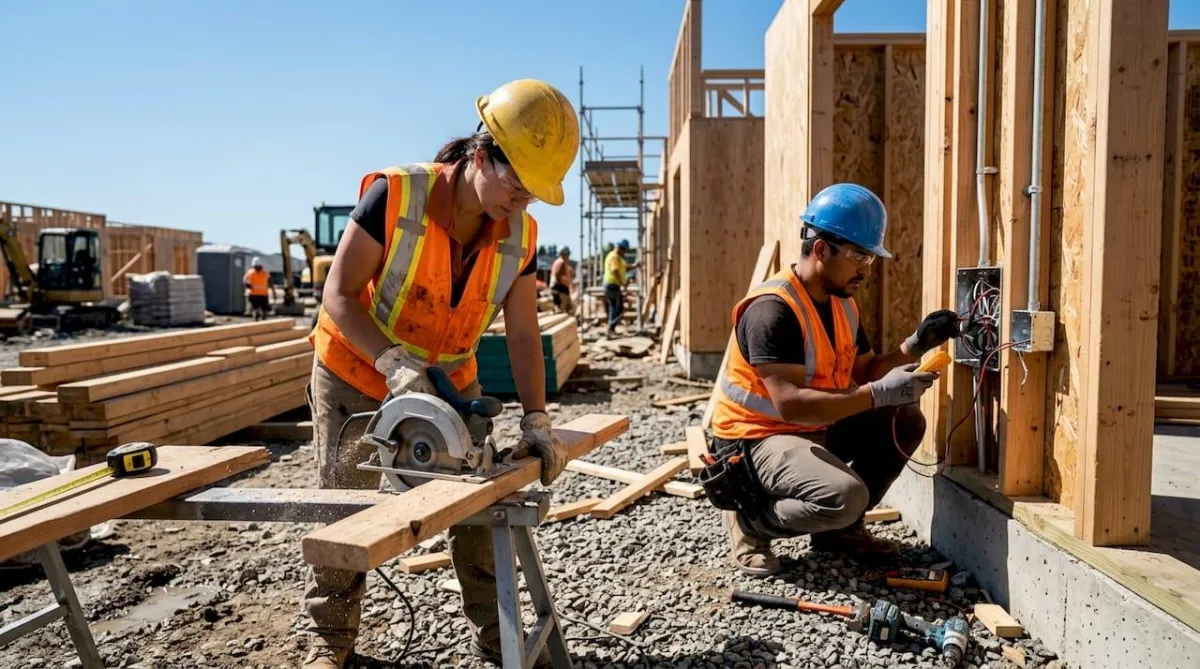
Multi-Skilled Workers: The Small Contractor's Edge in 2026
Multi-skilled workers are construction professionals trained to perform tasks across multiple trades, such as carpentry, electrical rough-in, and plumbing, giving small contractors the flexibility to run leaner crews without sacrificing project scope. The role of multi-skilled workers in a small contractor operation goes far beyond filling gaps. Industry data shows that a multi-trade labor strategy reduces project timelines by 15–30% and cuts labor costs by 12–18%. For small contractors managing tight budgets and tighter schedules, that is not a marginal gain. It is a structural advantage.
How do multi-skilled workers enhance project efficiency for small contractors?
The role of multi-skilled workers in a small contractor’s operation is most visible in how they eliminate idle time between trades. On a typical fragmented job, a plumber finishes rough-in and walks off site. The framer cannot proceed until inspections clear. The electrician is waiting on the framer. Each handoff creates a gap, and those gaps compound into weeks of lost time. A versatile worker who handles both rough carpentry and basic electrical coordination can bridge those gaps without waiting for a separate crew to mobilize.

The efficiency gains are measurable. A multi-trade workforce also reduces management time by 40%, which matters enormously for small contractors who are often the superintendent, estimator, and project manager all at once. Less time coordinating separate trade crews means more time on quality control and client communication.
The specific benefits of multi-skilled workers on project flow include:
- Reduced trade stacking: One crew handles sequential tasks without waiting for a separate subcontractor to mobilize.
- Faster punch-list resolution: A versatile worker can address minor items across trades without scheduling a specialist callback.
- Lower coordination overhead: Fewer vendors, fewer scheduling conflicts, fewer change orders from miscommunication.
- Improved site safety: Workers who understand adjacent trades recognize hazards that single-trade specialists often miss.
- Stronger client relationships: Fewer delays mean fewer difficult conversations about schedule slippage.
Pro Tip: Build your crew schedule around task sequences, not trade categories. When you assign work by what needs to happen next rather than who owns which trade, multi-skilled workers fill the gaps naturally and your timeline tightens without extra effort.
What are the common challenges of using multi-skilled workers?
Multi-skilled labor in small businesses is not without real risks. The most common failure mode is worker overload. When a small contractor relies on two or three versatile workers to cover six trade categories, those workers burn out fast. Burnout drives turnover, and high turnover above 30% creates significant labor cost variance that erases the savings you built the strategy around.
Quality dilution is the second risk. A worker trained in both drywall finishing and tile setting may perform both competently, but neither at the level of a dedicated specialist. On commercial projects with strict tolerances or visible finish work, that gap shows up in punch lists and client complaints. The solution is scope definition: be explicit about which tasks a multi-skilled worker owns independently and which require specialist oversight.
The challenges worth planning for include:
- Training investment: Cross-training takes time and money upfront before it pays back in scheduling flexibility.
- Certification gaps: Some tasks, such as licensed electrical work or OSHA 30-required safety roles, cannot legally be performed by uncertified workers regardless of their skill level.
- Scope creep on the worker: Without clear task boundaries, versatile workers get pulled in too many directions and productivity drops.
- Inconsistent quality across trades: Depth of skill varies; document which trade tasks each worker can perform independently versus with supervision.
Pro Tip: Create a skills matrix for every worker on your crew. List each trade task, then rate each worker’s proficiency as independent, supervised, or not qualified. Update it after every project. This single document prevents overloading your best people and keeps quality consistent.
Multi-skilled labor versus traditional single-trade contracting
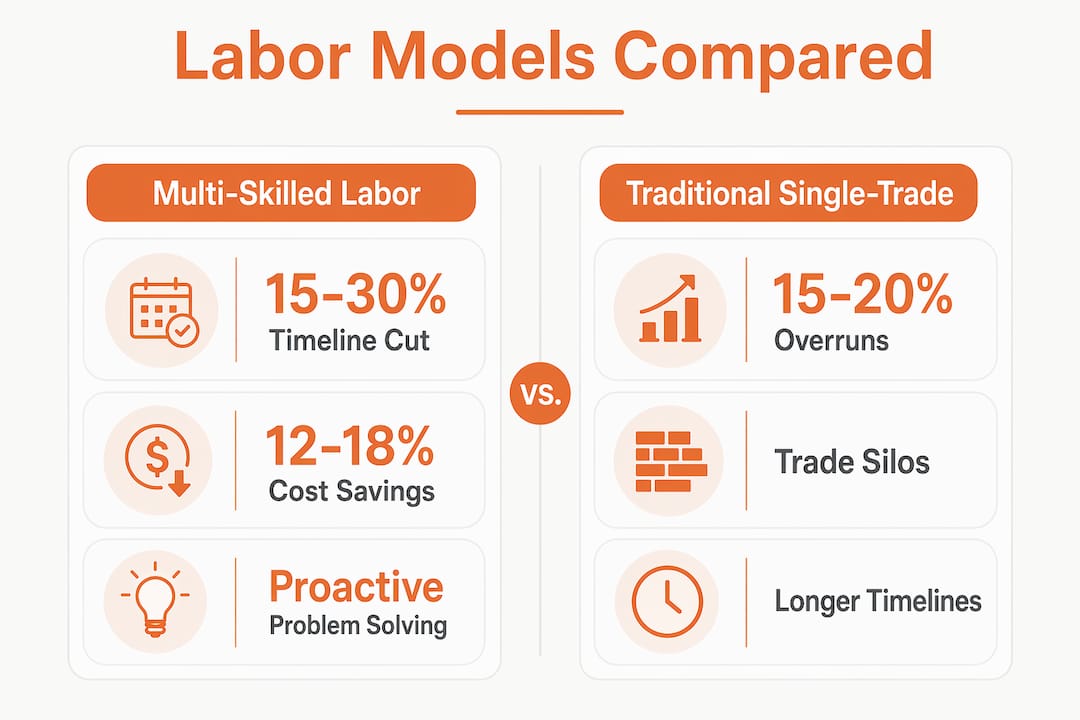
Fragmented single-trade contracting causes budget overruns of 15–20%, driven primarily by communication silos, trade stacking, and idle time between crews. That figure is not a rounding error on a $500,000 commercial renovation. It is $75,000–$100,000 in avoidable cost. Small contractors absorbing those overruns on fixed-price contracts feel it directly in their margins.
The table below compares the two models across the metrics that matter most to small contractors and project managers.
| Metric | Multi-skilled labor model | Traditional single-trade model |
|---|---|---|
| Project timeline | 15–30% faster due to reduced handoff gaps | Longer due to sequential trade scheduling |
| Labor cost | 12–18% lower with coordinated crews | Higher with multiple mobilization costs |
| Scheduling flexibility | High; workers cover adjacent tasks | Low; each trade requires separate scheduling |
| Communication risk | Lower; fewer vendors and handoffs | Higher; silos between trade crews |
| Quality on complex finishes | Moderate; specialist oversight may be needed | High; dedicated specialists on each trade |
| Budget overrun risk | Lower with integrated crews | 15–20% overrun risk with fragmented contracting |
Specialization still wins in specific contexts. In metro markets with populations above 500,000, specialized contractors command premium rates and face enough volume to keep a single-trade crew fully utilized. For small contractors operating in mid-size or rural markets, the volume simply does not support that model. Versatility is not a fallback position. It is the correct strategy for the market conditions most small contractors actually face.
How can small contractors implement a multi-skilled workforce?
Building a versatile crew requires a deliberate process. Ad hoc cross-training, where workers pick up adjacent skills informally on the job, produces inconsistent results. A structured approach produces workers who are genuinely capable across trades and confident enough to work independently.
- Audit your current crew’s secondary skills. Most workers already have informal experience outside their primary trade. Document it. You likely have more multi-skilled capacity than you realize.
- Build a formal cross-training program. Pair workers with experienced leads in adjacent trades for a defined period, typically 60–90 days per skill area. Set clear competency benchmarks before a worker performs tasks independently.
- Use project management software to coordinate multi-trade scheduling. Tools like Procore help you assign tasks by skill set rather than trade category, which is the operational shift that makes multi-trade scheduling work in practice.
- Market as a specialist, work as a generalist. Lead your marketing with a defined niche, such as commercial tenant improvement or light industrial build-out. Specialist marketing improves your search visibility and justifies premium pricing. Once you win the job, your versatile crew handles a broader scope and you capture more revenue per project.
- Build a hybrid crew model. The most resilient structure pairs highly skilled trade specialists with cross-trained generalists who float between tasks. Specialists anchor quality on critical work. Generalists maintain momentum when a specialist is off site or between tasks.
- Prioritize retention. Small firms with turnover below 15% experience far lower labor cost variance. Cross-training itself is a retention tool because workers who gain new skills feel invested in and are less likely to leave for a competitor offering the same single-trade role.
Pro Tip: When recruiting, look for candidates with OSHA 30 certification and documented experience in two or more trade categories. These workers already think in terms of whole-project outcomes rather than single-trade scope, which is exactly the mindset that makes multi-skilled labor work.
Multi-skilled workers also convert the “not my job” mindset into proactive problem-solving. When a worker understands how their task connects to the next trade’s work, they catch conflicts before they become change orders. That shift in mindset is worth as much as the scheduling flexibility.
Key takeaways
Multi-skilled workers reduce project timelines by 15–30% and labor costs by 12–18%, making versatile labor the most cost-effective workforce model for small contractors in mid-size and rural markets.
| Point | Details |
|---|---|
| Timeline and cost impact | Multi-trade crews cut project timelines 15–30% and reduce labor costs by 12–18%. |
| Fragmented contracting risk | Single-trade models cause 15–20% budget overruns from communication silos and idle time. |
| Hybrid crew model | Pair trade specialists with cross-trained generalists to maintain quality and momentum. |
| Retention drives savings | Keeping turnover below 15% stabilizes labor costs and protects your cross-training investment. |
| Market and marketing fit | Lead with specialist marketing to win premium work, then deploy versatile crews to capture broader project scope. |
Why I think small contractors underestimate this shift
The contractors I see struggle most are not the ones who lack skill. They are the ones who built their operations around a single-trade identity and never questioned whether that model still fits their market. The construction labor market in 2026 rewards flexibility. Clients want fewer vendors, faster completions, and one point of contact for accountability.
Multi-skilling is not about asking workers to do more for the same pay. It is about building a crew that understands the whole project and can maintain progress when conditions shift. I have seen small contractors with crews of six outperform larger firms on commercial tenant improvement projects simply because their workers did not stop when the next trade was delayed.
The balance between specialization and versatility is real, and I do not dismiss it. There are tasks, licensed electrical panels, structural steel connections, fire suppression systems, where you need a certified specialist and no amount of cross-training substitutes. The smart approach is to know exactly where those lines are and build your hybrid crew around them. Specialists anchor the work that requires it. Versatile workers carry everything else.
The contractors who will be most competitive over the next five years are the ones building crews that think in project outcomes, not trade categories. That shift starts with who you hire and how you train them.
— Rowena
How Constructconnect-rconstructionsolutions helps you build a versatile crew
Finding workers who combine trade depth with cross-functional capability is one of the hardest recruiting challenges in the AEC industry. Most general staffing agencies do not understand the difference between a carpenter who has framed 50 commercial projects and one who has also coordinated mechanical rough-in. Constructconnect-rconstructionsolutions does.

With 30-plus years of AEC recruiting experience, Constructconnect-rconstructionsolutions connects small contractors with pre-vetted candidates who bring documented multi-trade experience, OSHA 30 certification, and Procore familiarity. Their prorated 90-day payment model means you only pay for placements that stick. If you are ready to build the kind of crew that reduces delays and wins more work, their AEC recruiting services are built for exactly that.
FAQ
What is a multi-skilled worker in construction?
A multi-skilled worker is a construction professional trained to perform tasks across two or more trades, such as carpentry, electrical rough-in, or plumbing. This versatility allows small contractors to reduce crew size while maintaining project scope.
How much can multi-skilled workers reduce project costs?
A multi-trade labor strategy reduces labor costs by 12–18% and cuts project timelines by 15–30%. These savings come from reduced mobilization costs, fewer scheduling gaps, and lower management overhead.
What tasks are best suited for versatile construction workers?
Tasks for versatile construction workers include rough carpentry, basic electrical coordination, drywall installation, tile setting, and general site supervision. Licensed work such as panel connections or gas line installation still requires certified specialists.
How do I prevent burnout in a multi-skilled crew?
Build a skills matrix that defines which tasks each worker performs independently versus with supervision. Distribute multi-trade assignments across the crew rather than concentrating them on your two or three most capable workers.
When does single-trade specialization make more sense than multi-skilling?
Specialization is the stronger model in metro markets with populations above 500,000, where trade volume is high enough to keep a single-trade crew fully utilized. In smaller markets, versatile contractors consistently outperform single-trade specialists on project continuity and client retention.