
Subcontractor Dependency in Small Firms: What to Know
Subcontractor dependency in a small construction firm is defined as the condition where a prime contractor relies on subcontractors to perform the primary and vital requirements of a contract, to the point where the prime’s own role becomes secondary. The U.S. Small Business Administration (SBA) recognizes this condition as a compliance trigger under what is known as the ostensible subcontractor rule, codified at 13 C.F.R. § 121.103(h). For small firms competing on federal set-aside contracts, excessive subcontractor reliance in small businesses is not just an operational concern. It is a legal exposure that can result in affiliation findings, size standard breaches, and disqualification from future work.
What is subcontractor dependency and why does it matter for small firms?
Subcontractor dependency becomes a formal problem the moment the SBA determines that your subcontractor is performing the work your firm was awarded to do. The SBA’s ostensible subcontractor rule states that affiliation and size standard breaches occur when a subcontractor performs primary and vital contract requirements or when the prime is unusually reliant on that subcontractor. When affiliation is found, the SBA combines the size of both firms for procurement eligibility purposes, which almost always pushes a small firm over its applicable size threshold.
This matters because small business set-aside contracts exist specifically to direct federal spending toward firms that can genuinely perform the work. The SBA’s limitations on subcontracting rules prevent pass-through arrangements where a small business wins a contract but outsources most of the substantive work to a large firm. Small businesses that fail to meet self-performance requirements risk contract termination and exclusion from future set-asides. That is a steep price for a small firm that may have invested months into winning a single bid.
The practical signs of problematic dependency are worth knowing:
- The subcontractor holds the specialized licenses, certifications, or equipment the prime lacks
- The subcontractor manages day-to-day field operations while the prime handles only paperwork
- The prime cannot demonstrate independent capacity to supervise or direct the work
- The subcontractor’s workforce represents the majority of labor hours on the project
- The prime’s proposal was built around the subcontractor’s qualifications rather than its own
Each of these patterns raises the question of who is actually performing the contract. The SBA’s analysis looks at all circumstances, not just the written agreement, so operational reality matters as much as contract language.
How do federal regulations define and limit subcontractor dependency?
The SBA’s regulatory framework addresses subcontractor dependency through two primary mechanisms: the ostensible subcontractor rule under 13 C.F.R. § 121.103(h) and the limitations on subcontracting under 13 C.F.R. § 125.6. Understanding both is non-negotiable for any small firm pursuing federal construction work.
Here is how the compliance framework works in practice:
-
Identify primary and vital work. For general construction contracts, the SBA focuses on management, supervision, and oversight as the primary and vital work a prime must perform. Actual hands-on construction can be subcontracted, provided the prime retains genuine project management control. A superintendent with OSHA 30 certification and Procore experience who actively directs field operations satisfies this standard. A project manager who simply forwards emails does not.
-
Distinguish subcontractor types. The SBA separates “similarly situated” subcontractors (other small businesses in the same industry) from “non-similarly situated” subcontractors (large firms or firms in different categories). Work performed by similarly situated subcontractors counts toward the prime’s self-performance calculation. Work performed by non-similarly situated firms does not. This distinction directly affects how you structure your teaming agreements.
-
Meet the subcontracting limitation threshold. Under 13 C.F.R. § 125.6, the prime must perform at least 15% of the cost of the contract with its own employees for general construction. Compliance with this threshold is a strong defense against ostensible subcontractor affiliation allegations. Meeting the limitation on subcontracting requirement is highly probative and can rebut claims of dependency-based affiliation.
-
Lock in scope before award. Material post-award subcontractor changes can affect SBA size determinations and affiliation risk. Workshare responsibilities must be documented at the proposal stage and managed consistently through contract performance.
Pro Tip: Draft a written teaming agreement before submitting your proposal. Specify exactly which tasks your firm will perform, which tasks the subcontractor will perform, and how management authority is allocated. This document becomes your primary defense if the SBA ever challenges your size status.
What operational risks does subcontractor dependency pose to small firms?
Beyond regulatory exposure, the impact of subcontractors on small firms creates real financial and operational strain. The two most significant risks are cash flow disruption from retainage and revenue volatility from single-prime concentration.

| Risk Factor | Description | Mitigation Approach |
|---|---|---|
| Retainage withholding | 5% to 10% of payments withheld until final completion, straining working capital | Negotiate retainage release milestones in subcontract agreements |
| Single-prime revenue loss | Loss of one prime relationship can eliminate a subcontractor’s entire revenue stream | Maintain 3 to 5 active prime relationships simultaneously |
| Employment instability | Federal subcontracting yields weaker and less stable economic benefits than prime contracting | Pursue prime contractor status on smaller contracts to build stability |
| Pass-through exposure | Acting as a paperwork conduit while large subs perform core work threatens eligibility under SBA rules | Assign qualified internal staff to manage and supervise all subcontracted work |
Retainage is particularly damaging for small firms operating on thin margins. When a general contractor withholds 10% of every progress payment, and that retainage sits unreleased for months beyond scope completion, the subcontractor may be financing the project’s completion out of its own pocket. In some cases, retainage can exceed the subcontractor’s total profit on the project. That is not a cash flow inconvenience. It is a solvency risk.
Revenue concentration compounds the problem. A small electrical or mechanical subcontractor that derives 80% of its revenue from a single general contractor is one relationship away from a crisis. Research supports building multiple active prime relationships in the range of three to five to diversify and stabilize revenue. Losing one prime in that scenario is manageable. Losing your only prime is not.
Pro Tip: Track your revenue concentration by prime contractor quarterly. If any single prime accounts for more than 40% of your projected annual revenue, treat that as a risk indicator and actively pursue new prime relationships before the concentration becomes a dependency.
What strategies can small firms use to manage subcontractor dependency?
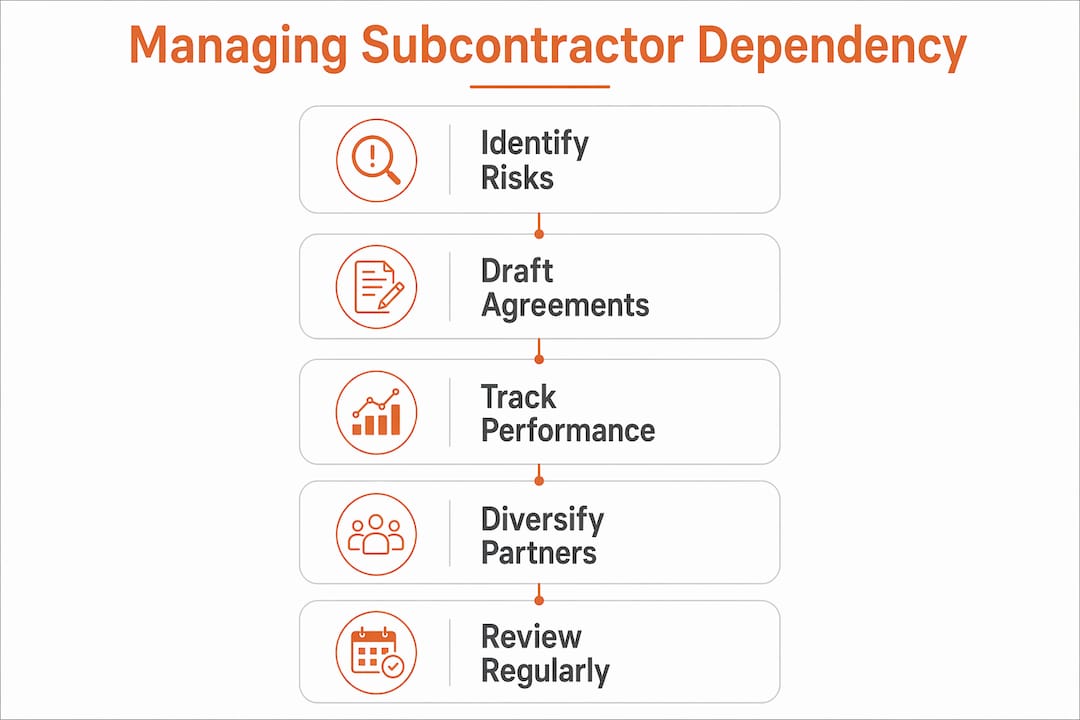
Managing subcontractor relationships effectively requires deliberate planning at the bid stage, not reactive adjustments after problems arise. The following strategies address both the regulatory and operational dimensions of dependency risk.
-
Control primary and vital functions internally. Assign your own superintendent, project manager, or foreman to every project where a subcontractor performs significant work. This person must have genuine authority to direct the work, not just observe it. Document their daily involvement through field reports, meeting minutes, and RFI logs.
-
Design workshare before you bid. Before submitting a proposal, map out exactly what percentage of contract cost your firm will self-perform. Use the SBA’s 15% threshold for general construction as your floor, not your target. Firms that self-perform 25% to 30% of contract cost have a much stronger compliance position than those hovering at the minimum.
-
Qualify subcontractors before project start. Knowing your subcontractor’s capacity, licensing status, and financial health before you commit to a contract protects you from mid-project failures. A structured subcontractor qualification process reduces the risk of replacing a subcontractor after award, which is exactly the kind of post-award change that can trigger SBA scrutiny.
-
Diversify your subcontractor pool. Relying on a single specialty subcontractor for every project creates the same concentration risk that affects revenue. Maintain relationships with at least two qualified firms in each specialty trade you regularly need. This also gives you negotiating leverage on price and schedule.
-
Negotiate retainage terms proactively. Push for retainage reduction clauses tied to project milestones rather than final completion. Many general contractors will accept 5% retainage reduced to 0% upon substantial completion if you ask during contract negotiation. Waiting until you are owed money is too late.
-
Use clear scope of work documentation. A well-drafted subcontractor scope of work prevents scope creep, clarifies responsibility boundaries, and creates a paper trail that supports your compliance position. Ambiguous scopes invite disputes and expose you to claims that your subcontractor was actually running the project.
Understanding why subcontractors miss deadlines is equally important. Dependency on a single subcontractor who underperforms can cascade into project delays that damage your reputation with the prime. Reviewing common deadline failure patterns helps you build contingency plans before they become necessary.
Key takeaways
Subcontractor dependency in small construction firms creates both regulatory exposure under SBA affiliation rules and operational risk through cash flow strain and revenue concentration, and both require proactive management.
| Point | Details |
|---|---|
| Define dependency early | Dependency exists when a subcontractor performs primary and vital contract functions the prime should control. |
| SBA affiliation is the core legal risk | Combined size calculations under the ostensible subcontractor rule can disqualify your firm from set-aside contracts. |
| Self-performance is your best defense | Performing over 15% of contract cost with your own employees satisfies 13 C.F.R. § 125.6 and rebuts affiliation claims. |
| Retainage threatens cash flow | Withheld payments of 5% to 10% can exceed project profit margins; negotiate milestone-based release terms. |
| Diversify prime relationships | Maintaining three to five active prime relationships protects revenue stability against single-prime loss. |
Why I think most small firms underestimate this risk until it’s too late
After working in AEC recruiting and sourcing for over 30 years, I have seen the same pattern repeat itself. A small firm wins a federal set-aside contract, brings in a specialty subcontractor to handle the technical work, and assumes that because the paperwork says “prime contractor,” the compliance box is checked. It is not.
The firms that get into trouble are rarely trying to game the system. They simply do not have the internal capacity to perform the management and supervision role the SBA expects, so the subcontractor fills that vacuum. By the time a size protest is filed, the operational reality has already diverged from the contract documents.
What I have found actually works is treating compliance as a staffing decision, not a legal one. If you cannot put a qualified superintendent or project manager on a contract who genuinely controls the work, you are not ready to prime that contract. That is a hard truth, but it is far less painful than an affiliation finding.
The diversification advice is equally underused. Small firms often build deep relationships with one or two primes because it feels safer and more predictable. The opposite is true. A concentrated prime relationship is a single point of failure. The firms I have seen grow steadily over time are the ones that treat their prime relationships like a portfolio, actively adding new ones while maintaining existing ones.
The regulatory and operational risks of subcontractor dependency are manageable. They require early planning, honest capacity assessment, and consistent documentation. Firms that build those habits early do not just avoid problems. They build the kind of track record that attracts better contracts and stronger prime partners.
— Rowena
How R. Construction Solutions helps small firms build stronger teams
Small construction firms managing subcontractor dependency need more than compliance advice. They need access to qualified people and vetted subcontractor relationships that reduce their exposure from day one.

Constructconnect-rconstructionsolutions brings 30-plus years of AEC industry experience to help small firms build the internal capacity they need to prime contracts confidently. Whether you need a superintendent with OSHA 30 certification to satisfy SBA management requirements or a pre-vetted subcontractor pool to reduce single-source dependency, the team at R. Construction Solutions delivers. Their AEC recruiting services connect you with candidates who are screened for the specific roles your projects demand. For firms looking to expand their prime relationships and reduce revenue concentration, their business opportunity sourcing program identifies new contract pathways matched to your firm’s capacity and certifications.
FAQ
What is the ostensible subcontractor rule?
The ostensible subcontractor rule is an SBA regulation under 13 C.F.R. § 121.103(h) that finds affiliation between a prime and subcontractor when the subcontractor performs the primary and vital requirements of the contract or the prime is unusually reliant on the subcontractor. When affiliation is found, both firms’ sizes are combined, which can disqualify the prime from small business set-aside contracts.
How much work must a small firm self-perform on federal construction contracts?
Under 13 C.F.R. § 125.6, a small business prime on a general construction contract must perform at least 15% of the contract cost with its own employees. Work performed by similarly situated subcontractors, meaning other small businesses in the same industry, can count toward this threshold.
How does retainage affect subcontractor cash flow?
Retainage typically withholds 5% to 10% of each progress payment until final project completion, which can tie up working capital for months beyond when the subcontractor’s scope is finished. In some cases, the withheld amount exceeds the subcontractor’s profit margin on the project, creating a direct solvency risk.
Can post-award subcontractor changes trigger SBA review?
Yes. Material changes to subcontractor scope or workshare after contract award can affect SBA size determinations and affiliation analysis. Firms should lock in documented responsibilities at the proposal stage and manage any changes carefully to avoid creating new compliance exposure.
How many prime relationships should a small subcontractor maintain?
Industry guidance recommends maintaining three to five active prime relationships to protect against revenue volatility. Losing a single prime when you have only one active relationship can eliminate your firm’s entire revenue pipeline, while a diversified portfolio absorbs that loss without threatening the business.