Hiring a Construction Project Manager: Steps for 2026
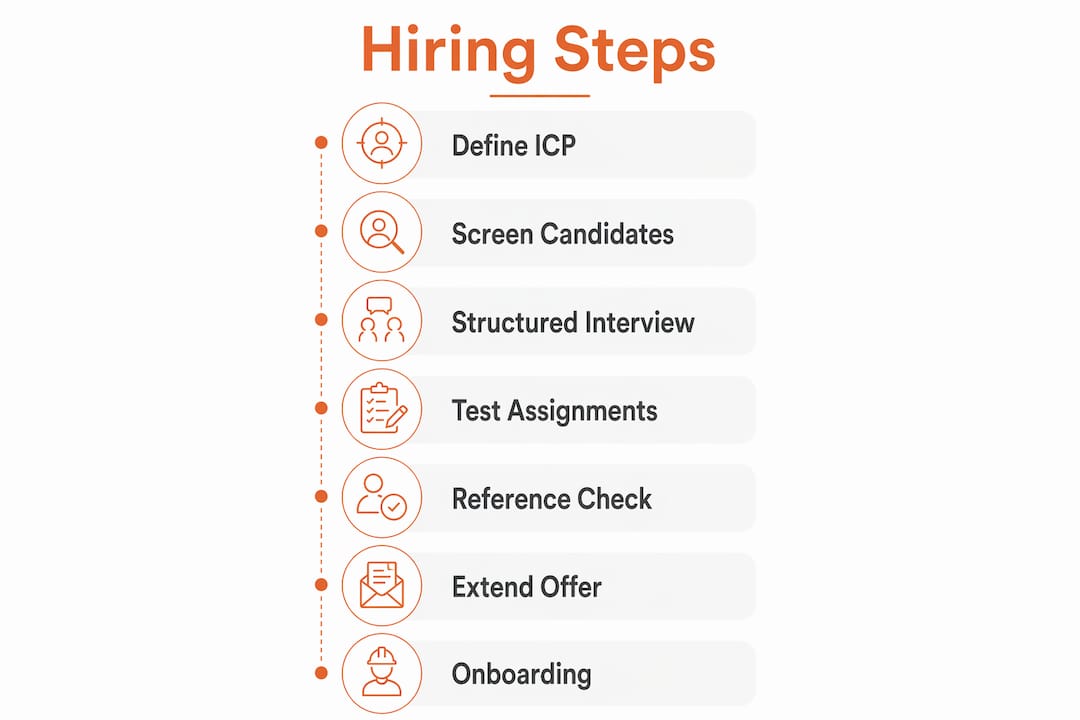
Hiring a construction project manager is a step-driven process that determines whether your project finishes on time, on budget, and without costly rework. The construction manager hiring process covers six distinct phases: role definition, candidate profiling, sourcing, screening, structured interviewing, and onboarding. Contractors and construction firms that skip or rush any of these phases consistently lose top candidates to faster-moving competitors or bring on project managers who lack the specific experience the job demands. This guide gives you a practical, field-tested roadmap for each step, built around 2026 market conditions and the realities of AEC industry recruiting.
What are the key hiring construction project manager steps?
The first step is defining the role with enough specificity that the right candidates self-select in and the wrong ones self-select out. A generic job description for a “construction project manager” will attract hundreds of resumes from candidates who have managed residential remodels when you need someone who has run a $40 million commercial ground-up build with a CM at-risk delivery method.
Start by answering four questions before you write a single word of the job posting:
- Project type and size: Is this a ground-up commercial build, a tenant improvement, a public infrastructure project, or a design-build?
- Delivery method: Design-bid-build, CM at-risk, or integrated project delivery each require different PM skill sets.
- Reporting structure: Does this PM report to a VP of Operations, a principal, or directly to the owner?
- Authority level: Can the PM approve change orders independently, or does every decision require sign-off?
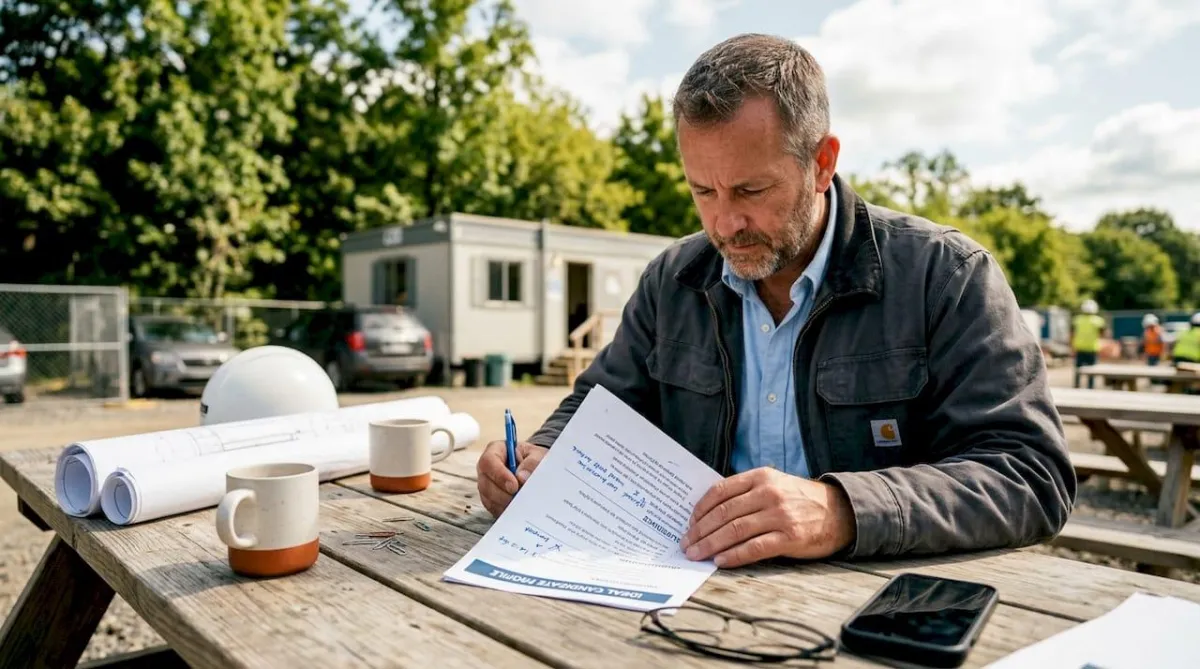
Once you have those answers, build an Ideal Candidate Profile (ICP) before drafting the job description. The ICP is an internal document that defines the outcomes the PM must achieve and the core traits required to achieve them. Building an ICP first improves hiring by focusing on project-based outcomes and candidate traits rather than years of experience alone. A candidate with 12 years of experience managing residential projects is not the same as one with 7 years running commercial healthcare construction, even though both resumes might clear a keyword filter.
Certifications matter, but they must match the project’s complexity. A Project Management Professional (PMP) credential signals process discipline. An OSHA 30 certification is a baseline safety requirement on most commercial sites. Procore experience is now a practical expectation on mid-size and larger projects. List only the certifications that genuinely apply to your project scope.

Pro Tip: Write the ICP as a one-page internal brief shared with every hiring stakeholder before the job posting goes live. Misaligned expectations between your field superintendent and your CFO about what the PM role requires will derail your hiring process faster than a bad candidate pool.
How do you source and screen qualified candidates efficiently?
Sourcing starts with the job posting, and the posting must include a realistic salary band. Competitive salary ranges in the job posting generate sufficient qualified applicant flow. Posting a vague “competitive compensation” line in 2026 signals to experienced PMs that the role is either underpaying or disorganized. Research current market rates for your region and project type, then post a specific range.
Sourcing channels for construction project managers fall into three categories:
- General job boards (LinkedIn, Indeed): High volume, lower signal-to-noise ratio. Expect a large percentage of applicants who do not meet your ICP criteria.
- Specialized AEC recruiting platforms and agencies: Lower volume, higher candidate quality. Firms like Constructconnect-rconstructionsolutions focus exclusively on AEC staffing roles, which means their candidate pools are pre-vetted for construction-specific experience.
- Referral networks: Your existing superintendents, project executives, and subcontractor partners know who the strong PMs are in your market. A structured referral program produces candidates who already understand your project environment.
Screening is where most firms lose time. A focused 15-minute phone screening using five specific project-based questions eliminates about 70% of candidates who look qualified on paper but lack the necessary depth. That number is significant. It means you can cut your interview load by more than two-thirds before you ever schedule a formal interview.
Your five phone screening questions should test project-specific knowledge, not general PM theory. Ask about the largest project they managed by dollar value, the most complex subcontractor coordination challenge they resolved, how they handle scope changes with an owner who resists change orders, their experience with your specific delivery method, and their familiarity with your project management software platform.
How do you conduct structured interviews that predict real performance?
Structured interviews with scenario-based questions scored by rubrics reduce bias and improve prediction of job performance under pressure. The key word is “structured.” Every candidate answers the same questions in the same order, and every interviewer scores responses against the same criteria. This removes the subjective “gut feel” that leads to hiring the most personable candidate rather than the most capable one.
Effective scenario questions for construction PMs include:
- “Walk me through how you managed a project that was 15% over budget at the midpoint. What specific actions did you take?”
- “Describe a situation where a subcontractor’s performance threatened the schedule. How did you address it without escalating to litigation?”
- “A key owner stakeholder is requesting a scope addition two weeks before substantial completion. How do you handle it?”
These questions reveal accountability, problem-solving process, and communication style simultaneously. A candidate who deflects blame in their answers will deflect blame on your project.
Paid test assignments for finalists provide real insight into candidate abilities beyond interview talk. A small-scale assignment, such as drafting a project status update for a fictional project scenario or outlining a three-week look-ahead schedule, takes a finalist two to three hours and tells you more than a second interview would. Candidates who decline the assignment tell you something important about their commitment level.
Reference checks are the final filter before an offer. Ask references specifically about the candidate’s weaknesses and about a project that did not go as planned. Vague, uniformly positive references are a signal that the reference was coached. A reference who can describe a specific challenge the candidate overcame is far more credible.
Pro Tip: Build a simple scoring rubric with four criteria: technical knowledge, communication clarity, accountability language, and cultural fit. Score each criterion 1–5 during the interview. This gives you a defensible, comparable record across all finalists.
What are the best practices for extending offers and onboarding?
Speed wins top candidates. Firms that let interview-to-offer timelines exceed four weeks consistently lose their top choices to competitors who move faster. Compressing that timeline to 10 days requires internal alignment before the process starts, not after.
Follow these steps to keep your offer timeline tight:
- Align all hiring stakeholders on the ICP and decision criteria before the first interview. Disagreements about what you need should happen before you meet candidates, not after.
- Set a decision deadline at the start of the interview process. Tell your team: “We will make an offer decision within five business days of the final interview.”
- Prepare the offer letter template in advance. Waiting for HR to draft an offer after you have decided adds days you cannot afford.
- Make the verbal offer before the written offer. A phone call to the finalist confirms interest and surfaces any compensation concerns before the formal letter goes out.
Onboarding is where most construction firms underinvest. A new PM who walks in on day one without clear authority, system access, or stakeholder introductions will spend their first month navigating internal politics instead of managing the project. New project managers should spend their first 30 days shadowing, documenting current processes, and learning before implementing any changes.
Structure the onboarding in three phases. Days 1–30 focus on listening and learning: meeting the project team, reviewing existing documentation, and understanding current workflows. Days 31–60 shift to ownership: the PM takes the lead on daily coordination, subcontractor communication, and schedule management. Days 61–90 focus on systems: the PM identifies process gaps and proposes improvements with full context behind them.
A detailed, written Scope of Work (SOW) is the foundation of this onboarding structure. A clear SOW sets measurable standards for project phases, deliverables, and roles, which is key to managing accountability and minimizing disputes from the start.
Pro Tip: Give your new PM a written authority matrix on day one. Define exactly what they can approve independently, what requires your sign-off, and what requires owner approval. Ambiguity about authority is the fastest way to undermine a new PM’s credibility with the field team.
Key takeaways
Hiring a construction project manager requires a defined ICP, structured screening, scenario-based interviews, and a 30-60-90 day onboarding plan to produce consistent results.
| Point | Details |
|---|---|
| Build the ICP first | Define project outcomes and candidate traits before writing the job description. |
| Screen fast and specifically | A 15-minute phone screen with five project-based questions eliminates most unqualified candidates early. |
| Structure every interview | Use scenario questions and scoring rubrics to compare candidates objectively and reduce bias. |
| Compress the offer timeline | Align stakeholders before interviewing to keep the interview-to-offer window at 10 days or fewer. |
| Onboard in three phases | Structure the first 90 days as learning, ownership, and systems development to build lasting effectiveness. |
What I’ve learned from watching firms get this wrong
Most construction firms do not have a hiring problem. They have a preparation problem. The firms I see struggle most with finding project managers are the ones that open a job posting before they have answered the four foundational questions about the role. They write a job description that could apply to any PM at any firm, and then they wonder why the candidates who apply do not fit.
The second pattern I see consistently is slow decision-making driven by internal misalignment. Two principals who disagree about whether the PM needs Procore experience or whether a PMP is required will stall the process for weeks. By the time they align, the candidate has accepted an offer elsewhere. Failing to align interview stakeholders internally causes lengthy hiring cycles and the loss of top candidates to faster-moving firms. That is not a talent shortage problem. That is a process problem.
The third mistake is treating onboarding as an HR formality rather than a performance investment. A PM who starts without a clear SOW, without defined authority, and without introductions to key subcontractors will take three to four months to reach full effectiveness instead of six to eight weeks. That delay has a direct cost to your project schedule. The firms that get onboarding right treat the first 90 days as a structured program, not an open door policy.
The construction manager hiring process is not complicated. It is just specific. Every step requires deliberate preparation, and the firms that prepare consistently hire better and retain longer.
— Rowena
How Constructconnect-rconstructionsolutions supports your hiring process
Constructconnect-rconstructionsolutions brings 30-plus years of AEC industry experience to every search, with a candidate pool built specifically for construction and engineering roles. When your next project requires a project manager with a specific delivery method background or a defined certification set, the team at Constructconnect-rconstructionsolutions sources pre-vetted candidates who match your ICP, not just your keyword list.
The prorated 90-day payment model means you pay only for successful placements, which removes the financial risk of a search that does not produce results. For firms that need to move quickly in a competitive hiring market, Constructconnect-rconstructionsolutions provides AEC recruiting services designed to compress your timeline without cutting corners on candidate quality. Reach out early in your project planning cycle to avoid the delays that cost firms their top choices.
FAQ
What qualifications should a construction project manager have?
A construction project manager should hold an OSHA 30 certification as a baseline safety credential, with a PMP designation for larger or more complex projects. Procore experience is a practical expectation on most mid-size commercial projects in 2026.
How long should the construction manager hiring process take?
The full process from job posting to signed offer should take three to four weeks for most firms. Compressing the interview-to-offer window to 10 days after the final interview prevents losing top candidates to competitors.
What is an Ideal Candidate Profile (ICP) in construction hiring?
An ICP is an internal document that defines the project outcomes a PM must achieve and the core traits required to achieve them. Building the ICP before writing the job description focuses the search on project-specific fit rather than generic experience.
How do you screen construction project manager candidates efficiently?
A 15-minute phone screening using five project-specific questions eliminates approximately 70% of candidates who appear qualified on paper but lack the required depth. Questions should cover project dollar value, delivery method experience, and software platform familiarity.
What should a construction PM onboarding plan include?
A strong onboarding plan covers three phases: days 1–30 for learning and documenting current processes, days 31–60 for taking ownership of daily coordination, and days 61–90 for identifying and proposing process improvements with full project context.