
Why Contractors Switch Material Suppliers: A Builder's Guide
Contractors switch material suppliers when pricing volatility, availability gaps, or purchasing friction directly threaten project margins and schedules. That’s the short answer. The longer one involves a structural shift in how the construction supply chain behaves in 2025–26, and 61% of contractors reported substituting preferred brands for alternatives by Q3 2025, a 21-percentage-point increase in under a year, according to Principia.
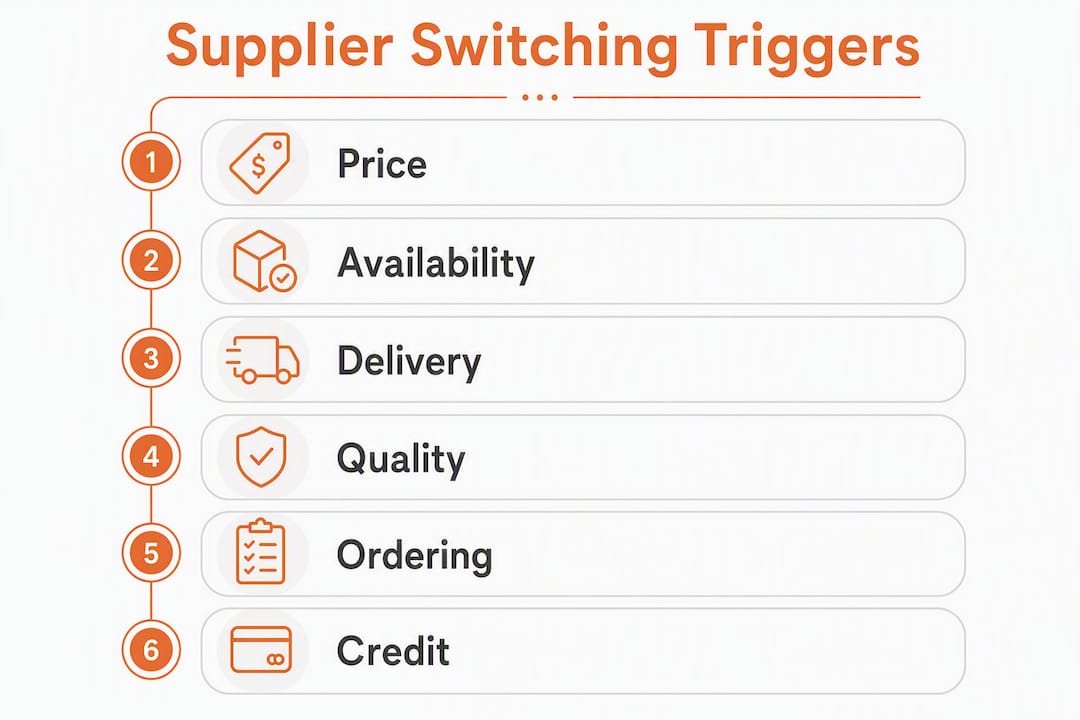
The five highest-impact triggers:
- Unpredictable price swings and hidden surcharges that blow up estimates
- Stockouts and long lead times that idle crews and delay milestones
- Delivery failures, damaged goods, and no clear claims process
- Opaque invoicing and unfavorable credit terms that strain cash flow
- Ordering friction, no real-time inventory visibility, and poor technical support
Each of these hits a different part of your business: margins, schedule confidence, crew productivity, and client relationships. When more than one stacks up with the same supplier, switching stops being a preference and becomes a business decision.
Table of Contents
- 1. Why contractors switch material suppliers: the real operational triggers
- 2. How switching suppliers changes your business
- 3. How to assess and pick a new material supplier
- 4. Step-by-step playbook to switch suppliers with minimal disruption
- 5. Market trends showing why supplier switching is rising
- Key Takeaways
- The case for treating supplier switching as a planned strategy, not a last resort
- How R. Construction Solutions connects contractors with pre-vetted suppliers
- Useful sources
- FAQ
1. Why contractors switch material suppliers: the real operational triggers
Price is almost always the first conversation, but it’s rarely the only one. Here’s what actually drives contractors to make the call.

Price volatility and hidden surcharges
Material price increases and tariff impacts have pushed buyer price sensitivity to levels not seen in a generation. When a supplier quotes one price at estimate time and invoices a different number at delivery, the margin on that job is gone before the crew finishes. The decision signal: if a supplier has adjusted prices mid-order more than twice in a 12-month period without advance notice, that’s a pattern, not an anomaly.
Product availability and lead times
A significant share of construction leaders identified supply chain management as a top business concern in 2026, per UHY. A drywall supplier that quotes a two-week lead time and delivers in five weeks doesn’t just cause a scheduling headache. It idles a framing crew, triggers a change order conversation with the owner, and compresses every downstream trade. When a supplier cannot show you real-time stock levels, you’re estimating blind.
Delivery reliability and damage rates
A supplier that delivers on time 80% of the time sounds acceptable until you calculate what the other 20% costs in crew standby, re-scheduling, and expediting fees. Damaged roofing materials on a residential job mean a return trip, a delay, and a client conversation you didn’t plan for. One missed delivery is a problem; a pattern is a liability.
Quality and performance consistency
Inconsistent product quality forces foremen to inspect every pallet instead of trusting the spec. That’s a hidden labor cost most contractors don’t track. If a product performs differently across batches, it also creates warranty exposure on completed work.
Ordering friction and lack of digital tools
A large proportion of B2B buyers would switch to a supplier offering a better digital buying experience, and the data behind that number is specific: Many buyers experience stock and shipping problems, and a notable share report that unclear pricing has delayed their purchasing decisions. When your purchasing manager spends 45 minutes on the phone confirming stock that should be visible in a portal, that’s a productivity tax paid every order cycle. Suppliers without digital ordering capability are increasingly a competitive disadvantage for the contractors who rely on them.
Credit terms and invoicing transparency
A considerable number of subcontractors sought new suppliers due to procurement challenges, with credit terms and payment timing among the most cited pain points. Net-30 terms that a supplier routinely enforces as net-15 in practice, or invoices that don’t match purchase orders, create cash flow problems that compound across a multi-phase project. The decision signal: if reconciling a supplier’s invoice takes more than 20 minutes per delivery, the billing process is broken.
Communication and trust failures
Suppliers that don’t return calls during a shortage, can’t provide a single point of contact for escalation, or fail to flag lead-time changes proactively are a risk to every job they touch. Supplier relationships function like insurance: vendors prioritize contractors who communicate forecasts and maintain predictable buying patterns. When that relationship breaks down on the supplier’s side, the contractor absorbs the cost.
“Contractors are increasingly willing to break historic brand loyalty when suppliers fail to address price sensitivity and transparency. This is a structural shift, not a temporary reaction to market conditions.” — Principia analysts, December 2025
2. How switching suppliers changes your business
The benefits of changing material suppliers are real, but so are the short-term costs. Understanding both is what separates a well-managed transition from a disruptive one.
Measurable benefits:
- Lower material cost per unit when a new supplier offers transparent, stable pricing
- Fewer change orders tied to availability failures or substitution surprises
- Improved schedule confidence when delivery SLAs are written and enforced
- Reduced storage and handling costs when procurement aligns with actual project backlog
Common risks and hidden costs:
- One-off pilot testing and crew familiarization with new products
- Warranty and rework exposure during the transition window
- Temporary friction with a new supplier’s account team before the relationship matures
- Potential gaps in material continuity if the handoff isn’t sequenced carefully
Pro Tip: Before committing to a full switch, calculate the expected margin improvement on one job type. If the projected savings exceed 3–5% of material cost on that job, the transition cost is typically recoverable within two to three projects. If the savings are thinner, negotiate with your current supplier first.
Understanding what causes subcontractor unreliability helps frame supplier risk in the same operational terms: both are upstream dependencies that, when they fail, cascade into field delays and client dissatisfaction.
3. How to assess and pick a new material supplier
A structured evaluation process reduces switching regret. Use this checklist before signing any new supplier agreement.
Due-diligence questions to ask every candidate supplier:
- Can you provide written pricing with a stated validity period, and how do you handle mid-order adjustments?
- Do you have real-time inventory visibility across multiple locations, and can I access it through a portal?
- What are your delivery SLAs, and what is your process when a delivery misses the window?
- How do you handle damaged goods claims, and what is the average resolution time?
- Who is my single point of contact, and who do I escalate to if that person is unavailable?
- What credit terms do you offer, and how are invoices structured relative to purchase orders?
- Can you provide references from contractors running similar project types and volumes?
Red flags that should stop the evaluation:
- No written SLA for delivery or damage claims
- Inability to show real-time stock levels on request
- Repeated billing errors in the first two sample invoices
- Unwillingness to share lead-time forecasts for the next 60–90 days
Suggested evaluation weighting:
| Criterion | Weight | What to Assess |
|---|---|---|
| Reliability (delivery, availability) | — | SLA documentation, reference checks, lead-time history |
| Price transparency | 30% | Written quotes, invoice-to-PO match rate, surcharge policy |
| Digital and ordering ease | 20% | Portal access, real-time inventory, reorder capability |
| Terms and service | 15% | Credit terms, escalation path, technical support access |
Reliability carries the highest weight because a cheaper supplier that misses deliveries costs more in crew standby than the price difference saves. Price transparency comes second because opaque billing is where margin leaks quietly over time.
4. Step-by-step playbook to switch suppliers with minimal disruption
A clean handoff protects your schedule, your crew, and your client relationship. Follow this sequence.
- Run a pilot order on a non-critical material. Choose a product category where a delay won’t halt work. Evaluate delivery accuracy, product quality, and invoice match before committing the full account.
- Overlap supply during the handoff window. Carry two to four weeks of buffer stock from your current supplier while the new relationship establishes its rhythm. Overbuying ties up working capital, but underplanning causes delays, so align the buffer to your committed backlog and historical usage.
- Update your bill of materials (BOM) and brief your foremen. Any product substitution needs a written note on the BOM so field crews aren’t installing the wrong spec. Verbal handoffs fail.
- Align delivery windows to crew schedules. Confirm that the new supplier’s delivery cadence matches your crew’s installation sequence. A pallet of roofing material that arrives three days before the roofing crew creates a storage and handling problem.
- Confirm warranty and return policies in writing. Before the first full order, get the supplier’s return and warranty terms documented. This protects you if a product performs differently than the spec sheet indicates.
- Maintain the outgoing supplier relationship professionally. You may need them again for a specific product or in an emergency. Emergency subcontractor and supplier sourcing situations are more manageable when you haven’t burned a bridge.
Suggested timeline: For most commercial projects, allow 4–8 weeks for a full transition on primary materials. Residential jobs with shorter phases can often complete a handoff in 2–4 weeks, provided the pilot order runs in the first week.
Pro Tip: Tell your project superintendent and procurement lead about the switch before the first new delivery arrives. Surprises on a job site create distrust. A two-minute briefing prevents a two-hour problem.
5. Market trends showing why supplier switching is rising
The data behind contractor supply chain decisions in 2025–26 points to structural pressure, not temporary market noise.
| Metric | Figure | Source |
|---|---|---|
| Contractors substituting preferred brands | 61% by Q3 2025 | Principia |
| Construction leaders citing supply chain as top concern | 30% in 2026 | UHY |
| B2B buyers willing to switch for better digital experience | 75% | BigCommerce |
| Buyers experiencing stock/shipping pain | 81% | BigCommerce |
| Subcontractors seeking new suppliers due to procurement issues | 65% | Roofing Contractor survey |
The Principia figure is the most telling: a 21-percentage-point increase in brand substitution in under a year signals that contractor loyalty is no longer a given. Marsh’s risk analysts recommend proactively adding qualified alternative suppliers as a deliberate risk-management tactic to protect project timelines, not just a reactive response to a supplier failure.
UHY’s 2026 supply chain research makes a related point: firms that treat procurement as an integrated function tied to estimating and field operations reduce their switching need over time. The contractors who struggle most with supplier disruption are those who manage procurement in isolation from the field.
These surveys sampled general contractors, specialty subcontractors, and residential builders across North America, giving the figures broad applicability across project types and company sizes.
Key Takeaways
Contractors switch material suppliers primarily because price volatility, delivery failures, and ordering friction directly erode project margins and schedules, and the data shows this is now a structural industry pattern, not an isolated reaction.
| Point | Details |
|---|---|
| Switching is widespread | 61% of contractors substituted preferred brands by Q3 2025, a 21-point increase in under a year. |
| Reliability outweighs price alone | Weight delivery SLAs and inventory visibility highest in your supplier evaluation, above price transparency. |
| Pilot before committing | Run a test order on a non-critical material before switching primary supply to reduce transition risk. |
| Digital capability matters | 75% of B2B buyers would switch for a better digital buying experience; ask suppliers for portal access upfront. |
| Constructconnect-rconstructionsolutions reduces switching risk | R. Construction Solutions connects contractors with pre-vetted suppliers through a 30+ year sourcing network, reducing the time and exposure of finding a reliable replacement. |
The case for treating supplier switching as a planned strategy, not a last resort
Most contractors switch suppliers reactively: a delivery fails, a price spikes, a foreman complains. That’s understandable, but it’s also the most expensive way to do it. A reactive switch happens under schedule pressure, which means less time to vet the replacement, less leverage to negotiate terms, and more risk of compounding the original problem.
The data from Principia, UHY, and Marsh collectively point toward a different posture: treating supplier diversification as a planned risk-management strategy. Marsh’s guidance to proactively add qualified alternative suppliers isn’t advice for large general contractors only. It applies to any firm where a single supplier failure can delay a milestone or trigger a penalty clause.
What most articles on this topic miss is the relationship dimension. Suppliers prioritize contractors who communicate forecasts and maintain predictable buying patterns. That means the contractors who are most protected during a shortage are the ones who have already built relationships with two or three vetted suppliers, not the ones scrambling to find a new account on a Monday morning when a delivery doesn’t show.
The practical implication: run a small pilot order with an alternate supplier on every major material category, even when your current supplier is performing well. It costs almost nothing in normal conditions and gives you a tested fallback when conditions aren’t normal. That’s not disloyalty to your current supplier. It’s sound procurement practice, and the supplier-contractor relationship works better when both parties know the contractor has options.
How R. Construction Solutions connects contractors with pre-vetted suppliers
Finding a reliable replacement supplier under schedule pressure is one of the most avoidable costs in construction. R. Construction Solutions gives contractors direct access to a pre-vetted supplier and subcontractor network built over 30+ years in the AEC industry, so you’re not starting a cold search when a supplier relationship breaks down.

The firm’s sourcing model is built for contractors who need qualified introductions fast, without the overhead of a traditional agency. Lower commission rates and a prorated payment structure mean you pay for results, not for the search. Whether you need a procurement specialist placed on a project, a vetted supplier introduction for a specific material category, or a subcontractor connection for a specialty trade, R. Construction Solutions matches you with pre-screened partners who fit your project type and volume.
To connect with pre-vetted suppliers or get AEC recruiting support for your procurement team, contact R. Construction Solutions directly through constructconnect-rconstructionsolutions.com.
Useful sources
The following resources informed this article and are worth reading for deeper context on contractor supply chain decisions.
- Supply Chain Resiliency in Construction | UHY — 2026 survey data on supply chain as a top contractor concern and procurement alignment best practices.
- Top Contractor Risks H1 2025 | Marsh — Risk analyst guidance on supplier diversification as a proactive risk-management strategy.
- Why Building Materials Buyers Switch | BigCommerce — Data on digital buying experience, stock/shipping pain, and unclear pricing as switching triggers.
- Survey: Material Pricing, Availability Affecting Supplier-Subcontractor Relationships | Roofing Contractor — Subcontractor survey data on procurement challenges and credit term pain points.
- Why Material Suppliers Need Contractor Networks | R. Construction Solutions — Context on building pre-vetted supplier lists and proactive risk management.
- The Build: Streamline Purchasing, Projects and Profits — Partner resource on integrating purchasing and crew management for better field coordination.
FAQ
Why do contractors switch material suppliers so frequently?
61% of contractors substituted preferred brands by Q3 2025, driven by price volatility, availability failures, and ordering friction that directly affect project margins and schedules. Switching has become a rational business response to structural supply chain pressure, not just dissatisfaction with a single vendor.
What are red flags when evaluating a new material supplier?
No written delivery SLA, inability to show real-time inventory, repeated billing errors in sample invoices, and unwillingness to share lead-time forecasts are the clearest warning signs. Any one of these in a first meeting indicates a supplier that will create operational problems at scale.
Why do contractors upcharge materials?
Contractors typically pass through material costs plus a markup to cover procurement time, storage, handling, and warranty risk. When a supplier’s pricing is unstable or invoices don’t match purchase orders, that markup often increases to buffer against billing surprises, which is one reason pricing transparency from suppliers directly affects what clients pay.
What should contractors do with leftover materials after a supplier switch?
Return unused materials to the outgoing supplier per their return policy, confirmed in writing before the transition. For materials that can’t be returned, document them in your inventory system and apply them to the next eligible job to avoid write-offs.
How long does a supplier switch typically take?
Most commercial projects require 4–8 weeks for a full transition on primary materials, starting with a pilot order in week one. Residential jobs with shorter phases can often complete the handoff in 2–4 weeks when the pilot runs immediately and buffer stock is maintained during the overlap period.

