
Role of Project Engineer in Scheduling: 2026 Guide
The project engineer (PE) is the operational coordinator of scheduling in construction, translating the master schedule into daily and weekly execution plans that keep trades aligned and projects on track. This role is distinct from the planning engineer, who builds the master schedule using tools like Primavera P6. The PE’s job is to apply that schedule to real site conditions through RFI management, submittal tracking, subcontractor coordination, and field verification. Understanding the role of project engineer in scheduling is what separates projects that finish on time from those that quietly slip until recovery is impossible.
How does the project engineer differ from the planning engineer in scheduling?
The planning engineer owns the master schedule. That means building the logic ties, identifying the critical path, loading resources, and forecasting project completion. The project engineer takes that master schedule and converts it into something the field can actually use: look-ahead schedules, trade-specific task lists, and daily coordination plans built with input from the superintendent and subcontractors.
This is not a minor distinction. Planning engineers own schedule logic and forecasting, while project engineers own trade-off decisions, execution feasibility, and site-level constraints. When a structural drawing conflict delays a concrete pour, the planning engineer updates the schedule model. The PE is the one who caught the conflict, escalated it, and coordinated the revised sequence with the affected trades.
A common mistake on project teams is expecting the PE to function as a backup planner. Experts clarify that the PE must focus on managing the flow of technical information and real-time execution decisions, not on building schedule logic. Treating a PE as a data entry clerk wastes their most valuable skill: technical depth.
| Responsibility | Planning engineer | Project engineer |
|---|---|---|
| Master schedule development | Owns | Consults |
| Critical path analysis | Owns | Monitors |
| Look-ahead schedule creation | Supports | Owns |
| RFI and submittal tracking | No direct role | Owns |
| Subcontractor coordination meetings | Occasional | Leads |
| Scope change schedule impact | Models | Prepares backup and escalates |
| Field progress verification | Rare | Daily |
Pro Tip: When onboarding a new PE, give them a copy of the master schedule and ask them to build a three-week look-ahead from it. Their ability to translate schedule logic into field-ready tasks tells you exactly how effective they will be on site.
What are the main scheduling responsibilities of a project engineer?
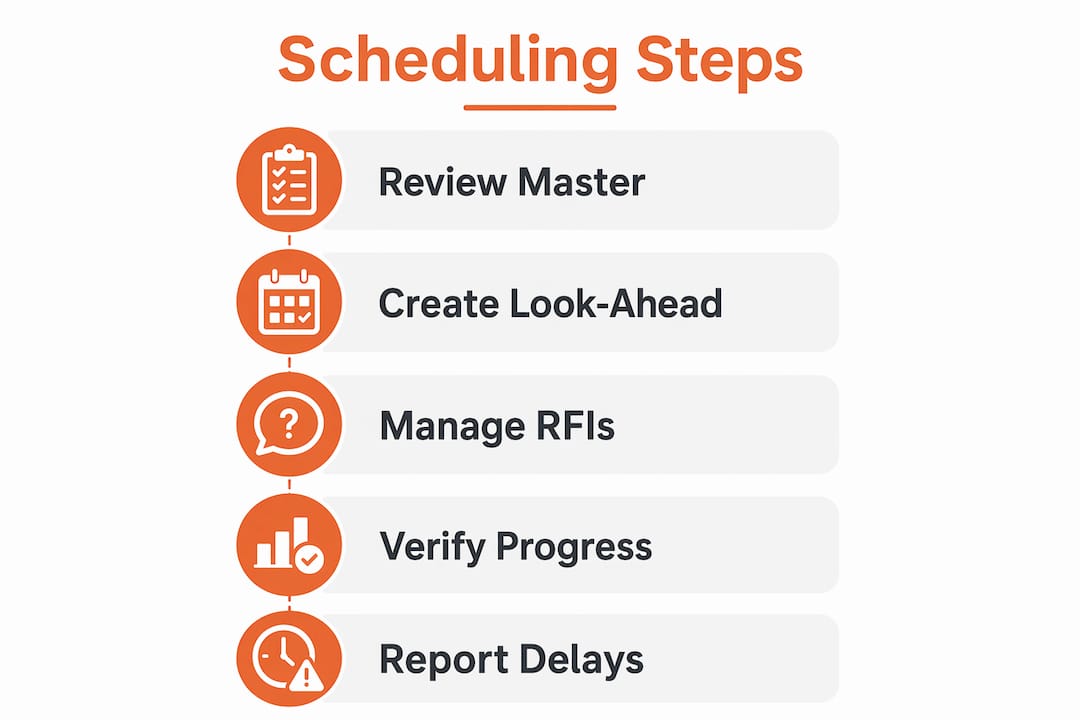
The PE’s daily schedule work falls into five core areas. Each one feeds directly into schedule accuracy and project delivery.
-
RFI and submittal management. The PE tracks every open RFI and submittal, flags items on the critical path, and follows up directly with architects and engineers when responses are overdue. Delays in RFI responses on critical path tasks can cause irreversible schedule impacts and cost escalations. Experienced PEs call architects proactively rather than waiting on passive document tracking systems.
-
Daily site walk-downs. High-performing PEs spend 1–3 hours daily walking the site to verify actual progress against the schedule baseline. This field time identifies subtle deviations that never appear in a software report. A PE who stays at their desk misses the information that causes scheduling problems two weeks later.
-
Look-ahead schedule facilitation. The PE runs weekly or biweekly look-ahead meetings with the superintendent and subcontractor foremen. These sessions confirm what work is planned, what materials and approvals are needed, and what constraints exist. The output is a three-to-six-week rolling schedule that the field actually uses.
-
Subcontractor coordination. Project engineers act as liaisons ensuring subcontractors have approved submittals and are aligned on scope and schedule. When trades work in silos, schedule fragmentation follows. The PE prevents that by keeping every party informed and accountable. Understanding why subcontractors miss deadlines is part of the PE’s working knowledge.
-
Schedule documentation. The PE records schedule-impacting events, logs delays with cause and effect, and prepares written summaries for the project manager. This documentation supports time extension claims and protects the owner and general contractor in disputes.
Pro Tip: Build a simple RFI log that color-codes items by their schedule impact: red for critical path, yellow for near-critical, green for float available. Review it every morning before the site walk. This single habit prevents most avoidable delays.
How do project engineers manage schedule risks and changes?
Schedule risk on a construction project is constant. Scope changes, material delays, design conflicts, and subcontractor performance issues all threaten the baseline. The PE is the first line of defense against each one.
When a scope change arrives, the PE prepares a schedule impact analysis and cost-backup package for the project manager. In large capital projects, PEs must produce these packages rapidly after scope changes to avoid compounding delays. Speed matters here. A scope change that sits unanalyzed for a week becomes a schedule problem that takes a month to recover from.
Critical path RFIs and submittals require aggressive tracking. The risk of irrecoverable schedule delay grows exponentially when critical path items linger unresolved. The PE must escalate immediately when a response is late, not wait for the next weekly meeting to raise the issue.
The PE also maintains what experienced project teams call “schedule rhythm.” Documented subcontractor coordination meetings led by the PE align all parties and prevent the silo effect, which is a leading cause of schedule delays. When each trade works without visibility into what the others are doing, conflicts compound and the schedule fractures.
“The project engineer is the connective tissue of the schedule. They provide the real-world technical data that keeps the schedule viable, not as backup planners building the model, but as the people who know what is actually happening on site.”
Key risk management actions the PE owns:
- Escalating overdue RFIs on critical path activities directly to the architect or design team
- Flagging material procurement gaps before they become delivery failures
- Documenting delay causes in writing within 24 hours of identification
- Coordinating revised sequences with the superintendent when constraints shift
- Alerting the project manager to any activity that threatens the project milestone dates
What skills and tools make a project engineer effective in scheduling?
Technical competence separates a PE who manages the schedule from one who merely reports on it. The PE’s value lies in technical depth that enables early identification of design conflicts before they cause site delays. Reading architectural, structural, and MEP drawings fluently is not optional. It is the foundation of every scheduling decision the PE makes.

Software proficiency is equally non-negotiable. PEs must be proficient in tools like Procore, Bluebeam, Primavera P6, Microsoft Project, and Autodesk BIM 360. Each tool serves a specific function in the scheduling workflow.
| Tool | Primary scheduling function |
|---|---|
| Primavera P6 | Master schedule review and critical path analysis |
| Microsoft Project | Look-ahead schedule creation and updates |
| Procore | RFI tracking, submittal routing, and daily logs |
| Bluebeam | Drawing markup and design conflict identification |
| Autodesk BIM 360 | Clash detection and model-based coordination |
Beyond software, the PE needs strong written and verbal communication skills. Schedule data is only useful when it reaches the right people clearly and on time. A PE who cannot communicate a delay concisely to a project manager or a subcontractor foreman creates as many problems as the delay itself.
AI-assisted schedule analysis and digital submittal routing are changing how PEs work in 2026. Automated workflows in Procore now flag overdue submittals and route approvals without manual follow-up. AI tools are beginning to analyze schedule data and surface risk patterns that a PE reviewing a Gantt chart might miss. PEs who learn these tools early gain a measurable advantage in schedule management.
Qualifying subcontractors before project start is another area where the PE’s technical knowledge pays off. A PE who understands a subcontractor’s actual capacity can flag scheduling conflicts before they become field problems.
Key takeaways
The project engineer is the operational owner of schedule execution, not a backup planner, and their effectiveness depends on field presence, technical depth, and proactive communication.
| Point | Details |
|---|---|
| PE vs. planning engineer | Planning engineers build the master schedule; project engineers translate it into field-ready look-aheads. |
| Field verification is non-negotiable | PEs who walk the site 1–3 hours daily catch deviations that software alone cannot detect. |
| RFI and submittal speed matters | Delays on critical path items compound fast; PEs must escalate overdue items immediately. |
| Schedule rhythm prevents fragmentation | Regular subcontractor coordination meetings led by the PE stop the silo effect before it starts. |
| Software proficiency drives accuracy | Procore, Primavera P6, Bluebeam, and BIM 360 are core tools for modern PE schedule management. |
What I have learned about PEs and scheduling after 30 years in AEC
The most common mistake I see on construction projects is treating the project engineer as a document processor. Teams hand them a stack of RFIs, a submittal log, and a login to Procore, then wonder why the schedule keeps slipping. That is not a PE problem. That is a role definition problem.
The PEs who actually move the schedule forward are the ones who own the information flow. They know which RFIs are on the critical path before the planning engineer flags them. They walk the site every morning not because it is required but because they know the schedule software does not show them what is actually happening. They call the architect on tuesday afternoon when a response is due friday, not on friday when it is already late.
What has changed in the last five years is the software. Procore and BIM 360 have made it possible for a PE to track submittals, coordinate trades, and document delays in real time from a tablet on site. AI-assisted schedule analysis is beginning to surface risk patterns that used to require a senior planner to identify. These tools raise the ceiling for what a skilled PE can accomplish. They do not replace the judgment that comes from reading drawings and walking the site.
The PEs who will define the next decade of construction are the ones who combine technical depth with software fluency and treat schedule management as a proactive discipline, not a reporting function. If you are building a project team, that combination is what you are looking for.
— Rowena
How Constructconnect-rconstructionsolutions supports your project engineering needs
Finding project engineers who combine scheduling discipline, software proficiency, and field credibility is one of the hardest staffing challenges in the AEC industry. Most general recruiting firms do not understand the difference between a PE who manages look-ahead schedules and one who simply processes documents.

Constructconnect-rconstructionsolutions brings 30+ years of AEC industry experience to every search. The team places pre-vetted project engineers, superintendents, and project managers who are ready to contribute to schedule management from day one. With a prorated 90-day model, you only pay for successful placements. If you are building or strengthening a project team, the AEC recruiting services at Constructconnect-rconstructionsolutions are built for exactly that need.
FAQ
What is the role of project engineer in scheduling?
The project engineer translates the master schedule into actionable look-ahead schedules, manages RFIs and submittals that feed material procurement, and coordinates subcontractors to keep daily work aligned with the project baseline.
How does a project engineer differ from a planning engineer?
Planning engineers build and maintain the master schedule, including critical path logic and resource loading. Project engineers apply that schedule to site conditions, manage technical documentation, and facilitate trade coordination.
What software do project engineers use for schedule management?
Project engineers commonly use Procore for RFI and submittal tracking, Primavera P6 for critical path review, Microsoft Project for look-ahead schedules, Bluebeam for drawing coordination, and Autodesk BIM 360 for clash detection.
Why is field verification important for project engineers?
Direct site observation allows PEs to identify subtle deviations from the schedule baseline that do not appear in software reports. PEs who skip field time consistently miss information that causes scheduling problems weeks later.
How do project engineers handle schedule delays?
Project engineers prepare schedule impact analyses after scope changes, escalate overdue critical path RFIs directly to the design team, and document delay causes in writing within 24 hours to support time extension claims and protect all parties.