
Project Staffing Plan Template & Steps for Managers
A project staffing plan is a short, working document that names who will do the work, at what percentage of their time, for how long, and how you will fill any gaps that show up along the way. It is not a vague org chart. It is a live tracking tool, usually a spreadsheet, that answers “who’s doing what, at what allocation, until when?”
Before you write another sentence of narrative, copy this checklist into a sheet or open a RACI template:
- Role and department for every position on the project
- Allocation percentage per person (50%, 75%, or 100%, not just “assigned”)
- Start and end dates tied to the work packages they support
- Required skills and certifications for each role
- Current status: confirmed, pending, or at risk
The PMI Lexicon and SHRM’s staffing guidance both treat this as a distinct planning artifact, not an afterthought bolted onto the schedule. Build the matrix first. Everything else in this guide fills in around it.
Key Takeaways
| Point | Details |
|---|---|
| Start with the matrix | Copy the nine-field staffing matrix before writing narrative; role, allocation%, and dates come first. |
| Use percentages, not checkboxes | Track allocation as 50%, 75%, or 100% to catch over-commitment before it becomes a crisis. |
| Build in contingency | Reserve 10 to 15% of total planned effort to absorb no-shows and scope changes. |
| Reforecast at milestones | Validate the plan at 30% completion, and flag any role sustained above 80% allocation. |
| Consider a specialist for scarce roles | Constructconnect-rconstructionsolutions offers prorated, lower-commission AEC recruiting for roles with long hiring lead times. |
Table of Contents
- What Is a Project Staffing Plan, Exactly?
- What Are the Core Components of a Staffing Plan?
- How Do You Create a Project Staffing Plan Step by Step?
- What Templates Should You Use to Build the Plan?
- What Mistakes Derail a Staffing Plan Fastest?
- How Do You Track a Staffing Plan Once the Project Starts?
- When Should You Bring In a Specialist Staffing Partner?
- When It Makes Sense to Bring in an AEC Staffing Partner
- Sources
- FAQ
What Is a Project Staffing Plan, Exactly?
A project staffing plan is the operational layer sitting underneath your broader project management plan. According to the PMI Lexicon of Project Management Terms, the project management plan describes how a project will be executed, monitored, controlled, and closed. The staffing management plan is a subset of that document, focused specifically on human resource needs and how you will meet them.
Here’s how the terms split apart in practice:
- Project staffing plan: names specific people or roles, allocation percentages, and dates for one project.
- Resource or portfolio planning: looks across multiple projects to balance capacity organization-wide.
- Staffing management plan: the formal PMI subset covering acquisition, training, and release criteria for a single project’s team.
A two-week software sprint might need nothing more than a simple RACI and a shared calendar. A 14-month construction phase with electricians, framers, and a superintendent rotating in and out needs the full matrix, allocation tracking, and a contingency line. Scale your approach to the project’s duration and headcount, not the other way around.
What Are the Core Components of a Staffing Plan?
Every usable staffing plan captures the same handful of fields, whether you’re staffing a hospital wing or a marketing campaign. Skip one and you’ll feel it during week three, usually as a scheduling conflict nobody saw coming.
Here’s the minimum column list to copy into your matrix:
- Role and department: the job function and which team it reports into
- Employment type: full-time, part-time, contractor, or outsourced
- Headcount needed: how many people fill this role
- Required skills: certifications, software proficiency, trade licenses
- Start and end dates: tied directly to work package timing
- Allocation percentage: how much of that person’s capacity this project consumes
- Status: confirmed, pending, at risk, or released
- Acquisition plan: internal transfer, new hire, or contract placement
- Budget or rate: loaded cost per role for financial tracking
That’s a nine-field matrix, and it mirrors the structure Formester’s project staffing template recommends for teams building this from scratch. SHRM’s staffing guidance adds two more worth tracking separately: training needs and release criteria, since both affect budget and morale if they’re left undocumented.
Pro Tip: Record allocation as a percentage, not a checkbox.
Now for the number most staffing plans get wrong: contingency. A reasonable buffer is 10 to 15% of total planned effort, set aside specifically to absorb no-shows, sick leave, and scope creep without blowing up your schedule. Build that percentage into your headcount math before you present the plan, not after someone quits in month two.
How Do You Create a Project Staffing Plan Step by Step?
Building a staffing plan in one sitting is realistic if you work through the steps in order. Skipping ahead to “assign people” before you’ve mapped effort is the single most common reason plans fall apart by week four.
- Gather requirements. Pull scope, deliverables, and constraints from the project charter and any client or sponsor briefings.
- Map roles to the work breakdown structure. Every work package needs an owner; list the role type against each one.
- Estimate effort. Convert scope into hours or weeks per role, using historical data from similar projects where you have it.
- Build the demand profile. Chart when each role is needed and for how long, so you can see where staffing needs peak.
- Confirm actual availability. Check real calendars, not theoretical capacity. Project Management Formula’s resource planning guidance flags this as the step most teams shortcut, then regret.
- Run a gap analysis. Compare what you need against who’s actually free, and flag shortfalls immediately.
- Assign allocations and document sign-offs. Lock in percentages, get manager approval, and note release criteria for each role.
At each stage, loop in the right stakeholder:
- Project sponsor for scope and budget authority
- Resource or line managers for availability confirmation
- HR or recruiting for external hires and contract placements
- Finance for rate approval and budget reconciliation
The plan isn’t final until the resource managers who own the people you’ve listed have actually confirmed availability in writing.
What Templates Should You Use to Build the Plan?
You don’t need custom software to start. A spreadsheet with the right columns and a basic RACI chart cover most projects, including AEC builds with rotating trade crews.
| Field | What Goes In It | Example |
|---|---|---|
| Role | Job function on this project | Site Superintendent |
| Type | Employment classification | Full-time, internal |
| Headcount | Number needed in this role | 1 |
| Skills required | Certifications or software | OSHA 30, blueprint reading |
| Start date | When the role begins | March 2, 2026 |
| End date | When the role is released | August 14, 2026 |
| Allocation % | Share of capacity committed | 100% |
| Status | Current confirmation state | Confirmed |
Pair the matrix with a lightweight RACI:
- Responsible: the person doing the work
- Accountable: the one signing off on quality and completion
- Consulted: subject-matter experts looped in before decisions
- Informed: stakeholders who need status updates, not approval rights
For anything longer than a few weeks, add a resource histogram, a simple bar chart plotting headcount demand against your timeline. Peaks show where you’re stretched thin; troughs show where people are underused and could shift to another project.
If your project also carries formal safety and phase documentation, a resource like Lifesafety shows how staffing ties directly into phase-level safety and scheduling requirements, worth a look if your matrix needs to sync with a broader phase plan.
What Mistakes Derail a Staffing Plan Fastest?
Fix it within 24 hours by redistributing the overage or flagging it to the resource manager before it becomes a crisis.
Other red flags and their fixes:
- Vague role descriptions: rewrite with specific skills and certifications within 48 hours.
- Missing contingency: add the 10 to 15% buffer retroactively before the next status meeting.
- Late confirmations: escalate to the resource manager the same day, don’t wait for the weekly sync.
- No actuals tracking: start logging planned versus actual hours immediately, even if it’s manual.
How Do You Track a Staffing Plan Once the Project Starts?
A staffing plan is only useful if someone updates it. Track planned versus actual hours, utilization by person and role, and the ratio of open to filled positions weekly for sprints and biweekly or monthly for longer construction phases.
Resource planning guidance recommends treating any role sustained above 80% allocation as an active risk requiring reforecast, not just a note for later.
Set clear change-control triggers: a role vacancy longer than one week, allocation drifting more than 15 points from plan, or a contingency draw exceeding half the reserved buffer should all require sponsor or resource-manager sign-off before you reassign people. Centralized dashboards that link timesheets to the financial forecast make this far easier to catch early, and teams using predictive resource management approaches report meaningfully better forecast accuracy than teams relying on static spreadsheets alone.
When Should You Bring In a Specialist Staffing Partner?
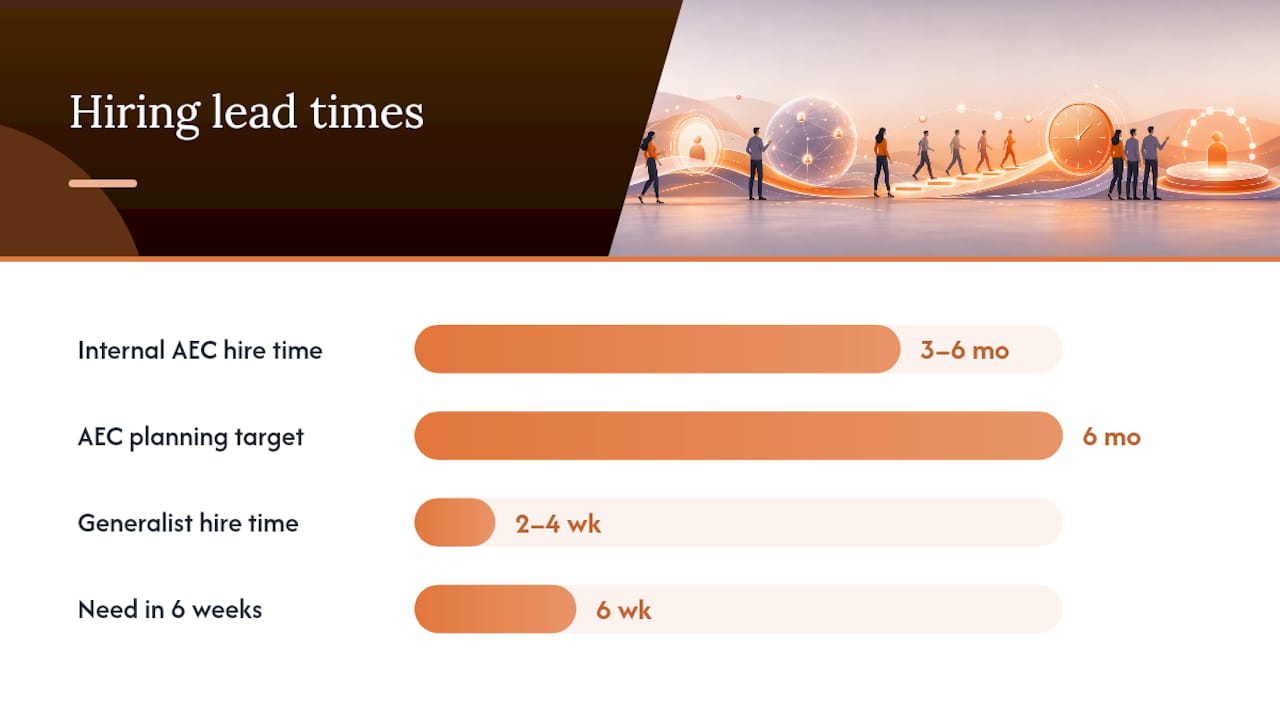
Internal hiring makes sense when you have lead time and the skill isn’t scarce. It stops making sense fast in AEC, where the gap between posting a role and having a productive, billable team member is often three to six months. If your gap analysis turns up a superintendent or licensed electrician you need in six weeks, internal recruiting alone usually can’t close that.
Evaluate any staffing partner against four criteria:
- Industry specialization in AEC roles, not generalist staffing
- Speed to fill, measured in weeks, not months
- Candidate vetting process, including certifications and past project history
- Commission structure, ideally prorated so you’re not paying full fees for a hire who doesn’t work out
A specialist recruiter shortens ramp time by supplying pre-vetted candidates and subcontractor crews who’ve already cleared the vetting most firms handle internally at a slower pace. For roles with long lead times, see how Constructconnect-rconstructionsolutions approaches contingency recruiting to compare timelines against your own hiring pipeline.
Pro Tip: Run your gap analysis against a six-month hiring lead time for specialized AEC roles, not the two to four weeks that works for generalist office positions. Planning against the wrong timeline is how projects end up short-staffed at the worst moment.
A quick do and don’t from the field
I’ve seen more staffing plans fail from vague role descriptions than from bad luck. If you can’t write a one-line skill requirement for a role, you don’t understand the role well enough to staff it yet.
Do: document allocation as a percentage for every person, every time, no exceptions.
Don’t: wait until a resource is already overcommitted to run your gap analysis.
When It Makes Sense to Bring in an AEC Staffing Partner
If your gap analysis just turned up a superintendent, project engineer, or licensed electrician you can’t fill in-house within your timeline, that’s the moment a specialist partner earns its fee instead of adding one. Constructconnect-rconstructionsolutions runs on lower commission rates than most generalist agencies, plus a prorated payment structure over the first 90 days, so you’re not paying full price for a placement that doesn’t stick.

The service covers direct-hire recruiting for office and field roles, plus connections to pre-vetted subcontractors, suppliers, and equipment rental partners built over 30-plus years in the AEC industry. That matters most for general contractors and construction managers running medium to large projects where a single vacancy in a critical role, like the superintendent you mapped in your staffing matrix, can stall an entire phase. Rather than starting a cold search when your gap analysis flags a shortfall, reach out to Constructconnect-rconstructionsolutions’ recruiting services for a consult on what a pre-vetted candidate pipeline could look like for your next project.
Sources
For deeper reading, PMI’s Lexicon of Project Management Terms defines the formal relationship between staffing and project management plans, while SHRM’s staffing guide covers acquisition and training elements in more depth.
- Using contingency and schedule reserve in your projects
- PMI Lexicon of Project Management Terms
- How to develop a staffing plan — SHRM
- Project Staffing: Process, Models + Free Template
- Project management resource planning – Project Management Formula
FAQ
What should be included in a staffing plan?
At minimum: role, department, employment type, headcount, required skills, start and end dates, allocation percentage, status, and a documented acquisition and release plan.
What are the 7 elements of a project plan?
Common frameworks include scope, schedule, budget, quality, resources (which covers staffing), risk, and communications, though exact lists vary by methodology and organization.
What are the 5 components of a project management plan?
Most frameworks cite scope, schedule, cost, quality, and resource management as core components, with the staffing management plan sitting inside resource management as a distinct subset.
What are the 7 steps of the staffing process?
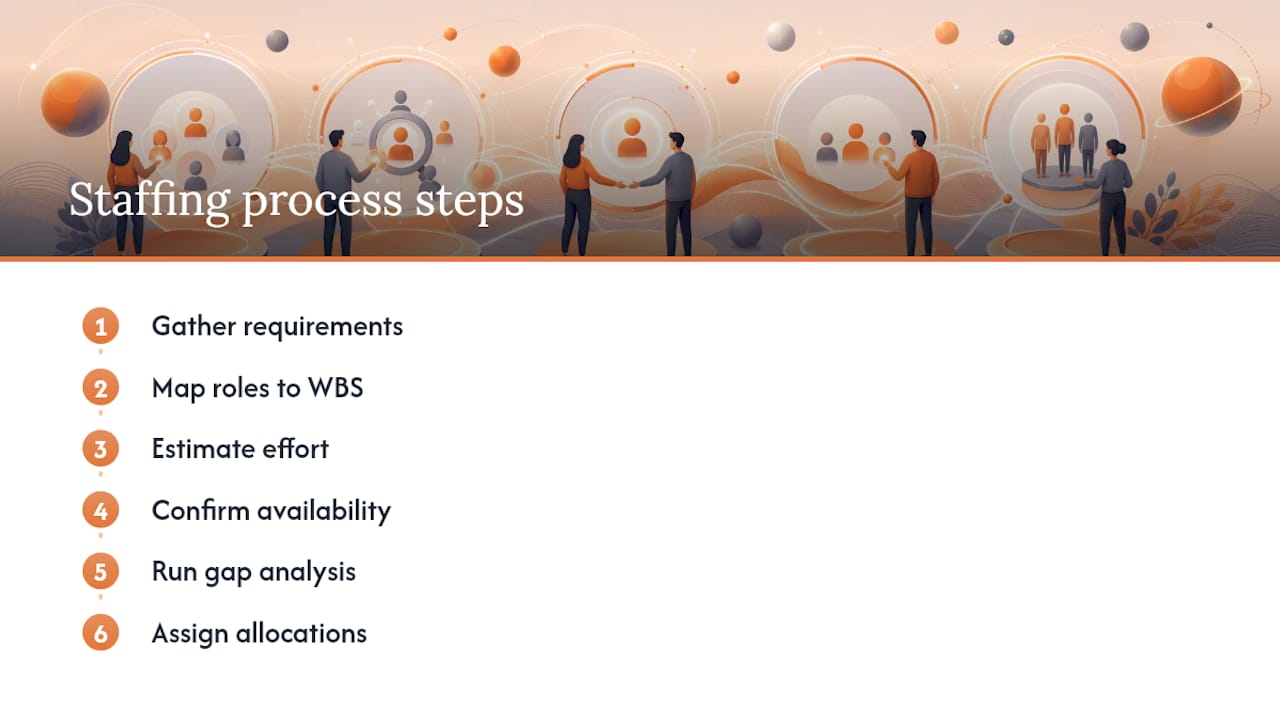
A typical sequence runs: gather requirements, map roles to the work breakdown structure, estimate effort, confirm availability, run a gap analysis, assign allocations, and document sign-off and release criteria.
When should I hire an AEC staffing partner instead of recruiting internally?
Bring in a specialist when a role has a three-to-six-month hiring lead time, the skill is scarce, or a delay would stall a critical project phase; Constructconnect-rconstructionsolutions specializes in exactly these scenarios with pre-vetted AEC candidates.