
How to Fill Construction Project Manager Jobs for AEC Firms
The fastest, most reliable way to fill a construction project manager opening is to run a structured, employer-side hiring process built around three measurable accountabilities: schedule, budget, and safety. When internal sourcing can’t deliver a qualified candidate within your project timeline, a specialized AEC recruiter shortens that gap considerably.
Before you post a single job listing, define what “qualified” actually means for your project. Name the delivery method, the contract value range, the software stack (Buildertrend or Autodesk Construction Cloud), and whether you need full-time staff or a project-based contractor. Hiring managers who skip this step fill the role twice.
Immediate actions to take right now:
- Lock in the three core accountabilities: schedule variance tolerance, budget ownership threshold, and safety record expectations (EMR below 1.0 is better-than-average performance)
- Specify required tools: Buildertrend, Autodesk Construction Cloud, Procore, or Primavera P6
- Decide employment type before sourcing begins: full-time, contract-to-hire, or project-based
Key Takeaways
Hiring a qualified construction PM requires a defined scorecard, scenario-based evaluation, and a sourcing strategy matched to your timeline and project complexity.
| Point | Details |
|---|---|
| Define accountabilities first | Lock in schedule, budget, and safety metrics before sourcing any candidate. |
| OSHA 30 is the baseline | Require OSHA 30 for all supervisory PM roles; treat EMR below 1.0 as the safety benchmark. |
| Scenario interviews outperform resumes | Ask candidates to walk through real cost overruns, schedule recoveries, and safety incidents with specific numbers. |
| Prorated fees reduce placement risk | A 90-day prorated payment structure means you pay as the hire proves out, not all at once. |
| Constructconnect-rconstructionsolutions | Specialized AEC recruiter with 30+ years experience, lower commission rates, and no-placement, no-fee terms. |
Table of Contents
- What do project manager jobs in construction actually require?
- Where do you find qualified construction project managers?
- How do you write a job description that attracts experienced AEC project managers?
- How do you evaluate candidates beyond the resume?
- How do you structure reference checks that actually reveal performance?
- What technical credentials and software should you verify before hire?
- What does a construction PM hire actually cost, and how long does it take?
- What should the first 90 days look like for a new construction PM?
- When does a specialized AEC recruiter make sense?
- What most hiring managers get wrong about construction PM recruiting
- R. Construction Solutions fills project manager jobs faster, with less risk
- Sources
- FAQ
What do project manager jobs in construction actually require?
A vague job opening attracts vague candidates. Before sourcing begins, define three accountabilities that the PM must own with measurable outcomes: schedule adherence (percent complete vs. plan), budget variance (cost-at-completion vs. original GMP or lump sum), and safety performance (EMR, OSHA recordables). Tie each to a number your firm tracks, and you’ll have the foundation of your evaluation scorecard.
Match the experience level to your project profile. A $5M design-bid-build ground-up retail job needs a different PM than a $60M design-build healthcare project with a CM at-risk delivery. Spell out the delivery method, typical contract value, and team size so candidates self-filter before the first interview.
Employment type follows project need:
- Full-time: ongoing project pipeline, multi-year backlog, need for cultural continuity
- Contract-to-hire: uncertain backlog, trial period before permanent commitment
- Project-based contractor: single large project, specialized delivery method, or gap coverage
On credentials, OSHA 30 is the safety baseline most employers require for any supervisory PM role. Treat it as a minimum, not a differentiator. The CCM (Certified Construction Manager, issued by CMAA) is the gold standard for senior roles. PMP (Project Management Professional, issued by PMI) signals process discipline and is useful for office-heavy or program-management roles. LEED AP matters when your project pipeline includes green building requirements. Avoid loading the must-have list with every credential; prioritize the two or three that directly match your project type.
Pro Tip: Keep your must-have list to three credentials maximum. Every additional requirement you add as “required” narrows your pool without improving hire quality.
Where do you find qualified construction project managers?
Multiple sourcing channels each serve a different hiring need. No single channel dominates every situation.
- Internal promotion: fastest path, strongest cultural fit, but limited to your existing bench depth
- Employee referrals: high-quality candidates, low cost, but can narrow diversity if not managed intentionally
- Technical colleges and university construction management programs: good for entry-level project manager and assistant PM roles; requires longer development runway
- Industry associations (AGC, CMAA, ABC): access to credentialed, active professionals; slower cycle
- Pre-vetted subcontractor and supplier networks: useful for identifying field-experienced candidates who’ve worked alongside your firm
- Specialized AEC recruiters: fastest time-to-fill for senior roles, verified credentials, and access to passive candidates not actively searching
For diversity, partner with HBCUs offering construction management programs, NAWIC (National Association of Women in Construction), and SMPS chapters. Broadening your sourcing channels is the most direct way to build a more representative candidate pool.
Escalate to a specialized recruiter when the role requires verified multi-project experience, distressed-project recovery leadership, or owner-facing execution on a project already in progress. General staffing agencies rarely carry the AEC-specific candidate pipelines that senior PM searches demand. See the construction sourcing guide for a deeper breakdown of channel strategy.
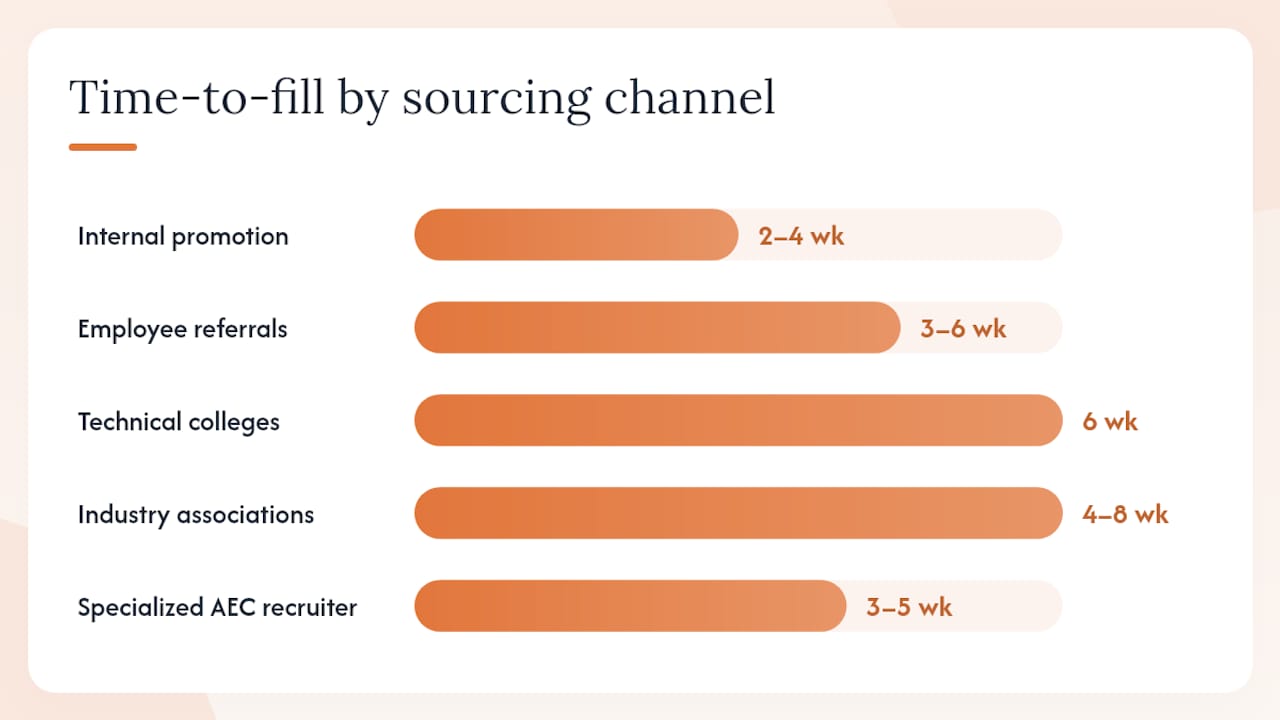
| Sourcing Channel | Best For | Typical Time-to-Fill |
|---|---|---|
| Internal promotion | Cultural fit, fast ramp | 2–4 weeks |
| Employee referrals | Quality, low cost | 3–6 weeks |
| Technical colleges | Entry-level PM roles | 6 weeks |
| Industry associations | Credentialed mid-senior | 4–8 weeks |
| Specialized AEC recruiter | Senior, hard-to-fill, urgent | 3–5 weeks |
How do you write a job description that attracts experienced AEC project managers?
Job descriptions that list project types, contract values, and specific software produce better-matched applicants and reduce early turnover by setting clear expectations upfront. A generic JD pulls generic candidates.
Your JD should include:
- Project profile: delivery method, approximate contract value range, sector (commercial, healthcare, industrial), and typical team size
- Three accountabilities: schedule, budget, and safety with measurable targets.
- Daily duties: RFI/submittal management, subcontractor coordination, owner reporting, change-order processing
- Must-haves vs. nice-to-haves: OSHA 30 and 5+ years field experience as required; CCM or PMP as preferred
- Software stack: Buildertrend, Autodesk Construction Cloud, Procore, Primavera P6, or your ERP/estimating platform
Include salary banding. Roughly 20% of turnover happens in the first 45 days, often because of mismatched expectations on compensation or project scope. Publishing a range filters out mismatches before the first call.
| JD Section | What to Include |
|---|---|
| Project profile | Delivery method, contract value, sector |
| Accountabilities | Schedule, budget, safety with metrics |
| Software required | Buildertrend, ACC, Procore, P6 |
| Credentials | OSHA 30 (required), CCM/PMP (preferred) |
| Compensation | Salary band, bonus structure, benefits |
How do you evaluate candidates beyond the resume?
Scenario-based interviews are more predictive of on-the-job performance than credential review alone.
Structure every interview around the three accountabilities. Sample scenario prompts:
- “Walk me through a project where your schedule slipped more than two weeks. What caused it, what did you do, and what was the final outcome?”
- “Describe a time you identified a cost overrun before it hit the owner. What was your process and what did you recover?”
- “Tell me about a safety incident or near-miss on one of your projects. How did you respond, and what changed afterward?”
- “A key subcontractor is three weeks behind on rough-in work. The GC is threatening liquidated damages. Walk me through your next 72 hours.”
- “You’ve inherited a project mid-stream. The previous PM left no updated schedule. What do you do in the first week?”
Strong answers include specific numbers, clear decision points, and honest outcomes. Vague answers (“I worked with the team to resolve it”) signal a candidate who managed process but not results. Lightweight practical assessments, such as a schedule review exercise or a change-order write-up, add another layer of signal. See the interview question guide for additional scenario prompts.
How do you structure reference checks that actually reveal performance?
Call both owners/clients and subcontractors or site superintendents. Each group reveals a different dimension of the candidate’s performance. Owners speak to communication, change-order management, and client satisfaction. Subcontractors reveal how the PM runs a site, handles conflict, and enforces schedule.
Sample reference questions:
- “Did this PM deliver the project on schedule and within budget? If not, what happened?”
- “How did they handle a significant change order or scope dispute?”
- “Would you hire them again or recommend them to a peer? Why or why not?”
- “How did subcontractors respond to their direction on site?”
Red flags: frequent mid-project exits with vague explanations, references who can’t recall specific project outcomes, and subcontractor feedback that focuses on personality rather than performance.
Cultural fit is best validated through site visits and joint meetings with your field leadership. Watch how the candidate interacts with superintendents, asks questions about active work, and responds to ambiguity.
Pro Tip: Ask subcontractor references specifically about change-order disputes. A PM who resolves scope conflicts without litigation is worth more than their base salary suggests.
Review the subcontractor reference guide for structured questions tailored to field-level feedback.
What technical credentials and software should you verify before hire?
Run a compact verification checklist before extending any offer. OSHA 30 is the safety baseline; verify the card, not just the claim. The Experience Modification Rate (EMR) is a company-level safety metric candidates should be able to discuss with specifics. An EMR below 1.0 indicates better-than-average safety performance.
Credentials to verify:
- OSHA 30-Hour Construction: required baseline for supervisory roles
- CCM (Certified Construction Manager, CMAA): gold standard for senior PM roles
- PMP (Project Management Professional, PMI): signals process and program management discipline
- LEED AP (U.S. Green Building Council): required when sustainability is a project deliverable
- ICC certifications (International Code Council): relevant for code-compliance-heavy projects
Software to confirm with examples or sample outputs:
- Buildertrend, Autodesk Construction Cloud, Procore (field management and document control)
- Primavera P6 (schedule management on large or complex projects)
- ERP and estimating platforms relevant to your firm
Ask candidates to walk through a real schedule they built or a change-order log they managed. Credential claims without demonstrated fluency are a common gap. See the PM certification guide for verification steps by credential type.
| Verification Item | How to Confirm |
|---|---|
| OSHA 30 | Physical card or OSHA training certificate |
| EMR | Ask candidate to describe their firm’s EMR history |
| CCM / PMP | Verify via CMAA or PMI credential lookup |
| LEED AP | Verify via GBCI credential directory |
| Software fluency | Request sample output or live walkthrough |
What does a construction PM hire actually cost, and how long does it take?
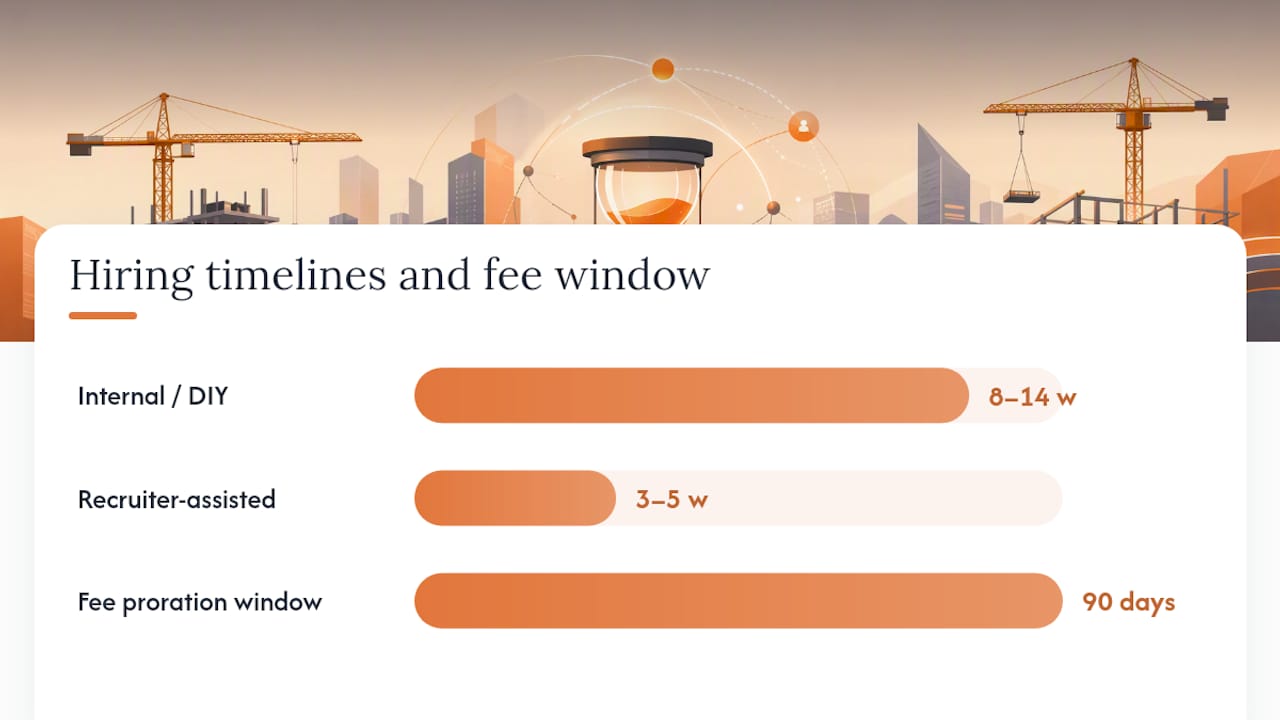
Internal hiring typically runs 8–14 weeks from job posting to accepted offer, factoring in sourcing, screening, multi-round interviews, and a candidate’s notice period. Recruiter-assisted searches compress that to 3–5 weeks for senior roles, because the candidate pool is pre-qualified before you see the first resume.
| Hiring Path | Typical Timeline | Key Cost Drivers |
|---|---|---|
| Internal / DIY | 8–14 weeks | Staff time, job board fees, lost project productivity |
| Specialized AEC recruiter | 3–5 weeks | Recruiter fee (commission-based, prorated over 90 days) |
Recruiter fees in construction staffing are typically commission-based as a percentage of first-year salary. The critical differentiator is payment structure. A prorated model, where the fee is spread across the first 90 days of employment rather than paid as a lump sum at placement, reduces your financial risk if the hire doesn’t work out.
Speed and quality are not always in conflict, but they do require a deliberate trade-off. Rushing a hire to fill a seat often produces a 90-day exit. Investing three to five weeks with a recruiter who has already screened for EMR, OSHA records, and schedule variance typically yields a candidate who stays.
Geographic market, project size, and required experience level all affect fee levels. Senior PMs on large-scale commercial or industrial projects in high-demand metros command higher placement fees than mid-level PMs in secondary markets. See the 2026 hiring steps guide for a detailed timeline breakdown.
What should the first 90 days look like for a new construction PM?
A structured onboarding plan reduces early exits and validates whether the hire is performing against the accountabilities you defined. The 30/60/90 framework gives you natural checkpoints.
- Days 1–30 (Learn): Complete project file review, meet all subcontractors and key owners, shadow existing PM or superintendent, confirm software access and tools, attend first owner meeting
- Days 31–60 (Contribute): Take ownership of schedule updates, lead first subcontractor coordination meeting, submit first cost report, conduct two toolbox talks
- Days 61–90 (Own): Full accountability for schedule, budget, and safety reporting; deliver first change-order log review; receive formal performance check-in
KPIs to track at 90 days:
- Schedule adherence: percent complete vs. plan
- Cost tracking cadence: weekly cost reports submitted on time
- Safety engagement: number of toolbox talks led
- Subcontractor satisfaction: informal feedback from two or three subs
- Owner communication: no escalated complaints
If the hire is on a prorated payment structure, the 30/60/90 milestones align naturally with payment intervals. Early coaching at day 30 prevents a corrective-action conversation at day 85.
When does a specialized AEC recruiter make sense?
A general staffing agency can fill an administrative role. Filling a senior construction PM position, especially one managing a $30M+ project or recovering a distressed job, requires a recruiter who understands EMR, delivery methods, and what “owner-facing execution” actually means on a job site.
The concrete benefits of a specialized AEC recruiter:
- Pre-vetted candidate pipelines with verified field credentials
- Faster time-to-fill (3–5 weeks vs. 8–14 weeks internally)
- Reference checks that include both owners and subcontractors
- Prorated fee structures that reduce placement risk
The roles that most justify a recruiter are the ones you can least afford to fill slowly. A senior PM vacancy on an active $40M project costs more in schedule slippage and subcontractor friction than any recruiter fee.
Scenarios that consistently benefit from a specialized recruiter: senior PMs managing multi-site programs, hard-to-fill geographic markets, distressed-project recovery leadership, and roles requiring specific delivery-method experience (design-build, CM at-risk, P3).
When evaluating a recruiter, ask about candidate vetting depth, reference-check scope, and contract flexibility. A recruiter who can’t describe their EMR screening process or explain how they verify software fluency is operating as a resume forwarder, not a hiring partner.
What most hiring managers get wrong about construction PM recruiting
The most common mistake is treating the PM search like a general hire: post the job, screen resumes, pick the best-looking candidate, and onboard fast. That process works for roles where the cost of a bad hire is recoverable. For a construction PM managing active projects, a 90-day exit means schedule disruption, subcontractor confusion, and owner relationship damage that takes months to repair.
What top candidates ask during the interview process tells you as much as their answers. The PMs who stay ask about scope clarity (“Who owns the change-order process?”), autonomy (“Will I have direct subcontractor relationships?”), and support structure (“What does the superintendent-PM dynamic look like here?”). Those questions signal someone who has been burned by unclear accountabilities before and is doing due diligence. Candidates who only ask about salary and start date are often optimizing for the offer, not the role.
A disciplined hiring scorecard built around schedule, budget, and safety, applied consistently across every candidate, removes the subjectivity that leads to regret hires. The scorecard doesn’t slow the process. It prevents the restart.
R. Construction Solutions fills project manager jobs faster, with less risk
Filling a senior construction PM role without a specialized partner often means 10+ weeks of internal effort, a thin candidate pool, and a hire you’re not fully confident in. Constructconnect-rconstructionsolutions offers a direct alternative: AEC recruiting services built specifically for general contractors and construction firms that need qualified PMs placed on active projects.
Key differentiators:
- 30+ years of AEC industry experience with a pre-vetted candidate network across North America
- Lower commission rates than general staffing agencies, with no placement, no fee
- Prorated payment structure spread over the first 90 days, reducing your financial risk if the hire doesn’t perform
- Candidate vetting that includes EMR review, OSHA credential verification, and software fluency confirmation
- Pre-vetted subcontractor and supplier connections to support the PM you place
To start, contact Constructconnect-rconstructionsolutions with your project profile, employment type, and timeline. Candidate introductions typically begin within two to three weeks of engagement. Payment is prorated over 90 days, and you pay nothing if no placement is made.
Sources
- How to Hire a Construction Project Manager (2026 Guide) | StartupKit
- How To Hire a Construction Project Manager
- What Are the Best Practices for Hiring a Construction Executive in the US?
FAQ
What certifications should a construction PM have?
OSHA 30 is the required baseline for supervisory roles. The CCM (Certified Construction Manager) is the gold standard for senior positions; PMP and LEED AP are preferred credentials depending on project type.
How long does it take to hire a construction project manager?
Internal hiring typically takes 8–14 weeks. A specialized AEC recruiter can compress that to 3–5 weeks by delivering pre-vetted candidates with verified credentials and field references.
What is a prorated recruiter fee structure?
A prorated fee spreads the recruiter’s commission across the first 90 days of employment rather than charging a lump sum at placement. If the hire doesn’t work out, you pay only for the portion of the placement period completed.
What scenario questions work best for evaluating construction PMs?
Ask candidates to walk through a real schedule recovery, a cost overrun they caught early, and a subcontractor dispute they resolved. Strong answers include specific numbers, clear decision points, and honest outcomes.
When should a GC use a specialized AEC recruiter instead of hiring internally?
Use a specialized recruiter for senior PM roles, hard-to-fill markets, distressed-project recovery leadership, or any opening where an 8–14 week internal search would create unacceptable project risk.