
How to Onboard a Project Manager at Your Construction Firm
Effective project manager onboarding at a construction firm is a structured, phased process that blends technical training with leadership development to integrate new hires quickly and protect project margins from day one. Done right, it covers far more than paperwork and a site tour. A well-built onboarding program gives your new PM a clear picture of company workflows, safety obligations, software systems, and the leadership expectations that come with managing crews, subcontractors, and client relationships simultaneously.
The core elements of a strong onboarding process for project managers in construction include:
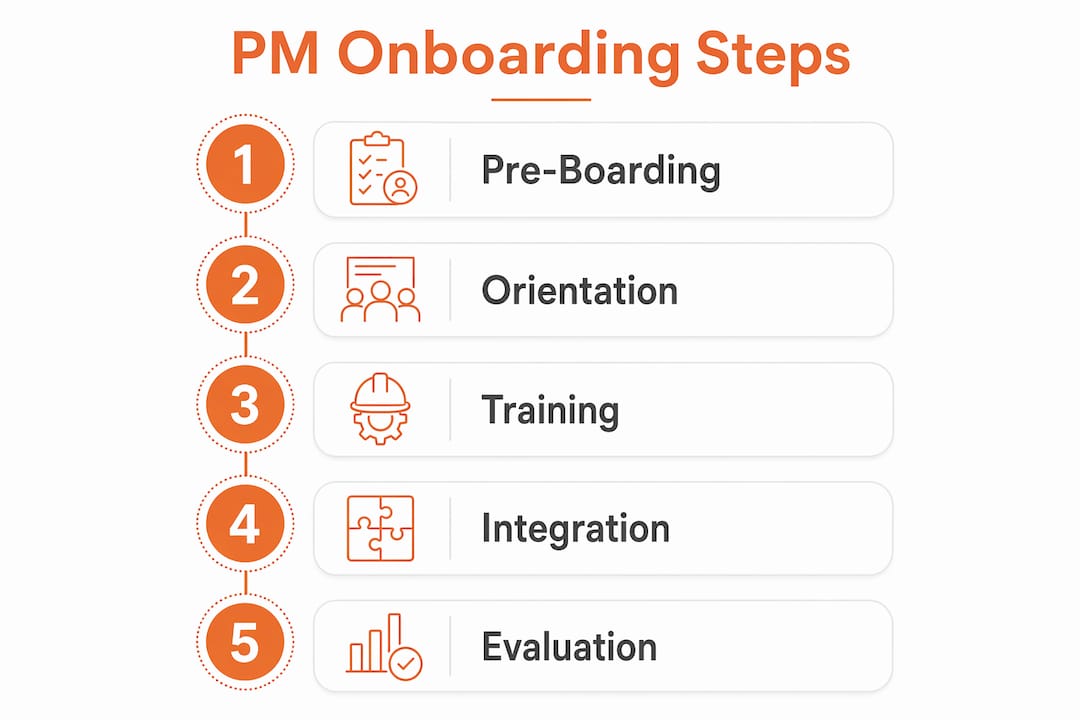
- Structured phases moving from pre-boarding through orientation to full integration
- Safety and compliance training aligned with OSHA standards and project-specific requirements
- Technical tool proficiency in platforms like Procore, Bluebeam, or Autodesk Construction Cloud
- Leadership development covering financial management, team cohesion, and client communication
- Mentorship pairing with a senior PM or superintendent for real-time guidance
- Documented workflows such as status report templates and risk registers that capture institutional knowledge
Construction PM employment is projected to grow 10% through 2028, faster than most occupations. That growth makes a repeatable, consistent onboarding process not a luxury but a competitive necessity.
Table of Contents
- What does the project manager onboarding process look like in construction?
- Why do so many construction firms struggle with PM onboarding?
- What does strong PM onboarding actually deliver for your firm?
- Why leadership training belongs in every construction PM onboarding program
- What training modules should your construction PM onboarding program include?
- Key Takeaways
- FAQ
What does the project manager onboarding process look like in construction?
Most firms that struggle with onboarding do so because they treat it as a single event rather than a progression. A phased approach changes that.
Phase 1: Pre-boarding (before Day 1)
- Complete employment paperwork, background checks, and I-9 verification
- Provision software access to Procore, scheduling tools, and company email
- Share the employee handbook, org chart, and active project summaries
- Assign a buddy or mentor before the new PM’s first day
Phase 2: Orientation (Week 1–2)
- OSHA 30-hour certification review or completion, plus site-specific safety protocols
- Introduction to project management tools and role-based dashboards
- Walkthroughs of company contract templates, subcontractor agreements, and billing procedures
- Meetings with key stakeholders: owners, superintendents, estimators, and accounting
Phase 3: Integration (Weeks 3–12)
- Shadowing on active projects, then gradual handoff of project ownership
- Weekly check-ins with a direct supervisor and assigned mentor
- Structured feedback sessions at 30, 60, and 90 days
- Participation in project meetings, RFI reviews, and owner updates
Automation tools like Paperform and Procore can route role-based software access and training automatically, cutting the manual setup that typically delays a new PM’s first productive week. Digital onboarding platforms also create process guides and training workflows that keep the experience consistent regardless of who is running HR that month.
Why do so many construction firms struggle with PM onboarding?
The construction industry has a well-documented onboarding problem, and it runs deeper than a missing checklist.
- Informal, person-dependent processes. Most firms rely on informal onboarding that lives in the heads of senior staff. When those people retire or leave, the knowledge walks out with them.
- Delayed software access. When a new PM spends their first week waiting on Procore credentials or email setup, that lag costs real money on active projects.
- Leadership skill gaps. Many PMs are promoted because of strong field or estimating skills, not because they have been trained to manage people, budgets, or client expectations. Onboarding that focuses only on technical tools misses this entirely.
- No standardized project workflows. Without documented procedures for submittals, RFIs, change orders, and safety reporting, each PM develops their own system. That inconsistency creates errors and makes it nearly impossible to scale.
- Compliance gaps. Construction carries serious legal and safety exposure. Onboarding that does not explicitly cover OSHA requirements, subcontractor compliance, and contract obligations puts the firm at risk.
Avoiding common construction project manager hiring pitfalls starts before the offer letter, but the onboarding process is where those early decisions either pay off or unravel.
What does strong PM onboarding actually deliver for your firm?
The business case for structured onboarding is straightforward. Firms that invest in it see faster ramp-up times, fewer costly mistakes, and better project outcomes.
- Faster time to productivity. A new PM who has documented workflows, tool access, and a mentor from day one reaches full productivity weeks earlier than one left to figure things out independently.
- Margin protection. Errors in change order management, billing, or subcontractor coordination are expensive. Consistent workflows reduce those errors before they hit the job cost report.
- Reduced rework. When PMs follow standardized submittal and RFI processes, fewer items fall through the cracks, and field crews spend less time waiting on answers.
- Stronger team cohesion. A PM who understands the company culture, the superintendent’s working style, and the owner’s expectations builds trust faster with everyone on the project.
- Better client relationships. Project Manager Academy participants report measurable improvements in client relationship management and decision-making after targeted onboarding programs.
“Standardizing workflows safeguards against knowledge loss from a retiring workforce and accelerates the onboarding timeline — two of the most pressing challenges facing construction firms in 2026.” — StackCT
Research from SHRM consistently shows that structured onboarding significantly improves new hire retention and performance. In construction, where replacing a PM mid-project can derail a schedule and damage a client relationship, that retention impact carries real dollar value.
Why leadership training belongs in every construction PM onboarding program
Technical competence gets a PM hired. Leadership skills determine whether they succeed.
Many construction firms promote their best field engineers or estimators into PM roles without providing any formal leadership development. The result is a technically capable person who struggles to hold a subcontractor accountable, navigate a difficult owner conversation, or manage a team through a schedule crisis.
“Balanced onboarding includes leadership training focused on financial performance, client relationship management, and team cohesion alongside technical skills — not as an afterthought, but as a core component of the program.” — FMI Corp
Effective leadership training during onboarding should address:
- Financial management: reading job cost reports, managing contingency, and protecting margin
- Client communication: setting expectations, delivering bad news professionally, and managing scope changes
- Team dynamics: working with superintendents, coordinating subcontractors, and resolving field conflicts
- Decision-making under pressure: using documented risk registers and escalation protocols
Pro Tip: Use behavioral assessments during onboarding, such as DiSC or similar tools, to help new PMs understand their own communication style and how it affects their team. Pair those insights with experiential learning on live projects rather than classroom-only instruction.
The AGC’s Project Manager Development Program (PMDP) is a nationally recognized five-course curriculum built specifically for early-career construction PMs. It covers the essentials of project management and provides a structured foundation that many firms use as the backbone of their onboarding training. For more advanced or experienced hires, the PMI Construction Professional (PMI-CP) certification offers a rigorous path that reinforces both technical and leadership competencies.

Understanding the full scope of construction project manager roles helps you calibrate which training modules matter most for each hire’s experience level.
What training modules should your construction PM onboarding program include?
A well-designed onboarding curriculum for construction project managers covers six core areas. The depth of each module should scale with the PM’s prior experience.
1. Safety and compliance OSHA 30-hour certification, site-specific safety plans, incident reporting procedures, and subcontractor safety compliance expectations. This module is non-negotiable and should be completed in the first two weeks.
2. Project management software Hands-on training in Procore, Bluebeam Revu, or whichever platform your firm uses. Cover submittals, RFIs, daily reports, drawing management, and budget tracking. Role-based dashboards help new PMs focus on the features relevant to their work immediately.
3. Contract and financial management Reading and interpreting subcontract agreements, managing change orders, understanding AIA billing documents, and tracking job costs against the original estimate. This is where margin is won or lost.
4. Scheduling and coordination Using scheduling tools like Primavera P6 or Microsoft Project, coordinating with superintendents, and managing look-ahead schedules. New PMs should also understand how to work with subcontractor workforce management to keep crews aligned with the project timeline.

5. Communication and documentation Meeting minutes, owner reports, RFI logs, and submittal registers. Documenting tribal knowledge into templates before a new PM arrives is one of the most practical steps a firm can take to protect project execution and margin.
6. Leadership and client relations Structured scenarios covering difficult conversations, scope disputes, and team conflict. Pair this with mentorship from a senior PM who can model the behavior in real project situations. Digital tools are accelerating how quickly new PMs can access and apply this knowledge on commercial projects.
Post-onboarding, build in formal evaluation checkpoints at 30, 60, and 90 days. Ask the new PM to self-assess alongside their supervisor’s review, and use both to adjust the integration plan. Feedback loops are what separate a one-time orientation from a program that actually produces capable project leaders.
If you are building or rebuilding your onboarding process and need the right PM in the seat first, Constructconnect-rconstructionsolutions brings 30+ years of AEC recruiting experience to every search. With pre-vetted candidates and a prorated 90-day placement model, you only pay for results. Explore AEC recruiting services built specifically for construction firms like yours.

Key Takeaways
A structured, phased onboarding program for construction project managers accelerates productivity, protects project margins, and reduces costly errors by combining technical training with deliberate leadership development.
| Point | Details |
|---|---|
| Use a phased approach | Move through pre-boarding, orientation, and integration with clear milestones at 30, 60, and 90 days. |
| Automate access and training | Tools like Procore and Paperform route role-based access automatically, cutting Day 1 delays. |
| Include leadership training | Financial management, client communication, and team dynamics belong in onboarding, not left to chance. |
| Standardize workflows | Documented templates for RFIs, submittals, and risk registers protect margin and reduce reliance on individual knowledge. |
| Measure and adjust | Formal feedback sessions at 30, 60, and 90 days turn onboarding from a one-time event into a continuous improvement process. |
FAQ
What is project manager onboarding in construction?
Project manager onboarding in construction is a structured process that integrates a new PM into a firm’s workflows, safety protocols, software systems, and leadership expectations. It typically spans 30–90 days and covers both technical and interpersonal skills.
How long should construction PM onboarding take?
Most effective onboarding programs run 90 days, with formal check-ins at the 30- and 60-day marks. The first two weeks focus on safety compliance and tool access; full project ownership typically transfers by the end of the first month.
What certifications support construction PM onboarding?
The AGC’s Project Manager Development Program (PMDP) is a nationally recognized five-course curriculum for early-career PMs. The PMI Construction Professional (PMI-CP) certification suits more experienced hires and requires three years of on-the-job construction experience.
Why do construction firms lose value during PM onboarding?
Most value loss comes from informal, person-dependent processes that delay productivity and create inconsistent project execution. Standardizing workflows and automating software access are the two highest-impact fixes.
How does mentorship improve PM onboarding outcomes?
Pairing a new PM with a senior project manager or superintendent accelerates real-world learning and provides a trusted resource for navigating firm culture, client dynamics, and field challenges that no training module can fully replicate.