
Contractors: Hire a Construction Controller, Stop Margin Fade in 5 Weeks
If you need financial leadership on a project fast, or your current team lacks bandwidth to vet construction-specific accounting talent, engage a specialist recruiter now. If your transaction volume already justifies a dedicated seat, hire in-house. Either way, the checklist below tells you exactly what to screen for before you sign an offer letter.
TL;DR:
- Hiring a construction controller is most effective when focusing on construction-specific skills like WIP schedule management and margin fade detection, rather than general accounting experience.
- Outsourcing to a fractional controller can be more cost-effective for firms with fewer than 10 active projects or under $10 million in annual revenue, while larger firms may justify a full-time hire.
- Candidates should demonstrate experience with construction software platforms like Vista, Sage, or NetSuite, and be able to quickly explain how they catch margin erosion on projects.
- A practical WIP review exercise during interviews can accurately assess a candidate’s ability to identify fade risks and variance issues.
- Specialized construction recruiting reduces mis-hire risk by screening explicitly for construction pattern recognition and WIP fluency before the interview stage.
Table of Contents
- How to Hire a Construction Controller the Right Way
- In-House or Outsourced: Which Fits Your Company?
- What Skills and Credentials Should the Job Spec Require?
- What Salary Should You Offer a Construction Controller?
- Building the Job Description and Hiring Timeline
- Interview Questions That Actually Test Competence
- Red Flags to Catch Before You Extend an Offer
- Onboarding and 30/60/90 Day Success Metrics
- Why Specialized Recruiting Reduces Mis-Hire Risk
- What This Playbook Gets Right That Most Hiring Guides Miss
- Get Pre-Vetted Controller Candidates Without the Guesswork
- Sources
- FAQ
How to Hire a Construction Controller the Right Way
Hiring a construction controller starts with getting the job right, not the resume. This role is not a general ledger clerk with a bigger title. A construction controller owns job costing, work-in-progress (WIP) schedules, project billing (often through AIA billing formats), and compliance items like retainage tracking and lien waivers that a standard corporate controller never touches.
The line between bookkeeper, controller, and CFO matters more than most hiring managers realize. A bookkeeper records transactions. A controller versus CFO comparison makes the distinction clear: the controller owns accuracy and process, while the CFO sets strategy and forecasts capital needs. You want a controller who does the former with construction fluency, not a generalist who will need six months to learn what WIP even means.
Core responsibilities to expect from day one:
- Job costing accuracy across every active project
- WIP schedule ownership, updated monthly at minimum
- AIA or owner-specific project billing and pay application review
- Cash flow monitoring and bonding-related financial reporting
- Variance analysis that catches margin fade before it erodes a project’s profit
That last point deserves emphasis. Margin fade, the slow erosion of expected profit on a job, is often the single biggest financial risk on a construction project. A controller who cannot explain how they catch fade early is not ready for the role.
In-House or Outsourced: Which Fits Your Company?
The revenue and transaction volume of your company should drive this decision, not personal preference. A firm running fewer than a handful of active projects at a time, or one still under roughly $10 million in annual revenue, often gets better return on a fractional controller than a full-time hire. Wipfli’s guidance on outsourced controllers points out that many mid-market firms can get controller-level WIP oversight and reporting on a part-time basis without paying for a 40-hour week they don’t yet need.
Pro Tip: Track how many hours per week your current bookkeeper or office manager spends chasing project billing and WIP updates. Once that number consistently exceeds 15 to 20 hours, you’ve likely crossed the threshold where a full-time controller pays for itself.
Consider these factors when deciding:
- Transaction volume: More than 10 to 15 active projects usually justifies full-time.
- Continuity needs: In-house hires build institutional knowledge outsourced talent can’t replicate as quickly.
- Cost control: Fractional arrangements avoid a six-figure salary commitment during slower seasons.
- Speed to value: Outsourced controllers can often start producing WIP reports within weeks, not months.
Smaller firms frequently see better ROI from a fractional controller until project load fills a full workweek consistently.
What Skills and Credentials Should the Job Spec Require?
Screen resumes against construction-specific accounting fluency first, software skills second, and general credentials third. A CPA license is a nice signal of rigor, but it doesn’t guarantee someone understands retainage schedules or ASC 606 revenue recognition as applied to long-term contracts.
Build your job spec around these three layers:
- Construction accounting fundamentals: WIP schedule preparation, retainage tracking, lien waiver processing, and comfort with ASC 606 percentage-of-completion concepts.
- ERP and software fluency: Direct experience with construction-grade platforms such as Vista by Viewpoint, Sage 300 CRE, or NetSuite, plus familiarity with Procore integrations for job-cost data flow between field and office.
- Leadership and process ownership: At least five years in a construction accounting seat, with demonstrated ability to shorten a month-end close cycle from something like 25 days down to 5 to 10 days.
Pro Tip: Ask candidates to walk you through how they’d close the books during a month with three active change orders and one disputed pay application. Their answer tells you more about ERP fluency than any resume line.
CPA preference is reasonable for larger firms managing complex bonding requirements, but treat it as a plus, not a hard requirement, if the candidate has ten-plus years of hands-on construction controller experience.
What Salary Should You Offer a Construction Controller?
Construction controller salary ranges in the United States typically run from about $80,000 to $160,000, with most offers clustering around $100,000 to $120,000 depending on experience, project complexity, and geography, according to Glassdoor’s compensation data. Coastal metros and firms managing large public infrastructure work tend to sit at the top of that band.
Variance across candidates usually comes down to three factors:
- Years of construction-specific experience (not general accounting years)
- Geography and local cost of living
- Project complexity, including bonding requirements and public versus private work mix
Total compensation should extend beyond base salary. Bonus structures tied to close-cycle speed or WIP accuracy, health benefits, and retirement matching all factor into whether a strong candidate accepts your offer over a competing one.
Building the Job Description and Hiring Timeline
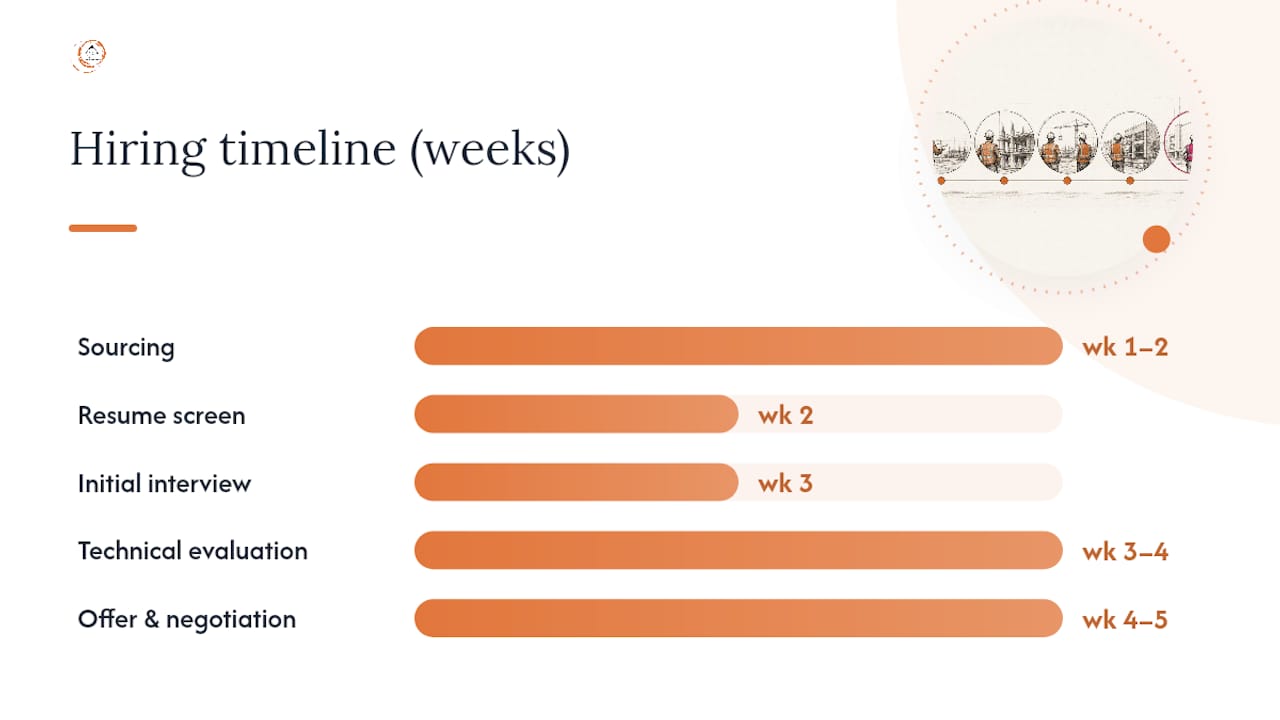
A clear job description that lists WIP ownership, ERP experience, and supervisory duties up front improves candidate fit and reduces wasted interview cycles.
Copy-ready responsibilities and qualifications to include:
- Owns monthly WIP schedule preparation and margin variance reporting
- Manages AIA billing cycles and reviews pay applications for accuracy
- Supervises accounts payable/receivable staff and enforces close-cycle deadlines
- Requires 5+ years construction accounting experience, ERP fluency (Vista, Sage 300 CRE, or NetSuite), CPA preferred not required
A realistic hiring process runs through five stages:
- Sourcing (week 1 to 2): Post through specialist channels or engage a contingency recruiter with existing AEC networks rather than relying solely on general job boards.
- Resume screen (week 2): Filter for construction-specific WIP and ERP language, not just “controller” title history.
- Initial interview (week 3): Behavioral and cultural fit, plus a walkthrough of past close-cycle improvements.
- Technical evaluation (week 3 to 4): WIP review exercise, detailed below.
- Offer and negotiation (week 4 to 5): Expect one to two rounds of salary discussion before acceptance.
Interview Questions That Actually Test Competence
Generic interview questions tell you nothing about whether someone can spot fade risk before it costs a project its margin. Build your interview around technical scenarios, not just resume recitation.
Technical questions worth asking:
- “Walk me through how you’d catch margin fade three months into a project.”
- “Describe a WIP schedule discrepancy you found and how you resolved it.”
- “How do you reconcile field cost reports with office job-cost data?”
Behavioral and leadership prompts:
- “Tell me about a time you had to push back on a project manager’s cost estimate.”
- “How have you improved a close cycle at a previous employer?”
A practical technical test works better than any interview question. Ask candidates to review a sample WIP schedule and identify fade risk items, then propose corrective action. Strong candidates complete this in 20 to 40 minutes.
| Score | What it looks like |
|---|---|
| 5 | Identifies 3+ fade indicators, proposes specific corrective steps, ties it to cash flow impact |
| 4 | Identifies 2 fade indicators with reasonable corrective logic |
| 3 | Identifies 1 indicator, general corrective language, no cash flow tie-in |
| 2 | Struggles to identify indicators without prompting |
| 1 | Cannot explain WIP mechanics at all |
Red Flags to Catch Before You Extend an Offer
Watch for candidates who talk about “controller experience” without a single construction-specific example. That’s the most common and most costly mis-hire pattern in this field, according to guidance from CivilCFO on fractional controller hiring.
Before extending an offer, run these checks:
- Ask for a specific example of a job-cost correction they personally made, not one their team made.
- Request a walkthrough of a real (redacted) WIP schedule from a past role.
- Reference-check with a former supervisor and ask directly: “Did this person catch margin fade before it became a problem, or after?”
- Confirm ERP experience matches your actual platform, not just “construction software” in general.
Common hiring mistakes that lead to overspending often trace back to skipping this verification step entirely.
Onboarding and 30/60/90 Day Success Metrics
Give the new controller full systems access and a first WIP audit deadline inside week one. Delay erodes credibility with the field team fast.
- Days 1 to 30: Complete systems access, shadow one full month-end close, and deliver an initial WIP audit flagging any existing fade risk.
- Days 31 to 60: Reduce close-cycle time toward the 5 to 10 day target and identify at least one process gap between field cost reporting and office data.
- Days 61 to 90: Demonstrate measurable AR improvement and present a variance analysis on at least two active projects to leadership.
Leadership should review progress at each milestone and adjust scope if the hire is exceeding or missing targets, rather than waiting for a standard annual review cycle.
Why Specialized Recruiting Reduces Mis-Hire Risk
Thirty-plus years of AEC-specific recruiting experience teaches you one thing fast: generalist staffing agencies rarely understand the difference between a controller who can talk about WIP and one who can actually own it. Constructconnect-rconstructionsolutions built a prorated 90-day payment structure around that reality, tying fees to actual placement success rather than a resume handoff. Contingency recruiting with construction-vetted candidates lowers replacement risk because the screening for WIP fluency and ERP experience already happened before you saw the resume.
What This Playbook Gets Right That Most Hiring Guides Miss
Most hiring advice for financial roles treats a controller like a fungible accounting title. That’s the mistake. A controller who thrived at a homebuilder may struggle with heavy-civil bonding requirements, and a candidate who mastered Sage 300 CRE at a $40 million subcontractor won’t automatically translate that fluency to a NetSuite environment on a $200 million general contractor.
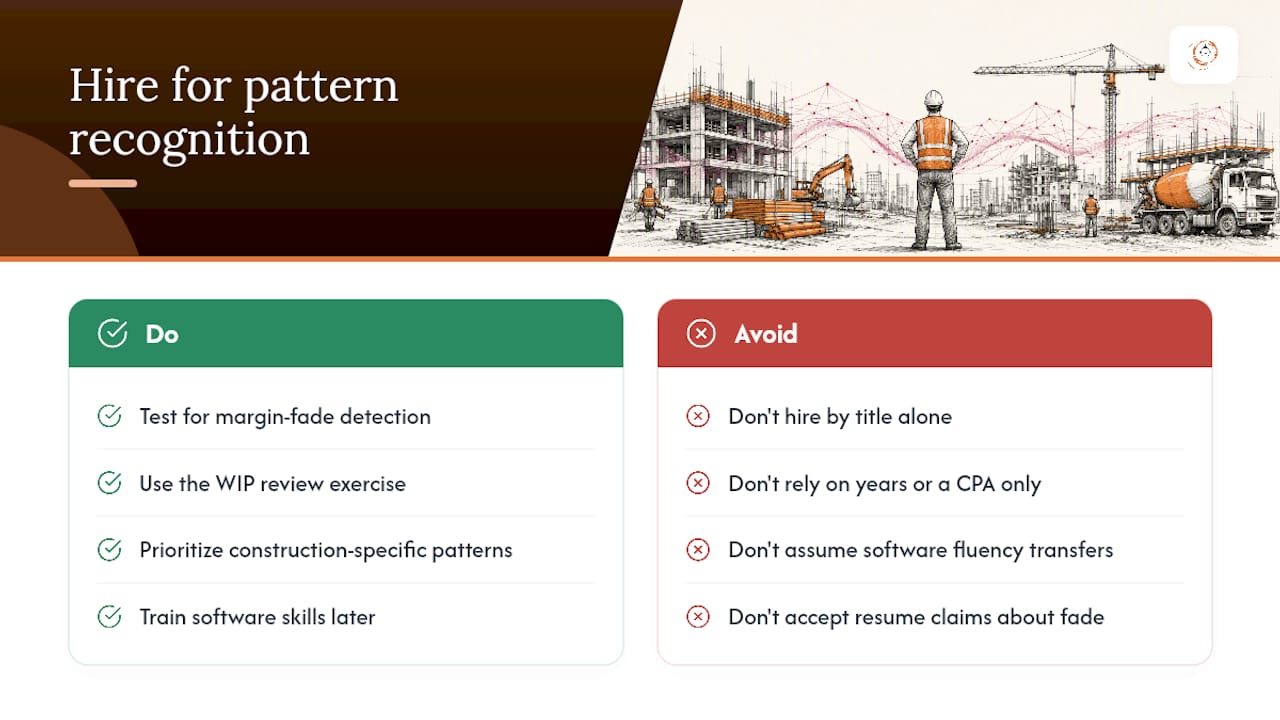
The conventional advice, “hire for years of experience and a CPA,” misses the variable that actually predicts success: whether the candidate has personally caught margin fade before it became a write-off. That’s a specific, testable skill, not a résumé line. The WIP review exercise in this guide exists because it’s the fastest way to separate someone who has managed fade from someone who has only heard the term in a meeting.
If you take one thing from this playbook, make it this: test for construction-specific pattern recognition before you test for anything else. Software skills are trainable in weeks. The instinct to spot a project heading toward fade before the numbers confirm it usually isn’t.
— Rowena
Get Pre-Vetted Controller Candidates Without the Guesswork
Running this entire evaluation process internally costs time your open projects don’t have. Constructconnect-rconstructionsolutions handles the sourcing, technical screening, and reference verification described above, so you interview only candidates who’ve already passed a construction-specific WIP review.

Some recruiting services offer a prorated payment structure where fees are based on successful placement, not a flat retainer regardless of outcome, presenting an alternative to traditional staffing agency invoices. If your project load already justifies a full-time seat, or you need a fractional controller bridge while you search, our recruiting services for the AEC industry connect you directly with pre-vetted candidates who’ve cleared exactly the kind of technical evaluation outlined in this guide. Reach out to start a search this week.
Sources
- The impact of fade analysis on project management — CSB CPA
- Does your construction firm need an outsourced controller? — Wipfli
- Construction Controller salary — Glassdoor
FAQ
What Does a Construction Controller Do?
A construction controller manages job costing, WIP schedule accuracy, project billing through AIA forms, and cash flow reporting, while catching margin fade through ongoing variance analysis.
How Much Does a Construction Controller Get Paid?
U.S. construction controller salaries typically range from about $80,000 to $160,000, with most offers clustering around $100,000 to $120,000 depending on experience and geography.
What Construction Job Pays Around $200,000 a Year?
Senior controllers at large general contractors, CFOs, and VP of finance roles at firms managing complex bonded public work can reach that range, usually requiring 10 or more years of construction-specific experience.
What Is a Realistic Salary for a Controller at a $100 Million Company?
At that revenue scale, expect the offer to sit toward the upper end of the typical range, often $120,000 to $160,000, reflecting the project complexity and bonding oversight the role demands.
Should I Hire a Recruiter or Search In-House for a Controller?
If you need construction-specific vetting fast or lack internal capacity to screen for WIP and ERP fluency, specialist recruiters typically fill the role faster and with lower mis-hire risk than an unassisted internal search.