Subcontractors: Find Private Construction Projects 12–24 Months Early
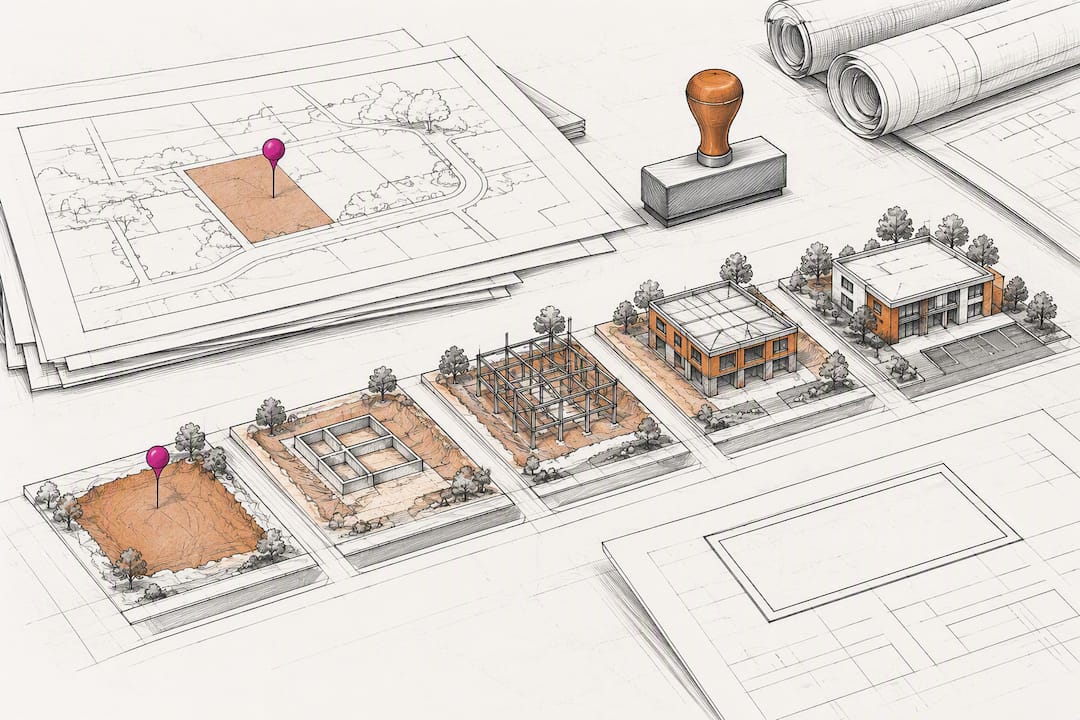
Use a mix of construction-intelligence feeds, targeted public-records monitoring, and proactive relationship outreach to find private construction projects before bids ever get posted. Construction-intelligence platforms, plat and permit filings, and architect or general contractor (GC) networks each surface leads at different stages, some as early as 12 to 24 months out. The immediate move: set up filtered alerts on two or three of these channels and block one hour a week to screen what comes in.
TL;DR:
- Building permit and planning agenda data often surface private projects 6 to 18 months before formal bid invitations, providing early positioning opportunities.
- Prioritize leads based on trade match, project size, geographic proximity, and licensing compliance, then score above 70% for targeted follow-up.
- Establish relationships with architects and design teams early through networks and trade events to gain preferential access before bids are public.
- Using a disciplined weekly screening routine and a basic CRM helps track project stages and ensures timely follow-up, increasing win rates.
- Paid lead services can provide verified contact details and jurisdiction coverage that manual monitoring cannot match for high-volume prospecting.
Table of Contents
- Where to Find Private Construction Projects Early
- How to Prioritize and Qualify Private Leads
- How to Get on GC Bid Lists and Prequalification Rosters
- Monitoring Public Records and Planning Signals
- Paid Lead Services vs. Free Public-Record Monitoring
- How We Source and Verify Leads
- Networking Events and Trade Shows Still Move the Needle
- Digital Marketing Tactics That Attract Project Opportunities
- Who You’re Actually Selling To: Owner Types and Decision-Makers
- Tools for Tracking Projects After You’ve Found Them
- What Actually Works for Small-to-Mid Construction Firms
- How R. Construction Solutions Fills the Gaps in Your Sourcing
- Sources
- FAQ
Where to Find Private Construction Projects Early
Every private project leaves a paper trail long before it reaches a bid board, and the trail starts in public records and design offices, not on a plan room login page. Knowing which document to watch, and when it surfaces, is the difference between bidding against forty competitors and being the first call an owner’s rep makes.
Here’s how the main channels break down:
- Construction-intelligence and paid lead databases. These platforms aggregate permit, plat, and plan-review data with contact information layered on top. Coverage varies by vendor, but the strongest ones track projects from early planning through construction start and flag the general contractor or owner’s rep once one is assigned. The value isn’t just the data. It’s contact depth, since a filing tells you a project exists, but a verified phone number or email tells you who to call.
- Building permit databases. Permits confirm a project has cleared design and is heading toward construction, typically 2 to 6 months before groundbreaking. Pull the permit type, valuation, scope description, and applicant contact. Valuation and scope tell you whether the job fits your trade and bonding capacity.
- Planning commission and zoning agendas. Posted online by most counties and cities, these agendas name the project, the parcel, and often the developer weeks before any permit application exists. Language like “site plan review” or “conditional use” signals a project is moving from concept to paper.
- Architect and engineer networks and developer announcements. Design teams are assigned before a single permit is filed, which makes them the earliest reliable signal in the entire cycle. A relationship with a mid-size architecture firm can put you on a bidder’s radar before the owner has even picked a GC, especially when you’re familiar with their construction products and mounting systems.
- Bid boards and plan rooms. These are the last stop, not the first. By the time a project posts publicly, dozens of firms already have it. They’re still useful for volume and for tracking projects you missed earlier, just don’t rely on them as your primary sourcing channel.
Public filings and planning agendas consistently surface private projects earlier than bid boards, often giving contractors 6 to 18 months of runway before formal bidding starts.
How to Prioritize and Qualify Private Leads
Not every filing deserves your attention, and chasing all of them burns hours you don’t have. A scoring system keeps your team focused on leads that convert instead of leads that just look busy.
Start with fit criteria before you even think about scoring:
- Trade match. Does the project scope align with what your crews actually do, or would you be stretching into unfamiliar territory?
- Contract size. Is the estimated value inside your bonding capacity and crew bandwidth?
- Geography. Is the job within a drive radius that doesn’t erode your margin on fuel and travel time?
- Compliance and licensing. Does the jurisdiction require licenses or certifications your firm currently holds?
Once a lead clears those filters, score it. Leads scoring above 70% get assigned to a specific person on your business development team that same week.
Watch for red flags in early conversations and draft contracts, especially clauses like “pay-if-paid,” which shifts payment risk onto subcontractors if the owner doesn’t pay the GC. Payment terms are often the most critical contract element for subcontractors, and reviewing them early avoids cash flow surprises later.
Pro Tip: Run your weekly screening session on the same day and time every week. Consistency in the review habit matters more than the sophistication of the scoring formula.
How to Get on GC Bid Lists and Prequalification Rosters
Spotting a project early only pays off if you’re already positioned to bid when the GC starts assembling its list. That means getting through prequalification before the invitation goes out, not after.
A tight prequal package should include:
- Current certificate of insurance and bonding capacity documentation
- OSHA 30 certification and a three-year safety incident history (EMR/TRIR)
- Three to five references from projects of comparable scope and value
- A project portfolio with photos, scope summaries, and completion dates
Submit prequal packages directly to GC estimators rather than waiting for a general inquiry form, and follow up once, roughly two weeks later, without repeated calls. Architect outreach matters here too. Design teams often recommend subs and suppliers to GCs during early coordination meetings, which is one reason connecting with architects on active projects pays off well before a bid invitation ever arrives.
Track every prequal submission, response, and follow-up date in a shared spreadsheet or CRM. A clean, responsive prequal process combined with consistent follow-up is what actually moves a subcontractor up a GC’s preferred bidder list over time.
Pro Tip: Send a short project-specific note when you resubmit an updated prequal package. GC estimators remember names attached to relevant projects, not generic renewal emails.
Monitoring Public Records and Planning Signals
Projects move through a predictable sequence: plat approval, then plan review, then permit issuance. Each stage gives progressively less lead time. A plat filing might surface a project 12 to 24 months before construction starts, while plan review shortens that window to 6 to 18 months, and permits confirm the job is imminent within 2 to 6 months.
Here’s a practical monitoring routine that doesn’t require a subscription:
- Set up county portal alerts. Most counties post plats, plan reviews, and permits on searchable public portals; many allow email notifications for new filings.
- Use Google Alerts for developer and architect names. Once you identify a recurring developer in your territory, a name-based alert catches press releases and zoning filings automatically.
- Subscribe to planning commission agenda RSS feeds. Weekly agenda reviews take fifteen minutes and reveal projects months before permits.
- Apply filtering rules immediately. Screen by trade code, valuation threshold, and territory boundary so you’re not drowning in filings outside your scope.
- Log metadata into your CRM at intake. Capture parcel number, applicant, estimated value, and filing date the moment you spot a lead, not after you decide it’s worth pursuing.
Projects moving through plat, plan review, and permit stages give contractors who track earlier signals far more runway to position for a bid than those waiting on permit data alone.
Paid Lead Services vs. Free Public-Record Monitoring
Whether a paid service earns its subscription fee depends on how much territory and trade breadth you’re trying to cover. A single-county, single-trade operation can often run adequately on free county portals and manual agenda checks. A firm bidding across multiple counties or several trade categories usually can’t keep up manually.
Paid, human-verified lead databases offer three things free monitoring struggles to match:
- Pre-bid contact details tied to a named decision-maker, not just a parcel number
- Filtering by trade, project stage, and geography built into the platform
- Consistent coverage across jurisdictions that would take a full-time employee to replicate manually
Paid, human-verified lead databases reduce time spent chasing stale leads, which matters most for teams that need volume rather than a handful of local leads.
Before committing to an annual contract, pilot a vendor on one county or one trade category for 60 to 90 days. Track how many leads convert to a bid invitation and compare that against the subscription cost versus the labor hours it would take to replicate the same coverage in house. If the platform surfaces even two or three qualified leads your team would have missed, it usually pays for itself.
How We Source and Verify Leads
Sourcing accurate leads is a discipline, not a download. R. Construction Solutions has spent more than 30 years placing talent and building supplier and subcontractor networks across the AEC industry, and that experience shapes how we think about lead quality: a contact is only as good as the verification behind it.
Human verification separates a usable lead from a stale one. A scraped database might list a project and an old phone number; a human-verified lead confirms the decision-maker, the timeline, and whether the project is still active before it ever reaches your pipeline.
Before trusting any lead provider, run this quick checklist:
- Does the provider verify contacts by phone or email, or only scrape public records?
- How far upstream does their coverage reach: plat stage, plan review, or permit only?
- Can they show accuracy rates or a sample data set before you commit?
(Client case studies and verified testimonials will be added here as they become available.)
Networking Events and Trade Shows Still Move the Needle
Digital tools find the paper trail, but relationships close the gap between “we saw your filing” and “we’d like you to bid.” Regional AEC trade shows, chapter meetings for groups like the Associated General Contractors (AGC), and local Associated Builders and Contractors (ABC) events put you in the same room as developers, architects, and GC estimators months before their projects go public.
The value isn’t the free coffee and name badges. It’s the follow-up. Collect names attached to specific project types, not generic titles, and send a short, personalized note within 48 hours referencing the actual conversation you had. Generic “great meeting you” emails get deleted; a note that says “following up on the mixed-use project you mentioned in the north county” gets a reply.
Trade shows also reveal who’s expanding. A developer speaking on a panel about upcoming portfolio growth is telling a room full of contractors exactly where to focus outreach next quarter. Architecture and engineering firm mixers work similarly, since design teams get assigned to projects before permits exist, making these events one of the earliest signal sources available outside of paid data feeds.
Treat every event as a data-gathering exercise as much as a relationship-building one. Bring a simple contact-capture method, whether that’s a CRM app on your phone or a notebook, and log names, firms, and project hints the same day. Momentum fades fast if follow-up waits until the following week.
Digital Marketing Tactics That Attract Project Opportunities
Sourcing leads is only half the equation. Getting found by architects, developers, and GCs searching for a qualified sub or supplier matters just as much, and that’s where a modest digital presence pays off.
A well-optimized Google Business Profile with accurate service categories, project photos, and recent reviews often ranks for local searches like “commercial electrical subcontractor near me,” putting your firm in front of decision-makers actively looking for a trade partner. Pair that with a project portfolio page on your website that highlights completed work by building type, since architects researching potential subs frequently search by project category rather than company name.
LinkedIn outreach targeted at architects, estimators, and developer business-development staff in your territory tends to outperform broad advertising. A short, specific message referencing a project type you specialize in gets more traction than a cold pitch. Email newsletters sent to a curated list of GC estimators, updated quarterly with recent project photos and capacity availability, keep your firm visible between bid cycles.
None of this replaces direct outreach or public-records monitoring. It supports both by making sure that when someone searches for a subcontractor in your trade and territory, your firm shows up rather than a competitor who invested in visibility while you didn’t.
Who You’re Actually Selling To: Owner Types and Decision-Makers
Not all private owners make decisions the same way, and misreading the decision-maker wastes outreach time. A single-location retail owner, a regional developer with a repeat pipeline, and a corporate facilities director all evaluate bids differently.
Private owners can use selective or negotiated tendering and weigh experience, safety record, and existing relationships alongside price, a sharp contrast to public-sector jobs that often default to lowest responsible bidder. That means a relationship with the right person can outweigh being the cheapest bid on a private job.
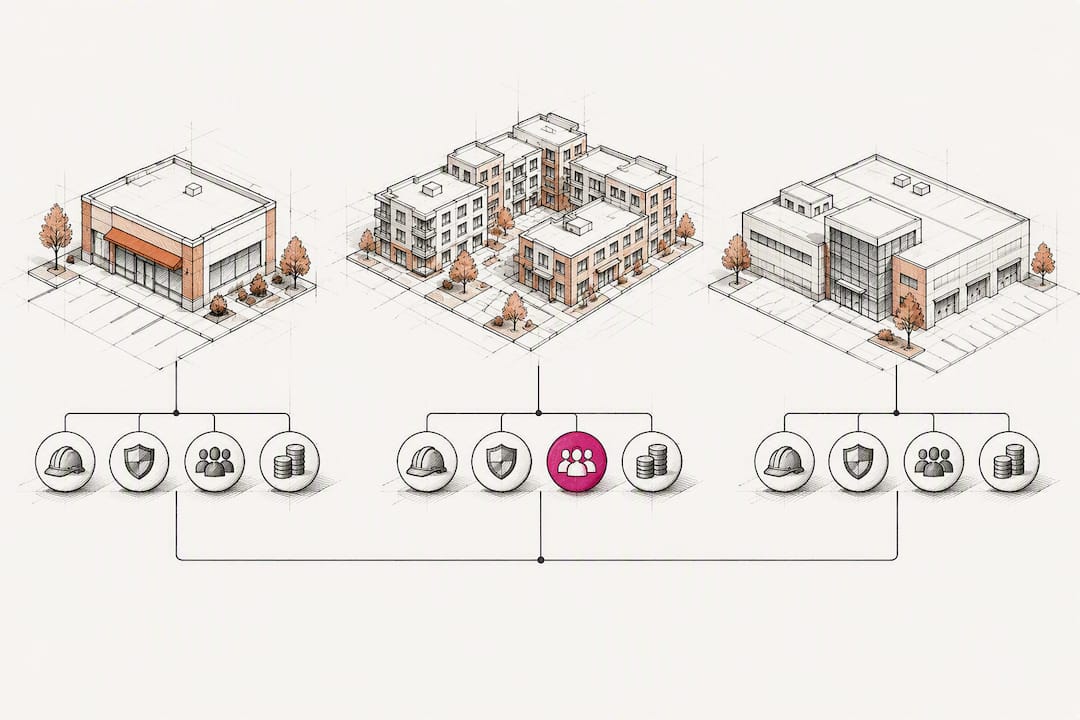
Know who actually signs off: an owner’s rep or project executive typically controls final selection on larger developments, while the architect or engineer of record influences the shortlist long before the owner sees names. On corporate or institutional projects, a facilities director or VP of construction often drives the decision, with procurement involved mainly for contract terms. Identifying which of these roles you’re talking to changes how you pitch, and how patient you need to be.
Tools for Tracking Projects After You’ve Found Them
Finding a lead is the easy part compared to tracking it through months of design development, permitting, and eventual bid release. A project identified today might not go to bid for a year, and without a system, it falls through the cracks.
A basic CRM, even a spreadsheet with disciplined fields, should capture the project name, parcel number, estimated value, decision-maker contact, current stage, and next follow-up date. More advanced construction-intelligence platforms often include stage-change alerts that notify you automatically when a project moves from plan review to permit, saving you from manually rechecking county portals every week.
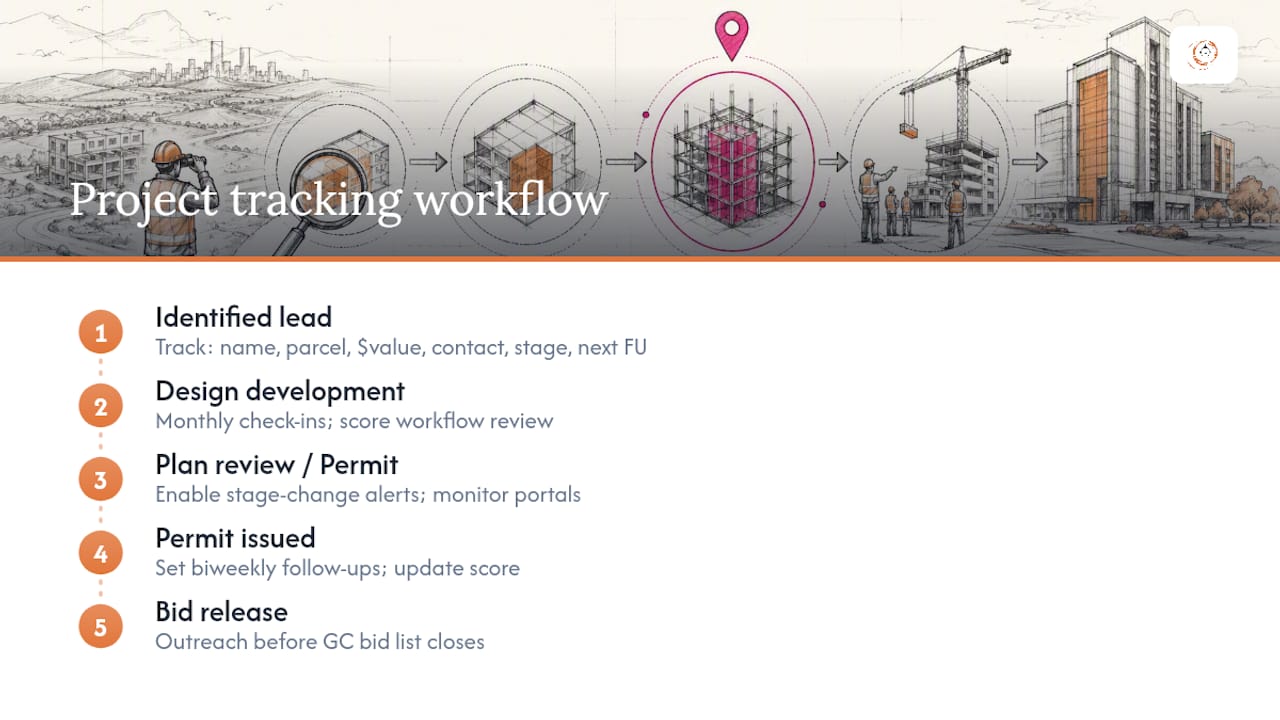
Calendar-based follow-up reminders matter more than any software feature. Set a recurring check-in, monthly for early-stage leads and every two weeks once a project reaches permit stage, so outreach happens before the GC’s bid list closes rather than after. A scoring workflow combined with a short recurring review routine is what actually turns a folder of filings into a working pipeline instead of a graveyard of forgotten leads.
What Actually Works for Small-to-Mid Construction Firms
Pick two channels and run them with discipline, rather than chasing five half-heartedly. A predictable pipeline comes from consistency, not breadth. Payment terms and reputation matter as much as project size in private work, and the highest-converting leads almost always trace back to a real relationship with an architect or GC estimator.
— Rowena
How R. Construction Solutions Fills the Gaps in Your Sourcing
Running a disciplined lead-sourcing operation alongside your actual project work stretches most construction teams thin, which is exactly where a managed partner earns its keep. The company specializes in recruiting, network sourcing, and business opportunity matchmaking for the AEC industry, leveraging extensive industry experience and a prorated commission structure where payment is due only upon successful placement.
If your team is spending more hours chasing candidates and subcontractor connections than closing projects, that’s the signal to bring in a managed alternative rather than continuing to DIY it. Our Recruiting Services connect you with pre-vetted office and field talent, our Supplier Sourcing and Subcontractor Connections give you access to a network we’ve built over three decades, and our Business Opportunity Sourcing service introduces you to tailored partnership opportunities you wouldn’t find scrolling permit portals alone. Reach out today to schedule a consultation and find out whether a managed sourcing partnership fits where your firm is headed next.
Sources
Developers, architects, and municipal planning departments increasingly post project updates on LinkedIn and, in some markets, on X or local community Facebook groups, often before a formal press release goes out. A developer announcing a groundbreaking ceremony or a rezoning approval on LinkedIn is handing you a lead with a timestamp attached.
Local subreddits and neighborhood Facebook groups sometimes surface project chatter even earlier, particularly for controversial developments where neighbors discuss a proposed project during the public comment period, months before permits are filed. That’s noisy data, but it’s also free and often faster than official channels.
Municipal planning department social accounts are worth a follow too. Many post agenda highlights or approval announcements that duplicate what you’d find in a formal agenda search, just with less digging required. Set a recurring reminder to scan these channels weekly alongside your public-records routine, since social signals work best as a supplement, not a replacement, for verified data.
- Gordian – Construction bidding guide
- Siteline – A subcontractor’s guide to pursuing the right construction bids
- Platineer – How to find new construction projects before bid
- PermitPipeline – Construction business development from permit data
FAQ
How much do private contractors charge per hour?
Rates vary widely by trade, region, and project complexity, and no single published figure applies across the industry. Pricing on private commercial work also reflects negotiated factors like experience and safety record rather than a fixed hourly rate, since private owners often weigh relationships and track record alongside cost.
Is construction slowing down in 2026?
Construction activity fluctuates by region and sector, and no single national trend applies evenly across residential, commercial, and industrial work. Firms that diversify their lead sources, rather than relying only on bid boards, tend to weather regional slowdowns better because they’re tracking projects earlier in the pipeline.
What is the best contractor bidding app?
There’s no single best app, since the right tool depends on whether you need broad public-record monitoring, human-verified contact data, or CRM-style pipeline tracking. A combination of a permit-monitoring platform and a disciplined weekly review process typically outperforms relying on any one app alone.
What not to tell a contractor?
If you’re the one hiring a subcontractor or supplier, avoid revealing your maximum budget upfront or disclosing that you’re desperate to fill a schedule gap, since either detail weakens your negotiating position. On the sourcing side, be cautious sharing exclusive project details with a bidder before contracts are signed, and always review payment terms carefully before committing to a scope.

