
How to Find Commercial Subcontractors: A GC's Guide
The fastest, lowest-risk way to find commercial subcontractors is to post a tight scope to two or three targeted channels simultaneously, run a short prequalification check on every respondent, and maintain a tiered bench of 2–3 vetted subs per trade so you are never sourcing from scratch under schedule pressure.
Three actions you can take within 48 hours:
- Post your scope package to a bidding platform or plan room (such as Dodge Construction Network or a regional plan room) and send direct invitations to peer-referred subs you already know by name.
- Run a quick license and insurance check on every sub you plan to invite: pull their state contractor license number on your state licensing board’s public lookup and call the COI carrier to confirm active coverage.
- Make two referral calls to non-competing GCs or your primary material supplier to ask who they have used on similar commercial work in the last 12 months.
Selecting subs based mainly on availability or low bids frequently produces higher long-term costs from rework, safety incidents, and missed milestones. These three steps interrupt that pattern before it starts.
Key Takeaways
The most reliable way to find commercial subcontractors is to combine targeted sourcing channels with a structured prequalification workflow and a tiered bench of 2–3 verified subs per trade.
| Point | Details |
|---|---|
| Start with high-signal channels | Peer referrals and material suppliers reveal operational reliability that directories cannot match. |
| Run a 14–28 day bid cycle | A structured workflow from scope release to conditional award keeps sourcing predictable and defensible. |
| Verify before mobilization | Check active license, COI currency, EMR, and OSHA 300 logs on every sub before allowing site access. |
| Flag low bids immediately | Any bid more than 15% below the median requires a line-item scope breakdown before consideration. |
| Constructconnect-rconstructionsolutions | Delivers pre-vetted subcontractor shortlists with verified documentation and a prorated commission model. |
Table of Contents
- Where can you find commercial subcontractors worth bidding?
- What does a step-by-step bid workflow look like?
- What should your prequalification checklist include?
- How do you level bids and score subcontractor proposals?
- How should you use bidding platforms and plan rooms effectively?
- How do you build a prequalified subcontractor bench?
- When does it make sense to hire a sourcing partner?
- What seasoned GCs know about maintaining a reliable bench
- R. Construction Solutions connects you with pre-vetted subcontractors
- Sources
- FAQ
Where can you find commercial subcontractors worth bidding?
Not all sourcing channels return the same quality of lead. The channel you choose shapes how much verification work follows, so matching the channel to your trade and timeline matters.
Peer referrals and material suppliers
High-signal sourcing comes from peer referrals and material supply houses because they reveal operational behaviors that directories cannot: who pays on time, who keeps a jobsite organized, who shows up with the right crew size. A quick call to your lumber yard, mechanical supply house, or electrical distributor will surface names that have already been stress-tested on real projects. Non-competing GCs working in adjacent markets are equally reliable. This channel is slow to build but returns the lowest noise-to-signal ratio of any option.

Trade associations and union halls
Organizations such as the Associated Builders and Contractors (ABC), Associated General Contractors (AGC), and the National Electrical Contractors Association (NECA) maintain member directories with verified licensing and insurance requirements baked into membership. Union halls for trades like IBEW, UA (plumbers and pipefitters), or SMACNA sheet metal contractors give you access to workforce that carries documented training and wage compliance. For public works, union-affiliated subs often arrive with apprenticeship documentation already in order.
Bidding platforms and plan rooms
Digital platforms let you post a scope package and receive structured bids from a wide pool. The advantage is speed and breadth; the disadvantage is that a directory listing is not a credential check. Use these platforms to generate a candidate list, not a prequalified shortlist. Selective invite lists on these platforms, where you control who receives the bid invitation, produce better results than open public postings for critical trade packages.
LinkedIn and targeted social outreach
LinkedIn is underused for subcontractor sourcing but works well for specialty trades and superintendent-level contacts. Search by trade, geography, and company size. A direct message referencing a specific project type converts better than a generic inquiry. The limitation is that LinkedIn profiles are self-reported, so every contact still needs document verification before you extend an invitation.
Industry events and jobsite networking
Pre-construction meetings, industry trade shows, and AGC chapter events put you in the same room as project managers and owners from subcontracting firms. A conversation at a supplier counter or a pre-bid walkthrough gives you a read on a sub’s operational culture that no online profile can replicate.
Manufacturer reps and dealer networks
Manufacturer representatives for mechanical equipment, roofing systems, or specialty glazing often maintain short lists of certified installers in your region. These subs have completed factory training and carry product-specific warranties, which reduces your risk on performance-sensitive scopes.
Prioritizing channels by project type: For a large, schedule-critical commercial package, lead with peer referrals and association directories, then supplement with a platform posting. For a smaller fill-in scope with a tight timeline, a platform invite list combined with a supplier referral is usually faster.
What does a step-by-step bid workflow look like?
A repeatable, time-boxed process keeps your sourcing from compressing into a last-minute scramble. The workflow below fits a standard commercial trade package and assumes a 14–28 day cycle from scope release to conditional award.
- Pre-solicitation scouting (Days 1–3). Confirm your scope is complete: drawings, specifications, allowances, exclusions, and any owner-furnished material. Build your invite list from your prequalified bench first, then supplement with new candidates from the channels above.
- Bid package release and invitations (Day 3–4). Issue the bid package with a mandatory scope acknowledgment form. Specify required attachments: COI, license copy, safety record summary, and a completed bid form with line-item breakdowns.
- Q&A and addenda period (Days 5–12). Hold a pre-bid walkthrough for complex scopes. Issue all clarifications as numbered addenda distributed to every bidder simultaneously. Log every question and response.
- Bid submission deadline (Day 14). Require a single-file submission with all attachments. Late bids should be rejected unless you have documented a schedule extension issued to all bidders.
- Bid leveling and verification (Days 14–18). Compare bids line by line, not lump sum to lump sum. Confirm scope alignment, identify exclusions, and normalize unit prices. Flag any bid more than 15% below the median for a mandatory scope breakdown request.
- Prequalification verification (Days 18–22). Pull license status, call the COI carrier, review OSHA 300 logs, and check references on your top two or three candidates.
- Conditional award and onboarding (Days 22–28). Issue a conditional letter of intent with specific documentation requirements before mobilization. Confirm subcontract execution, bonds (where required), and final COI with additional insured endorsements before the sub sets foot on site.
| Phase | Typical Duration | Key Output |
|---|---|---|
| Pre-solicitation scouting | Days 1–3 | Confirmed scope, invite list |
| Bid package release | Day 3–4 | Issued package with mandatory forms |
| Q&A and addenda | Days 5–12 | Numbered addenda, walkthrough notes |
| Bid submission deadline | Day 14 | Received bids with attachments |
| Bid leveling | Days 14–18 | Leveled comparison, exclusion log |
| Prequalification verification | Days 18–22 | Verified license, COI, safety records |
| Conditional award | Days 22–28 | Signed LOI, executed subcontract |
When the schedule is compressed, cut the Q&A period to 3 days and run prequalification verification in parallel with bid leveling rather than sequentially. Never compress the verification step itself.
What should your prequalification checklist include?
Prequalification is most effective when it is project-specific and integrated with automated tools to maintain current records and reduce repetitive administrative work. The checklist below covers the minimum gates before you allow mobilization.
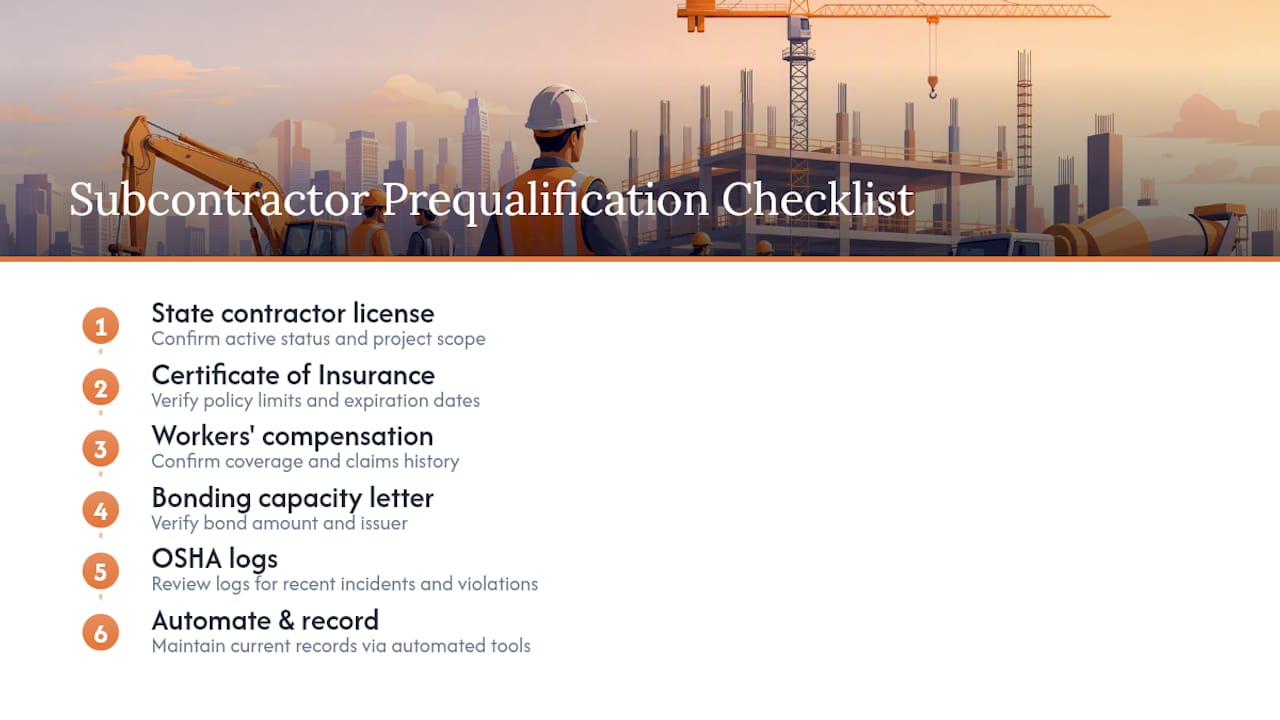
Required documents to collect and verify
| Document | What to Check | Verification Method |
|---|---|---|
| State contractor license | Active status, correct classification, no disciplinary holds | State licensing board public lookup |
| Certificate of Insurance (COI) | GL, auto, workers’ comp, umbrella; additional insured endorsement | Call issuing carrier directly |
| Workers’ compensation verification | Active policy, correct class codes | Carrier confirmation or NCCI lookup |
| Bonding capacity letter | Sufficient single and aggregate limits for scope value | Surety agent letter on surety letterhead |
| OSHA 300/300A logs | Last 3 years; review incident types and frequency | Request directly; cross-check with EMR |
| Experience Modification Rate (EMR) letter | EMR below regulatory thresholds preferred; above 1.3 requires written mitigation plan | Request from sub’s insurer on carrier letterhead |
| References from recent similar projects | Two to three commercial projects of comparable scope and value | Direct phone calls to GC or owner contacts |
| Financial references | Trade credit references or basic liquidity indicators for scopes above your threshold | Supplier credit references or D&B report |
For a deeper look at bonding capacity verification, review the full bonding qualification checklist before issuing a conditional award on larger commercial packages.
Red flags that should trigger disqualification or a conditional award
- Expired or suspended state license, or a license classification that does not match the scope of work
- COI with gaps in coverage dates, missing additional insured endorsements, or policy limits below your contract requirements
- EMR above 1.3 with no written explanation or corrective action plan
- Recurring DIR wage, apprenticeship, or prevailing wage citations on public works (California and other states with DIR enforcement)
- A bid more than 15% below the median of all received bids without a line-item scope breakdown explaining the difference
- Heavy reliance on 1099 labor where worker misclassification risk exists under state law
- Inability or refusal to provide OSHA 300 logs or an EMR letter from the carrier
Pro Tip: Use your state licensing board’s online lookup and the COI carrier’s certificate verification line to complete the core document check in under 30 minutes per sub. Most carriers have a direct verification number printed on the COI itself.
California CSLB/DIR compliance checklist
California carries the highest regulatory exposure for GCs working with subcontractors on public works. Verifying CSLB license classification, DIR Public Works registration, DAS-140/DAS-142 apprenticeship submissions, and DIR enforcement history before award is not optional on public contracts. The GC effectively inherits the sub’s regulatory exposure on covered projects.
California pre-award checklist:
- Confirm active CSLB license at Cslb with the correct classification (C-10 for electrical, C-36 for plumbing, etc.)
- Verify DIR Public Works registration at Dir for every sub and lower-tier sub on covered projects
- Confirm DAS-140 (apprenticeship notification) and DAS-142 (apprenticeship utilization) submissions are in order before work begins
- Check DIR enforcement history for wage citations, stop orders, or debarment
- Review AB 5 worker classification compliance: confirm the sub is not misclassifying field workers as independent contractors
For GCs operating across multiple states: build a pre-award jurisdiction check into your standard workflow. Verify state or provincial licensing, insurance, and public works registration requirements before the bid package goes out, not after award. Set a re-check cadence (at minimum, 30 days before mobilization) to catch any license or insurance lapses between award and start of work.
Pro Tip: California’s DIR enforcement database is searchable by contractor name and license number. Run this check on every sub before issuing a conditional award on any public works project, regardless of scope size.
How do you level bids and score subcontractor proposals?
Bid leveling is the process of making bids comparable before you evaluate them. A lump-sum comparison without leveling rewards the sub who excluded the most scope, not the one who priced the work correctly. Leading contractors evaluate a composite of price, recent capacity, financial health, and recent similar work rather than selecting on price alone.
Bid leveling steps
- Confirm scope alignment. Map each bid against your scope checklist line by line. Mark every exclusion and clarification in a separate column.
- Identify and price exclusions. Add the cost of excluded items back into each bid at your best estimate so you are comparing apples to apples.
- Normalize unit prices. For unit-price contracts, compare per-unit rates across bidders to identify outliers.
- Check long-lead assumptions. Confirm that each bidder has included the same lead times for owner-furnished or specified equipment.
- Verify crew and crew-hour assumptions. For labor-intensive scopes, ask each bidder to confirm their crew size and anticipated duration.
Sample scoring matrix
Score each bidder on a 1–5 scale per criterion, multiply by the weight, and sum the weighted scores. The matrix creates a defensible record of your award decision and surfaces cases where the lowest-price bidder scores poorly on safety or capacity.
This structure protects your schedule and margin without requiring you to reject the sub outright.*
How should you use bidding platforms and plan rooms effectively?
Digital tools accelerate the sourcing process, but the features you prioritize determine whether you get qualified leads or just volume.
Features worth paying for:
- Verified company profiles with license and insurance document uploads
- Messaging and Q&A tools that create a documented audit trail
- Selective invite lists so you can limit bidding to pre-screened subs on critical packages
- Integration with prequalification tools (such as Autodesk Construction Cloud’s TradeTapp module) or your project management software
- Bid submission tracking with timestamped receipt confirmation
Do/don’t list for platform use:
- Do use invite-only lists for mechanical, electrical, and structural packages where scope gaps carry the highest risk.
- Do require subs to upload their COI and license copy as part of the platform submission, so you have a document trail before the first phone call.
- Don’t treat a directory listing or a platform profile as a credential verification. A profile tells you a company exists; it does not confirm their license is active or their insurance is current.
- Don’t rely solely on platform messaging for scope clarifications. Issue formal addenda and distribute them to every bidder, even if the question came through the platform’s chat function.
- Do combine platform leads with offline referrals from supplier counters and manufacturer reps to improve your hit rate on quality candidates.
The strongest sourcing results come from combining a platform’s reach with the signal quality of a peer referral. A sub who appears on both lists, one from a platform search and one from a supplier recommendation, is worth prioritizing on your invite list.
How do you build a prequalified subcontractor bench?
A prequalified bench means you are never sourcing from scratch under a deadline. Maintaining 2–3 prequalified subs per trade is the standard for teams that consistently hit schedule in tight markets.
Tiering your bench
- Tier A (Preferred). Proven performance on at least two comparable commercial projects with your firm or with a verified reference. Full documentation on file and current. First to receive bid invitations.
- Tier B (Qualified). Completed prequalification with some commercial project experience, but limited direct history with your firm. Receives invitations when Tier A capacity is committed or unavailable.
- Tier C (Conditional/Backup). Meets minimum document requirements but has not yet completed a project with your firm or a verified reference. Used only when Tier A and B are unavailable; requires closer oversight and conditional-award terms.
Maintenance cadence
Run annual re-checks on every sub in your bench: pull current license status, request updated COIs, and ask for an updated EMR letter. Before each new award, run a pre-award re-validation to catch any lapses since the last check. After project completion, update each sub’s record with a performance note covering schedule adherence, quality, safety incidents, and crew reliability. This post-project update is what separates a living bench from a static list.
Keeping bench subs engaged
Occasional smaller scopes, shared project forecasting, and supplier introductions keep Tier A and B subs invested in your pipeline. A brief site visit or a pre-construction meeting invitation signals that you value the relationship beyond the current contract. Subs who feel like partners tend to prioritize your calls when capacity is tight.

For a structured approach to qualifying subcontractors before project start, the full qualification workflow covers documentation gates and mobilization checks in detail.
When does it make sense to hire a sourcing partner?
Some situations make the case for outsourcing the sourcing process entirely. A done-for-you partner is worth considering when:
- You have multiple urgent trade packages to fill simultaneously and your internal team cannot run parallel prequalification tracks
- You are entering a new geographic market where you have no existing bench or referral network
- A project carries high compliance risk (prevailing wage, Davis-Bacon, California DIR requirements) and you need verified documentation before a hard deadline
- You need to scale quickly for a large award and your current bench does not have the capacity depth
What a quality sourcing partner should deliver
- Pre-vetted shortlists with active license and insurance verification completed before the list reaches you
- Reference calls on recent comparable projects, with written summaries
- Onboarding support: subcontract review, document collection, and mobilization checklist
- A measurable service-level agreement (SLA) covering turnaround time from scope receipt to shortlist delivery
Questions to ask before engaging a sourcing partner
- What is your typical turnaround from scope receipt to a verified shortlist?
- What specific documents do you verify, and how do you confirm COI currency?
- How do you handle a placement that does not perform? What is your replacement guarantee?
- What is your fee structure: flat fee, percentage of subcontract value, or prorated over the engagement?
- Can you provide references from GCs who used your service on comparable commercial projects?
Track post-engagement metrics: time-to-mobilize, document deficiency rate at mobilization, and first-90-day performance on schedule and safety. These numbers tell you whether the partner is delivering real value or just generating a longer list.
What seasoned GCs know about maintaining a reliable bench
The GCs who rarely scramble for subcontractors share one habit: they treat prequalification as a continuous process, not a pre-bid checklist they pull out when a package is already late. The bench is a living asset, updated after every project and reviewed before every award.
Here is a lesson that comes up repeatedly in the field. Because the PM had maintained a Tier B mechanical sub with current documentation and a completed reference check, she was able to mobilize a replacement within five days. The project finished two weeks behind schedule instead of two months. The difference was not luck. It was a bench entry that had been updated six months earlier after a smaller tenant improvement project.
The behavior you can adopt tomorrow: after every project closes, spend 20 minutes updating your sub’s bench record. Note the actual crew size versus what was proposed, any safety incidents, whether they hit their schedule milestones, and whether you would use them again on a larger scope. That note is worth more than any directory listing when you are under pressure to fill a package fast.
R. Construction Solutions connects you with pre-vetted subcontractors
Finding qualified commercial subcontractors through referrals, platforms, and association directories takes time you often do not have when a project is already awarded. Constructconnect-rconstructionsolutions offers a faster path: pre-vetted subcontractor connections, project-based recruiting, and a prorated commission model that means you pay only for successful placements, spread over the first 90 days.
With 30-plus years of AEC industry experience, the Constructconnect-rconstructionsolutions network delivers verified documentation, reference-checked candidates, and onboarding support so your team spends less time chasing paperwork and more time managing the project. The commission structure is lower than traditional agency rates, and the prorated model eliminates the risk of paying a full fee upfront for a placement that does not continue.
If you need a pre-vetted subcontractor shortlist for an active package or want to build a stronger bench before your next award cycle, request a sourcing consultation with the Constructconnect-rconstructionsolutions team today.
Sources
Use these resources to confirm subcontractor credentials before award. For public works projects, run every check below as a gating requirement, not a courtesy step. For private commercial work, prioritize license, COI, and EMR verification at minimum.
Key verification resources:
- Subcontractor Choices Are Costing Contractors More Than They Think | Construction Business Owner
- Hiring subcontractors — Relay blog
- Subcontractor prequalification best practices | Autodesk (TradeTapp)
- How contractors actually evaluate, qualify, and avoid project failure before contract award in 2026 | Builder Outlook
FAQ
How long does it take to find and vet a commercial subcontractor?
A standard commercial trade package runs 14–28 days from scope release to conditional award when you follow a structured bid workflow. Compressing the Q&A period and running prequalification verification in parallel with bid leveling can reduce that to 10–14 days for urgent packages.
What is the biggest red flag when evaluating subcontractor bids?
Request a line-item scope breakdown before proceeding; unexplained low bids frequently indicate scope gaps or workforce misclassification issues.
Do I need to verify subcontractor licenses on private commercial projects?
Yes. License verification protects you from contract voidability and liability exposure regardless of project type. On public works, it is a legal requirement in most states; on private commercial work, it is a standard risk management practice.
When should a GC use a done-for-you sourcing partner?
Consider a sourcing partner when you have multiple urgent packages to fill simultaneously, you are working in a new market without an existing bench, or the project carries high compliance risk that requires verified documentation before a hard mobilization deadline.
How does Constructconnect-rconstructionsolutions differ from a general staffing agency?
Constructconnect-rconstructionsolutions specializes exclusively in the AEC industry, delivering pre-vetted subcontractor connections with verified documentation and a prorated commission model paid only on successful placements. General staffing agencies typically lack the trade-specific vetting depth and compliance knowledge that commercial construction projects require.