
How Contractors Find Pre-Vetted Suppliers and Subcontractors
Contractors typically get pre-vetted suppliers and subcontractors through five or six reliable channels: specialized recruiting and sourcing firms, bid and vendor platforms, maintained internal vendor databases with scorecards, supplier onboarding portals, and referral networks built through trade associations. Each one solves a different problem. There are several proven ways suppliers reach targeted contractors and, in reverse, ways contractors reach the right suppliers, and choosing the right one depends on how much risk you’re carrying and how fast you need boots on the ground.
If you need a name tomorrow for a routine trade, your internal database or a bid platform will move faster than anything else. If you’re staffing a specialty scope where a bad hire could shut down a schedule, a specialized recruiting or sourcing firm earns its fee by doing the vetting work before you ever see a name.
- Specialized recruiting/sourcing firms — best for high-risk, high-skill placements
- Bid platforms and vendor directories — fastest for routine trade coverage
- Internal vendor databases and scorecards — fastest for repeat work with known partners
- Supplier onboarding portals — reduces friction once a vendor is selected
- Referral networks and trade associations — best for local, trust-based introductions
- Early preconstruction engagement — best for constructability input on complex projects
Constructconnect-rconstructionsolutions works directly in that first category, connecting contractors with pre-vetted subcontractors and suppliers through a sourcing model built specifically for AEC teams.
Key Takeaways
The fastest, most reliable path to a pre-vetted supplier or subcontractor combines a documented prequalification checklist with a channel matched to your project’s risk level and timeline.
| Point | Details |
|---|---|
| Match channel to risk | Use recruiting firms for high-stakes specialty roles, bid platforms for routine trade coverage. |
| Prequalify before bidding | Screening COIs, bonding, and licenses upfront prevents most downstream vendor problems. |
| Watch EMR thresholds | Treat an EMR above 1.2 as a caution flag and above 1.5 as a likely disqualifier for high-risk scopes. |
| Automate onboarding | Document parsing and ERP integration can cut onboarding processing time by more than 60%. |
| Consider a sourcing partner | Constructconnect-rconstructionsolutions offers prorated, lower-commission recruiting for vetted AEC placements. |
Table of Contents
- Ways Suppliers Reach Targeted Contractors Through Different Channels
- What Makes a Supplier or Sub “Pre-Vetted”?
- How Technology Speeds Up Sourcing and Cuts Onboarding Risk
- Working With a Sourcing or Recruiting Partner: What to Ask First
- What I’ve Learned Watching Contractors Get This Wrong
- How R. Construction Solutions Can Help You Find the Right Vendors Faster
- Sources
- FAQ
Ways Suppliers Reach Targeted Contractors Through Different Channels
Each channel operates on a different mechanism, and understanding that mechanism tells you when to use it.
Specialized recruiting and sourcing firms work by maintaining a standing network of pre-screened candidates and vendor relationships, rather than starting a search from zero every time a request comes in. These firms verify licenses, safety records, and certifications ahead of time, so when a contractor calls with an urgent need, the firm isn’t beginning the vetting process. It’s pulling from a shortlist already cleared. This matters most for scopes like BIM coordination, commissioning, or safety leadership, where specialized recruiting agencies maintain pre-screened candidate pools that can cut time-to-fill from weeks to days.
Bid platforms and vendor directories work differently. They centralize invitations, track who has responded, and let you compare bids side by side across trades. Platforms in this category, described in tools like BuildingConnected Pro’s overview, improve bid coverage by making it harder for a qualified vendor to slip through the cracks simply because nobody remembered to invite them. Subcontractors themselves increasingly rely on these systems to spot relevant opportunities, a dynamic explored in Won2Build’s breakdown of commercial construction bids.
An internal vendor database, paired with a scorecard, speeds up repeat sourcing because you’re not rebuilding trust from scratch on every project. Tag vendors by trade, capacity, and geography, and your team can generate a qualified invite list in minutes instead of days.
- Pull your last 12 months of vendor performance data
- Flag anyone with expired insurance or licensing
- Rank remaining vendors by response rate and quality score
- Send targeted invites instead of a mass blast
Supplier onboarding portals reduce friction after selection by letting vendors upload documents and track their own approval status, which cuts down on the back-and-forth emails that used to eat up a coordinator’s week. Referral networks and trade associations still matter, especially for local specialty work where reputation travels faster than any database entry.
Pro Tip: Keep your vendor database segmented by trade and capacity, not just alphabetically. A plumbing sub who can handle a 200-unit multifamily job is a different resource than one who only does small tenant improvements, and your database should reflect that distinction at a glance.
What Makes a Supplier or Sub “Pre-Vetted”?
“Pre-vetted” isn’t a marketing term. It describes a specific set of checks that should happen before a vendor ever gets added to a bid list.
- Certificate of insurance (COI) with proper endorsements for your project type
- Current bonding capacity matching your project size
- Active state and local licensing for the scope of work
- Documented safety program and OSHA history
- At least two verifiable references from comparable projects
A robust prequalification process screens vendors before they bid, and doing this work upfront prevents the majority of vendor performance problems that show up later in a project. Skipping it is how contractors end up with a mechanic’s lien filed mid-project or a sub who disappears after the first pay application.
Financial and behavioral red flags deserve their own line item. An erratic bidding pattern, unusually low numbers compared to the rest of the field, or a history of liens on past jobs should all trigger a closer look before you sign anything.

Practitioners commonly treat an Experience Modification Rate (EMR) above 1.2 as a caution flag, and above 1.5 as a likely disqualifier for high-risk scopes like structural work or crane operations, though the threshold should flex depending on the trade’s inherent risk profile.
Building a scorecard turns these checks into a repeatable decision. Combine response rate, EMR, COI validity, bonding limits, and past project outcomes into a single score, then set a threshold below which a vendor doesn’t make your invite list. Once a vendor clears that bar, the real work of onboarding, syncing their profile into your accounting or ERP system, still needs to happen before they’re truly ready to work.
How Technology Speeds Up Sourcing and Cuts Onboarding Risk
The biggest gains in vendor sourcing over the past few years haven’t come from new channels. They’ve come from automating the boring parts of the old ones.
- Automated bid invitations and follow-up reminders cut down on manual chasing and measurably increase response rates from your vendor list
- COI and document parsing tools automatically flag missing endorsements or expired coverage instead of relying on someone catching it manually
- ERP and accounting system integration turns an approved vendor profile into a live, payable supplier record without re-entering data
- Self-service portals let vendors upload their own documents and check status, freeing your team to focus on exceptions
Automated onboarding workflows that combine COI parsing, ACH bank verification, and routed approvals can cut processing time by more than 60% compared to manual methods. That’s the difference between a new supplier waiting two weeks for their first purchase order and getting one within a few days. For high-exposure scopes, the smartest systems set rule-based triggers that automatically route a vendor to contracting and legal review once a contract value or structural scope threshold is crossed, so nothing risky slips through on autopilot.
Working With a Sourcing or Recruiting Partner: What to Ask First
Not every contractor has the internal bandwidth to run a full vetting and scorecard system in-house. That’s where a recruiting or sourcing partner earns its keep, but not every partner operates the same way.
Before signing an agreement, ask these questions:
- What is your sourcing method, and how deep does your candidate or vendor network actually go?
- What specific vetting steps happen before a name reaches me, and can you show documentation?
- Do you offer any placement guarantee if a hire or vendor doesn’t work out?
- Can your process integrate with our existing vendor database or ERP system?
- What KPIs do you track, and will you share them?
Engagement models vary. Contingency-based pricing means you pay only on a successful placement, which aligns incentive but can lead to less depth of search. Retained models guarantee dedicated attention but require payment upfront regardless of outcome. Project-based and prorated structures split the difference, spreading payment across a defined period tied to performance.
Watch for red flags: a partner with no client references, no measurable KPIs, or one that demands full payment upfront with no success metric attached. Specialized recruiters who act as an extension of your team reduce hiring risk precisely because their compensation is tied to a placement that sticks, not a resume that gets forwarded.
Pro Tip: Ask any sourcing partner how they handle a bad placement. A firm with a real prorated model will have a clear answer, because their payment structure already assumes some placements need adjustment.
Constructconnect-rconstructionsolutions structures its fees this way on purpose: lower commission rates than typical staffing agencies, paid out over a 90-day prorated window tied to the placement actually working out.
What I’ve Learned Watching Contractors Get This Wrong
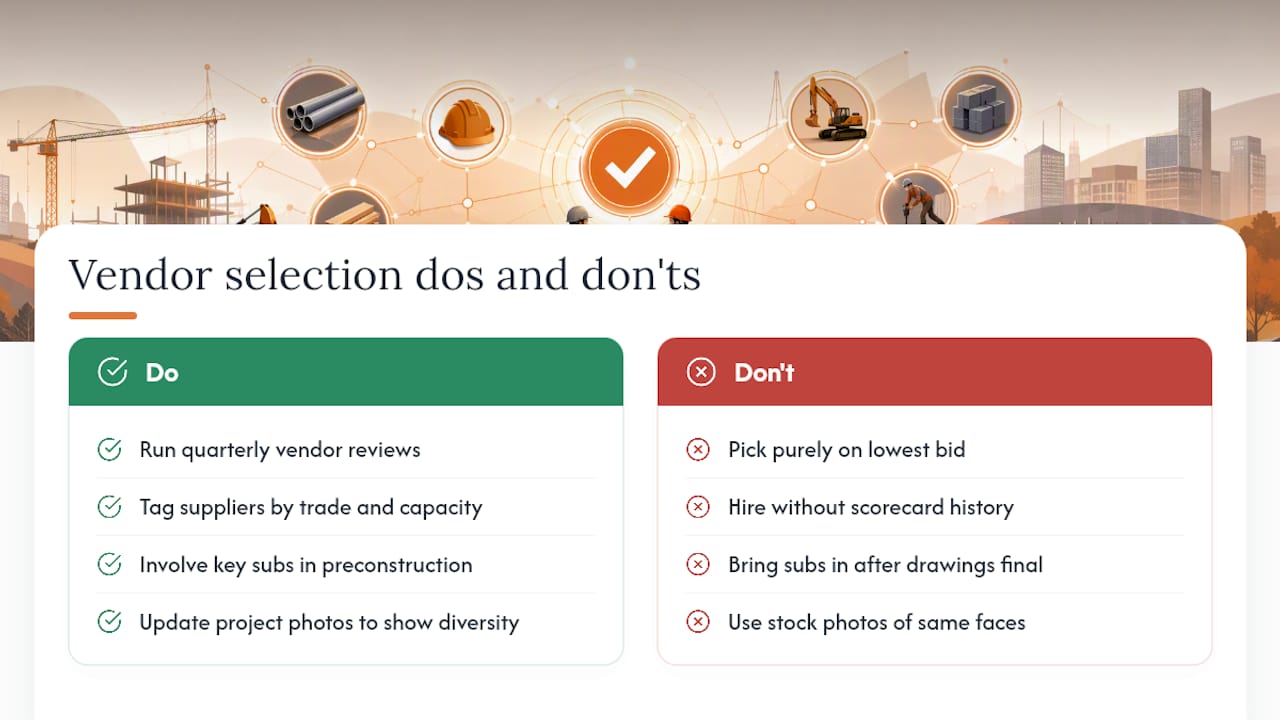
The contractors who struggle with vendor reliability almost never lack access to suppliers. They lack a system for deciding which suppliers deserve repeat business. I’ve seen projects stall for weeks because a sub was chosen purely on lowest bid, with no scorecard history to flag their track record on schedule adherence.
The fix is boring but effective: quarterly vendor reviews, trade and capacity tags in your database, and involving key subs during preconstruction instead of after the drawings are final. And if your project photos still show the same handful of faces, it’s worth updating them. Construction teams today are far more diverse than most stock imagery suggests, and your marketing should look like your actual jobsite.
How R. Construction Solutions Can Help You Find the Right Vendors Faster
If you’ve read this far, you already know the tradeoff: build your own vetting system and database, or bring in a partner who’s already done that work. Constructconnect-rconstructionsolutions exists for contractors who don’t want to spend three months building a scorecard system before they can hire confidently.
With more than 30 years in AEC recruiting, Constructconnect-rconstructionsolutions connects general contractors and construction managers with pre-vetted suppliers, subcontractors, and equipment rental partners, along with office and field staff placements. The prorated payment model spreads commission over the first 90 days, so you’re paying based on a placement that’s actually working, not a name that looked good on paper. Commission rates run lower than typical staffing competitors, and every candidate or vendor connection comes pre-screened for the specific demands of construction work.
This fits best for contractors who need a specialty trade filled fast, or who want a vetted supplier relationship without building an internal sourcing team from scratch. Visit the recruiting services page to see current placement categories, or start with a conversation about your next open scope.
Sources
- Construction Vendor Management & Scorecarding Guide | Trueleveler
- Supplier Onboarding: Construction Procurement Playbook 2026
FAQ
What’s the fastest way to find a pre-vetted subcontractor?
An internal vendor database with a current scorecard is typically the fastest option if you already have qualified vendors on file; a bid platform is the next fastest if you don’t.
How long does specialized recruiting typically take to fill a role?
Specialized recruiting agencies with pre-screened networks can reduce time-to-fill for technical construction roles from weeks or months down to days.
What EMR should disqualify a subcontractor?
Many practitioners treat an EMR above 1.2 as a caution flag and above 1.5 as a likely disqualifier for high-risk scopes, though the right threshold depends on the trade.
Does Constructconnect-rconstructionsolutions handle both staffing and supplier connections?
Yes. Constructconnect-rconstructionsolutions places office and field staff and connects contractors with pre-vetted subcontractors, suppliers, and equipment rental partners under a prorated commission model.
How much can automated onboarding actually save?
Automated onboarding workflows using COI parsing and verification can cut supplier onboarding processing time by more than 60% compared to fully manual methods.