
90 Day Employee Retention Playbook for Construction Site Managers
The fastest way to cut construction employee retention problems is to combine competitive total compensation with stronger frontline leadership, schedule stability, and visible career pathways. That mix typically pays back two to three times its cost within two years. Start with a 90-day pilot on one crew or site, measure the results, then scale what works.
TL;DR:
- Training and developing frontline supervisors significantly improve retention, as workers leave supervisors more often than companies altogether.
- Conducting regular market wage surveys and offering earned-wage access can help address pay concerns that drive workers away.
- Implementing structured onboarding and scheduling stability initiatives can reduce early turnover and improve workers’ sense of security.
- Focused retention pilots on one site can produce measurable improvements in overtime, absenteeism, and workforce tenure within three months.
- Ensuring safety compliance and clear communication about benefits, career paths, and workplace culture supports long-term employee loyalty.
Table of Contents
- What Is Driving Construction Employee Retention Problems Right Now?
- Proven Retention Strategies Contractors Can Deploy Today
- How Do You Measure Retention and Catch Turnover Risk Early?
- A 90-Day Retention Rollout for One Site
- Legal and Regulatory Considerations Affecting Retention
- How Company Culture and Engagement Shape Retention
- Technology and Tools That Support Retention
- What Do High-Retention Contractors Actually Do Differently?
- What the Field Actually Tells Us
- How R. Construction Solutions Helps You Retain What You Hire
- Sources
- FAQ
What Is Driving Construction Employee Retention Problems Right Now?
Turnover in the trades is not a mystery. It is a math problem contractors keep losing. The AGC 2026 Workforce Survey puts median annual turnover at 38.2%, and the fully loaded cost of replacing a single field worker averages $4,700 once you count recruiting, onboarding, lost productivity, and rework from an inexperienced replacement. For a 150-person contractor running near typical turnover rates, that amounts to a substantial annual cost disappearing before a single new hire becomes fully productive.
Workers are direct about why they leave. Higher pay elsewhere tops the list, followed by poor working conditions, and lack of advancement, according to the same AGC survey data. Notice that pay is the biggest single factor but not the only one, and definitely not the cheapest one to fix. Supervisor relationships and schedule instability compound all three, since a bad foreman or a chaotic schedule makes any paycheck feel not worth it.
The retention math: A 10-point drop in turnover commonly returns 2 to 3 times its cost within two years through lower replacement spending and higher crew productivity.
The root causes stack up predictably across most contractors we work with:
- Pay that lags the local market by even a dollar or two per hour
- Working conditions shaped by inconsistent safety enforcement or poor site logistics
- Supervisors who manage by yelling instead of coaching
- Schedules that shift with little notice, disrupting childcare, second jobs, or travel plans
- Few visible paths from laborer to foreman to superintendent
Proven Retention Strategies Contractors Can Deploy Today
You don’t need to fix everything at once. You need to fix the things with the highest leverage first, and the data is fairly clear on what those are.
Competitive total compensation, transparently communicated. Run a market wage survey against local competitors twice a year, not once every three years. Workers who suspect they’re underpaid start looking regardless of whether they actually are, so pair the survey with clear pay bands workers can see. Earned-wage access, where crews can draw a portion of pay before the standard cycle, has become a meaningful differentiator for hourly trades workers living paycheck to paycheck.
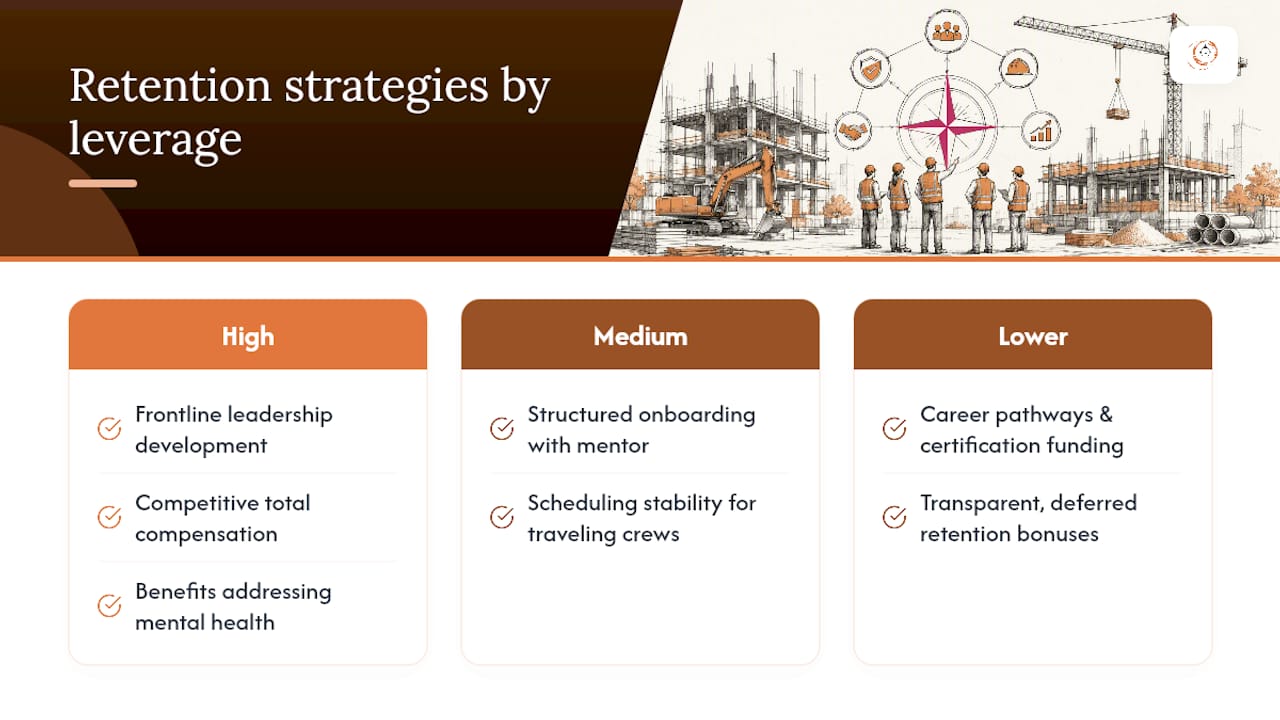
Benefits that address real gaps. Health coverage and retirement contributions matter, but don’t overlook mental health support. Construction workers often wait years before seeking help for stress, substance use, or depression, and that delay carries real workforce risk. Building EAP access and telehealth options into your benefits package addresses a gap most competitors still ignore.
Frontline leadership development. This is the single highest-leverage investment most contractors underfund. Industry consensus is blunt about it: workers leave supervisors, not companies. A foreman who recognizes good work daily, gives clear direction, and handles conflict fairly retains crews that an equally skilled but abrasive foreman loses. Formal supervisory training programs pay off because small behavior changes at the site level compound across every crew that foreman touches.

Onboarding that starts strong. Structured onboarding with a mentor assigned for the first two weeks and a phase-in checklist reduces early turnover measurably. Companies with formal onboarding programs have reported turnover reductions of up to 30% among new hires, largely because new workers stop feeling abandoned on day three.
Scheduling stability, especially for traveling crews. Advance schedules posted two weeks out, fair per diem policies, and single-occupancy lodging for crews on the road are non-obvious levers that reduce churn significantly. Unpredictability is a silent killer of loyalty, particularly for workers managing family obligations around shifting job sites.

Career pathways and certification funding. Cover the cost of OSHA 30 certification, equipment operator licensing, or apprenticeship enrollment, and make the path from apprentice to journeyman to foreman visible on paper, not just in conversation.
Retention bonuses done right. Bonuses only move the needle when they’re transparent, material, and close to the work they reward. Partial deferral over 12 to 24 months increases their retention pull, but workers need to be able to calculate their expected payout themselves. A vague “end of year bonus if things go well” does almost nothing.
Site-level culture. Equitable safety enforcement and visible recognition programs build trust faster than posters in the break trailer. Structured safety management systems reduce incidents, and fewer incidents mean fewer reasons for good workers to walk.
Pro Tip: Ask departing workers one question in the exit interview: “What would your foreman have needed to do differently to keep you here?” The answers cluster fast, and they usually point straight at supervisory training gaps you can fix in a single quarter.
How Do You Measure Retention and Catch Turnover Risk Early?
Retention metrics only work if you calculate them consistently and check them often enough to act.
- Annual turnover rate — divide the number of separations by average headcount, multiply by 100.
- Retention rate — the inverse view: workers who stayed the full period divided by total headcount at the start.
- Average tenure — total time employed across your workforce, tracked by role and by crew.
- Time-to-productivity — how many weeks a new hire takes to hit full output, a number structured onboarding shortens.
- Leading indicators — rising overtime, increased absenteeism, more pay advance requests, and negative stay-interview responses all predict resignations before an exit interview ever happens.
Run a weekly site-level dashboard tracking overtime and absenteeism by crew, then roll it into a monthly report comparing turnover and tenure across projects. Any site trending worse than your company average on two or more leading indicators needs a foreman conversation that week, not next quarter.
A 90-Day Retention Rollout for One Site
You don’t need a company-wide overhaul to start seeing results. Pick one site or crew and run this:
- Weeks 1 to 2: Pull a market wage check for that site’s roles and fix any gap immediately if budget allows.
- Weeks 2 to 4: Run stay interviews with your longest-tenured and highest-risk workers, asking what would make them leave and what would make them stay.
- Weeks 3 to 6: Enroll the site’s foreman in a coaching program focused on daily recognition and clear task communication.
- Weeks 4 to 8: Rebuild the first-30-day onboarding checklist with an assigned mentor and a two-week check-in.
- Weeks 6 to 12: Launch one pilot: a transparent retention bonus, a two-week-advance schedule commitment, or a formal mentoring pairing. Track its target metric weekly.
Pro Tip: Choose only one pilot per site for the first 90 days. Running three changes at once makes it impossible to know which one actually moved the needle when you present results to leadership.
If the pilot moves tenure or drops overtime and absenteeism trends, present the before-and-after numbers to leadership with the replacement cost savings attached, then expand it to two more sites next quarter.
Legal and Regulatory Considerations Affecting Retention
Retention strategy doesn’t operate in a legal vacuum, and a few compliance gaps quietly drive workers out the door. Wage and hour rules under the Fair Labor Standards Act govern overtime calculation for hourly trades workers, and errors here erode trust fast, since workers notice a shorted paycheck immediately. Prevailing wage requirements on public projects under the Davis-Bacon Act also affect how competitive your pay looks on government-funded work compared to private jobs.
Safety compliance carries retention weight beyond avoiding fines. OSHA’s safety management framework gives contractors a structure for integrating safety into daily operations, and sites with weak safety cultures see both higher injury rates and higher voluntary turnover, since workers who feel unsafe leave regardless of pay.
Worker classification matters too. Misclassifying employees as independent contractors to dodge payroll taxes creates legal exposure and denies workers benefits that factor into whether they stay. If your retention bonus structure includes deferred payouts, document the terms clearly. Workers who don’t trust that a deferred bonus will actually arrive treat it as fiction rather than an incentive, which defeats the entire purpose of offering one.
How Company Culture and Engagement Shape Retention
Culture is not a poster in the break room. It’s whether a laborer believes the superintendent will back them up when a schedule gets unreasonable, or whether a foreman plays favorites when overtime gets assigned. Construction culture is built entirely at the site level, one shift at a time, which is exactly why frontline leadership carries more retention weight than almost any other single factor.
Engagement initiatives work when they’re specific to trades work, not borrowed wholesale from office environments. A weekly toolbox talk that opens with a genuine safety win, or a foreman who publicly credits a crew member for catching a mistake before it became a problem, does more for retention than a company newsletter. Recognition that happens close to the work, in front of peers, sticks. Recognition buried in a quarterly email does not.
Equitable enforcement matters as much as recognition. If two workers commit the same safety violation and only one gets written up, every worker on that crew notices, and trust erodes across the whole site, not just for the person disciplined unfairly. Culture problems compound quietly until a good worker resigns and cites something vague like “it just wasn’t a good fit,” when the real answer was inconsistent treatment they watched for months.
Technology and Tools That Support Retention
Field technology earns its place in a retention strategy when it removes friction workers actually feel, not when it adds another app nobody wants to open after a 10-hour shift. Time tracking is the clearest example. Crews working remote or multi-site jobs often deal with unreliable connectivity, and offline time tracking tools built for field teams prevent the paycheck errors and overtime disputes that erode trust fast when workers can’t verify their own hours.
Scheduling software that lets workers see shifts two weeks out on their phone addresses one of the biggest silent turnover drivers directly: unpredictability. When a worker can plan childcare or a second job around a schedule they trust, the schedule itself becomes a retention tool rather than a source of anxiety.
Stay-interview and pulse-survey platforms give you the leading indicators covered earlier without waiting for a formal annual review. A quick five-question check-in every quarter, tracked over time, surfaces the workers drifting toward the door months before they hand in notice.
None of this replaces good supervision. A scheduling app doesn’t fix a foreman who plays favorites, and a time-tracking tool doesn’t build trust on its own. Technology works best when it removes administrative friction so foremen can spend more time coaching and less time chasing paperwork.
What Do High-Retention Contractors Actually Do Differently?
The contractors who hold onto skilled workers longest rarely have one secret tactic. They stack several ordinary practices consistently instead of running one flashy program once a year. Firms that formalize supervisory training programs and track foreman-specific retention outcomes see the pattern clearly: crews under trained foremen stay measurably longer than crews under untrained ones, and the gap widens over time as coached supervisors keep improving.
Firms scaling up crews quickly tend to succeed when they pair aggressive hiring with equally aggressive onboarding investment, treating the first 30 days as make-or-break rather than a formality. Contractors who cross-train workers across multiple trades also report stronger retention, since multi-skilled crews create more advancement opportunities without requiring a promotion to a management title, which matters for workers who want growth without leaving field work behind.
The common thread across these firms is not size or budget. It’s discipline. They measure tenure by crew, they act on leading indicators before resignations, and they treat foreman coaching as a line item worth protecting even when budgets tighten.
What the Field Actually Tells Us
Supervisor training moves the needle more consistently than almost anything else contractors try, and it’s rarely the first thing budgets protect when money gets tight. Realistic job previews during hiring, where candidates hear honestly about schedule demands, travel expectations, and physical intensity before they accept an offer, cut early turnover because nobody feels misled in week two. Prorated placement structures also change hiring incentives in a useful way, since a recruiter only gets paid in full when a placement actually lasts, which keeps everyone focused on fit rather than just filling a seat fast.
[Editorial note: imagery for this section should feature a diverse mix of construction professionals across race and gender, reflecting the workforce contractors actually manage on site.]
— Rowena
How R. Construction Solutions Helps You Retain What You Hire
Retention starts before day one, with who you hire and how much it costs to get them onsite. Constructconnect-rconstructionsolutions runs on a prorated payment structure across the first 90 days, so you’re not writing a full recruiting check for a placement that walks in week six. That structure alone changes the retention conversation, because you and your recruiter both stay focused on long-term fit instead of a quick fill.

This approach fits mid-size general contractors scaling crews fast, teams that need pre-vetted subcontractors and suppliers without months of vetting calls, and HR departments tired of paying full commission on placements that don’t last the season. Lower commission rates than typical staffing firms make the math work even better once you factor in the $4,700 average replacement cost per lost field worker.
If you’re rebuilding a hiring pipeline or need reliable recruiting support that reduces upfront spend, visit the recruiting services page and start a conversation about your next placement.
Sources
- The Real Cost of Construction Turnover — $4,700 Per Worker | Buildermuse
- Construction Workforce Retention Benefits | ABC Rocky Mountain Chapter
- OSHA safety management
- PMC: mental health and workplace interventions
- Building a strong foundation: Proven strategies for employee retention in construction | BerryDunn
FAQ
What Are the 5 C’s of Employee Retention?
Definitions vary across HR sources, but a common version covers compensation, career development, culture, connection, and communication, all factors this article addresses directly for construction crews.
How Long Is Retention Held in Construction?
“Retention” in a payroll or contract context usually refers to withheld payment on a project, typically 5% to 10% of contract value released after substantial completion, which is a separate concept from employee retention rate.
What Is an Acceptable Employee Retention Rate?
Most contractors aim to keep annual turnover below the industry median of 38.2%, and top performers reduce turnover significantly through the leadership and compensation practices covered above.
What Is the Retention Rate in the Construction Industry?
Industry turnover runs high, with a median annual rate of 38.2% reported by AGC, so the corresponding retention rate across the industry is substantially lower than half for many contractors in a typical year.
How Fast Can a Contractor See Results From Retention Changes?
A focused 90-day pilot on one site, covering wage checks, stay interviews, and foreman coaching, typically shows measurable shifts in overtime, absenteeism, and tenure within the first quarter.