
How to Build an Elite Construction Project Team
Building an elite construction project team starts with one decision: define a shared project mission, hire for attitude, and integrate every member through a structured 30/60/90-day plan with mentorship built in. Get those three right, and the rest of the playbook falls into place.
At-a-glance checklist for team formation:
- Mission and project charter written before mobilization
- Role clarity established via RACI mapping
- Hiring screened for attitude and cultural fit first
- 30/60/90-day onboarding plan active from day one
- Project Executive (PX) assigned with people-management ownership
- Pre-vetted subcontractors sourced and reference-checked
- Team Health Assessments scheduled from week two onward
Quick timeline:
- Days 1–30: Assign PX, write mission, complete role charters, run kickoff, begin hiring critical roles
- Days 31–60: Complete onboarding, activate buddy/mentor pairs, run first Team Health Assessment
- Days 61–90: Evaluate early performance, integrate subcontractors into standups, adjust roles where needed
Jacobs recommends four core components for high-performing delivery teams: structure, alignment, behaviors, and connection. Those four elements map directly onto the checklist above.
Key Takeaways
Building an elite construction project team requires a shared mission, role clarity from day one, attitude-first hiring, a structured 30/60/90 onboarding plan, and continuous Team Health Assessments to catch alignment problems before they become schedule problems.
| Point | Details |
|---|---|
| Mission before mobilization | Write and share the project mission before the kickoff meeting, not after. |
| Hire for attitude | Screen behavioral signals first; technical gaps can be trained, character cannot. |
| RACI prevents drift | Map accountability for PM, safety, QA/QC, and procurement before work starts. |
| Team Health Assessments | Run bi-weekly in the first 90 days; act on results within 48 hours to build trust. |
| Constructconnect-rconstructionsolutions | Provides pre-vetted AEC placements with a prorated 90-day fee model and lower commission rates. |
Table of Contents
- What does building an elite project team in construction actually require?
- How do you define roles so your team moves without confusion?
- How do you onboard new hires and subcontractors fast?
- What does a Project Executive actually do to sustain high performance?
- Which tools keep office, field, and subcontractors aligned?
- How do you source and vet subcontractors before they hit the site?
- How do you measure team health and keep improving?
- What does it cost and how long does team assembly take?
- A 10-step checklist to launch your project team in 30 days
- How R. Construction Solutions places the right people faster
- What the field actually teaches you about team formation
- Ready to staff your next project with pre-vetted talent?
- Sources
- FAQ
What does building an elite project team in construction actually require?
Velocity Advisory Group’s guidance is direct: hire for attitude, train for skill. That principle sounds simple, but most hiring panels in construction still weight technical credentials too heavily and behavioral signals too lightly.
For a project executive or senior superintendent, probe for reliability and accountability under pressure. Ask behavioral questions: “Tell me about a time a subcontractor missed a critical milestone. What did you do in the first 24 hours?” For project engineers and foremen, situational questions work better: “Walk me through how you’d handle a concrete pour delayed by a late delivery.” Work-sample checks, such as reviewing a short schedule or a daily log, reveal practical competence faster than any resume.
Red flags to screen out: candidates who blame others exclusively, who cannot name a specific mistake they corrected, or who show no curiosity about the project’s scope.
Pro Tip: Structure your 45–60 minute interview in three blocks: 15 minutes on past behavior (reliability, conflict), 20 minutes on situational judgment (schedule, safety, subcontractor management), and 10 minutes on culture fit and questions the candidate asks you. Candidates who ask sharp questions about team structure and project goals are almost always the ones who perform.
Use a scorecard with defined criteria so every panel member rates the same dimensions. Assign a decision gate: no offer moves forward without sign-off from both the PX and the hiring manager. For role-specific pitfalls, the construction project manager hiring guide covers the most common selection errors GCs make.
How do you define roles so your team moves without confusion?
Firstbit’s playbook is clear: define roles early, involve the team in that definition, and use RACI techniques to prevent duplicated work and missed tasks. The mobilization phase is the right moment, not after the first RFI backlog builds up.
A short role charter for each core position should include:
- Purpose: one sentence on why this role exists on this project
- Key KPIs: schedule adherence, safety incident rate, submittal turnaround
- Decision authority: what this person can approve without escalation
- Escalation path: who they go to and within what timeframe
Map the RACI across five core functions: project management, site supervision, safety, QA/QC, and procurement. Every function gets one Accountable owner. Responsible parties can be shared, but accountability cannot.
Subcontractors belong in this mapping too. When subs know their decision authority and escalation path from day one, you eliminate the most common source of schedule friction: waiting for approvals that nobody knew they owned. Jacobs notes that structure must match governance so decision-making and risk escalation stay rapid on complex programs.

How do you onboard new hires and subcontractors fast?
A 30/60/90-day plan gives every new hire a clear runway. At day 30, the goal is orientation complete: safety training finished, systems access granted, project documents reviewed, and the first deliverable submitted. At day 60, the hire is contributing independently and has completed at least one structured one-on-one with their mentor. At day 90, they are evaluated against their role KPIs and their charter is confirmed or adjusted.
For field hires, assign a buddy from the existing crew on day one. For office hires, pair them with a senior PM or project engineer for the first two weeks. The buddy’s job is not to train technically; it is to answer the questions new hires are reluctant to ask in a group setting.
A first-week agenda should include: site walk with the superintendent, safety orientation, Procore or equivalent platform access, review of the project schedule, and a one-on-one with the PX. For a reproducible template, the project manager onboarding guide provides a detailed checklist you can adapt for any role.
Subcontractor onboarding follows the same structure. Bring sub foremen into the project charter review, include them in the first standup, and confirm their escalation path in writing before mobilization.
What does a Project Executive actually do to sustain high performance?
Procore frames the PX role as fundamentally people-focused: hiring, developing, and sustaining team culture are the core responsibilities, not just schedule and budget oversight. That framing matters because PXs who treat people management as secondary consistently produce teams that underperform in the back half of a project.
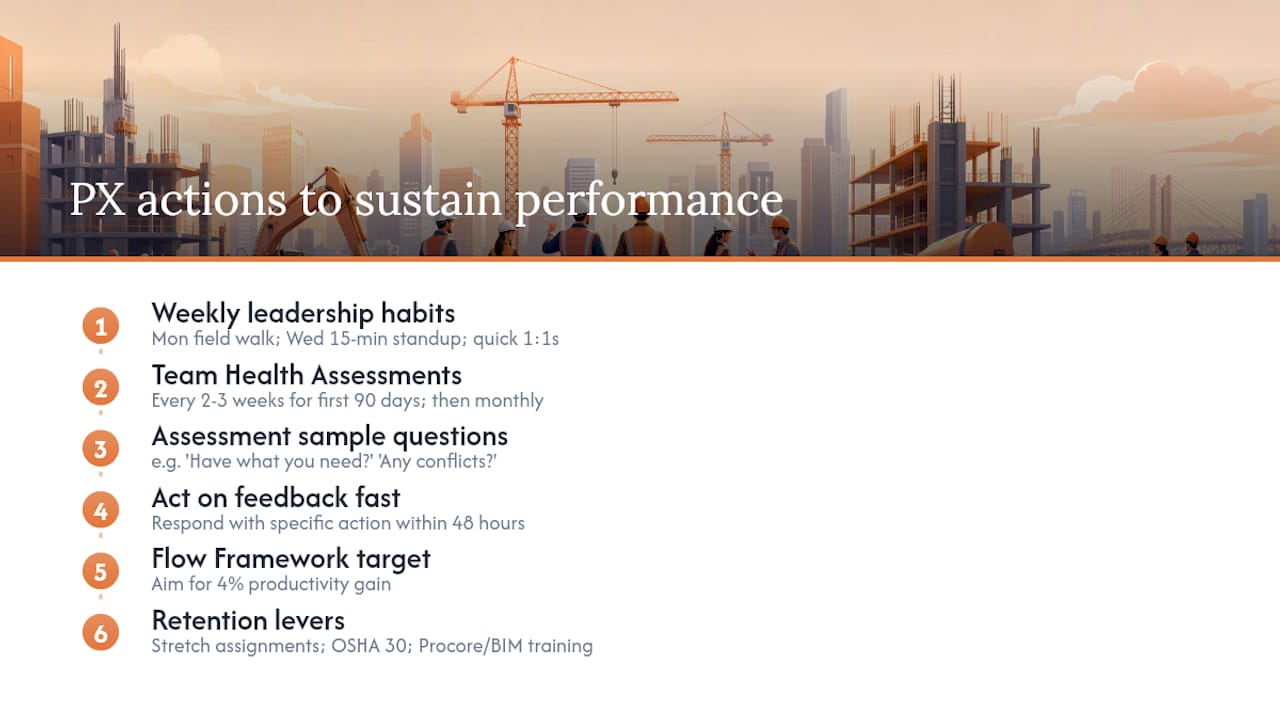
Weekly leadership habits that work: field walkarounds every Monday morning, a 15-minute standup with the PM and superintendent mid-week, and brief one-on-ones with any team member showing early signs of disengagement.
JE Dunn’s experience with Team Health Assessments shows that regular check-ins provide real-time insight into morale, trust, and alignment, and that deliberate relationship-building accelerates teams from forming to performing. Run a Team Health Assessment every two to three weeks in the first 90 days, then monthly. Sample questions: “Do you have what you need to do your job this week?” and “Is there a conflict or confusion on the team that leadership should know about?”
Pro Tip: When a Team Health Assessment surfaces a morale dip, address it in the next standup with a specific action, not a general acknowledgment. Teams that see their feedback acted on within 48 hours report higher trust scores in the following assessment.
JE Dunn also highlights the Flow Framework mindset: targeting small, consistent productivity improvements, with a 4% productivity gain as a practical continuous-improvement benchmark. That is a realistic, measurable goal for any project team.
Retention levers that work: stretch assignments tied to the next project, OSHA 30 certification support, and targeted training in Procore or BIM tools. Recognition does not require budget; a specific, public acknowledgment of a foreman who caught a safety issue is more effective than a generic team lunch.
Which tools keep office, field, and subcontractors aligned?
The core tool stack for a high-performing construction team covers four categories: a PM platform (Procore is the most widely adopted in North America), a BIM coordination tool for design-heavy projects, a field reporting app, and a document control system.
The single most important configuration rule is one source of truth. Every RFI, submittal, and change order lives in one place. Naming conventions matter: a file named “CO-007_Rev2_Approved” is findable; “final_final_CO copy” is not.
Set channel rules early: urgent safety or schedule issues go to a direct call or text, not a project management thread. Non-urgent coordination stays in the platform. This prevents the inbox collapse that buries critical information under routine updates.
For construction task management at the field level, tools that allow daily log updates from mobile devices reduce the reporting lag that distorts schedule tracking. Designate one champion per trade to enforce platform adoption, and run a 30-minute training session in week one.
How do you source and vet subcontractors before they hit the site?
Pre-qualification is not optional on a high-performing team. A reliable vetting checklist covers:
- Safety record: EMR (Experience Modification Rate) below 1.0 is a standard threshold
- References: at least three verified contacts from comparable project types
- Bonded and insured status: confirmed in writing before bid acceptance
- Capacity validation: confirm they are not overcommitted on concurrent projects
- Past performance: verified schedule adherence and punch-list closure rates
Run pre-qualification in parallel with bid evaluation, not after. Waiting until award to check references adds two to three weeks to mobilization.
Contract clauses that align incentives: tie payment milestones to schedule performance, include liquidated damages for critical-path delays, and offer incentive credits for early completion of key phases. Subs who share in the upside perform differently than those who are purely penalty-driven.
Once awarded, bring subcontractors into the team charter and the first standup. Jacobs emphasizes that connection and shared identity are as important as structure when teams come from multiple organizations. A sub foreman who knows the project mission and the escalation path is a team member. One who only knows their scope is a vendor.
For sourcing pre-vetted project teams when your internal network falls short, a specialized AEC recruiting and sourcing firm shortens the vetting cycle significantly.
How do you measure team health and keep improving?
| KPI | Target / Threshold | Owner | Cadence |
|---|---|---|---|
| Team sentiment score | Above 7/10 on health assessment | PX | Bi-weekly |
| Schedule variance | Within 5% of baseline | PM | Weekly |
| Safety incident rate | Zero recordables | Superintendent | Daily |
| Subcontractor turnaround | RFI response within 48 hours | PM | Weekly |
| Punch-list closure rate | 90% closed before substantial completion | QA/QC lead | Monthly |
Run a retrospective at the end of every major phase: what worked, what slowed us down, and what one change would have the biggest impact next phase. Keep it to 45 minutes. Prioritize no more than two improvement actions per cycle, assign an owner, and review progress at the next retrospective.
What does it cost and how long does team assembly take?
Mobilization timelines split into two tracks. Rapid mobilization (under 30 days) is achievable when a PX is pre-assigned, role charters are templated from a prior project, and subcontractors are sourced from a pre-vetted network. Standard mobilization runs 45–75 days when hiring starts from scratch and subcontractors require full pre-qualification from zero.
| Factor | Rapid Mobilization | Standard Mobilization |
|---|---|---|
| Timeline | Under 30 days | 45–75 days |
| Recruiting approach | Pre-vetted network or AEC recruiter | Open market search |
| Onboarding readiness | Templates in place | Built from scratch |
| Sub sourcing | Pre-qualified roster | Full pre-qualification cycle |
| Primary cost driver | Recruiter placement fee (prorated) | Overtime, productivity loss, rework |
The largest hidden cost in standard mobilization is not the recruiting fee. It is the productivity loss from a team that takes several weeks to reach full output. Investing in a specialized AEC recruiter with a prorated commission model often costs less than two weeks of schedule delay. Construction recruiting cost strategies covers the cost-benefit math in detail.
A 10-step checklist to launch your project team in 30 days
- Assign the PX (Day 1) — PX owns all subsequent steps; no delegation without a named backup.
- Write the project mission (Days 1–3) — One paragraph, shared with every team member before kickoff.
- Complete role charters (Days 1–5) — PX and PM draft; team reviews and signs off.
- Build the RACI (Days 3–7) — Cover PM, site supervision, safety, QA/QC, and procurement.
- Hold the project kickoff (Day 7) — All core staff and sub foremen present; mission and charters reviewed.
- Activate 30/60/90 onboarding plans (Days 1–7) — One plan per new hire; buddy assigned on day one.
- Hire critical open roles (Days 1–21) — Use a pre-vetted AEC recruiting source for speed; project engineer recruiting is often the longest lead-time position.
- Configure the PM platform (Days 5–10) — Naming conventions, channel rules, and access granted.
- Run the first Team Health Assessment (Day 14) — Baseline morale and alignment before habits form.
- Review and adjust (Day 30) — PX reviews all charter KPIs, addresses any morale flags, confirms sub integration.
How R. Construction Solutions places the right people faster
Constructconnect-rconstructionsolutions provides recruiting, sourcing, and business-opportunity matchmaking specifically for the AEC industry, covering office staff, field personnel, and pre-vetted subcontractor and supplier connections. With 30+ years of industry experience, the team understands what separates a reliable superintendent from one who looks good on paper.
The engagement process is straightforward: intake call to define the role and project context, shortlist of pre-vetted candidates within days, reference and credential verification, placement, and a prorated 90-day payment structure so you pay for performance, not promises. Commission rates run lower than standard agency models, and the prorated structure means your fee scales with the hire’s tenure.
For AEC recruiting services or subcontractor and supplier sourcing, Constructconnect-rconstructionsolutions is the direct route to a vetted shortlist without the overhead of a full agency retainer.
Contact Constructconnect-rconstructionsolutions to schedule a discovery call and receive a shortlist within your project’s mobilization window.
What the field actually teaches you about team formation
Most project teams fail not because of a bad hire but because of a rushed formation. The pressure to mobilize fast pushes PXs to skip the mission conversation, hand out role charters as paperwork rather than working documents, and defer the first Team Health Assessment until something goes wrong.
The diversity question deserves a direct answer: teams that include women, people of color, and workers from varied trade backgrounds consistently surface problems earlier and solve them faster. That is not a theoretical claim; it is what happens when a team has enough different perspectives to catch what a homogeneous group normalizes. Building cross-functional teams that integrate field, office, and subcontractor roles, with genuine representation across race and gender, is a performance strategy, not a compliance exercise.
One practical caution: watch the first 30 days for the hire who is technically competent but subtly undermines team norms. They rarely announce themselves. They show up in the health assessment as a pattern: one or two team members consistently rating trust lower than everyone else. Act on that signal before day 45.
Ready to staff your next project with pre-vetted talent?
Constructconnect-rconstructionsolutions gives general contractors and AEC firms a faster path to qualified project staff and verified subcontractors than an open-market search. The prorated 90-day payment model means your recruiting cost is tied to a hire who stays and performs, not a placement that walks in week three. Lower commission rates than standard agencies, 30+ years of AEC-specific network depth, and a process built around your project timeline rather than a generic staffing cycle.
Start with a discovery call. Constructconnect-rconstructionsolutions will scope your open roles, confirm your mobilization timeline, and deliver a pre-vetted shortlist. Visit the AEC recruiting services page or the main sourcing hub to begin.
Sources
- Delivering critical infrastructure programs: 4 ways to build high-performing teams | Jacobs
- Why Building a High-Performing Team Matters | JE Dunn Construction
- How to Build a High-Performing Project Team in the Construction Industry | Velocity Advisory Group
- Building a High-Performing Team in Construction: Effective Strategies
FAQ
How long does it take to assemble a high-performing construction project team?
Rapid mobilization using a pre-vetted network takes under 30 days. Standard mobilization from an open-market search typically runs 45–75 days.
What is a Team Health Assessment in construction?
A Team Health Assessment is a short, structured survey run every two to three weeks to measure morale, trust, and alignment. JE Dunn reports that regular assessments provide real-time insight and accelerate teams from forming to performing.
What does a Project Executive do differently from a Project Manager?
The PX owns hiring, culture, and conflict resolution across the full project portfolio, while the PM manages day-to-day schedule and budget. Procore frames the PX role as primarily people-focused.
How does Constructconnect-rconstructionsolutions differ from a general staffing agency?
Constructconnect-rconstructionsolutions focuses exclusively on AEC roles, offers lower commission rates, and uses a prorated 90-day payment model so clients pay for placements that hold, not just placements that start.
What is the most common reason construction teams underperform?
Rushed formation: skipping the mission conversation, assigning roles without charters, and deferring Team Health Assessments until a problem is already visible.

