
What Subcontractor Sourcing Firms Do for GCs
Subcontractor sourcing firms shorten your bid-to-award timeline, cut change-order rates, and put a verified safety and compliance record behind every trade partner on your job. The main benefits subcontractor sourcing firms give GCs break down into five buckets: faster preconstruction, tighter vetting, fewer budget surprises, cleaner coordination across trades, and standing capacity when a trade partner falls through.
Here’s what that looks like on an actual project:
- Faster schedules — bid leveling and pre-built trade databases cut days off preconstruction.
- Verified compliance — licenses, insurance, and safety records get checked before a name ever reaches your desk.
- Fewer change orders — scope gaps get caught during pre-award review, not after mobilization.
- Single point of coordination — one workflow tracks assignments instead of scattered emails and texts.
- Backup capacity — a standing bench of vetted trades means fewer scrambles when someone no-shows.
Pro Tip: Ask any sourcing firm you’re evaluating to show you a sample verification file, not just a sales deck. If they can’t produce a real example of a license check, insurance certificate, and OSHA record on file, they’re brokering, not vetting.
Key Takeaways
Subcontractor sourcing firms deliver their biggest value by combining faster bid leveling, systematic compliance verification, and centralized performance tracking into one accountable workflow.
| Point | Details |
|---|---|
| Speed gains concentrate on complex jobs | Multi-trade commercial builds see the largest timeline benefit; single-trade jobs see less. |
| Vetting reduces safety exposure | License, insurance, and OSHA-aligned safety checks happen before award, not after. |
| Change orders drop with pre-award review | Normalized bid comparison catches scope gaps before they become disputes. |
| Fee models vary by engagement type | Contingency, percentage-of-value, and subscription models each fit different project sizes. |
| R. Construction Solutions offers prorated, lower-commission sourcing | 30+ years connecting GCs to pre-vetted subs and staff, paid only on successful placement. |
Table of Contents
- Benefits of Subcontractor Sourcing Firms for GC Timelines
- Vetting, Compliance, and Safety: What Sourcing Firms Actually Verify
- How Sourcing Firms Cut Change Orders and Protect Budgets
- Coordination That Runs Through One Workflow, Not Ten Inboxes
- Fee Models, ROI, and What Payback Actually Looks Like
- How to Evaluate and Choose a Subcontractor Sourcing Firm
- What Real Sourcing Engagements Actually Deliver
- Simplifying Communication Across Trades on Multi-Sub Projects
- Accountability: Who Owns a Problem When Something Goes Wrong
- Where Sourcing Firms Fall Short and How to Manage It
- Work With R. Construction Solutions on Your Next Sourcing Need
- Sources
- FAQ
Benefits of Subcontractor Sourcing Firms for GC Timelines
Sourcing firms shrink the gap between “we need a sub” and “we have a signed sub” by replacing manual bid comparison with structured, repeatable workflows. That gap is where most preconstruction time disappears, and it’s the first place a sourcing partner earns its fee.
The mechanics are straightforward. Instead of an estimator manually reading 30 PDF bids line by line, a sourcing firm normalizes those bids against a common scope template, flags exclusions, and surfaces the outliers that need a phone call. Centralized subcontractor registries mean the firm already knows which drywall crews are licensed in your state, bonded to your project size, and available in your timeframe, so outreach isn’t cold.
One case summary found AI-assisted bid leveling can read and normalize 50 subcontractor bids into a decision-ready comparison in 30 to 45 minutes, work that traditionally consumes several estimator days.
Where the payoff is biggest:
- Multi-trade commercial builds with 15 or more trade packages, where bid volume alone overwhelms manual review.
- Projects entering new markets, where the GC has no existing sub relationships to lean on.
- Fast-track schedules, where mobilization delays of even a week carry real cost.
Single-trade residential jobs or small tenant improvements see smaller gains. When you already know your three go-to electricians, a sourcing firm adds less value than it does on a ground-up hospital wing with 22 trade packages running in parallel.
Vetting, Compliance, and Safety: What Sourcing Firms Actually Verify
Sourcing firms reduce your safety and compliance exposure by systematically checking licenses, insurance, and safety history before a subcontractor ever bids your work, not after they’re already on-site causing problems.
A professional prequalification process typically covers:
- Active state and local contractor licenses, cross-checked against your project’s jurisdiction.
- Certificates of insurance, including general liability and workers’ comp, with expiration dates tracked.
- Bonding capacity relative to project size.
- Safety history and training records, often benchmarked against OSHA standards.
- Trade-specific certifications (welding certs, crane operator licenses, EPA lead-safe certification, and similar).
Pro Tip: Build your service-level agreement to require insurance certificates updated at least 30 days before expiration, not on the expiration date itself. A sub whose coverage lapses mid-project is a liability you inherit, and a 30-day buffer gives you time to react.
The strongest sourcing firms back this up with visible trust signals: client project portfolios you can call and check, documented verification workflows rather than a one-time phone screen, and safety scorecards that track a sub’s incident history over multiple jobs. One prequalification case study reported building a 317-subcontractor trade partner database with automatic license verification in 48 hours, versus the two weeks that process traditionally takes.

How Sourcing Firms Cut Change Orders and Protect Budgets
Sourcing firms reduce post-award scope disputes and change orders by catching exclusions during pre-award bid review, before the number is locked into a subcontract.
Normalized bid comparison is the mechanism. When every bid gets mapped against the same scope template, missing line items (temporary protection, cleanup, permit fees) show up as gaps instead of surprises three weeks into the job. Prequalification also screens out subs likely to default mid-project, which is its own budget risk since a contractor default often costs more than a slightly higher bid would have.
A construction case study reported that centralizing subcontractor records and certificate monitoring prevented roughly CAD $28,200 in waste tied to rework, insurance lapses, and scheduling conflicts, against a monthly software cost of CAD $260. That’s the shape of the return you should expect: modest ongoing cost, concentrated savings from problems that never happened.
Pro Tip: Negotiate a small retainage holdback tied to punch-list completion into every subcontract your sourcing firm sets up, not just your prime contract. It protects your margin without needing to invoke the sourcing firm at all.
What to measure over two or three projects:
- Change-order rate as a percentage of original contract value.
- Average days from RFI submission to resolution.
- Rework hours logged against subcontractor error versus design change.
Coordination That Runs Through One Workflow, Not Ten Inboxes
Centralized sourcing gives you a single point of assignment and a recorded decision trail instead of parallel email threads with a dozen trade contacts.
That single-point structure shows up in a few concrete features:
- Posting portals where a scope goes out once to a filtered pool of qualified subs instead of a round of individual calls.
- Applicant pipelines that log who responded, when, and with what pricing.
- Assignment actions where accepting a bid automatically updates status for every other party in the pipeline, so no one is left wondering if they lost the bid.
- Integrations with the project management tools you already run, so subcontractor data lands in the same place as your schedule and budget.
One case example of a GC-built sourcing portal found that publicly posting a scope and collecting applications through a visible pipeline cut outreach effort and made the whole selection process auditable after the fact, which matters if a losing bidder ever questions how the award was made.
Pro Tip: Before signing with a sourcing firm, confirm their platform can export or sync subcontractor data into whatever scheduling and PM software you already use. A sourcing tool that creates a second, disconnected system is a coordination cost, not a coordination fix.
Trade Capacity and Scheduling Reliability When You Need a Sub Fast
Sourcing firms expand your access to available trade capacity and improve the odds that a booked sub actually shows up when scheduled.
They manage this through standing subcontractor databases segmented by trade and geography, response-rate tracking that flags which subs reliably answer outreach, and rapid-dispatch pipelines built for exactly this situation. One prequalification case reported subcontractor response rates climbing from 20% to 68% after moving to a structured outreach system.
- For common trades in a covered market, expect coverage within days.
- For specialty trades or remote geographies, expect a multi-week lead time even with a sourcing firm involved.
Fee Models, ROI, and What Payback Actually Looks Like
The most common fee structures are contingency-based placement fees, a percentage of subcontract value, flat sourcing fees per project, and monthly subscription access to a vetted trade database. Contingency models dominate staffing placements; percentage-of-value fees are more common on sourcing engagements tied to subcontract awards.
A simple ROI formula you can run internally: (estimator hours saved × loaded labor rate + avoided rework cost) divided by annual sourcing fees equals payback in months. If a firm saves your team 40 estimator hours a month at a $65 loaded rate, that’s $2,600 monthly in recovered capacity before you even count avoided change orders.
Cost drivers worth watching:
- Scope complexity — more trade packages mean more verification work, which can raise fees.
- Geographic reach — sourcing subs across multiple markets costs more than one metro.
- Number of trades covered — a firm that only handles three trades won’t move your whole preconstruction timeline.
Pro Tip: Ask for SLA-based fee credits tied to missed response times or verification delays. A firm confident in its process will agree to it; one that hesitates is telling you something.
When It Makes Sense to Bring in a Sourcing Firm
The ROI is highest when your internal team is stretched thin relative to bid volume, when you’re entering a market you haven’t built relationships in, or when a specialty trade shortage threatens your schedule.
Common trigger scenarios:
- Market expansion — you’re bidding work in a region where you have no established sub base.
- Bid-volume spikes — your estimating team is buried under more packages than they can level manually.
- Specialty-trade shortages — a crane operator, curtain wall installer, or fire protection sub is scarce in your area.
- Emergency staffing — a sub defaults mid-project and you need coverage fast, not in three weeks.
The difference from DIY sourcing shows up fastest in emergencies: a GC calling personal contacts after a mid-project default might spend a week finding coverage, where a firm with a standing database can often present qualified options within days.
How to Evaluate and Choose a Subcontractor Sourcing Firm
Prioritize firms with verified pipelines, real integration capability, documented performance tracking, and SLAs you can hold them to. Vague promises about a “large network” without evidence of verification are the biggest red flag in this category.
Run through this checklist during vendor selection:
- What is their exact service scope: full sourcing, vetting only, or vetting plus ongoing management?
- What verification methods do they use, and can they show you a sample scorecard?
- What are their SLA response times for a standard trade versus a specialty or emergency request?
- Can their platform integrate with or export to your existing project management software?
- Will they provide client references and let you speak with a current GC customer?
- Is their pricing model transparent, and does it match one of the standard fee structures above?
Look for these signals as evidence of a serious operation:
- Documented prequalification workflows, not a one-page questionnaire.
- Client portfolios with named projects you can verify independently.
- Clear scope-of-work templates that define inclusions and exclusions before a bid goes out.
Red flags that should end the conversation quickly:
- No client references offered, or references that seem scripted.
- Manual-only verification with no certificate-tracking system.
- No process for tracking insurance or license expirations over the life of a project.
- Pricing that shifts or gets vague once you ask direct questions.
For groundworks and civil trades specifically, a structured technical reference guide for subcontractor selection is a useful benchmark for how detailed a vetting checklist should get before you trust a sourcing firm’s judgment on your behalf.
What Real Sourcing Engagements Actually Deliver
Sourcing firms convert scattered, memory-based subcontractor knowledge into a documented company asset, which matters more than most GCs expect until the person who “knows all the good electricians” retires or leaves.
That risk is common enough to have a name in the industry: practitioners sometimes call it the “Ray problem,” after the one senior PM everyone relies on for sub recommendations. Many GCs manage 15 to 25 trades on a single commercial project, all tracked in one person’s head instead of a shared system.
A documented subcontractor registry preserves institutional knowledge and prevents service disruption when long-tenured staff leave, turning individual expertise into a resource the whole company can use.
One case example reported a 48-hour database build replacing what typically took two weeks, alongside measurable savings from centralized certificate tracking. Onboarding a sourcing service well means exporting your current sub list and any performance notes you already have, then assigning one internal owner (usually a preconstruction or operations lead) to keep the relationship active rather than treating it as a one-time setup.
Simplifying Communication Across Trades on Multi-Sub Projects
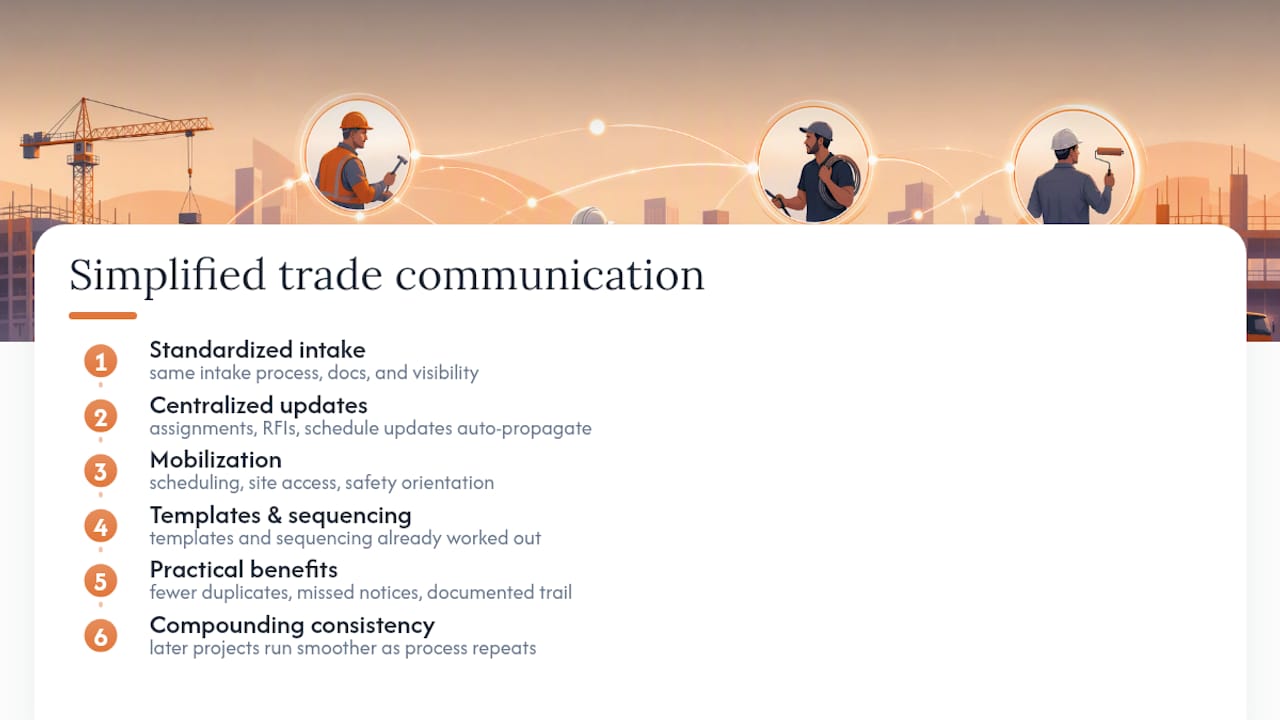
Coordinating 15 to 25 trades on a single commercial job creates a communication load that scales faster than most scheduling software accounts for. Sourcing firms address this by giving every trade partner the same intake process, the same documentation standard, and the same status visibility, which removes a huge amount of the friction that comes from each sub operating on its own communication habits.
Instead of your project manager fielding calls from twelve different subs asking for the same schedule update, a structured sourcing workflow pushes updates through one system that every party can see. Assignment status, RFI responses, and schedule changes propagate automatically rather than depending on someone remembering to forward an email.
This matters most during mobilization, when a dozen trades are trying to get scheduling confirmation, site access details, and safety orientation information at the same time. A sourcing firm that has already run this process hundreds of times has templates and sequencing worked out. A GC running it manually for the first time on a given project size is improvising.
The practical benefit shows up in fewer duplicate questions, fewer missed notifications about schedule slips, and a documented trail if a dispute ever arises about who was told what and when. That paper trail alone has settled more than a few payment disputes before they became legal ones. For GCs juggling subcontractor onboarding across multiple simultaneous projects, that consistency compounds. The tenth project runs smoother than the first, not because the trades are different, but because the intake process is the same every time.
Accountability: Who Owns a Problem When Something Goes Wrong
Quality control on a multi-sub project depends on knowing exactly who is responsible for a given outcome, and sourcing firms improve this by attaching a documented performance record to every subcontractor they place rather than leaving accountability as a verbal understanding.
Single-point responsibility means the sourcing firm, not a scattering of individual introductions, stands behind the vetting that put a sub on your job. If a trade partner underperforms, there’s a documented history: prior job performance, response reliability, and any safety flags from earlier placements. That history is worth far more after a problem than a reference call would have been before one.
Performance tracking works best when it’s ongoing rather than a one-time prequalification snapshot. A subcontractor’s insurance can lapse six months into a two-year job. A crew that performed well on a small job might struggle on a larger one. Firms that track performance across projects, not just at intake, catch these shifts before they become your problem.
The practical version of accountability looks like a scorecard: on-time delivery rate, punch-list closure time, safety incidents, and responsiveness to RFIs, tracked per subcontractor across every project they’ve worked with a given GC. That data turns “I think this sub is reliable” into a defensible business decision, and it gives you leverage in the next negotiation. A sub with a documented track record of clean punch-list closures has earned the right to skip some of the scrutiny a new, unproven trade partner still needs.
Where Sourcing Firms Fall Short and How to Manage It
Sourcing firms are not a substitute for your own project judgment, and treating them as a fully hands-off solution is the most common mistake GCs make with this service.
The real limitations worth planning around:
- Verification lag on fast-moving markets. A trade database is only as current as its last update. A sub that looked solid six months ago might have taken on too much work since. Ask how often the firm refreshes its records, not just how it built them initially.
- Local knowledge gaps. A sourcing firm entering a new geography for you doesn’t have the years of local reputation a GC who’s worked that market for a decade has. Use their speed to build the shortlist, then apply your own judgment to the final call, especially on specialty trades.
- Integration friction. Not every sourcing platform plays well with every project management tool. Confirm data compatibility before signing, not after your team has already built workflows around it.
- Fee misalignment on small jobs. A percentage-of-value fee model that makes sense on a $4 million build can feel disproportionate on a $400,000 tenant improvement. Match the fee structure to the project size before committing.
None of these are reasons to skip a sourcing firm. They’re reasons to keep your own preconstruction team engaged in reviewing the shortlist a sourcing firm produces, rather than rubber-stamping whatever name comes back first.
A GC’s Bottom Line on Sourcing Firms
If your team is drowning in bid volume or you’re bidding blind in a new market, a pilot engagement on one project is worth the risk. I’d rather see a GC test a sourcing firm on a mid-size job with real stakes than on a throwaway project where a bad match teaches nothing.
Pro Tip: Run your pilot on a project with at least eight trade packages so you get a real read on the firm’s coverage and response speed, not a false positive from a simple scope.
Work With R. Construction Solutions on Your Next Sourcing Need
If the friction points in this article sound familiar, that’s exactly what R. Construction Solutions was built to solve. Unlike sourcing firms that lock you into flat retainer fees regardless of results, R. Construction Solutions uses a prorated payment structure spread over the first 90 days, so you’re paying for placements that actually stick, not just a name on a shortlist.

With more than 30 years in AEC recruiting and sourcing, R. Construction Solutions connects GCs with pre-vetted subcontractors, suppliers, and equipment rental partners, alongside placement for office staff and field personnel. Every connection comes with lower commission rates than most competitors charge, and you only pay when a placement succeeds. Marketing materials across the industry tend to show the same narrow slice of who works in construction; R. Construction Solutions builds its imagery and client materials to reflect the actual diversity of the AEC workforce it places every day.
If you’re facing a bid-volume crunch, a market expansion, or a trade shortage on an active job, visit the recruiting services page and start a conversation about your specific staffing or sourcing gap.
Sources
- OSHA
- AI for Construction Procurement: From 50 Sub Bids to a Decision in 30 Minutes — Mirage Metrics
- Streamlining Subcontractor Prequalification: How AI-Powered Solutions Built a Trade Partner Database in 48 Hours vs. 2 Weeks - Palcode ai
- Subcontractor Matching Agent: $28K in Waste Prevented | Construction
FAQ
Do GCs hire subcontractors, or does someone else?
General contractors directly hire and manage subcontractors for specific trades, while sourcing firms like R. Construction Solutions help GCs find, vet, and place those subcontractors faster and with verified credentials.
What are the benefits of being a subcontractor placed through a sourcing firm?
Subcontractors get access to more consistent bid opportunities, faster payment cycles tied to clearer scopes of work, and a documented performance record that helps them win future work with the same GC.
How much does a GC typically charge per hour?
Hourly billing rates for GCs vary widely by region, project type, and overhead structure, and no single national figure applies; GCs typically build markup into subcontract pricing rather than billing a flat hourly rate.
How much do general contractors make off subcontractors?
GCs typically earn a markup on subcontracted work, often built into the overall project fee rather than itemized per sub, and that margin depends heavily on project complexity, risk, and how well change orders are controlled during execution.

