
What Does a Construction Administrator Do?
A construction administrator (CA) is the design-side professional responsible for ensuring that what gets built matches the approved drawings, technical specifications, and contract terms. On most North American commercial projects, the CA represents the owner’s interests in contract enforcement while serving as the primary communication link between the design team and the contractor. The core duties fall into five recurring categories:
- Processing and logging RFIs (Requests for Information)
- Reviewing and approving material submittals
- Verifying and certifying monthly pay applications against the schedule of values
- Conducting and documenting field observation visits
- Tracking change orders, lien waivers, and certificates of insurance (COIs)
Effective CA work is fundamentally about risk mitigation and design intent. When a CA is doing the job well, costly rework stays rare, change-order disputes get resolved on documented facts, and project closeout happens without last-minute scrambles for missing warranties or final lien waivers.
Table of Contents
- What does a construction administrator do every day?
- How CA responsibilities shift across project phases
- How a CA differs from a CM, architect, and owner’s rep
- Skills and qualifications that strong CA candidates bring
- Sample job description elements and career path guidance
- Which software tools do construction administrators rely on?
- When should an owner hire a construction administrator?
- Evidence-based benefits of effective construction administration
- Key Takeaways
- The CA role is underused, and that gap is costing owners money
- R. Construction Solutions places qualified CA talent for AEC firms
- Useful sources and further reading
- FAQ
What does a construction administrator do every day?
The daily workload of a CA is built around document control and communication. Every task either generates a record or responds to one, and the quality of those records determines how well the project is protected.
Here are the core recurring responsibilities, in the order they typically flow through a project week:
-
Receive and log RFIs. When a contractor or subcontractor encounters a design ambiguity in the field, they submit an RFI. The CA receives it, assigns a tracking number, routes it to the architect or engineer of record for a technical response, and monitors the response deadline. On a large commercial project with 40 or more subcontractors, missed RFI response deadlines can create legitimate contractor delay claims the owner may be obligated to pay.
-
Review submittals. Submittals include shop drawings, product data sheets, and material samples. The CA reviews each one against the contract documents, stamps it (Approved, Approved as Noted, Revise and Resubmit, or Rejected), and logs the action. Turnaround time matters: a submittal stuck in review can hold up procurement and delay the schedule.
-
Process pay applications. Each month, the general contractor submits a pay application tied to the schedule of values (SOV). The CA verifies that the percentage of completion claimed for each line item is accurate, checks that required lien waivers and COIs are attached, and certifies the amount for the owner to pay. Retainage, commonly held at a portion of each payment, is tracked and released at closeout.
-
Conduct site observation visits. The CA visits the site at intervals defined in the contract, observes work in progress, and prepares a written field observation report. These reports document what was seen, any nonconforming work identified, and any verbal direction given. They are not inspections in the code-enforcement sense; they are contract-compliance checks.
-
Review and audit change orders. When scope changes arise, the contractor submits a change-order proposal with cost backup. The CA audits that backup carefully. Contractors sometimes include “add” alternates without corresponding to deduct offsets, and an experienced CA catches those discrepancies before the owner signs.
-
Distribute drawing revisions. When the design team issues revised drawings or specification sections (ASIs, Architect’s Supplemental Instructions, or RFI responses), the CA manages distribution to the contractor and updates the document log.
-
Record meeting minutes. The CA typically chairs or attends the weekly owner-architect-contractor (OAC) meeting, records minutes, assigns action items, and distributes the record within 24–48 hours.
Pro Tip: Require your CA to maintain a live RFI log, submittal log, and change-order log in a shared platform from day one. Owners who wait until a dispute arises to request these logs often find them incomplete or inconsistent.

How CA responsibilities shift across project phases

Construction administration does not start when the contractor breaks ground, and it does not end at substantial completion. Understanding the phase structure helps owners write better contracts and avoid coverage gaps.
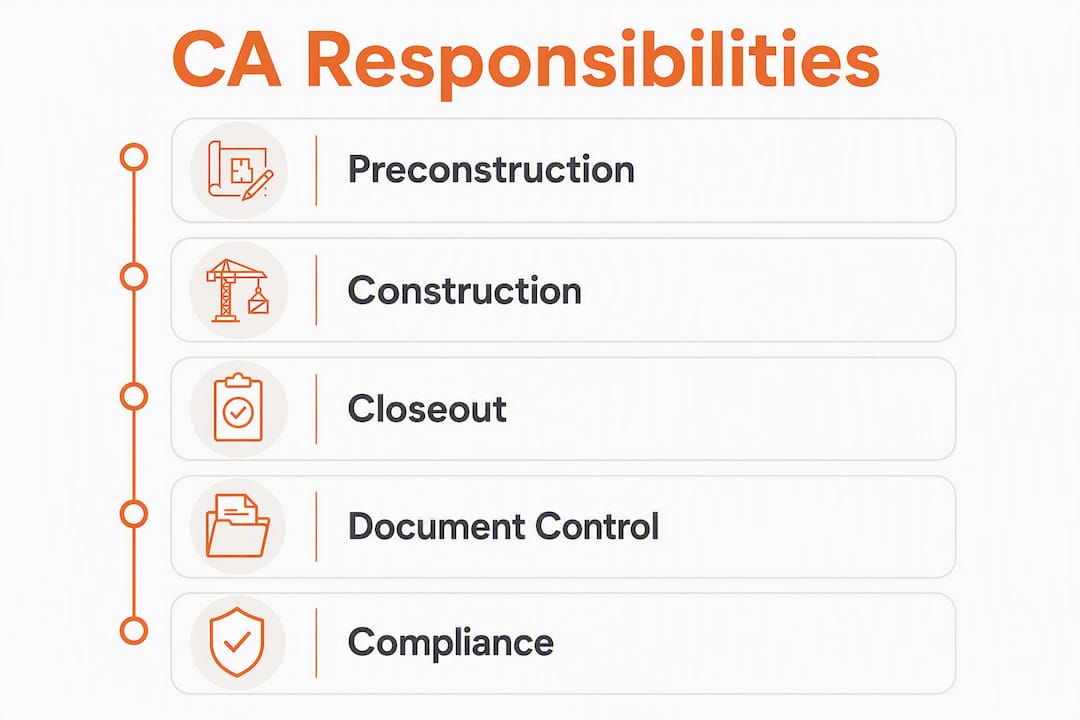
| Phase | Key CA Activities | Critical Deliverables |
|---|---|---|
| Preconstruction | Review contract documents for coordination issues; confirm COIs and SOV format; attend pre-construction meeting | Approved SOV, executed COIs, pre-construction meeting minutes |
| Construction | Process RFIs, submittals, pay applications; conduct site observations; track change orders; distribute drawing revisions | Certified pay applications, field observation reports, RFI/submittal logs, change-order log |
| Substantial Completion | Conduct punch-list walk; issue Certificate of Substantial Completion; confirm TCO/CO requirements with AHJ | Punch list, Certificate of Substantial Completion, TCO/CO documentation |
| Closeout | Collect O&M manuals, warranties, as-built drawings, final lien waivers; release retainage; confirm 1-year contractor warranty period | Closeout package, final lien waivers, warranty letters, retainage release |
The closeout phase is where CA coverage most often falls short. Building the closeout package incrementally during construction, rather than chasing documents after the contractor has demobilized, is one of the highest-value habits a CA can develop. Your contract should explicitly require CA services through final payment and warranty period activation, not just through substantial completion.
The project lifecycle role of the CA connects directly to how project managers hand off deliverables at each phase milestone.
How a CA differs from a CM, architect, and owner’s rep
These four roles overlap enough to cause real confusion on project teams, and contract gaps at those overlaps are where disputes originate.
| Role | Primary Focus | Who They Represent | Typical Contract Relationship |
|---|---|---|---|
| Construction Administrator (CA) | Contract compliance, design intent, documentation | Owner (design-side) | Architect’s contract or separate CA contract with owner |
| Construction Manager (CM/GC) | Schedule, budget, trade coordination, site execution | Contractor/self | Prime contract with owner |
| Architect | Design, technical interpretation, code compliance | Owner (design lead) | Design services contract |
| Owner’s Representative | Owner advocacy, budget oversight, stakeholder management | Owner (client-side) | Direct contract with owner |
CA is a design-side function focused on ensuring the build matches approved design and contract obligations, while construction management focuses on site execution. In practice, CA is typically performed by architects or engineers to protect design intent; CM is performed by contractors or construction managers focused on schedule.
A few scenario-based distinctions worth knowing:
- Who responds to an RFI? The CA routes it and issues the formal response; the architect or engineer of record provides the technical answer.
- Who manages a daily schedule conflict between two trades? The CM/GC. The CA documents it if it affects contract scope or cost.
- Who certifies a pay application? The CA. The CM/GC submits it; the owner pays it only after CA certification.
- Who issues a stop-work notice for nonconforming work? The CA has that authority under most AIA contract forms.
The architect’s role in the design and construction process clarifies how design-side responsibilities are distributed between the architect of record and the CA.
Skills and qualifications that strong CA candidates bring
Hiring a CA without a clear checklist of required capabilities is one of the most common mistakes owners and GCs make. The role demands both technical depth and communication discipline.
Hard skills:
- Document control: proficiency with RFI/submittal tracking systems and version-controlled drawing logs
- Contract literacy: working knowledge of AIA A201 General Conditions and standard contract terms (substantial completion, retainage, notice requirements)
- Pay application review: ability to read and verify a schedule of values, identify overbilling, and reconcile stored materials
- Change-order analysis: reading contractor cost backup, verifying labor rates and material pricing, identifying missing deducts
- Basic estimating: enough cost knowledge to evaluate whether a change-order price is reasonable
- Field observation: ability to identify nonconforming work against contract documents
Soft skills:
- Written communication: clear, defensible field observation reports and meeting minutes
- Schedule discipline: tracking response SLAs and escalating overdue items before they become delay claims
- Stakeholder management: maintaining professional relationships with contractors while enforcing contract terms
- Detail orientation: catching a missing lien waiver or an incorrect retainage calculation before payment is released
Typical qualifications employers require:
- Bachelor’s degree in architecture, construction management, or civil engineering (or equivalent field experience)
- Familiarity with AIA contract documents and CMAA standards; the CMAA’s Certified Construction Manager (CCM) credential is recognized as a mark of professional competence in the field
- Experience with project management software (Procore, Autodesk Construction Cloud, or equivalent)
- OSHA 10 or OSHA 30 certification for field-observation roles
- Several years of relevant project experience for mid-level positions
Sample job description elements and career path guidance
A well-written CA job description covers five components: a role summary, a responsibilities list, required qualifications, preferred skills, and reporting relationships.
Role summary (sample language): “The Construction Administrator oversees contract compliance and documentation for active construction projects, serving as the primary point of contact between the design team, owner, and general contractor. This role is responsible for processing RFIs, reviewing submittals, certifying pay applications, and maintaining complete project records from preconstruction through final closeout.”
Responsibilities (sample bullets):
- Process and log all RFIs within contract-specified response windows
- Review submittals for conformance with contract documents and issue formal disposition
- Verify monthly pay applications against the SOV; confirm lien waivers and COIs before certification
- Conduct periodic site observations and prepare written field observation reports
- Audit change-order cost backup and recommend approval or rejection to the owner
- Compile and deliver the closeout package including O&M manuals, warranties, and final lien waivers
Preferred qualifications: Procore experience, AIA contract familiarity, CCM credential, prior experience on projects exceeding $10M in construction value.
Reporting relationships: Reports to the Project Manager or Director of Construction; coordinates daily with the architect of record, GC project manager, and owner’s representative.
Career path: Most CAs begin as project engineers or document control specialists, advance to CA or senior CA roles, and then move into project management, owner’s representative positions, or specialty consulting. According to the U.S. Bureau of Labor Statistics, construction-related administrative and management roles vary in compensation by market, project complexity, and required technical depth. Pay for CA roles in major North American markets generally reflects the level of contract responsibility carried and the size of projects managed.
Which software tools do construction administrators rely on?
A CA’s effectiveness is directly tied to the quality of the tools supporting document control and workflow tracking. The right platform creates audit trails, enforces version control, and keeps all parties working from the same current documents.
Document control and project management platforms:
- Procore: widely used for RFI management, submittal tracking, drawing distribution, and pay application workflows; strong audit trail and mobile field access
- Autodesk Construction Cloud (ACC): integrates design files with field workflows; useful when the design team is already on BIM 360 or Revit
- Bluebeam Revu: standard for PDF markup, drawing review, and submittal stamp workflows
RFI and submittal management:
- Most enterprise platforms (Procore, ACC) include native RFI and submittal modules with response-time tracking and automatic log generation
- Smaller projects sometimes use structured spreadsheet logs, though these lack the audit trail protection that enterprise tools provide
Pay application and financial workflows:
- Textura (Oracle): purpose-built for pay application processing, lien waiver collection, and COI tracking on commercial projects
- GCPay: similar functionality with strong subcontractor compliance tracking
Digital signature and document execution:
- DocuSign and Adobe Acrobat Sign are standard for executing change orders, certificates, and lien waivers without physical routing delays
When you are hiring a CA, ask specifically about their experience with the platforms your project uses. A candidate who has processed pay applications in Procore and managed submittals in ACC will ramp up faster than one who needs to learn both the role and the tools simultaneously.
When should an owner hire a construction administrator?
The decision to hire a dedicated CA, rely on the architect’s CA services, or lean on the contractor’s project management staff depends on project complexity, owner capacity, and risk tolerance.
Decision checklist for owners:
- Is the project value above a certain threshold? Dedicated CA coverage typically pays for itself on projects of higher complexity and value.
- Does the owner have in-house staff with contract administration experience? If not, outsourcing is the lower-risk path.
- Is the delivery method design-bid-build? CA is most critical in this model because the design team and contractor are separate entities with competing interests.
- Does the project involve multiple prime contracts or a large subcontractor pool? More contracts mean more RFIs, more submittals, and more pay applications to manage.
- What is the owner’s tolerance for change-order disputes or lien exposure? Lower tolerance means more CA coverage is warranted.
| CA Source | Pros | Cons |
|---|---|---|
| Architect-provided CA | Deep design knowledge; direct access to design intent; standard AIA contract structure | Scope often limited; may not include full document control or pay-app processing |
| Owner-hired CA consultant | Dedicated bandwidth; aligned solely with owner interests; can be scoped precisely | Additional contract to manage; requires coordination with design team |
| Contractor CM staff | On-site daily; strong schedule awareness | Represents contractor’s interests; not a substitute for independent CA oversight |
The contract must clearly state which CA duties are included to prevent scope gaps, regardless of which party provides the service. Vague CA scope language is one of the most reliable predictors of closeout disputes.
For guidance on qualifying subcontractors before mobilization, the CA’s COI and prequalification checklist is the right starting point.
Evidence-based benefits of effective construction administration
The business case for investing in CA is well-documented. Skilled CAs who conduct constructability reviews early identify design ambiguities before they become field conflicts, preventing the costly change orders that follow. Maintaining tight documentation, including submittal logs, RFI response records, lien waivers, and COIs, serves as the primary contractual defense for owners and reduces legal and financial exposure.
Owners who treat CA as an investment rather than overhead typically see fewer reworks and faster handovers. The cost of good CA is often lower than the cost of defending a single large change-order dispute or correcting rework after occupancy.
Best-practices checklist for owners and project managers:
- Set contractual SLAs for RFI responses (typically 7–14 calendar days) and submittal reviews (10–21 days depending on complexity)
- Require live, shared logs for RFIs, submittals, and change orders from the notice to proceed
- Audit every change-order cost backup before signing; require itemized labor, material, and equipment breakdowns
- Collect COIs and executed lien waivers before authorizing any subcontractor mobilization
- Begin assembling the closeout package at the 50% construction milestone, not at substantial completion
- Track CA performance with four KPIs: RFI turnaround time, submittal approval cycle time, pay application error rate, and percentage of closeout documents collected
State procedure manuals, such as Connecticut DAS’s Construction Administrator’s Procedure Manual, define the CA as the owner’s authorized overseer of contract fulfillment, with enumerated duties covering inspection for conformance and thorough documentation across all project phases. That framing, owner’s authorized overseer, is the right lens for every CA engagement.
Key Takeaways
A construction administrator is the owner’s primary contract-compliance resource, and the quality of CA documentation directly determines how well a project is protected from disputes, liens, and rework.
| Point | Details |
|---|---|
| CA is a design-side role | The CA enforces contract terms and preserves design intent, distinct from the CM/GC who manages site execution. |
| Core daily tasks | RFIs, submittal review, pay application certification, field observation reports, and change-order auditing are the recurring deliverables. |
| Phase coverage matters | CA services must extend through final closeout, not just substantial completion, to capture lien waivers, warranties, and O&M manuals. |
| Hire based on project complexity | Projects above $2M with multiple subcontractors and design-bid-build delivery carry the highest CA risk and benefit most from dedicated coverage. |
| Constructconnect-rconstructionsolutions for CA recruiting | R. Construction Solutions places pre-vetted CA candidates for AEC firms using a prorated 90-day payment model, so you pay only for successful placements. |
The CA role is underused, and that gap is costing owners money
Most project teams understand that a construction administrator exists. Fewer treat the role as the strategic investment it actually is. What I observe consistently, working with AEC firms across North America, is that CA staffing gets treated as a line item to minimize rather than a function to staff well. The result is predictable: RFI logs that fall weeks behind, pay applications certified without proper lien waiver backup, and closeout packages assembled in a panic after the contractor has moved on to the next job.
The firms that get this right share one habit: they define CA scope in the contract with the same precision they apply to structural or MEP specifications. They name the deliverables, the response SLAs, the log formats, and the closeout checklist. Then they hire someone with the document control discipline and contract literacy to execute against that scope. A CA who understands AIA A201, knows how to read a schedule of values, and has Procore experience from day one is not a luxury on a $10M project. That person is the difference between a clean closeout and a six-month dispute over retainage.
Staffing this role with a generalist or leaving it to the contractor’s PM is the single most common and most avoidable risk I see on mid-size commercial projects.
R. Construction Solutions places qualified CA talent for AEC firms
Finding a construction administrator with the right combination of contract literacy, document control experience, and field observation skills is harder than it looks. Most general job boards surface candidates who know the title but lack the Procore proficiency, AIA contract familiarity, or pay-application experience your project actually requires.

Constructconnect-rconstructionsolutions sources and places pre-vetted CA candidates specifically for the AEC industry, with over 30 years of experience identifying professionals who can step into active projects and manage RFIs, submittals, and pay applications from day one. The prorated 90-day payment model means you pay only for a successful placement, spread across the first three months, with no upfront fee. For project-based recruiting or a permanent CA hire, explore the AEC recruiting services or review the hiring steps for construction project roles to start the process.
Useful sources and further reading
These references support the claims in this article and give you direct access to authoritative guidance on construction administration practice, credentials, and procedures.
| Source | What It Covers |
|---|---|
| Connecticut DAS Construction Administrator’s Procedure Manual | A detailed, phase-by-phase CA procedure manual from a state owner’s agency; useful for understanding scope of work language and documentation requirements. |
| NAIOP: Seven Questions for an Architecture Firm’s CA | Practitioner perspective on what separates a proactive CA from a passive one; covers change-order auditing and constructability review. |
| Procore: Construction Administration Guide | Covers pay application cycles, retainage tracking, warranty periods, and CA risk mitigation; useful for owners and PMs new to the CA function. |
| CMAA Certified Construction Manager (CCM) | The primary professional credential for construction management and administration; explains certification requirements and scope of competency. |
| Mastt: Construction Administration Guide | Explains the CA vs. CM distinction and the importance of explicit contract language defining CA scope. |
Internal resources from Constructconnect-rconstructionsolutions:
- Construction Project Manager Roles: 2026 Career Guide: Useful context for how CA duties integrate with PM responsibilities on larger projects.
- Subcontractor Onboarding Best Practices for GCs: Covers COI collection and SOV setup, two areas where CA and GC workflows intersect directly.
- Construction Project Manager Hiring Pitfalls to Avoid: Hiring considerations that apply equally to CA recruiting.
FAQ
What is the highest-paid position in construction?
Project executives, program managers, and senior owner’s representatives on large capital programs typically earn the highest compensation in construction, with pay reflecting the scale of projects managed and contract risk carried. Construction administrators on major commercial projects command competitive salaries that increase significantly with Procore proficiency, CCM credentials, and experience on large commercial projects.
Is a construction administrator role stressful?
The role carries real pressure because response deadlines are contractual, not advisory. Missing an RFI turnaround window or certifying a pay application with an incomplete lien waiver can expose the owner to financial and legal risk, so CAs who manage large subcontractor pools and active document logs work in a high-accountability environment.
What are the main duties of a construction administrator?
A CA’s core duties are processing RFIs, reviewing and approving material submittals, certifying monthly pay applications against the schedule of values, conducting field observation visits, auditing change-order cost backup, and compiling the project closeout package including warranties, O&M manuals, and final lien waivers.
What skills do you need to be a construction administrator?
Strong CAs combine contract literacy (particularly AIA A201 General Conditions), document control discipline, pay-application reconciliation ability, and proficiency with platforms like Procore or Autodesk Construction Cloud. Written communication and schedule discipline are equally important, since the role depends on producing defensible records and meeting contractual response deadlines consistently.