Verify Subcontractor Insurance Same Day for U.S. Jobs
Yes, subcontractors need their own insurance on almost every U.S. construction job. General contractors typically require general liability, workers’ compensation, and commercial auto at minimum, plus specific endorsements: additional insured for both ongoing and completed operations, primary and noncontributory wording, and a waiver of subrogation. Before any subcontractor sets foot on site, request their certificate of insurance, the policy declaration page, and the actual endorsement forms. A certificate alone proves nothing.
TL;DR:
- Most subcontractors must carry comprehensive insurance coverage, including general liability, workers’ compensation, and commercial auto, with specific endorsements like additional insured and waiver of subrogation.
- Typical insurance limits are around $1 million per occurrence for general liability and $1 million for employers liability, but endorsement language and policy details are crucial to ensure proper coverage.
- Verifying a subcontractor’s insurance requires reviewing declaration pages, actual endorsement forms, and carrier ratings, not just certificates of insurance, to confirm compliance before project mobilization.
- Lacking required insurance exposes the subcontractor to site exclusion, payment withholding, increased project costs, legal liability, and potential licensing or bonding issues.
- Early, thorough vetting and ongoing tracking of insurance documentation, aided by specialized services like ConneX, reduce delays, prevent disputes, and ensure compliance on construction projects.
Table of Contents
- Which Coverage Lines Do Subcontractors Need to Carry?
- What Insurance Limits Do GCs Typically Require?
- How Do You Verify a Subcontractor’s Insurance Coverage?
- What Happens If a Subcontractor Lacks Required Insurance?
- How Do Workers’ Comp and Licensing Rules Interact With Contracts?
- How Is Subcontractor Insurance Priced, and How Can You Manage Cost?
- How Do Insurance Requirements Affect Bidding and Pricing?
- Do Insurance Requirements Differ by Industry Sector?
- What Steps Should Subcontractors Take to Get Insured Efficiently?
- How Are Insurance Disputes Between GCs and Subcontractors Resolved?
- What Legal Risks Do Subcontractors Face for Noncompliance?
- Why Insurance Compliance Breaks Down (and How to Fix It)
- How ConneX Cuts Down Your Insurance Verification Workload
- Sources
- FAQ
Which Coverage Lines Do Subcontractors Need to Carry?
Most subcontract agreements name three or four coverage lines as non-negotiable. Understanding what each one actually pays for helps you spot a mismatch between what a sub claims to carry and what a project genuinely needs.
Commercial general liability (CGL) is the backbone. It covers third-party bodily injury and property damage arising from the subcontractor’s work, and it typically includes completed operations coverage, meaning claims that surface after the job is finished (a leaking roof, a failed electrical connection) can still trigger the policy. Most CGL policies are typically written on an occurrence basis, so the policy in force when the damage happened responds, not the one active when the claim is filed. That distinction matters because a subcontractor who let coverage lapse years ago can still leave a GC exposed if the original policy no longer exists to respond.
Workers’ compensation and employers liability is required by state law in nearly every jurisdiction once a business has employees, and GCs insist on proof of it even where a state carves out an exemption for very small crews or sole proprietors. Employers liability, the companion coverage to statutory workers’ comp, picks up claims that fall outside the workers’ comp system, like a third-party lawsuit alleging the employer’s negligence caused an injury.
Commercial auto covers owned, hired, and non-owned vehicles used on the job, from a foreman’s pickup to a rented dump truck. GCs frequently overlook the “hired and non-owned” piece, then discover during a claim that a sub’s policy only covered company-titled vehicles.
Beyond those three, several trades carry additional lines:
- Umbrella or excess liability stacks on top of primary limits when a single claim could exceed them, common on demolition and high-rise work.
- Professional liability applies to design-build subs, engineers, or consultants whose errors and omissions create financial rather than physical damage.
- Pollution liability matters for excavation, abatement, and any trade disturbing soil or hazardous materials.
- Tools and equipment coverage protects a sub’s own gear, which GL and property policies often exclude.
A roofer without completed operations coverage, an electrician without employers liability, or a demolition sub without pollution coverage each represent a specific, predictable gap that shows up the moment something goes wrong. Reviewing types of subcontractors needed for commercial construction helps match trade to coverage before you write the contract.
What Insurance Limits Do GCs Typically Require?
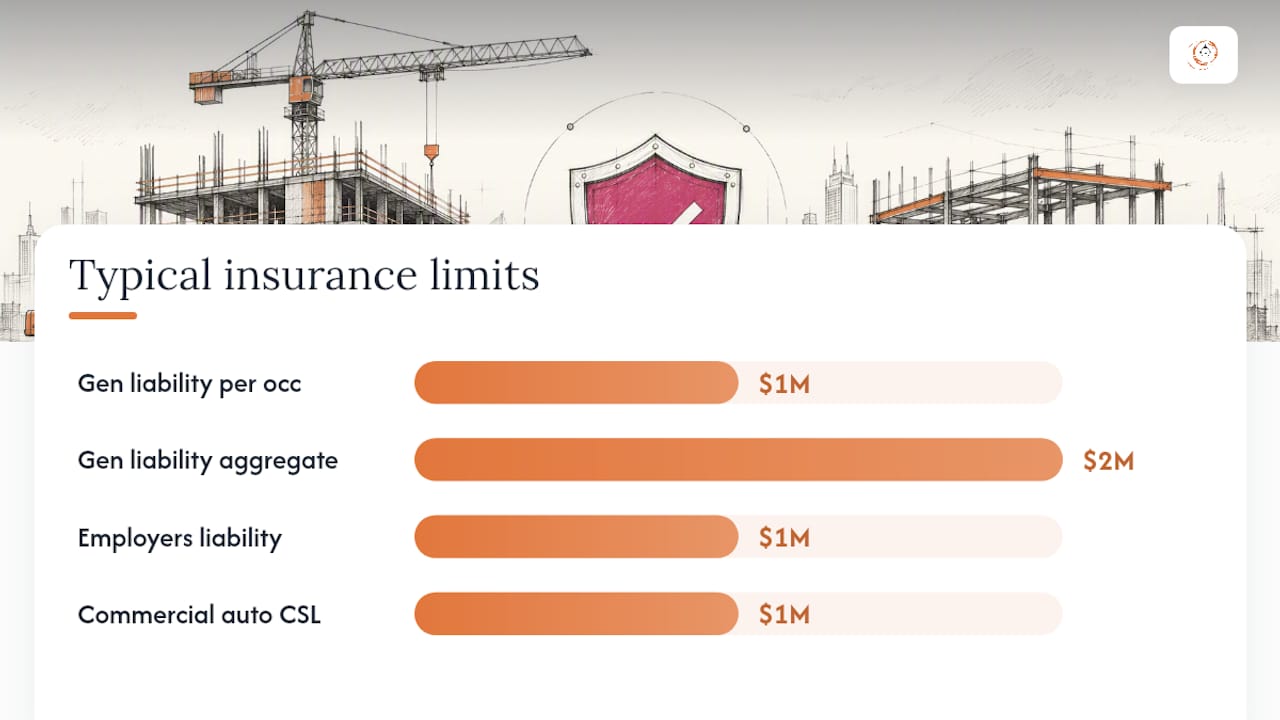
Contract language throws around numbers fast, and knowing what’s standard versus excessive saves both negotiation time and unnecessary premium cost. According to TradesCoverage, the most commonly cited general liability limits are around $1 million per occurrence and $2 million in the aggregate, with employers liability approximately $1 million and commercial auto about $1 million combined single limit. Umbrella requirements typically range between low and moderate millions depending on project size, and public infrastructure work often pushes limits higher still.
| Coverage | Typical Limit | Notes |
|---|---|---|
| General liability | around $1M per occurrence / $2M aggregate | Per-project aggregate often required on larger jobs |
| Employers liability | approximately $1M each accident | Companion to statutory workers’ comp |
| Commercial auto | about $1M combined single limit | Must include hired/non-owned auto |
| Umbrella/excess | coverage varies from low to moderate millions | Scales with project size and trade risk |
The bigger issue isn’t the dollar figure. It’s the endorsement language attached to it. Additional insured status comes in two flavors that get confused constantly: CG 20 10 covers ongoing operations while the sub is actively working, and CG 20 37 extends that protection to completed operations, meaning claims that arise after the job wraps. A GC who only collects CG 20 10 has zero protection for a defect that surfaces eighteen months later. Edition dates matter too. Older versions of these forms carry different language than current ones, and some insurers have issued endorsements that quietly remove the subcontractor exception altogether, effectively unwinding the coverage a GC thought it had.
Two more phrases to check for: primary and noncontributory, which forces the sub’s policy to pay first rather than splitting the claim with the GC’s own insurance, and waiver of subrogation, which stops the sub’s insurer from turning around and suing the GC after paying a claim. A per-project aggregate endorsement resets the sub’s aggregate limit for each job, so a bad claim on one project doesn’t quietly erode the coverage available on yours.
Pro Tip: Ask for the endorsement form number and edition date in writing, not just a checkbox on the certificate. If the sub’s broker can’t produce it within a day, that’s usually a sign the endorsement doesn’t actually exist yet.
How Do You Verify a Subcontractor’s Insurance Coverage?
A certificate of insurance is a summary document. It confirms a policy existed on the date it was issued, but it carries no contractual weight and creates no coverage rights for the certificate holder, a point Alliant’s insurance requirements manual makes explicit. The only way to know what a policy actually does is to read the policy documents themselves.
- Request the declaration page alongside the COI. It lists actual limits, deductibles, and named insureds, which sometimes differ from what the certificate claims.
- Request the endorsement forms, not a summary. Confirm CG 20 10 and CG 20 37 (or their equivalents) are attached with current edition dates.
- Check for primary and noncontributory and waiver of subrogation language directly on the endorsement, not just referenced in a cover email.
- Verify the carrier’s A.M. Best rating. A financially weak carrier can hold all the right endorsements and still fail to pay a claim.
- Confirm policy dates span the full contract period, including any completed operations tail for work that will be inspected or occupied after substantial completion.
Assign one person to own this process, log expiration dates, and set renewal reminders 30 days out. Most COI rejections trace back to missing additional insured wording or a policy that expired mid-project, not fraud. Both are fixable in a phone call if you catch them early. Our subcontractor coverage checklist for awarded projects walks through the document flow in more detail.
Pro Tip: Build a shared tracking sheet or use COI compliance software that flags expirations automatically. Chasing renewals by memory is how a sub ends up working three weeks on an expired policy nobody noticed.
What Happens If a Subcontractor Lacks Required Insurance?
The consequences land fast and they land on both parties, just in different ways.
- Site exclusion. Most GCs typically do not allow an uninsured sub to mobilize, and public owners often enforce this as a strict requirement.
- Withheld draws. Payment applications get held until an acceptable COI and endorsement package arrives, which can freeze a sub’s cash flow for weeks.
- Premium audit reallocation. If a sub’s coverage lapses and an injury occurs, the GC’s own carrier may absorb the claim, then reclassify payroll during audit and raise the GC’s premium.
- Subrogation exposure. Without a waiver in place, an insurer that pays a claim can sue the responsible party directly, dragging an uninsured sub (or the GC who hired them) into litigation.
- License and bonding consequences. Some states tie license renewal to proof of active coverage, and a lapse can jeopardize bonding capacity on future work.
None of this requires bad faith. A sub who simply forgets to renew creates the same exposure as one who never intended to carry coverage at all.
How Do Workers’ Comp and Licensing Rules Interact With Contracts?
Workers’ compensation is a state-by-state statutory requirement, and the details shift meaningfully depending on where the work happens. Most states require it once a business has any employees, though a handful carve out exceptions for sole proprietors or very small crews with no employees on payroll.
- Contract requirements often exceed statutory minimums. A GC can require workers’ comp even where state law technically exempts a one-person operation, and most well-drafted subcontracts do exactly that.
- Licensing boards frequently require proof of active coverage as a condition of maintaining a contractor’s license, separate from whatever a specific GC’s contract demands.
- Anti-indemnity statutes vary significantly by state and can void broad indemnification language in a subcontract if it isn’t drafted to match local law.
- “Occurrence” definitions differ by jurisdiction, and whether defective workmanship even triggers CGL coverage in the first place depends on how a state’s courts have ruled, according to LegalClarity’s analysis of the subcontractor exception.
Because these rules shift by state and sometimes by county, generic contract templates pulled off the internet are a real liability. Run subcontract insurance clauses past counsel familiar with your project’s state, especially on indemnification and anti-indemnity language.
How Is Subcontractor Insurance Priced, and How Can You Manage Cost?
Underwriters price a policy based on a handful of hard variables: trade classification code, total payroll, state territory, claims history, vehicle count, and whether the sub relies on lower-tier labor that may not carry its own coverage. A drywall sub and a structural steel erector pay wildly different rates for identical limits because the class code reflects real loss data for that trade.
- Get class codes right. Misclassified payroll is one of the most common and most expensive mistakes subs make, and it surfaces during a premium audit rather than upfront.
- Run a documented safety program. Fewer claims mean better experience modification factors, which directly lower premium over time.
- Package coverage where possible. Bundling GL, auto, and umbrella with one carrier often beats piecing policies together separately.
- Verify lower-tier labor carries its own coverage. Hiring uninsured labor beneath you can trigger a payroll reclassification and a premium increase at audit, a risk TradesCoverage flags as a common underwriting surprise.
- Engage a broker early, not after a bid is due. Broker lead time affects whether you can secure competitive terms versus a rushed binder.
Pro Tip: If a GC’s contract asks for a limit increase mid-project, ask whether an umbrella layer costs less than raising the underlying GL limit. It usually does. Reviewing common contractor overspending mistakes shows how misjudged insurance costs frequently sneak into bid overruns elsewhere too.
How Do Insurance Requirements Affect Bidding and Pricing?
Insurance cost isn’t a footnote in a bid; it’s baked into the number. A sub carrying higher limits, broader endorsements, and a clean claims history usually prices coverage lower per dollar of revenue than a sub with thin limits and a rocky loss history, and that difference shows up directly in the bid.
GCs who set insurance requirements too high for a project’s actual risk profile can unintentionally shrink their bidder pool. A small residential remodeling sub simply can’t absorb the same limits routinely required on a hospital expansion, so an oversized requirement either inflates every bid received or eliminates qualified small operators before they submit one.
The reverse problem is just as real. Underspecifying insurance requirements to attract more bidders looks like savings on paper, then turns into exposure the moment a claim exceeds what an underinsured sub can cover. Sophisticated GCs scale requirements to actual project risk: higher limits and broader endorsements for structural and life-safety trades, proportionally lighter requirements for lower-risk finish work. Subs who understand this dynamic can price their coverage costs into a bid confidently instead of guessing, and GCs who calibrate requirements correctly get a fuller, more competitive bidder list without carrying uncompensated risk.
Do Insurance Requirements Differ by Industry Sector?
Construction insurance requirements are the most detailed in the built environment, but the underlying logic (match coverage to the actual risk of the work) applies across every sector that hires subcontractors.
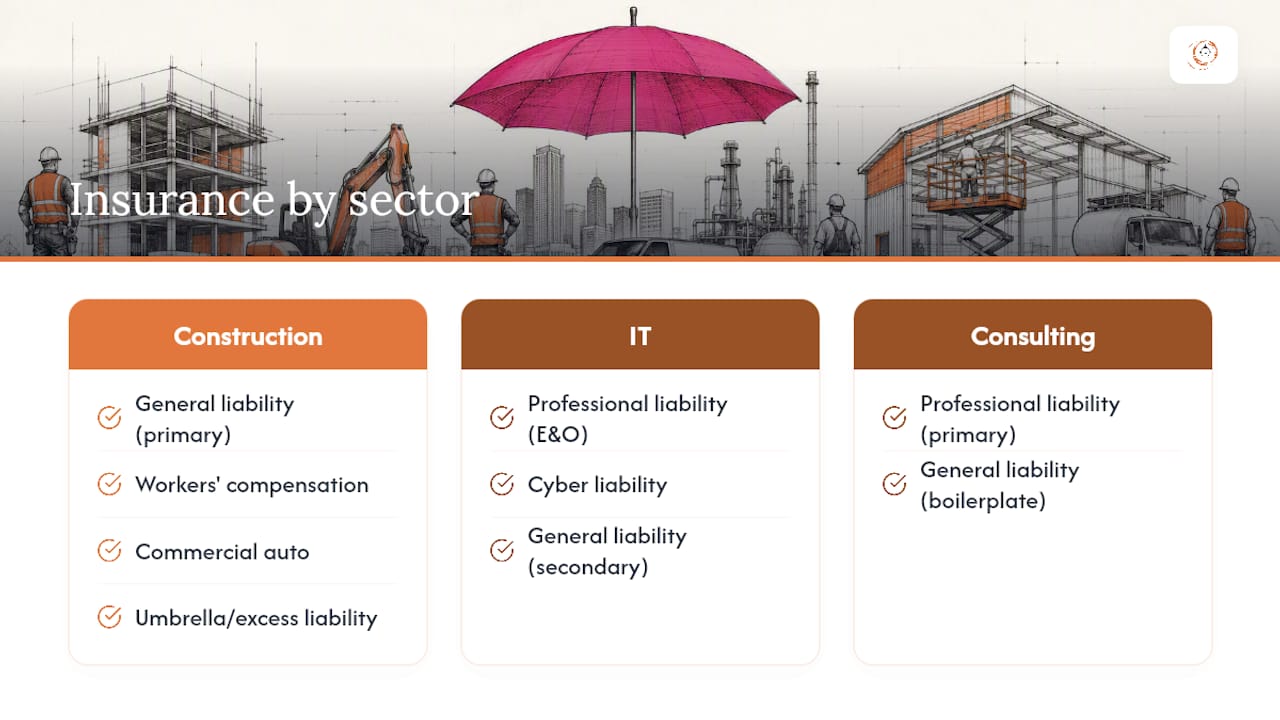
Construction trades face the most layered requirements because the physical risk is highest: GL, workers’ comp, auto, and often umbrella and pollution coverage stacked together, with completed operations coverage carrying real weight because defects surface years after substantial completion.
IT and technology subcontractors carry a different risk profile entirely. Professional liability (errors and omissions) and cyber liability replace much of what construction trades need, since the exposure is a coding error or a data breach rather than a physical injury. General liability still appears in most IT subcontracts, but it plays a smaller role than in construction.
Consulting and professional services subs lean almost entirely on professional liability, with GL included mostly to satisfy standard contract boilerplate rather than genuine risk exposure.
The common thread across every sector: the contract should require coverage proportional to what could actually go wrong on that specific engagement, not a copy-pasted list from an unrelated industry’s template. A construction GC hiring an IT subcontractor for a project management platform doesn’t need that vendor carrying pollution liability, and a tech company hiring a construction sub for a tenant buildout absolutely does need workers’ comp and GL regardless of what its standard vendor contract usually requires.
What Steps Should Subcontractors Take to Get Insured Efficiently?
Getting properly insured doesn’t have to eat weeks, but it does require sequencing the work correctly instead of scrambling after a contract lands.
- Read the subcontract’s insurance exhibit before bidding, not after signing. Know the required limits and endorsements upfront so pricing reflects real cost.
- Engage an independent broker who understands construction risk, rather than a general commercial lines agent unfamiliar with additional insured endorsement structures.
- Request quotes on package policies first. Bundled GL, auto, and umbrella coverage is usually faster to bind and cheaper than assembling separate policies.
- Confirm class codes match the actual scope of work before binding, since a wrong code either overcharges the sub or creates an audit gap later.
- Keep a standing file of declaration pages and endorsement forms ready to send the moment a new contract requires them, rather than requesting them fresh from the carrier every time.
- Renew before expiration, not after. A short lapse between old and new policy periods can create a coverage gap that surfaces only when a claim hits during that window.
Subcontractors who treat insurance procurement as a standing operational process, not a one-time task tied to a single job, mobilize faster and win more bids because they can turn around a compliant COI within hours instead of days.
How Are Insurance Disputes Between GCs and Subcontractors Resolved?
Most disputes fall into a small number of recurring patterns, and most of them are avoidable with better documentation upfront.
The most common dispute involves additional insured scope: a GC assumed completed operations coverage applied and discovers, after a claim, that only ongoing operations were endorsed. Resolution typically starts with a direct review of the endorsement forms against the contract’s insurance exhibit, since the actual policy language usually settles the question without litigation.
A second recurring dispute centers on who pays first when both the GC’s and sub’s policies could respond to a claim. Primary and noncontributory language is supposed to resolve this cleanly, but disputes still arise when that language is missing, ambiguous, or contradicted by other endorsement wording on the same policy.
A third pattern involves claims tied to defective work discovered after project completion, where the underlying legal question is whether the state treats faulty workmanship as a covered “occurrence” at all. Because that answer varies by jurisdiction, these disputes often require legal analysis specific to the state where the project sits rather than a straightforward reading of the policy.
The fastest path to resolution in nearly every case is the same one that prevents the dispute in the first place: pulling the actual endorsement forms and declaration pages rather than arguing from the certificate of insurance, which carries no contractual authority to begin with.
What Legal Risks Do Subcontractors Face for Noncompliance?
Failing to meet a contract’s insurance requirements creates exposure that extends well past a missed COI deadline. A subcontract’s insurance clause is typically a condition of performance, meaning a sub that can’t produce compliant coverage may be found in breach even if the underlying work itself is flawless.
That breach can trigger contract default provisions, forfeiture of retention, and in some cases termination for cause, which follows a sub into future bid history and bonding applications. Where a project involves a payment or performance bond, insurance noncompliance can also complicate a claim against that bond, since sureties frequently examine whether the sub met all stated contract conditions before honoring a claim; understanding the relationship between subcontractor performance bonds and insurance requirements helps clarify where one risk-transfer tool ends and the other begins.
Beyond contract remedies, an uninsured sub carries direct personal and business liability for any claim a policy would otherwise have covered, with no carrier standing behind them. Combined with potential licensing consequences in states that tie license renewal to proof of coverage, the financial and legal downside of ignoring an insurance requirement dwarfs the cost of simply maintaining the coverage in the first place.
Why Insurance Compliance Breaks Down (and How to Fix It)
The failures we see repeatedly aren’t exotic. They’re the same three gaps showing up on project after project: missing completed operations additional insured coverage, endorsement forms with outdated edition dates that no longer match what the contract requires, and lower-tier hires nobody documented until an audit or a claim forced the question.
None of these are hard to catch. They’re just tedious to catch consistently, which is exactly why they get missed. Pre-vetting subcontractors for insurance compliance before they ever hit a job site turns a week of chasing paperwork into a same-day mobilization, and it removes the audit surprises that eat into margin months later. When we vet a subcontractor, we confirm actual endorsement forms, not certificates, verify carrier ratings, and check that lower-tier labor is documented before it becomes someone else’s problem. It’s less glamorous than the negotiation side of construction risk, but it’s the part that actually prevents claims.
— Rowena
How ConneX Cuts Down Your Insurance Verification Workload
If you’ve read this far, you know exactly how much time COI chasing, endorsement verification, and lower-tier labor checks eat out of a project manager’s week. ConneX by Constructconnect-rconstructionsolutions is the alternative to running that process cold on every new hire: we pre-vet subcontractors and suppliers for insurance compliance and reliability before we ever introduce them to a client, so the mobilization delays and audit surprises this article covers show up far less often on your jobs.

Our commission structure is prorated over the first 90 days, so you’re not paying full price for a placement that doesn’t pan out, and our rates run lower than traditional staffing agencies serving the AEC sector. With 30-plus years in construction sourcing, we’ve built the vetting habits this article describes into how we source every subcontractor and supplier relationship we broker. If your next bid depends on getting compliant, reliable subs on site fast, start with our recruiting services for the AEC industry and tell us what the project needs.
Sources
- INSURANCE REQUIREMENTS IN CONTRACTS 2026.1 (Alliant IRIC manual)
- Subcontractor insurance: Coverage, cost & requirements | TradesCoverage
- CGL ‘Your Work’ exclusion: Subcontractor exception explained | LegalClarity
- Back to the exclusions: the subcontractor exception | IRMI
FAQ
What Are Subcontractor Insurance Requirements?
Most subcontracts require general liability, workers’ compensation, and commercial auto at minimum, with additional insured, primary and noncontributory, and waiver of subrogation endorsements attached. Larger or riskier trades often add umbrella, professional liability, or pollution coverage.
What Type of Insurance Do You Need to Subcontract People?
If you’re hiring subcontractors, you need to confirm they carry their own general liability and workers’ compensation, since your own policy generally will not extend to cover their work or their employees. Verify coverage through declaration pages and endorsement forms, not just a certificate of insurance.
How Much Does $1 Million in Contractor Insurance Cost?
Pricing varies widely by trade classification, payroll, claims history, and state, so there’s no single flat rate across the industry. Getting an accurate figure requires a broker quote based on the sub’s actual class code and loss history rather than a generic estimate.
What Happens if My Subcontractor Does Not Have Insurance?
An uninsured subcontractor typically gets excluded from the site, has payment draws withheld, and exposes the general contractor to premium audit reallocations and direct liability if a claim occurs. In states with anti-indemnity statutes, the legal exposure can extend further depending on how the contract’s indemnification language is drafted.
Can Constructconnect-rconstructionsolutions Help Verify Subcontractor Coverage Before Hiring?
Yes. ConneX by Constructconnect-rconstructionsolutions pre-vets subcontractors for insurance compliance, including endorsement verification and carrier checks, before introducing them to a client, which shortens mobilization time compared to vetting a new sub from scratch.