
Subcontractor Coverage Gap: What GCs Must Know
A subcontractor coverage gap is defined as the uninsured exposure a general contractor inherits when a subcontractor’s insurance policy fails to cover a claim arising from that subcontractor’s work. This is the industry’s formal term for what project managers often discover too late: a certificate of insurance (COI) on file does not equal actual protection. Construction insurance premiums are rising 5% to 15% annually in 2026, which means the financial stakes of an undetected gap are higher than ever. General contractors who rely on passive COI collection rather than active verification are carrying risk they cannot see. Understanding what a subcontractor coverage gap is, how it forms, and how to close it is the most practical risk management step you can take this year.
What is subcontractor coverage gap and how does it form?
A subcontractor coverage gap forms when the insurance a subcontractor carries does not actually respond to a loss connected to their work. The gap can exist even when a valid COI is on file, because COIs are snapshot documents that reflect policy status at one moment in time. If a policy cancels, lapses, or is modified after the COI is issued, the GC has no automatic notice and no coverage.
Several specific conditions create these gaps in practice:
- Excluded work types. Hidden policy exclusions for residential construction, high-rise work, and labor law claims (known as “action over” exclusions) make a subcontractor appear insured while leaving the GC exposed for the exact risk on your project.
- Missing endorsements. Endorsements CG 20 10 and CG 20 37 add the GC as an additional insured for ongoing and completed operations coverage, respectively. Without both, you lose protection the moment the project closes out.
- Inadequate limits. A roofing subcontractor carrying $1 million in general liability on a $20 million project creates a structural mismatch. The limits do not reflect the actual risk exposure.
- Fraudulent or outdated COIs. Some subcontractors submit certificates from canceled policies. Without direct verification with the insurer, this fraud goes undetected until a claim surfaces.
- No waiver of subrogation. Without this endorsement, the subcontractor’s insurer can pay a claim and then sue the GC to recover those costs, turning a resolved claim into active litigation.
Pro Tip: Request the actual policy declarations page and the specific endorsements, not just the COI. A COI is a summary. The policy is the contract.
What are the financial consequences for general contractors?
The financial fallout from a subcontractor coverage gap reaches well beyond the immediate claim. Most GC commercial general liability policies exclude costs tied to subcontractor work, which means the GC absorbs the loss directly when a subcontractor’s policy does not respond. That misconception about CGL policies acting as a blanket safety net is one of the most expensive assumptions in the industry.
The consequences stack up in a predictable sequence:
- Premium increases. An uninsured subcontractor claim gets charged to the GC’s own policy. That claim history drives up your general liability and workers’ compensation premiums for years.
- Retroactive audit charges. Insurance audits at policy renewal can trigger retroactive premium charges when uninsured subcontractor payroll is discovered and reclassified under the GC’s own experience modification rate.
- Bonding capacity loss. Uninsured subcontractor exposure raises the GC’s risk profile with surety companies. A weakened bond capacity limits your ability to bid on public projects and larger private contracts.
- Litigation costs. The absence of a waiver of subrogation means the subcontractor’s insurer can recover claim costs from you after paying out. That recovery action becomes a lawsuit, adding legal fees and management time on top of the original loss.
- Project delays. Disputed liability between the GC, subcontractor, and their respective insurers stalls work. Owners hold retainage, and schedules slip while attorneys negotiate.
The subcontractor default risk compounds the insurance problem. A subcontractor who defaults and carries no valid insurance leaves the GC holding both the completion cost and the liability exposure simultaneously.
How do you close subcontractor coverage gaps?
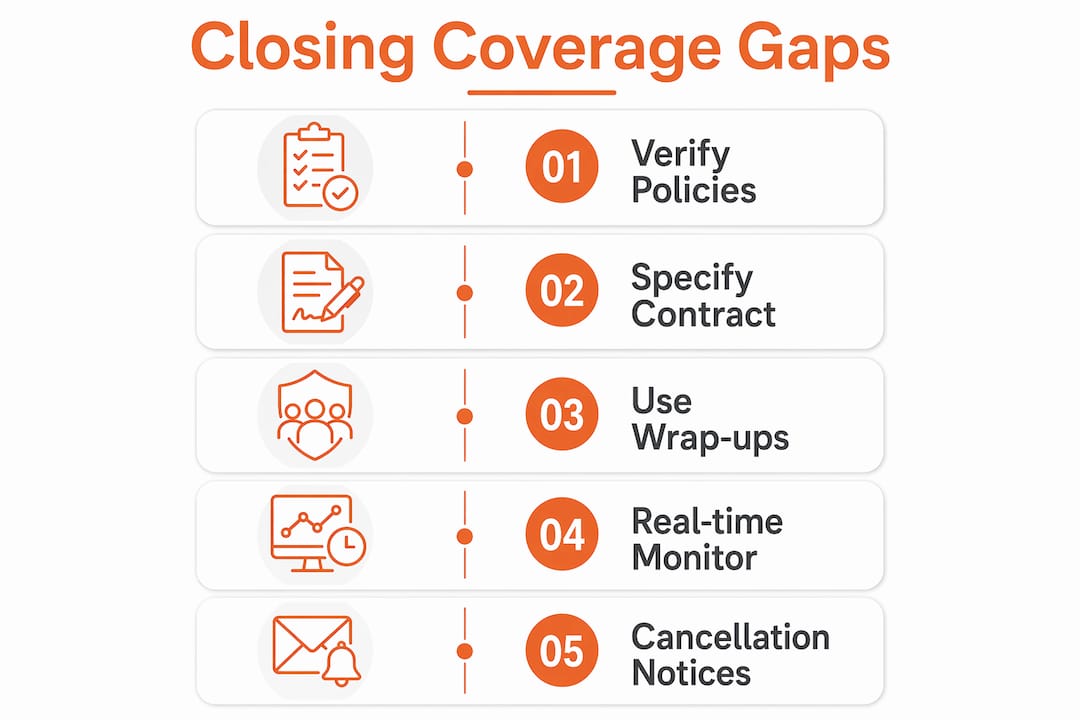
Closing coverage gaps requires moving from passive document collection to active, contract-enforced verification. The difference between the two approaches is significant. Passive collection means you receive a COI and file it. Active verification means you confirm the policy is current, the endorsements are correct, and the limits match the project’s risk profile before work begins and throughout the project duration.

The most effective framework combines four elements:
Contract language. Your subcontract must specify the exact coverage types required, the minimum limits by trade, the required endorsements (CG 20 10 and CG 20 37), and the waiver of subrogation. Generic insurance clauses leave too much room for interpretation. Tailor requirements to each trade’s actual risk exposure.
Wrap-up programs. On larger projects, OCIP and CCIP programs (Owner Controlled Insurance Programs and Contractor Controlled Insurance Programs) place all parties under a single policy structure. This eliminates the fragmentation that creates gaps in the first place. Wrap programs are particularly effective on projects where multiple subcontractors work in overlapping scopes.
Real-time monitoring. Active verification systems that track certificate expiration dates and trigger renewal requests before a lapse occurs reduce exposure far more than annual COI reviews. Set calendar alerts or use compliance tracking software to automate this process.
Pro Tip: Require 30-day notice of cancellation language in every subcontract. Most standard policies only provide 10 days. The extra 20 days gives you time to act before a gap opens.
The table below compares passive and active verification approaches across key risk factors:
| Risk factor | Passive COI collection | Active verification |
|---|---|---|
| Coverage currency | Unknown after issuance | Confirmed in real time |
| Endorsement accuracy | Rarely checked | Verified against policy |
| Lapse detection | Discovered at claim | Caught before it occurs |
| Limit adequacy | Assumed from COI | Matched to trade risk |
| Waiver of subrogation | Often missing | Contractually required |
How do you audit subcontractor insurance beyond the COI?
A COI tells you a policy existed on the date it was issued. It does not tell you what the policy actually covers, whether it has been modified, or whether it is still active. Effective auditing requires going one layer deeper.
Use this checklist when reviewing subcontractor insurance for any project:
- Request the declarations page. The dec page shows actual limits, named insureds, and policy period. Compare it directly to your contract requirements.
- Verify endorsements by form number. Ask for CG 20 10 and CG 20 37 by name. A COI that says “additional insured” without specifying the endorsement form may not include completed operations coverage.
- Confirm notice of cancellation rights. Call the subcontractor’s broker to verify the policy is active and that your company is listed for cancellation notice.
- Check for exclusions in writing. Ask the broker to confirm in writing that the policy does not exclude the specific work type on your project, such as residential, high-rise, or labor law claims.
- Document everything post-project. Keep copies of all endorsements and policy declarations for at least the completed operations tail period, which can extend 10 years on some project types.
Technology helps here. Compliance tracking platforms can automate expiration alerts, store endorsement copies, and flag gaps before they become claims. The subcontractor coverage checklist developed for awarded projects provides a practical starting point for building your own audit process. Pair that with a clear understanding of common subcontractor gaps in 2026 to prioritize where your review effort goes first.
Key Takeaways
A subcontractor coverage gap transfers uninsured liability directly to the general contractor, making active verification and contract-enforced insurance requirements the only reliable defense against premium increases, bonding loss, and litigation.
| Point | Details |
|---|---|
| COIs are not coverage | A certificate of insurance confirms a policy existed; it does not confirm current, adequate, or correctly endorsed coverage. |
| Endorsements are non-negotiable | Require CG 20 10 and CG 20 37 by form number to protect against both ongoing and completed operations claims. |
| Passive collection creates gaps | Active, real-time verification of policy status and limits is the only way to catch lapses before a claim occurs. |
| Financial exposure compounds | Uninsured subcontractor claims raise GC premiums, trigger audit charges, and can reduce bonding capacity for years. |
| Wrap programs eliminate fragmentation | OCIP and CCIP programs place all project parties under one policy, removing the gaps that separate policies create. |
What I have learned after years of watching coverage gaps cost GCs
The most consistent pattern I have seen is not fraud or negligence. It is assumption. A project manager receives a COI, files it, and moves on. The subcontractor’s policy quietly lapses three months into the job. Nobody checks. A worker gets injured. The subcontractor’s insurer denies the claim because the policy was not renewed. The GC’s insurer pays, and the GC’s premium goes up for the next three years.
The uncomfortable truth is that collecting certificates is not risk transfer. It is paperwork. Real risk transfer happens in the contract language, in the endorsement verification, and in the ongoing monitoring that most teams skip because it feels administrative. The GCs who handle this well treat insurance verification the same way they treat schedule management: as a live document that requires regular updates, not a one-time task at project kickoff.
The other thing I would tell any project manager is to pay close attention to completed operations exposure. Most teams focus on active construction risk and forget that a subcontractor’s policy can expire long before a latent defect claim surfaces. If your contract did not require a completed operations additional insured endorsement, you may be defending a claim years after the project closed with no coverage behind you. That is a gap that does not announce itself until it is too late.
— Rowena
How Constructconnect-rconstructionsolutions helps GCs manage subcontractor risk
Managing subcontractor insurance compliance starts with having the right subcontractors on your project. Constructconnect-rconstructionsolutions works exclusively in the AEC industry, connecting general contractors with pre-vetted subcontractors who meet defined qualification standards before they ever set foot on a job site.

With over 30 years of industry experience, Constructconnect-rconstructionsolutions screens candidates for reliability, licensing, and compliance history, reducing the risk of partnering with subcontractors who carry inadequate or lapsed coverage. The prorated 90-day payment model means you only pay for successful placements. If you are looking to reduce subcontractor liability issues at the source, the AEC recruiting services at Constructconnect-rconstructionsolutions give you a direct path to qualified, vetted partners who meet your project’s standards from day one.
FAQ
What is a subcontractor coverage gap in construction?
A subcontractor coverage gap is the uninsured liability a general contractor absorbs when a subcontractor’s insurance policy does not cover a claim from that subcontractor’s work. It occurs due to policy exclusions, lapsed certificates, missing endorsements, or inadequate limits.
Does a GC’s CGL policy cover subcontractor claims?
Most commercial general liability policies exclude costs tied directly to subcontractor work. GCs cannot rely on their own CGL as a backstop for subcontractor liability without specific endorsements and contractual risk transfer in place.
What endorsements should GCs require from subcontractors?
Require CG 20 10 for ongoing operations and CG 20 37 for completed operations, both naming the GC as an additional insured. Also require a waiver of subrogation to prevent the subcontractor’s insurer from recovering claim costs from the GC.
What is the difference between a COI and actual insurance coverage?
A COI is a summary document that reflects policy status at the time of issuance. Actual coverage depends on the policy’s current status, its endorsements, and its exclusions. Verifying the declarations page and endorsements directly is the only way to confirm real coverage.
How do wrap-up programs close subcontractor coverage gaps?
OCIP and CCIP wrap programs place the GC, subcontractors, and owner under a single unified policy. This eliminates the fragmented coverage that creates gaps when multiple subcontractors carry separate policies with varying limits and exclusions.