
Steady Supply Agreements for Local Contractors: A GC's Guide
The fastest path to a reliable pipeline of local subcontractors, suppliers, and field personnel is a feedback-driven, pre-vetted network tied directly to ready-to-use subcontract templates. Build that system internally using a centralized database, project-specific prequalification, and a performance feedback loop, or engage a specialist sourcing partner to deliver the same outcome in weeks rather than months. Either way, start today: run a 30-day audit of every sub and supplier you awarded work to over the past three years, pull their current certificates of insurance (COIs) and licenses, and add the qualified ones to a working shortlist. That shortlist is the seed of your steady supply agreement system, and it costs nothing but staff time to create.
Key Takeaways
A feedback-driven, pre-vetted vendor network tied to versioned subcontract templates is the most reliable way to secure a steady pipeline of local subcontractors and suppliers.
| Point | Details |
|---|---|
| Start with a 30-day audit | Pull three years of awarded contracts to build your first pre-qualified shortlist at no software cost. |
| Prequalify per project | Evaluate each sub’s capacity, safety record, and scope fit for the specific package, not just their company profile. |
| Attach contract templates | Link a versioned, date-stamped subcontract template to every approved vendor record before the first invite. |
| Track six core KPIs | Bid response rate, fill rate, on-time delivery, change-order frequency, COI compliance, and mobilization time. |
| Constructconnect-rconstructionsolutions | Delivers pre-vetted local sub and supplier connections with prorated fees and contract templates included. |
Table of Contents
- What does a steady supply agreement actually mean for GCs?
- Six components every steady-supply system must include
- How to set up your system in 12 weeks
- Which tools and sourcing channels work best, and when?
- What your subcontract templates must cover
- How to connect prequalification data to estimating and operations
- KPIs and governance: how do you know the system is working?
- When should you hire a sourcing partner instead of building internally?
- Why these recommendations hold up
- A sourcing leader’s view on keeping supply steady
- R. Construction Solutions delivers a pre-vetted pipeline, faster
- Sources
- FAQ
What does a steady supply agreement actually mean for GCs?
In recruiting and sourcing terms, a steady supply agreement is not a formal contract with a single vendor. It is an operational arrangement, internal or outsourced, that guarantees ongoing access to pre-vetted local subcontractors, suppliers, and field personnel you can call on project after project. Think of it as a living network rather than a static directory.

The distinction matters. A directory tells you who exists. A pre-vetted network tells you who performs. According to National Dispatching, a pre-qualified vendor network is a continuously maintained, performance-scored pool whose scores are updated after each order, making it a fundamentally lower-risk sourcing option than any open list.
The practical benefits are direct:
- Faster mobilization: approved subs already have docs on file, so you skip the two-week verification scramble.
- Higher bid response rates: vendors who know you and trust your payment terms respond more reliably.
- Fewer delivery failures: supply-management issues are a leading cause of construction project delays, and pre-vetted networks reduce that risk by verifying capacity, safety records, and insurance before invitations go out.
Six components every steady-supply system must include
A reliable local contractor supply system is not a spreadsheet. It is a structured program with six interdependent components, each doing a specific job.
- Centralized searchable database. Every vendor record lives in one place, tagged by CSI trade division, service area, project size capacity, and current approval status. Most contractors keep this knowledge in tribal memory; centralizing it delivers the highest return on any single investment in procurement.
- Project-specific prequalification. Prequalification should be project-specific, combining document checks, scope fit, capacity review, safety review, references, workload, and bid responsiveness. A sub who is qualified for a $500K interior fit-out may not be qualified for a $4M structural package.
- Performance scorecards. Track response rates, on-time delivery, change-order frequency, and punchlist rates after every project. These fields are underused in most firms, yet they deliver the most predictive value for future award decisions.
- Contract-template linkage. Every approved vendor record should have a versioned subcontract template attached. Attaching a subcontractor agreement template to every approved record and maintaining version control with an annual legal review keeps templates defensible and aligned with current state laws.
- Automated compliance alerts. Set expiration reminders for COIs, licenses, and bonding limits so a vendor’s status never lapses silently between projects.
- Incentive and volume commitments. Early bid access, preferred-vendor status, and prompt payment terms keep your best subs engaged and responsive.
Pro Tip: Tag every vendor record by trade AND project size bracket (e.g., “Electrical / $250K–$1M”). This prevents estimators from inviting a two-crew shop to a $3M package and wasting everyone’s time.
How to set up your system in 12 weeks
This rollout assumes one dedicated coordinator (or a sourcing partner) and a basic database platform. Costs will vary by firm size, but the structure holds regardless of scale.
- Weeks 1–2: Data audit. Pull every awarded contract and paid invoice from the past three years. Flag subs and suppliers with two or more successful projects. Collect current COIs, W-9s, and licenses. This audit typically yields a working shortlist of a moderate number of qualified vendors at no software cost.
- Weeks 3–6: Build the database and attach templates. Structure vendor records with the fields recommended by MeltPlan’s subcontractor database guidance: contact info, CSI divisions, service areas, insurance expirations, bonding limits, performance notes, last bid date, and project size capacity. Attach the correct subcontract template to each approved record and assign a template owner for annual legal review.
- Weeks 7–10: Pilot with three trade packages. Run the system live on three active bid packages. Record invite counts, response rates, and award decisions. Refine prequalification thresholds based on what you learn. Bid response rate is your single most important early KPI.
- Weeks 11–12: Full rollout and governance. Activate automated COI alerts, establish a quarterly vendor review cadence, and schedule the first annual legal review of all contract templates.
Pro Tip: Budget $200–$600/month for a mid-tier vendor management or bid platform subscription. The staff time saved on manual doc chasing typically covers that cost within the first project cycle.
Which tools and sourcing channels work best, and when?
Choosing the right channel depends on market size, trade rarity, and project urgency.
| Channel / Tool | Best for | When to use |
|---|---|---|
| AGC local/state chapters | Regional fit, specialty trades | New markets, thin local coverage |
| Local plan rooms | Active project coverage | Competitive bid markets |
| Supplier referrals | Trusted specialty subs | Niche trades, fast mobilization |
| Digital bid networks (BuildingConnected, iSqFt) | Cross-market scale | Large GCs, multi-region projects |
| Workforce planning tools (Bridgit, Raken, Matrak) | Staffing forecasts, delivery alignment | Complex schedules, multi-trade coordination |
Autodesk’s construction resource management coverage highlights Bridgit, Raken, and Matrak as particularly useful for staffing forecasts and aligning deliveries to project schedules. For regional depth, though, local plan rooms and supplier referrals often outperform digital platforms in smaller markets where relationships drive response rates.
- Use AGC chapters and supplier referrals when entering a new region or sourcing a specialty trade with thin digital coverage.
- Use digital networks when you need volume across multiple markets quickly.
- Use workforce planning tools when schedule complexity requires precise resource sequencing.
When evaluating a local specialty contractor, asking the right project-specific questions upfront saves significant rework later.
What your subcontract templates must cover
Every approved vendor record needs a contract-ready template attached before the first invitation goes out. The minimum elements:
- Detailed scope with explicit exclusions to prevent scope gap disputes at closeout.
- Schedule milestones with liquidated damages tied to the project’s critical path.
- Payment terms that comply with your state’s prompt payment statutes (enforceability varies by state; confirm with legal counsel).
- Termination clauses covering both cause and convenience.
- Insurance and indemnity language that mirrors the upstream owner contract.
- Retainage and lien waiver process documented step by step.
Use the subcontractor coverage checklist to verify insurance, safety records, and contract clauses before each award. Date-stamp every template version and require contract-ready status before any vendor moves to “approved to bid.”
Pro Tip: Add a simple version control field to each vendor record (“Template v2.3, reviewed March 2025”). When state law changes, you know exactly which records need updating.
How to connect prequalification data to estimating and operations
The steady-supply system only works if estimators and operations teams share the same vendor data. Here is the workflow:
- Bid day: estimators search the database by trade tag and project size bracket, pull only “approved” status vendors, and log every invite and response.
- Award decision: the system surfaces each vendor’s COI expiry, bonding limit, recent response rate, and last performance score alongside the bid number.
- Post-project: project managers log performance notes within 30 days of substantial completion. Those notes feed directly back to the estimating team’s vendor view.
Key data fields to sync between your estimating and operations platforms: approval status, COI expiry date, bonding limit, bid response rate (trailing 12 months), on-time delivery rate, change-order frequency, and punchlist rate. A well-maintained vendor database that consolidates this information and tags vendors by trade and capacity is a genuine competitive advantage in tight bid markets.
KPIs and governance: how do you know the system is working?
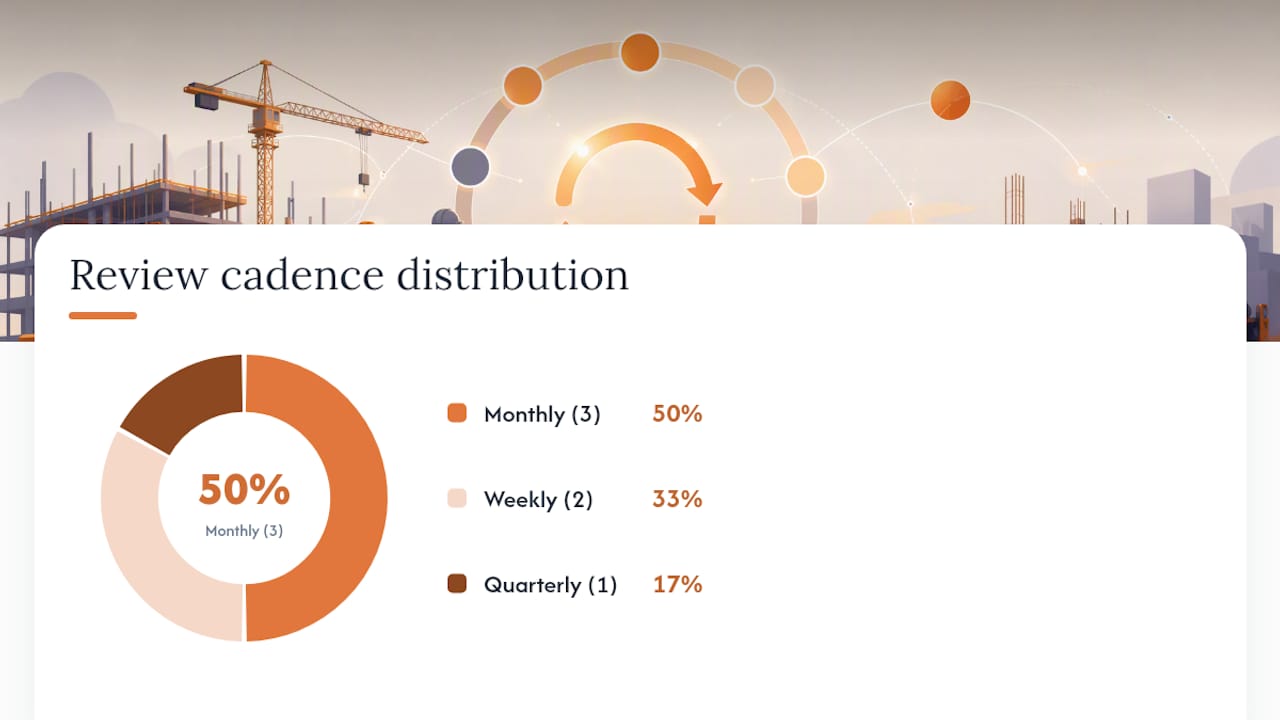
Track these six metrics and review them on a defined cadence:
| KPI | Owner | Cadence |
|---|---|---|
| Bid response rate | Estimating | Weekly snapshot |
| Award fill rate | Estimating | Monthly |
| Vendor on-time delivery rate | Operations | Monthly scorecard |
| Change-order frequency (vendor-attributable) | Operations | Monthly scorecard |
| COI compliance rate | Coordinator | Weekly alert |
| Average invite-to-mobilization time | Operations | Quarterly |
Governance triggers: move a vendor to “conditional” status after one documented performance failure. Archive after two. Escalate for corrective action when a COI lapses without notice or a safety incident occurs. Vendors with consistent poor scores should be archived or placed on conditional status promptly, not carried forward on inertia.
When should you hire a sourcing partner instead of building internally?
Outsource when speed to reliable coverage is critical, internal bandwidth is limited, or your market knowledge is thin in a target region. A qualified sourcing partner should deliver:
- Pre-vetted local sub and supplier lists with current docs on file.
- Contract templates attached to each approved record.
- Performance scoring after each project cycle.
- Measurable SLAs: bid response rate targets, fill rate guarantees, and mobilization time benchmarks.
When evaluating partners, ask for pilot results from comparable markets, sample scorecards, a documented compliance verification process, and transparent pricing. Prorated or placement-based fee structures, where you pay only for successful connections, reduce financial risk compared to retainer models. The subcontractor prequalification guide recommends combining document checks, capacity reviews, safety checks, references, and bid responsiveness into every vendor decision, and a good partner applies exactly that standard before handing you a shortlist.
Why these recommendations hold up
The guidance in this article draws from documented industry practice on vendor networks, subcontractor database design, and prequalification standards. Recommendations combine published platform guidance, practitioner experience from Constructconnect-rconstructionsolutions’s 30-plus years in AEC recruiting and sourcing, and the six pre-approved citations linked throughout. Results will vary by market size, trade mix, and internal capacity. Every contract template referenced here requires project-specific legal review before use.
A sourcing leader’s view on keeping supply steady
The difference between a project that mobilizes on schedule and one that scrambles for subs in week two almost always traces back to one decision made months earlier: whether the GC had a pre-vetted shortlist ready or was starting from scratch. Firms that treat their vendor network as a living system, scored and updated after every project, consistently outperform those that rebuild their list at each bid cycle.
The single leadership recommendation worth acting on: assign one person to own vendor records and the annual legal sign-off on contract templates. Without a named owner, both tasks drift. The 30-day audit described in the opening of this article is the highest-return action you can take this quarter if you have limited bandwidth for anything else.
R. Construction Solutions delivers a pre-vetted pipeline, faster
General contractors who need reliable local coverage without the months-long build time have a direct route: Constructconnect-rconstructionsolutions sources, screens, and delivers pre-vetted local subcontractors, suppliers, and field personnel with contract templates already attached to each approved record.
With 30-plus years of AEC industry experience, a prorated 90-day payment structure, and commission rates below the market standard, Constructconnect-rconstructionsolutions charges only for successful placements. No retainer, no upfront risk. The firm offers pilot engagements so you can validate coverage and quality before committing to a full program. To start your pilot or review available AEC recruiting and sourcing services, reach out directly and request a sourcing consultation.
Sources
- Construction vendor networks — how to build
- How to build a subcontractor database in 7 steps | Struvia
- Construction resource management | Autodesk blog
- Constructionbids
- What a pre‑qualified vendor network actually means | National Dispatching
FAQ
What is a steady supply agreement in construction sourcing?
It is an operational arrangement that gives a GC ongoing, prioritized access to pre-vetted local subcontractors, suppliers, and field personnel through a continuously scored vendor network, rather than rebuilding a list at each bid cycle.
How long does it take to build a pre-vetted vendor network?
A basic system can be operational in 12 weeks using a three-phase rollout: a two-week data audit, a four-week database build, and a four-week pilot with three trade packages.
What data fields should every vendor record include?
At minimum: trade and CSI division, service area, project size capacity, COI expiry date, bonding limit, last bid date, bid response rate, and a performance note from the most recent project.
When does outsourcing to a sourcing partner make more sense than building internally?
Outsource when you need coverage in a new region quickly, internal staff bandwidth is limited, or your existing vendor list is too thin to support reliable bid coverage across target trade packages.
How does Constructconnect-rconstructionsolutions support steady supply agreements?
Constructconnect-rconstructionsolutions sources and delivers pre-vetted local subcontractors, suppliers, and field personnel with a prorated 90-day fee structure, charging only for successful placements, and offers pilot engagements to validate coverage before a full program commitment.