
Operations Director Role at Large Contractors: A Full Guide
At a large contracting firm, the operations director is the senior executive accountable for operational efficiency across every active project, department, and job site. This is not a project-level role. It sits above project management and reports directly to the COO or CEO, making it one of the most consequential positions in large contractor management. The role of operations director at a large contractor demands at least 15 years of construction management experience, a command of multi-project budgeting, and the leadership capacity to hold project managers, superintendents, and subcontractors accountable simultaneously.
Here is what defines the position at a glance:
- Scope: Oversees all operational functions across multiple concurrent projects and business units
- Reporting line: Reports directly to the COO or CEO; sits on or adjacent to the executive board
- Core accountability: Operational efficiency, budget performance, safety compliance, and strategic execution
- Experience threshold: Typically 15+ years in construction management, with multi-project leadership
- Strategic function: Translates executive goals into field-level systems and processes
- Team leadership: Manages project managers, superintendents, and key subcontractor relationships
What does an operations director actually do at a large contractor?
The day-to-day reality of this role is broader than most job descriptions suggest. According to a construction operations job description from WorkScreen, operations directors at large general contractors typically oversee scheduling, budgeting, and risk mitigation across several concurrent projects of substantial value each. That scale separates this role from a senior project manager in every meaningful way.
Core duties include:
- Multi-project oversight: Plan, schedule, and manage execution across all active job sites simultaneously, not one at a time
- Team leadership: Direct project managers, superintendents, and subcontractor partners; hold each accountable for schedule and margin targets
- Budget and cost control: Conduct weekly cost-to-complete reviews, manage overhead expenses, and report margin forecasts to the CEO and CFO
- Process standardization: Build and enforce standard operating procedures across all job sites, using tools like Procore to create consistency
- Safety enforcement: Champion a zero-incident safety culture; enforce OSHA standards and company safety protocols across every site
- Executive advisory: Serve as the primary operational advisor to executive leadership, translating field data into decisions that affect company-wide strategy
- Risk mitigation: Identify project risks early and build systems that prevent problems rather than react to them
Pro Tip: The most effective operations directors treat weekly cost-to-complete reviews as non-negotiable. Skipping them even once on a $10M project creates blind spots that compound fast.
The Institute of Directors notes that operations directors provide data that shapes long-term strategy at the executive level. In construction, that means translating job site performance into board-level decisions about which project types to pursue, which subcontractors to retain, and where to allocate capital.
How does the operations director fit into the leadership hierarchy?
Understanding where this role sits relative to the COO, General Manager, and other senior leaders is critical, especially at firms with layered management structures.

The operations director reports to the COO and focuses on operational systems across all business units. The COO, by contrast, holds broader executive authority over company-wide strategy, finance, and culture. Think of the operations director as the person who makes the COO’s strategy executable at the field level.
The distinction from a General Manager is equally important:
- Operations Director: Manages operational efficiency and systems across the entire company or a major division; accountable for corporate-wide performance
- General Manager: Responsible for profitability at a specific location, unit, or project; a more contained, site-specific role
- Project Manager: Handles one project at a time, managing timelines, budgets, and subcontractors for a single build
Anthony Allen, vice president of recruiting at Supply Chain Talent Advisors and adjunct instructor at Southern New Hampshire University, describes the position clearly: “A director of operations is a senior management role, usually reporting directly to the chief operating officer or CEO. Directors of operations have a significant influence on strategic decisions, resource allocation and implementing policies that shape the organization’s success.”
At large contractors with multiple regional offices or divisions, you may see more than one operations director, each overseeing a division, with all of them reporting to a single COO. The operations director is not second in command of the whole company. That position belongs to the COO. But within the operational structure, the operations director carries the most direct accountability for whether projects get built on time and on budget.
What skills and qualifications does this role require?
The operations director job description at large contractors consistently calls for a combination of construction-specific technical knowledge and executive-level leadership capacity. Technical skill alone does not get you to this level. Leadership capacity outweighs hands-on expertise at this stage of a career.
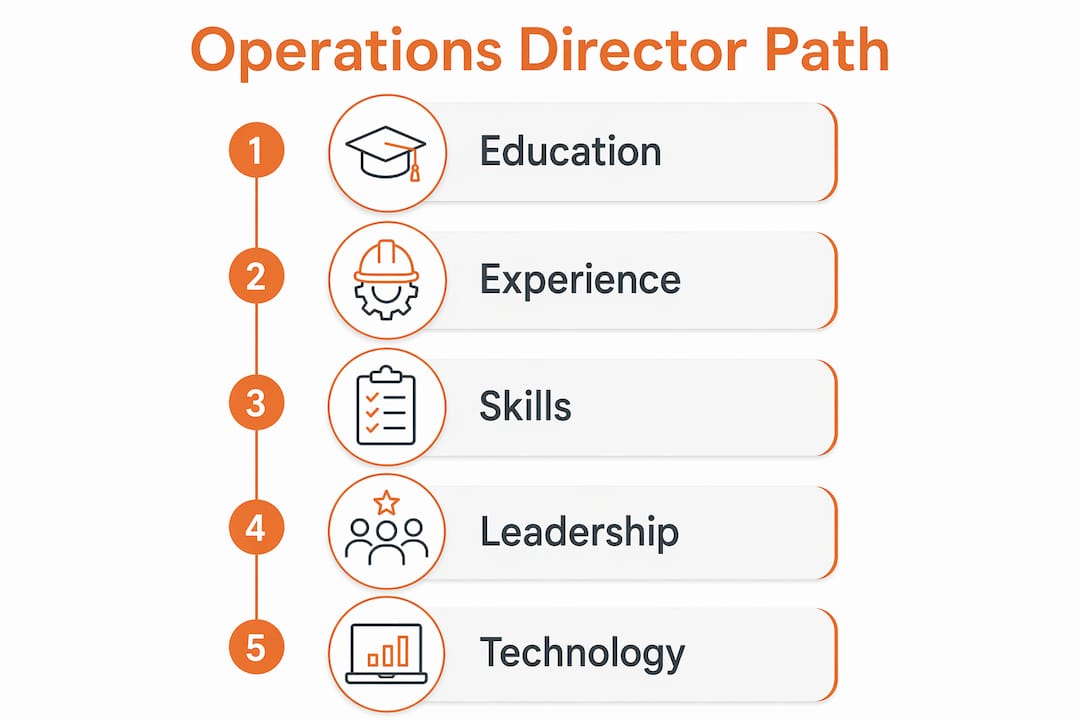
Experience and education:
- Minimum 15 years in construction management, with a track record of delivering projects on time and at or above target margin
- Bachelor’s degree in Construction Management, Civil Engineering, Architecture, or a related field is standard
- An MBA or equivalent advanced degree is advantageous, particularly at firms with revenues above $50M, as it adds financial and organizational depth
- OSHA 30 certification is typically required or strongly preferred
Technical skills:
- Proficiency in Procore, MS Project, or comparable construction management platforms
- CPM scheduling, buy-out negotiations, and cost control methodology
- Budget development and financial forecasting across multiple concurrent projects
Leadership and interpersonal skills:
- Ability to lead managers, not just workers. The operations director manages people who manage people.
- Clear, direct communication with field crews, executive leadership, and clients
- Negotiation skills for subcontractor agreements, procurement, and dispute resolution
- Decisiveness under pressure, with the ability to solve problems without derailing a project
According to SNHU’s overview of the role, most directors of operations hold a bachelor’s degree in business, supply chain management, operations management, or engineering, with an MBA providing additional strategic and financial depth critical for larger organizations.
How do professionals typically reach this role?
The career path to operations director in construction is not a straight line, but it follows a recognizable pattern. Most people who reach this level started as project managers or site superintendents, then moved into senior PM or assistant PM roles before taking on multi-project or regional leadership responsibilities.
A typical progression looks like this:
- Entry to mid-level: Project Engineer, Assistant Project Manager, or Site Superintendent on projects valued at $1M–$10M
- Mid-level: Project Manager with full budget and schedule accountability on projects in the $5M–$25M range
- Senior level: Senior Project Manager or Operations Manager overseeing multiple PMs or job sites
- Executive level: Operations Director, then VP of Operations
The jump from Senior PM to Operations Director usually requires demonstrated experience managing other project managers, not just projects. Companies scaling beyond three active job sites simultaneously, or crossing $10M in annual revenue, typically reach the point where hiring a construction project manager at each site is no longer enough. They need someone above the PM layer to create consistency, accountability, and systems.
Formal education accelerates the path. Certifications relevant to this trajectory include OSHA 30, the Project Management Professional (PMP) credential, and Certified Construction Manager (CCM). Continuous development in financial management and organizational leadership distinguishes candidates who move into VP of Operations roles from those who plateau at the director level.
Industry best practices for operations directors at large contractors
The most effective operations directors at large US contracting firms share one defining characteristic: they build systems, not just solve problems. Reacting to individual project crises is a project manager’s job. At the director level, the goal is to prevent those crises from occurring across all projects simultaneously.

Industry leaders consistently recommend treating contractor management as a structured business function, not an ad hoc process. That means using standardized KPIs and historical performance data to evaluate subcontractor reliability rather than relying on memory or informal relationships. Experienced operations directors maintain documented performance logs on every subcontractor, which becomes institutional knowledge that survives personnel changes.
The Lead, Manage, Accountability (LMA) framework is widely applied at this level. It means holding project managers and superintendents accountable for their performance metrics while reserving the director’s attention for strategic decisions and systemic issues. Micromanaging individual job sites is a sign that the role is being executed at the wrong level.
Technology adoption is no longer optional. Platforms like Procore for project documentation, MS Project for scheduling, and dashboard tools for real-time cost tracking give operations directors the visibility they need to manage 6–8 projects without being physically present at each one. Pair that with construction site safety protocols embedded into weekly reporting, and you create a culture where safety and performance data flow upward automatically.
Cross-departmental communication frameworks matter just as much as technology. Weekly stand-ups between field teams and office leadership, structured subcontractor coordination meetings, and direct reporting lines to the CEO or CFO keep everyone aligned without creating bottlenecks.
How does the operations director coordinate across departments?
The operations director sits at the intersection of project management, safety, and procurement. None of those functions can operate in isolation at a large contractor, and the director is the person responsible for making sure they do not.
With project management teams: The operations director sets the performance standards that project managers execute against. That includes schedule milestones, budget thresholds, and quality benchmarks. When a PM flags a risk, the director decides whether it requires a resource reallocation, a subcontractor change, or an executive-level conversation. Consistent subcontractor onboarding practices across all projects reduce the variability that makes multi-site management difficult.
With safety teams: The operations director owns the safety culture, not just the safety policy. That means enforcing OSHA compliance across every site, reviewing incident reports, and making sure safety standards are embedded in how projects are planned, not added as an afterthought. The Institute of Directors confirms that operations directors develop policies and systems that uphold safe and healthy working environments across all company locations.
With procurement: Procurement decisions at large contractors affect project margins directly. The operations director oversees purchasing to confirm that materials and services meet quality standards, arrive on schedule, and stay within agreed costs. When supply chain disruptions hit, the director coordinates the response across all active projects rather than letting each PM handle it independently.
The coordination function is where the operations director’s value becomes most visible. A well-run large contractor does not have PMs, safety officers, and procurement leads working in separate silos. The director creates the connective tissue between those functions, which is what keeps multi-million-dollar projects on track.
How Constructconnect-rconstructionsolutions helps you fill this role

Finding an operations director with the right mix of construction experience, leadership capacity, and executive presence is one of the hardest hiring challenges a large contractor faces. The candidate pool is narrow, and the cost of a wrong hire at this level is measured in project losses, not just recruiting fees.
Constructconnect-rconstructionsolutions specializes in AEC recruiting services with more than 30 years of industry experience. The firm connects large contractors with pre-vetted candidates who have verified track records in multi-project leadership, OSHA compliance, and construction management software. The prorated 90-day payment model means you only pay for a successful placement, which removes the financial risk that makes senior-level hiring so difficult.
Whether you are scaling past $10M in revenue and need your first operations director, or replacing a departing executive, Constructconnect-rconstructionsolutions has the network and the process to get it right.
Key Takeaways
Operations directors at large contractors are the senior executives who translate company strategy into field-level systems, managing 6–8 concurrent projects and holding project managers, superintendents, and subcontractors accountable for performance.
| Point | Details |
|---|---|
| Executive seniority | The operations director reports directly to the COO or CEO and influences strategic decisions company-wide. |
| Project scale | Large contractor operations directors typically oversee several concurrent projects of substantial value each. |
| Experience required | The role requires at least 15 years of construction management experience, with multi-project leadership. |
| Hierarchy distinction | The operations director manages corporate-wide systems; a General Manager handles a single location or unit. |
| Hiring trigger | Companies running multiple active job sites or exceeding $10M in annual revenue typically need this role filled. |
FAQ
Is operations director a high position?
Yes. The operations director is a senior executive role, typically reporting directly to the COO or CEO and holding significant influence over resource allocation, strategic decisions, and company-wide operational policy.
What are the responsibilities of an operations director?
An operations director oversees planning, scheduling, budgeting, safety compliance, and execution across multiple projects, while managing project managers and subcontractors and serving as the primary operational advisor to executive leadership.
Who is higher, COO or director of operations?
The COO is higher. The operations director reports to the COO and focuses on executing operational systems across business units, while the COO holds broader authority over company-wide strategy and leadership.
What is higher, GM or director of operations?
The director of operations typically operates at a higher organizational level. A General Manager is accountable for profitability at a specific location or unit, while the operations director manages operational efficiency and systems across the entire company or a major division.
When should a large contractor hire an operations director?
Hire when you are running three or more active job sites simultaneously, scaling revenue beyond $10M per year, or when inconsistency across project managers is affecting quality, safety, or schedule performance.

