
90 Day Prorated Recruiting Fee Guarantee for Construction Employers
A recruiting fee guarantee is a contract clause requiring a staffing or search firm to remedy a failed placement, usually through a free replacement search, a prorated refund, or a service credit if the hire leaves or is terminated within a set window. Most windows typically run around three months. Before signing anything, get the guarantee in writing, confirm which party chooses the remedy, and pin down exactly what starts the clock.
TL;DR:
- Most recruiting guarantees last around 90 days to match the typical time it takes to identify performance issues or cultural mismatches.
- The guarantee period should be longer for senior or executive roles, ideally between 120 to 180 days, depending on the role’s complexity and ramp-up time.
- A prorated refund usually calculates back a percentage of the fee based on days remaining in the guarantee window, using a clear, explicit formula to avoid disputes.
- Key contract clauses include a defined guarantee start date, explicit remedy options, notification procedures, and candidate ownership limits, with clear conditions for voiding coverage.
- Negotiating benefits include lower fees for larger or multi-role commitments, shorter exclusivity periods, employer-choice remedies, and guarantees conditioned solely on timely payment.
Table of Contents
- What Does a Recruiting Fee Guarantee Actually Cover?
- How Long Should a Recruiting Guarantee Period Last?
- How Are Recruiting Fee Guarantees Calculated?
- What Contract Clauses Protect Your Recruiting Guarantee?
- How Do You Negotiate a Stronger Recruiting Guarantee?
- How Prorated Guarantees Work in Practice
- When Should You Rely on a Guarantee Versus a Different Hiring Model?
- Get a Recruiting Guarantee Built for Construction, Not Just Written for It
- Sources
- FAQ
What Does a Recruiting Fee Guarantee Actually Cover?
A recruiting fee guarantee only protects you against specific, defined events. Voluntary resignation and termination for documented cause both typically trigger coverage, but the agency will usually ask you to show your work. A performance improvement plan, written warnings, or an exit interview summary all count as documentation that supports a claim.
Where the clock starts matters more than most hiring managers realize. Some agreements start the guarantee period on the offer date, others on the first day worked, and others on the invoice date. A construction recruiter’s fee structure can shift by weeks depending on which trigger the contract names, so get the exact date in writing before the candidate accepts.
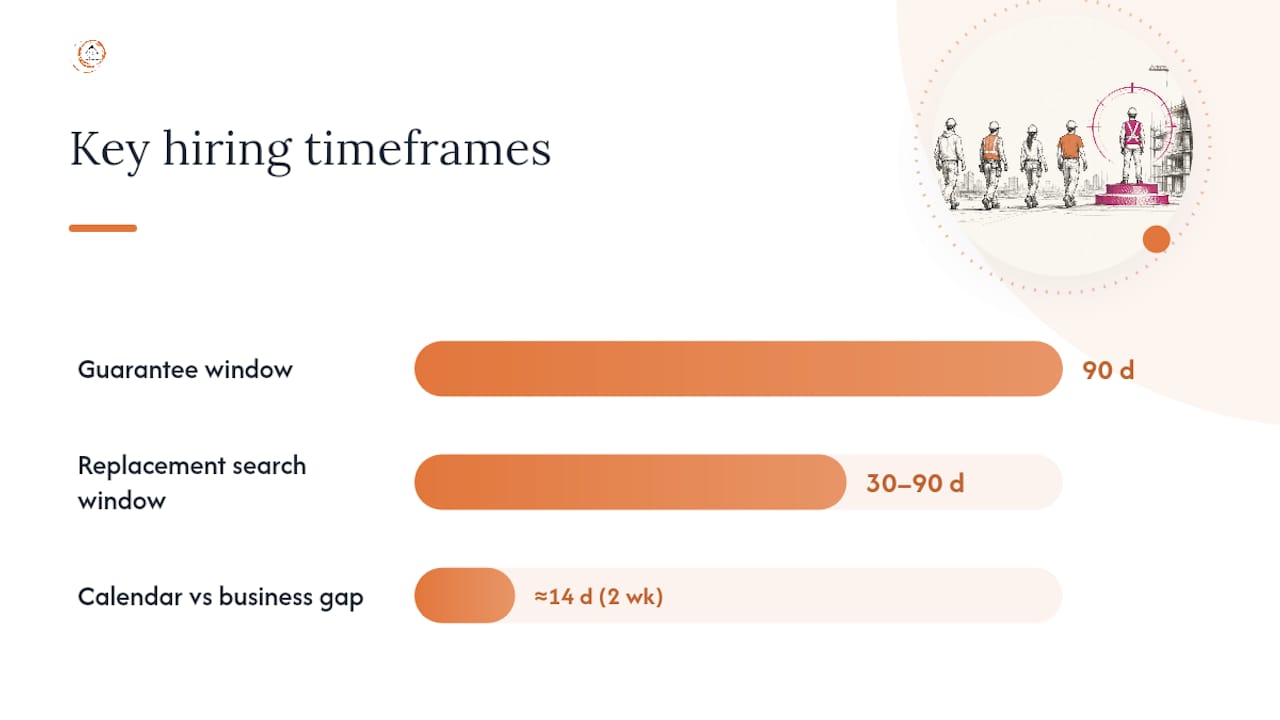
Days-counting is the other quiet trap. Most agreements use calendar days rather than business days, and that difference can eat two full weeks off a 90-day window. Specify calendar or business days explicitly in the contract rather than assuming the agency means what you mean.
The three remedy types work differently:
- Replacement search: the agency sources a new candidate for the same role at no added fee, typically within 30 to 90 days of the departure notice.
- Prorated refund: you receive cash back on a sliding scale, with the refund shrinking as more of the guarantee period elapses.
- Credit: the fee (or a portion of it) applies toward a future search, which helps the agency retain your business but does you no good if you never hire through them again.
Replacement-only clauses are common in contingency agreements, but they lock you into the same firm after a search has already failed once. That is worth negotiating around, a point worth revisiting once you have seen the math behind prorated refunds.
How Long Should a Recruiting Guarantee Period Last?
Ninety days is the default you should expect, and it is the benchmark to negotiate from rather than against. Industry surveys show that roughly 45% to 60% of agencies build their contracts around a 90-day window, which lines up with the time it typically takes a new hire’s performance issues, or a bad culture fit, to surface.
Choosing the right length for a specific role comes down to three factors: seniority, time-to-productivity, and total hire cost. Here is how to apply them:
- Default to 90 days for mid-level roles such as project engineers, estimators, or field superintendents, where competence usually shows up inside the first quarter.
- Push for 120 to 180 days on senior or executive hires, including VPs of construction, directors of operations, or specialized project executives, because ramp time is longer and a bad fit takes longer to expose itself. Retained search firms are generally more willing to accept six-month windows than contingency firms, but contingency firms can often be moved to 120 or 150 days for a key hire if you ask directly.
- Accept 30 to 60 days for high-volume or short-cycle roles, such as seasonal laborers, temporary field staff, or project-specific hires tied to a single job’s duration, where the fee itself is smaller and a longer guarantee adds little practical value.
The math is simple: the more expensive the hire and the longer it takes to know if the placement worked, the longer your guarantee window should run. A $180,000 director-level placement justifies a fight for 150 days. A $55,000 field coordinator role usually does not.
How Are Recruiting Fee Guarantees Calculated?
Recruiting fees typically run 15% to 25% of first-year base salary for contingency placements, with retained executive searches often priced higher. That percentage, combined with your guarantee’s prorating formula, determines exactly what you get back if a hire falls through.
By the numbers: On a $100,000 hire at a 20% fee ($20,000 total), a 90-day prorated guarantee typically refunds the fee on a sliding scale tied to days remaining in the window. If the employee leaves on day 45, halfway through a 90-day guarantee, you would receive roughly 50% back, or about $10,000, under a straight linear prorate.
The cleanest way to avoid disputes is a formula, not a vague promise. Tying the refund to a stated calculation, refund = fee × (days remaining ÷ guarantee length), removes the ambiguity that “prorated” alone invites. Insist this formula appears in the contract itself, not just in a verbal assurance from your account rep.
A few rules of thumb for the negotiating table:
- Push for cash refunds over credits whenever you are not certain you will use the same agency again. A credit only has value if there is a next search.
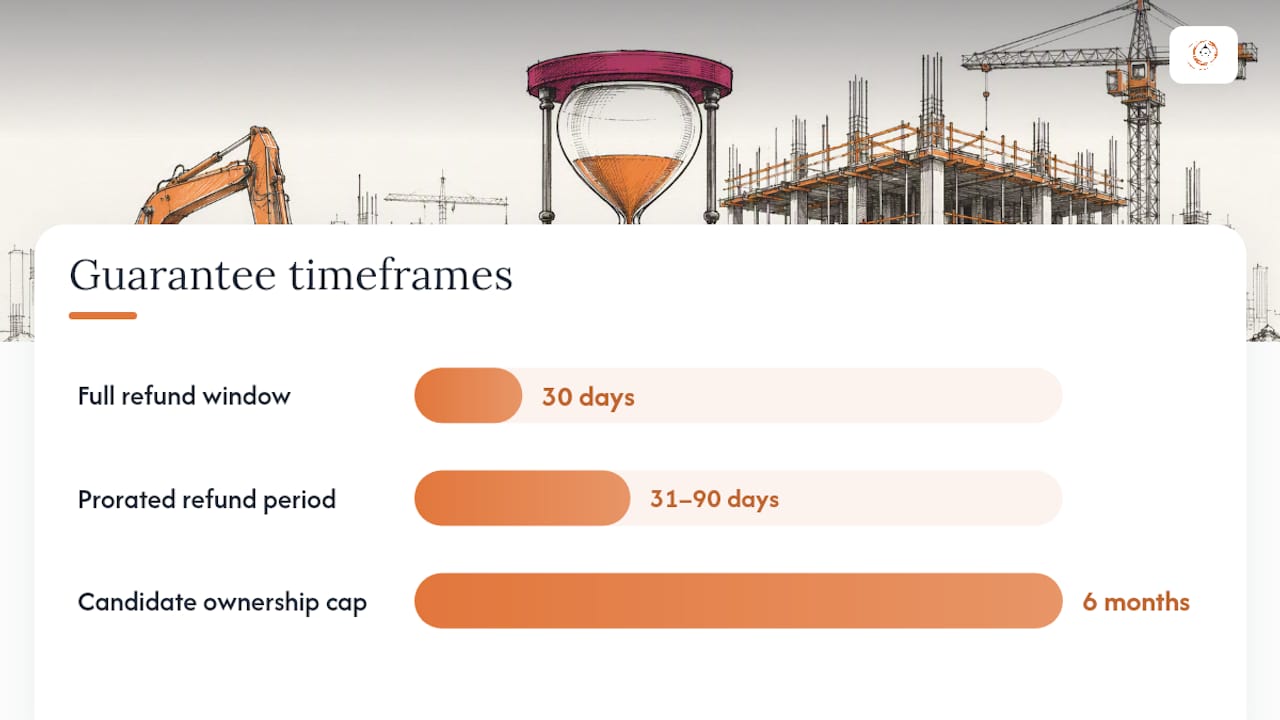
- Ask for a hybrid structure: full refund in the first 30 days, prorated after that. This protects you against the worst-case scenario, an early, obvious mismatch while still giving the agency a fair shake on longer tenures.
- Confirm whether the fee triggers on offer acceptance or start date. A fee that triggers on offer date puts more risk on you if the candidate never actually shows up for day one.
Related reading on construction recruiter commission structures breaks down how these percentages typically get applied across different role types.
What Contract Clauses Protect Your Recruiting Guarantee?
The clauses you negotiate before signing matter more than any conversation you have after a hire falls through. Treat this as a checklist for your next RFP or offer letter review.
Essential clauses to require:
- A written fee agreement stating the exact percentage, the salary base it applies to, and the trigger date.
- A clearly defined guarantee period, in calendar days, with a named start date (offer, start, or invoice).
- Payment terms, typically net 15 to 30 days from the trigger date, stated explicitly.
- A notification procedure: how and when you must inform the agency of a departure, usually in writing, within a set number of business days.
- A candidate ownership window, the length of time the agency can claim credit for a candidate they introduced, capped at a reasonable duration rather than left open-ended.
Guarantees are frequently voided by conditions buried in the fine print. The most common: late payment on your end, and role changes (a promotion or lateral move that the agency argues counts as a “different” placement than the one they guaranteed). Negotiate carve-outs so a late invoice by a few days does not wipe out your claim, and so a legitimate internal promotion does not void coverage either.
Pro Tip: Read the notification deadline twice. Agencies routinely set a 5 to 10 business day window to report a departure, and missing it by even a day can void an otherwise valid claim. Calendar it the moment a hire’s start date is confirmed.
Watch for these red flags before you sign anything:
- Full payment required before the candidate’s start date, with no refund mechanism at all.
- Ambiguous remedy language (“agency will make it right”) with no defined replacement, refund, or credit process spelled out.
- Candidate ownership periods stretching beyond 12 months, which can trap you into paying a fee on a hire you sourced independently, months later.
- No stated timeline for producing a replacement candidate if that is the remedy you chose.
How Do You Negotiate a Stronger Recruiting Guarantee?
Most hiring managers treat the fee percentage as fixed and the guarantee terms as non-negotiable. Neither assumption holds up once you know what agencies are actually willing to trade.
- Offer volume in exchange for a lower rate. If you have three or four open roles rather than one, agencies will often drop their fee by two to five percentage points for the guaranteed pipeline. Multi-role commitments are the single strongest lever you have.
- Trade faster payment for guarantee improvements. Agencies value cash flow. Offering net-15 instead of net-30 payment terms can be worth a longer guarantee window or a better refund structure, since it reduces the agency’s own risk.
- Shorten exclusivity periods. If an agency wants 60 days of exclusive rights to fill a role, negotiate it down to 30 and reserve the right to run a parallel search if they are not producing candidates.
- Insist on employer-choice remedies. Do not accept replacement-only language. You want the contractual right to choose between a replacement search, a prorated refund, or a credit, depending on what makes sense when a placement actually fails.
- Condition the guarantee on your own timely payment, and nothing more. Agencies will try to add broad carve-outs (role changes, department transfers, “material changes to job duties”). Push back and narrow these to only the specific scenario they are meant to cover.
A workable fallback structure, if the agency will not move on everything you ask for, looks like this: full refund in the first 30 days, prorated refund from day 31 to 90, and a candidate ownership window capped at six months rather than a full year. That structure protects you against the worst outcomes without asking the agency to absorb every risk. For more tactics on trimming overall recruiting spend, see construction recruiting cost reduction strategies.
Pro Tip: Get everything confirmed in writing before any candidate interview takes place. Courts and industry guidance both treat a client’s participation in interviews as acceptance of the previously disclosed fee terms, even when a signature is still pending, so verbal-only agreements can bind you faster than you’d expect.
How Prorated Guarantees Work in Practice
Construction hiring carries its own version of this risk. A superintendent who looks strong on paper, OSHA 30 certified, ProCore experience, solid references, can still be the wrong fit for a specific jobsite culture or client relationship, and that mismatch often does not surface until week six or seven on the job.
A fee model built around that reality prorates the fee over the first 90 days rather than charging the full commission upfront, and the commission rate itself runs lower than what many general staffing agencies charge for AEC placements. In practice, that means:
- You are not paying full freight for a placement that does not survive its first quarter.
- The 90-day window matches the industry-standard guarantee period, so it lines up with what most contracts already expect.
- Lower baseline commission rates mean the math on any prorated refund is smaller in absolute dollars, which reduces your downside from the start.
That structure maps directly onto the negotiation checklist above: it gives employers remedy flexibility instead of a replacement-only trap, and it puts the financial risk of an early departure back on the agency rather than entirely on you.
When Should You Rely on a Guarantee Versus a Different Hiring Model?
Recruiting guarantees are a risk transfer tool, not a risk elimination tool. They shift some of the financial exposure of a bad hire back onto the agency, but they do so at the cost of locking you into that agency’s process, timeline, and remedy structure until the guarantee period lapses.
Guarantees earn their keep on high-cost, high-consequence hires: a project executive, a senior estimator, a role where a bad fit costs you months of project delays and a six-figure fee. On lower-cost or high-volume roles, the guarantee matters less than speed and price, since the downside of a bad hire is smaller and easier to absorb.
The alternative worth considering is a fractional or in-house sourcing model, where you trade the agency’s guarantee for direct control over the search and no ongoing fee exposure at all, which is explained in detail in Why Choose Technical Advisory for Construction Projects. Neither approach is universally better. Treat the guarantee as one line item in a broader hiring-risk assessment, weighed against cost, control, and how fast you actually need the seat filled.
— Rowena
Get a Recruiting Guarantee Built for Construction, Not Just Written for It
This option is practical for construction employers who want guarantee terms that actually favor them, not just terms that sound standard on paper. The prorated 90-day payment structure means you are never paying full commission on a placement that does not last, and the lower commission baseline, backed by more than 30 years sourcing AEC talent, helps keep your downside smaller from day one.

Beyond direct hires, similar relationships can extend to pre-vetted subcontractors, suppliers, and equipment rental partners, so a bad staffing decision is not the only project risk this addresses. If you are staffing a superintendent role, an estimator seat, or a full project team and want guarantee language that does not lock you into a bad outcome, start with the recruiting services page and request a rundown of current fee and guarantee terms before your next search goes out.
Sources
- U.S. Department of Labor — Recruitment and migrant worker guidance
- Recruitment Guarantee Periods: Replacements, Refunds & Claims — LegalClarity
FAQ
What Is a Normal Recruiter Fee?
Most contingency recruiting fees run 15% to 25% of the hired candidate’s first-year base salary, with retained executive searches often priced above that range.
What Is the 70/30 Rule in Hiring?
There is no established “70/30 rule” tied to recruiting fee guarantees or standard placement contracts; if you encountered this term from a specific source, ask that source to clarify what it refers to, since it is not a recognized industry standard.
How Can You Tell If a Recruiter Is Scamming You?
Warning signs include demanding full payment before the candidate’s start date, refusing to put fee terms in writing, offering vague or undefined remedies instead of a specific replacement, refund, or credit process, and setting candidate ownership windows well beyond 12 months.
Are Recruitment Fees Legal?
Yes. There is no single federal law capping recruitment fees or dictating guarantee terms, but roughly half of U.S. states require agency licensing, which often includes rules on written disclosure and fee transparency.
What Remedy Should You Ask for in a Recruiting Fee Guarantee?
Push for an employer-choice remedy that lets you pick between a replacement search, a prorated refund, or a credit, rather than accepting a replacement-only clause that limits your options if a placement fails.