
Construction Recruiter Commission: What You Need to Know
Construction recruiter commission is defined as the fee a recruiting agency or independent recruiter earns when they successfully place a candidate with a construction employer, calculated as a percentage of that candidate’s first-year salary. For most permanent placements in the Architecture, Engineering, and Construction (AEC) industry, agency fees range 15% to 30% of first-year salary. That means placing a project manager earning $120,000 generates a recruiter fee of $18,000 to $36,000. Understanding what is construction recruiter commission, and how it breaks down, is the first step toward budgeting your hiring costs accurately and choosing the right recruitment partner.
What is construction recruiter commission and how is it calculated?
Construction recruiter commission is the recruiter’s share of the placement fee charged to the client. The agency bills the employer a percentage of the placed candidate’s salary, and the recruiter receives a portion of that revenue. These two numbers are separate, and confusing them is one of the most common budgeting mistakes construction employers make.
Here is how the calculation works in practice:
- Determine the candidate’s first-year salary. A field superintendent role pays $95,000 annually.
- Apply the agency fee percentage. At 20%, the agency charges the employer $19,000.
- Calculate the recruiter’s share. If the recruiter earns 25% of the agency fee, their commission is $4,750.
- Account for any threshold. Recruiters must meet billing thresholds before commissions kick in, covering their “desk costs” first.
- Factor in the payment timeline. Most agencies pay recruiter commissions after the candidate completes a probationary period, typically 30 to 90 days.
The recruiter’s personal commission rate depends on their arrangement with the agency. Recruiters with a base salary typically earn 15% to 30% of the fees they generate. Freelance or independent recruiters working on a desk split model earn 40% to 60% of fees but receive no base salary.
Pro Tip: Ask any agency to separate the client-facing fee from the recruiter’s internal commission split. Agencies with transparent structures are far more likely to prioritize quality placements over quick fills.

What drives variation in construction recruiter fees?
Construction staffing commission rates vary more than most employers expect. Several factors push fees above or below the standard range, and knowing them helps you negotiate from a position of knowledge.
- Role seniority and specialization. A laborer placement carries a lower fee than recruiting a project manager with Procore experience and an OSHA 30 certification. Specialized roles command fees at the higher end of the 15%–25% range for permanent construction placements.
- Placement type. Permanent placements use a percentage-of-salary model. Temporary and contract staffing uses an hourly markup model instead.
- Geographic market. High-demand metros like New York, Houston, and Seattle push fees up because qualified candidates are scarce and competition among employers is intense.
- Agency size and overhead. Larger agencies carry higher operational costs, which compresses the recruiter’s share but may offer broader candidate networks.
- Markup for temp staffing. Temporary staffing markups range 15% to 50% above the base wage to cover payroll taxes, workers’ compensation, and overhead. This is not a commission in the traditional sense, but it functions as the agency’s revenue on each hour worked.
The table below shows how fee models differ by placement type in construction recruiting.
| Placement type | Fee model | Typical rate |
|---|---|---|
| Permanent hire | % of first-year salary | 15%–25% |
| Temporary/contract | Hourly markup on base wage | 15%–50% above base |
| Executive/retained search | Upfront retainer plus success fee | 25%–30% of salary |
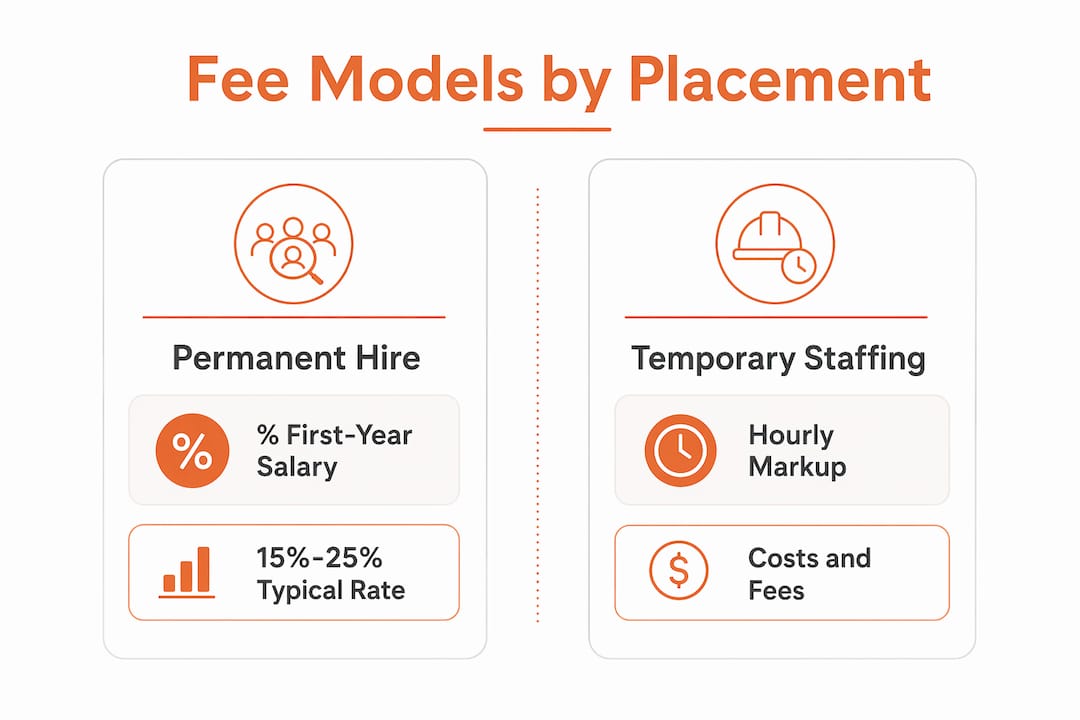
Understanding construction staffing agency costs at this level of detail lets you compare proposals from multiple agencies on equal terms, rather than comparing headline percentages that mask very different structures.
How do the main recruiter commission models compare?
The recruitment commission structure an agency uses shapes recruiter behavior directly. Knowing the model tells you a lot about how motivated a recruiter will be to find you a candidate who actually stays.
Contingency vs. retained search
Contingency recruiting means you pay only when a candidate is placed. Retained search requires an upfront fee, with the balance due at placement. Contingency is the most common model for construction roles below the director level. Retained search is standard for VP, C-suite, and highly specialized engineering roles where the search requires dedicated effort over months.
Tiered commission models
Tiered commissions are used by approximately 65% of staffing agencies with 50 or more recruiters. The recruiter earns a higher percentage as their total billings cross set thresholds. For example, a recruiter might earn 20% on the first $100,000 billed, then 25% on billings above that. This structure rewards volume and motivates recruiters to close placements quickly.
Draw commissions
Draw commissions, which come in recoverable and non-recoverable forms, provide recruiters financial stability while tying their pay to placement success over time. A recoverable draw means the recruiter repays advances from future commissions. A non-recoverable draw functions more like a guaranteed minimum. Construction employers rarely see this structure directly, but it affects how urgently a recruiter works your open roles.
Clawback clauses and guarantee periods
Clawback clauses recoup commissions when a placed candidate leaves within a defined guarantee period, typically 60 to 90 days. The agency either refunds part of the fee or provides a replacement candidate at no additional charge. Clawbacks are a direct incentive for recruiters to prioritize candidates who will stay, not just candidates who will accept an offer.
Pro Tip: Always confirm the guarantee period and clawback terms in writing before signing an agency agreement. A 30-day guarantee on a superintendent hire is nearly worthless. Ninety days is the minimum that gives you meaningful protection.
For recruiting project engineers and other mid-level construction roles, a contingency model with a 90-day guarantee and a prorated clawback is the most cost-effective structure for most employers.
How does understanding recruiter commission improve your hiring efficiency?
Knowing how recruiter commissions work changes how you budget, negotiate, and evaluate agency partners. Construction projects run on tight margins and tighter timelines. Recruitment costs that catch you off guard can disrupt both.
- Budget accurately from the start. If you are hiring a construction project manager at $110,000, build a $16,500 to $27,500 recruiter fee into your project budget before you post the role.
- Negotiate the fee percentage, not just the rate. Agencies often have flexibility on the percentage, especially for volume hiring or long-term partnerships. A reduction from 22% to 18% on three placements saves you thousands.
- Understand payment timing. Most agencies invoice when the candidate starts. Some invoice at offer acceptance. Knowing this prevents cash flow surprises on active projects.
- Use commission structure as a quality signal. Agencies that use clawbacks and longer guarantee periods have a financial incentive to place candidates who stay. Agencies without these protections do not.
- Ask about prorated fee models. Some specialized AEC recruiters, including Constructconnect-rconstructionsolutions, offer prorated payment structures where you pay based on how long the candidate stays. This aligns the agency’s incentive directly with your retention goals.
Transparent commission agreements benefit both sides of the hiring relationship. Employers who understand the fee structure ask better questions, set clearer expectations, and get better results from their recruiting partners. Contractors researching construction marketing and business development often find that the same transparency principle applies across all vendor relationships in the industry.
Key Takeaways
Construction recruiter commission is a percentage of the placed candidate’s first-year salary, and understanding its structure directly determines how well you control hiring costs and recruiter incentives.
| Point | Details |
|---|---|
| Standard fee range | Permanent placement fees run 15%–25% of first-year salary for most construction roles. |
| Temp staffing differs | Temporary construction staffing uses hourly markups of 15%–50%, not a salary percentage. |
| Clawbacks protect you | A 90-day guarantee with clawback terms is the minimum protection worth negotiating for. |
| Commission model signals quality | Agencies using tiered commissions and clawbacks are incentivized to place candidates who stay. |
| Transparency saves money | Asking agencies to separate client fees from recruiter splits helps you compare proposals accurately. |
My take on what most construction employers get wrong about recruiter commissions
Construction companies often focus entirely on the headline fee percentage and ignore everything else. That is the wrong place to focus. A 15% fee from an agency with no guarantee period and no clawback clause costs you far more than a 22% fee from an agency that replaces a bad hire at no charge within 90 days.
The second mistake I see constantly is treating all placement types the same. A temp laborer markup and a permanent superintendent fee are completely different financial instruments. Mixing them up in a budget leads to real shortfalls on active projects.
The detail most employers overlook entirely is the desk split. When a recruiter earns 40% to 60% of the fee on a commission-only arrangement, they are highly motivated to close placements fast. That speed is not always in your interest. Recruiters on base-plus-commission structures with clawback exposure tend to be more selective, because a bad placement costs them money too.
Transparency in commission agreements is not just a nice-to-have. It is the clearest signal that an agency is confident in the quality of its candidates. If an agency resists explaining its fee structure, that tells you something important about how it operates.
— Rowena
How Constructconnect-rconstructionsolutions approaches recruiting fees
Constructconnect-rconstructionsolutions brings over 30 years of AEC industry experience to every search, and that depth shows up directly in how the firm structures its fees.

Unlike general staffing agencies that apply standard percentage fees across all roles, Constructconnect-rconstructionsolutions offers lower commission rates and a prorated payment structure, so you pay based on actual placement success rather than a flat fee at day one. Every candidate is pre-vetted for role-specific requirements, whether that means Procore experience, OSHA 30 certification, or superintendent-level field leadership. If you are ready to take control of your construction hiring costs, explore the AEC recruiting services that Constructconnect-rconstructionsolutions provides, built specifically for construction employers who need quality hires that stick.
FAQ
What is the average recruiter commission for construction roles?
The average construction recruiter fee runs 15% to 25% of the placed candidate’s first-year salary for permanent roles. Temporary staffing uses an hourly markup of 15% to 50% above base wage instead.
How do recruiter commissions work for temporary construction staffing?
Temporary construction staffing agencies charge an hourly markup above the worker’s base wage, covering payroll taxes, workers’ compensation, and overhead. This markup typically ranges from 15% to 50% depending on the role and market.
What is a clawback clause in a recruiter commission agreement?
A clawback clause requires the agency to refund part of the placement fee or provide a free replacement if the candidate leaves within a defined guarantee period, usually 60 to 90 days.
Can construction employers negotiate recruiter commission rates?
Yes. Agencies frequently offer reduced percentages for volume hiring, long-term partnerships, or roles that are straightforward to fill. Always negotiate the guarantee period and clawback terms alongside the fee percentage.
What is the difference between contingency and retained search fees?
Contingency fees are paid only after a successful placement. Retained search requires an upfront payment before the search begins, with the balance due at placement. Retained search is standard for executive and highly specialized AEC roles.
Recommended
- Recruiting Project Engineers for Construction Companies
- What is AEC Recruiting and Why Construction Companies Are Outsourcing It
- Top AEC Talent and Sourcing Solutions | R. Construction Solutions"
- Why Santa Cruz Construction Companies Can’t Find Quality Estimators and Project Managers (And How 30 Years of Industry Experience Finds Them)